St. Philip’s Church, Brunswick Town: Colonial Anglican Church
Site at a Glance
- Rating
- 5
- Popularity
- Very Low
- Country
- United States
- Primary era
- Early Modern
- Eras represented
- Early Modern
- Civilizations
- British
- Site type
- Religious
- Remains
- Church
On this page9 sections
History
Parish foundation and construction
St. Philip’s Church is an eighteenth-century Georgian Anglican church in Brunswick Town beside the Cape Fear River near Winnabow, North Carolina, United States. Construction began in 1754 and was completed in 1768, serving St. Philip’s Parish, which had been established in 1741. The parish’s first vicar, a clergyman responsible for serving the congregation, was Rev. James Moir. St. Philip’s was the sister church of St. James Church in Wilmington.
Rev. John Barnett became the first minister of the completed church, followed by J. Cramp and Nicholas Christian. Colonial Governor Arthur Dobbs designated the building “His Majesty’s Chapel in North Carolina,” reflecting its connection with the Anglican establishment in the colony.
Revolutionary War destruction
In 1776, during the American Revolutionary War, British forces attacked Brunswick Town. The assault burned St. Philip’s Church, Russelborough, and most of the settlement. The church walls survived, while Brunswick Town was later deserted. The remains stood relatively untouched for almost a century.
Fort Anderson and the Civil War
In March 1862, Confederate engineers surveyed Brunswick Town and the church ruins while laying out earthworks and trenches across the settlement. The fort was intended to protect Wilmington, a vital Civil War port 18 miles (29 km) upstream. First called Fort St. Philip, it was renamed Fort Anderson in July 1863.
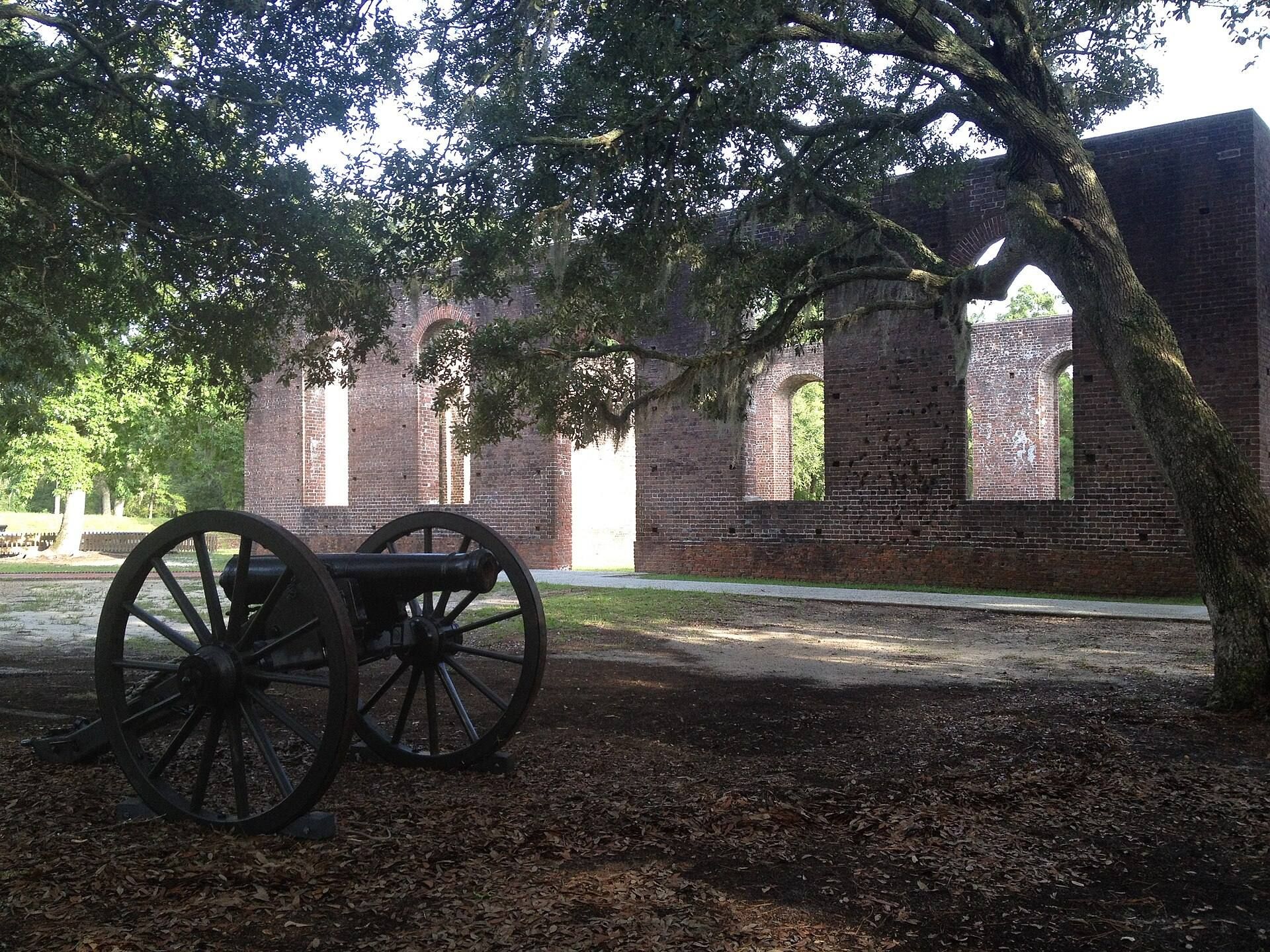
Union forces attacked Fort Anderson in February 1865, and cannonballs struck the church walls. Confederate soldiers killed in the fighting were initially placed inside the church. After the Confederate defeat, Union soldiers desecrated several graves and removed the church’s cornerstone. Additional graves outside the structure were not disturbed.
Commemoration and archaeological study
The newly formed Cape Fear Chapter of the North Carolina Society of the Colonial Dames of America visited the site in 1899 to commemorate those killed during the American Revolutionary War in Brunswick Town. Excavations at Brunswick Town began in 1958 and recovered bullets, buttons, and a cannonball from inside the church ruins. St. Philip’s Church is now part of the Brunswick Town State Historic Site and was listed on the U.S. National Register of Historic Places on February 26, 1970, as a contributing property of the Brunswick Town Historic District.
Remains
Brick church walls
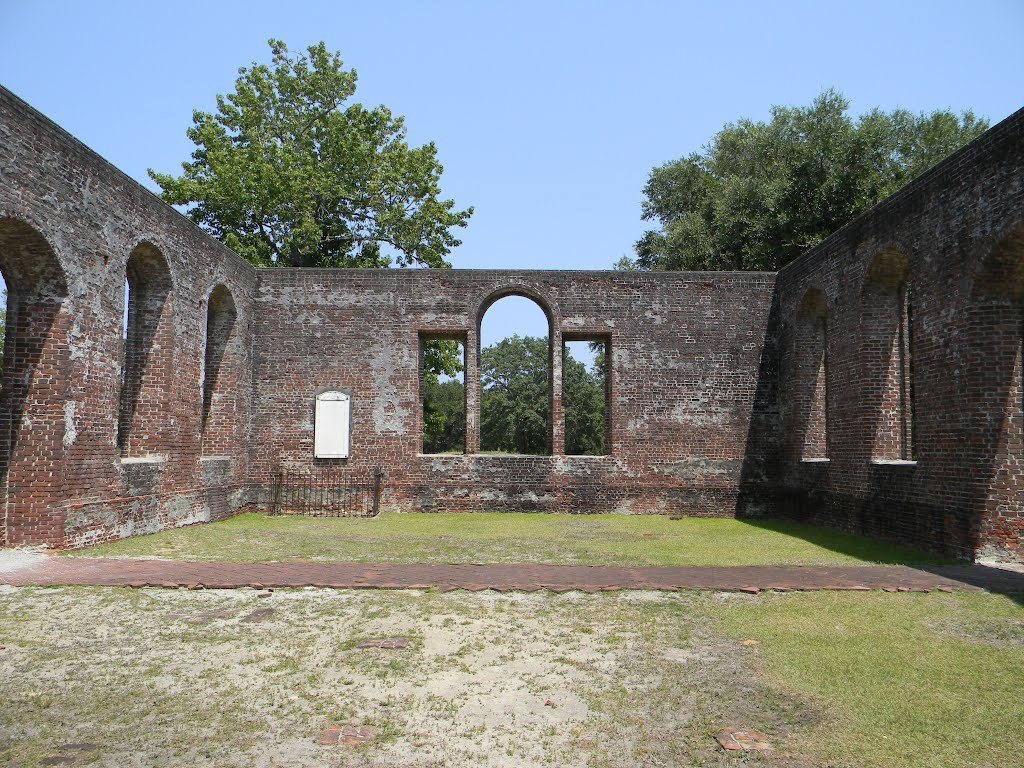
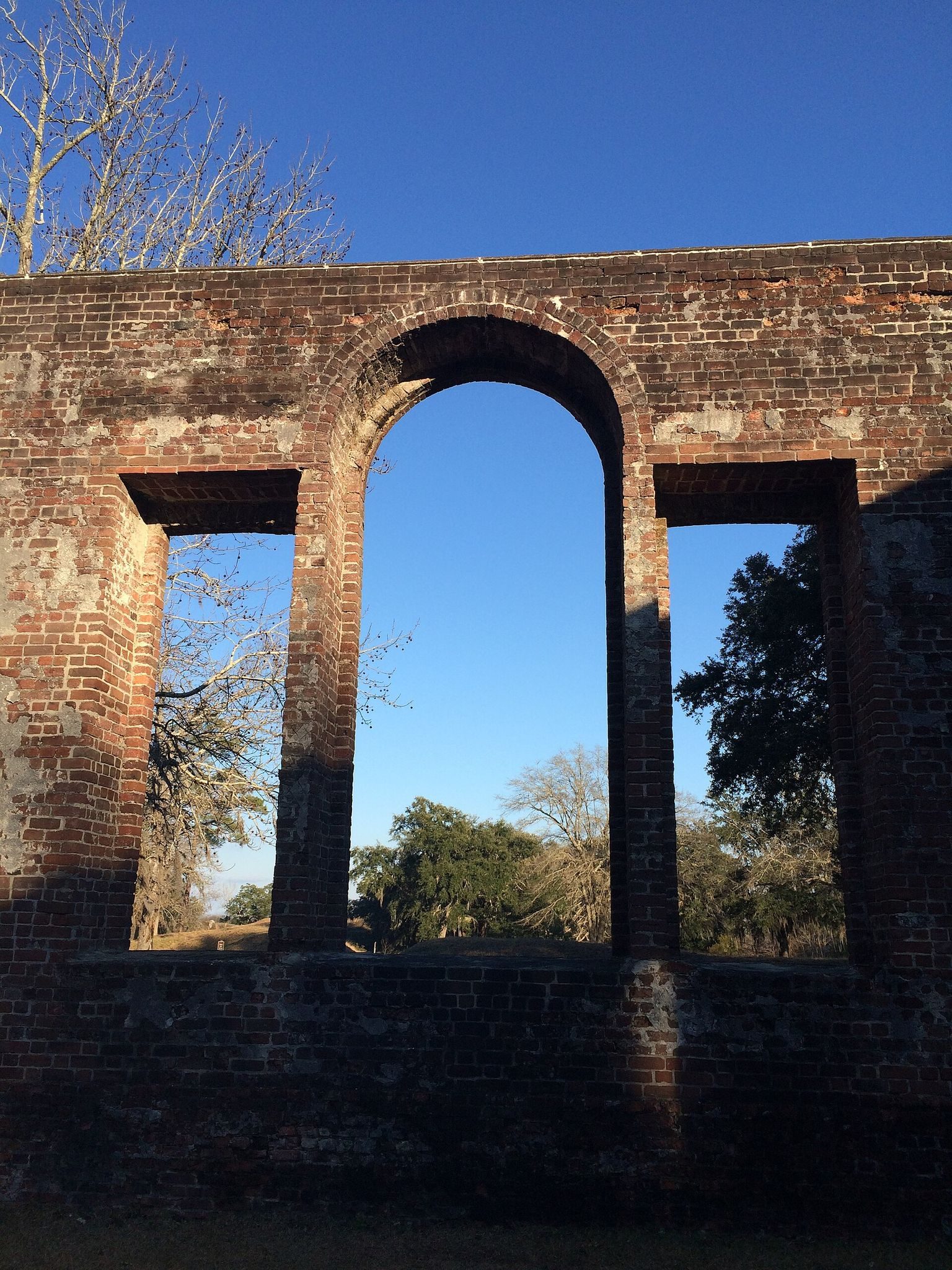
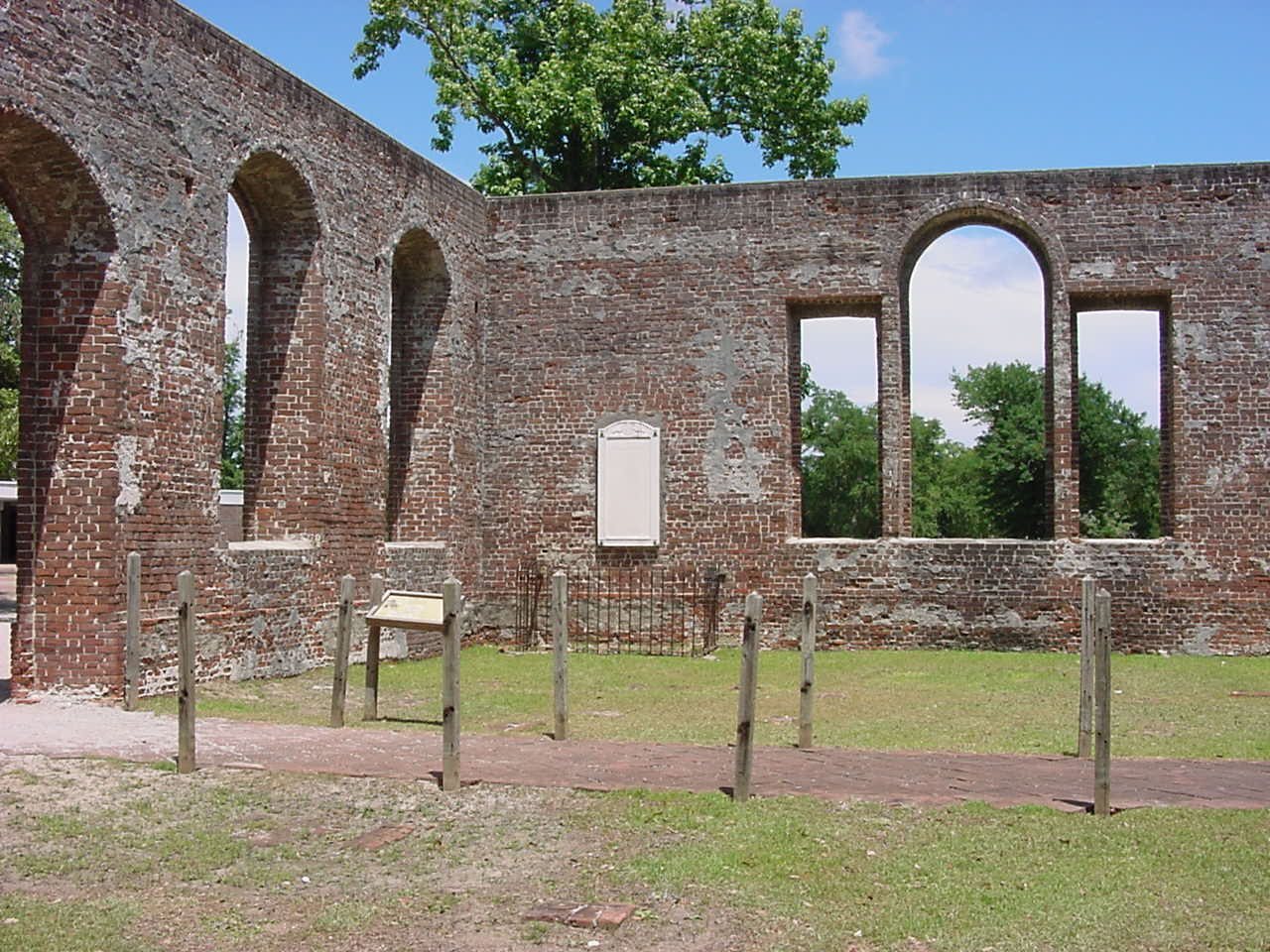
The surviving church consists of four brick walls within the eight-acre (3.2-hectare) Brunswick Town Historic District. Imported from England, the bricks form walls 3 feet (0.91 m) thick. The building measures 76 feet 6 inches (23.3 m) in length, 53 feet 3 inches (16.2 m) in width, and 24 feet 4 inches (7.4 m) in height.
The 1776 fire destroyed the floor, roof, three doors, and eleven windows. Each window measured 15 by 7 feet (4.6 by 2.1 m). The original floor was wooden except in the aisles, where one-foot-square (0.3 m-square) brick tiles formed a cross-shaped pattern. The church contained wooden pews, including a raised Governor’s pew reserved for the colonial governor.
Burials and commemorative features
Twelve burial sites lie inside the church, while several other graves remain outside its walls. Those buried at St. Philip’s include Benjamin Smith, a governor of North Carolina, and Alfred Moore, an associate justice of the U.S. Supreme Court. A marble plaque installed inside the church in 1902 commemorates Brunswick Town co-founder Maurice Moore.
Wartime traces
Cannonball impacts from the February 1865 attack on Fort Anderson remain visible in the brick walls. Together with the excavated bullets, buttons, and cannonball, these marks connect the surviving structure to the military history of Brunswick Town during the Civil War.