Fort Fisher: A Confederate Fortification Guarding Wilmington’s Port
Site at a Glance
- Country
- United States
- Primary era
- Modern
- Eras represented
- Modern
- Civilizations
- Unclassified
- Site type
- Military
- Remains
- Fort
On this page16 sections
History
Fort Fisher was a Confederate Civil War fortification at the Atlantic outlet of the Cape Fear River near Wilmington, North Carolina, United States. Work began in spring 1861, and the fort grew into a major defense of Wilmington’s port and supply routes. Its strength inspired the nicknames “Southern Gibraltar” and “Malakoff Tower of the South,” the latter recalling the Malakoff Tower, a major fortification at Sevastopol during the Crimean War.
Wilmington and the Cape Fear defenses
Wilmington lay upstream from the river’s mouth. After Norfolk fell to Union forces in May 1862, Wilmington became the Confederacy’s principal Atlantic port. Ships called blockade runners evaded the Union naval blockade, bringing goods such as food, clothing, and munitions from British colonies including Bermuda, the Bahamas, and Nova Scotia. They carried cotton and tobacco out in return. This trade supported the Confederacy and helped supply Robert E. Lee’s forces in Virginia.
Confederate defenses along the final stretch of the Cape Fear included forts, artillery positions, sunken wrecks, and mines, then called torpedoes. The river met the Atlantic through two shallow inlets separated by Smith Island, now Bald Head Island. Confederate guides helped blockade runners change course between the inlets to avoid Union ships.
Building and expanding the fort
The first artillery batteries were established about one mile from New Inlet in spring 1861. Major Charles Pattison Bolles supervised the work under regional commander General Theophilus H. Holmes, while Major William H. C. Whiting inspected North Carolina’s defenses. After Bolles was transferred to Oak Island, Captain William Lord deRosset took over and brought Wilmington’s Light Infantry to the position. The early battery was known as Bolles Battery, and Camp Wyatt, a training ground, was established to its north.
In summer 1861, Colonel Seawell L. Fremont assumed command and added defenses along the isthmus. Around September, the post was formally named Fort Fisher, after Colonel Charles F. Fisher of the 6th North Carolina Infantry, who had died at the First Battle of Manassas, an early major engagement of the Civil War. Colonel William Lamb took command in July 1862 and began extensive improvements. As Wilmington’s importance grew, the expanded fort was intended to protect the port and keep Union warships at a distance.
More than 1,000 people worked on the defenses. They included over 500 enslaved Black people brought from nearby plantations, as well as Native Americans, most of them Lumbee, who were impressed into labor. Fort Fisher became the Confederacy’s largest fortification. President Jefferson Davis visited in November 1863, and the entire 36th North Carolina Infantry regiment was stationed there in 1864.
Union attacks and capture
Before the attacks, the garrison numbered about 2,400 and was regarded as inadequately trained to stop a land assault. Robert E. Lee removed Whiting from regional command amid allegations of alcohol-related and other personal problems, and General Braxton Bragg took over. In November 1864, Bragg was ordered to Georgia to oppose William T. Sherman and took 2,000 troops from the Wilmington defenses. After learning of the reduction, Union commander Ulysses S. Grant began planning an attack.
The first assault opened with a naval bombardment on December 24, 1864. Damage to Confederate gun positions allowed Union infantry to land, but troops under Major General Robert Hoke stopped their advance. On December 27, Major General Benjamin Butler withdrew about 1,000 Union soldiers who remained on the beach, despite Grant’s order to besiege the fort if the attack failed. Grant subsequently relieved Butler of command.
A second attempt began with bombardment on January 12, 1865. The next day, about 8,000 infantry under Major General Adelbert Ames landed north of the fort and helped isolate it. A division of African American Union soldiers was sent to the peninsula’s north side to hinder Confederate reinforcements. On January 15, a further force of 1,600 sailors and 400 Marines landed northeast of the fort under Lieutenant Commander Kidder Breese. At about 3 p.m., Ames’s infantry attacked the northern land face while Breese’s force struck the northeast bastion. The naval assault was repulsed, but it drew defenders away from the northern line. Union troops entered through Shepherd Battery, and after six hours of fighting the Confederate defenders retreated.
The capture was the decisive Union victory in North Carolina and cut Wilmington’s supply route to the Confederacy and Lee’s Army of Northern Virginia. The operation was the largest amphibious landing by the U.S. Army until World War II. About 2,500 Confederates were at the fort during the final assault, and approximately 1,800 survived to surrender. Union army casualties numbered 691, with another 309 among naval forces. Whiting, wounded in the leg, surrendered as commander of the Cape Fear district.
After the battle
Shortly after sunrise on January 16, 1865, the fort’s main powder magazine exploded, killing at least 200 men from both sides. An inquiry found that guards had been posted at 31 entrances but that the instructions did not cover the main magazine. It also found that intoxicated soldiers, sailors, and Marines had entered shelters with lights and discharged firearms, and that people carrying lights had been seen searching the magazine shortly before the blast. The inquiry attributed the explosion to carelessness by unidentified individuals and rejected the claim that a wire had set it off.
Whiting died of dysentery in captivity in New York on March 10, 1865. Wilmington fell to Union forces on February 22, after the fall of Fort Anderson. Fort Fisher became a National Historic Landmark in 1961, the first such designation in North Carolina, and was added to the National Register of Historic Places in 1966. It is now part of Fort Fisher State Historic Site, administered by North Carolina’s Department of Natural and Cultural Resources. Undersea archaeological work also takes place around the site.
Remains
Fort plan and earthwork defenses
Fort Fisher stood on the peninsula at New Inlet, then called Federal Point or Confederate Point and now part of Pleasure Island. Its plan formed an inward angle, with unequal sides meeting at the Northeast Bastion. Earth and sand, including timber covered with earth and sand, made up most of the defenses. This construction was intended to absorb artillery impacts. Dry ditches and a fence of stakes and palm trunks added to the fort’s protection.
Land defense
The land defense extended about 1,800 feet from the Northeast Bastion to Shepherd Battery. It had about 15 earth barriers, called traverses, which shielded defenders from fire, and roughly 25 guns. Sheltered passages beneath the barriers and wall included an arsenal. A fence about nine feet high stood in front of the line.
Sea defense
The sea defense ran about one mile southwest from the Northeast Bastion to Mound Battery. Its 22 guns stood about 12 feet above sea level. Large artillery positions marked each end, with two smaller mounds between them. A telegraph office and a hospital built to resist bombardment were incorporated into the works.
Northeast Bastion and Mound Battery
At the junction of the land and sea defenses, the Northeast Bastion rose about 30 feet and formed the fort’s strongest position. A narrow-gauge railway, a small-track railway, was used during its construction. A light-signal station stood there. Mound Battery, built in spring 1863, was the fort’s most important work. A small locomotive dumped earth onto the mound, and a beacon on top signaled to blockade runners.
Additional works and armament
Battery Buchanan
Battery Buchanan was a small fortification at the tip of the peninsula, overlooking New Inlet and protecting the main fort’s flank. Built in 1864, it was named for Confederate Navy admiral Franklin Buchanan. Its surviving remains form part of the Zeke’s Island site within the North Carolina National Estuarine Research Reserve, a protected coastal area supporting conservation and research.
Artillery positions
The sea-facing defenses included 8- and 10-inch Columbiads, large coastal guns, Brooke guns, and a 150-pound Armstrong gun. An 8-inch Blakeley gun stood at the Northeast Bastion, while Parrott guns were placed at Shepherd and Mound batteries. The land defenses included 4.5-inch Parrott guns, two small 24-pound Coehorn mortars, and a seacoast mortar. Near the entrance, a 12-pound Model 1857 Napoleon field gun and a 3-inch Parrott gun covered the approach. Two 12-pound guns protected the middle sally port, a controlled opening through the fortification.
Survival and interpretation
Earthworks and surviving guns
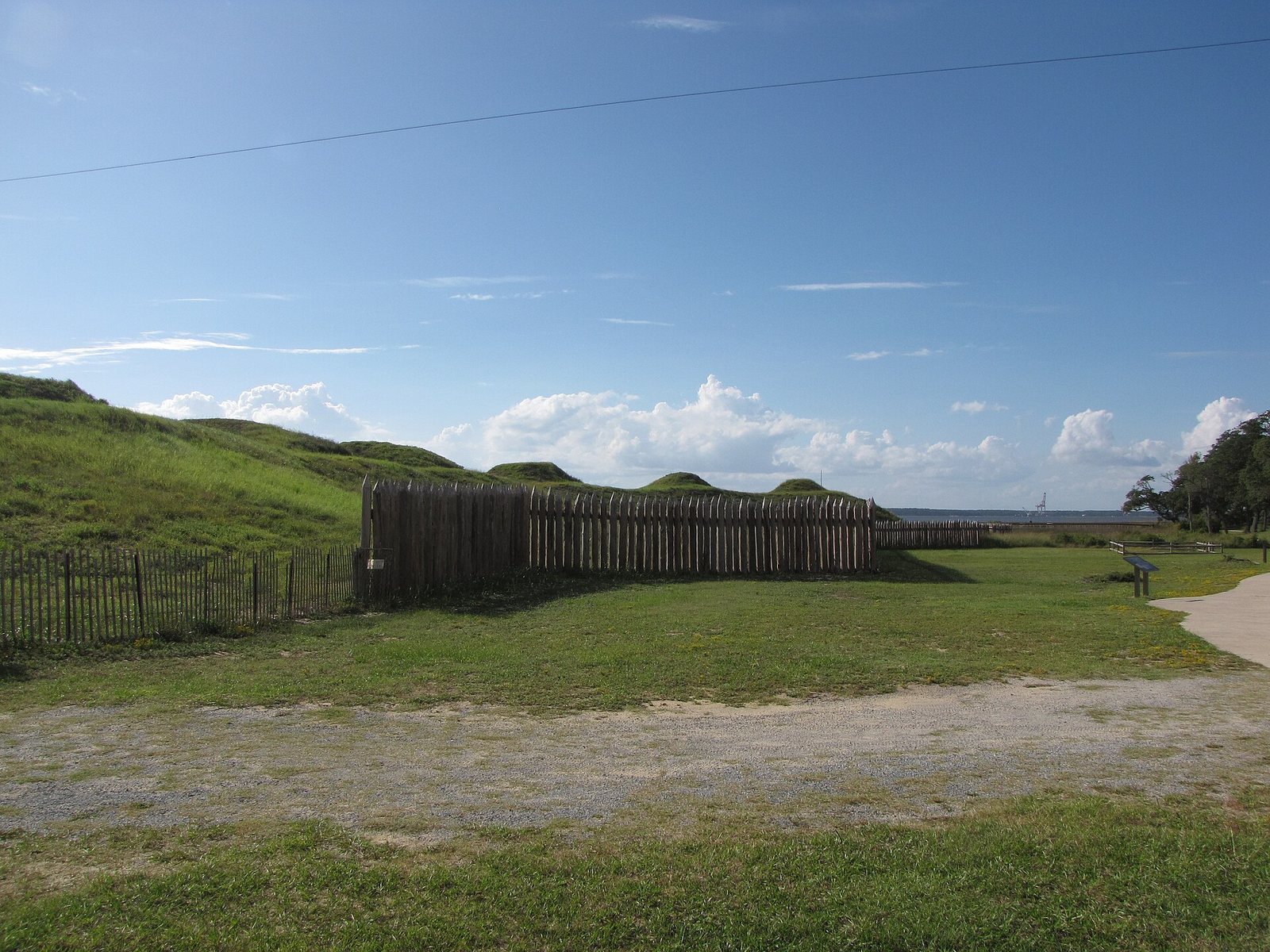
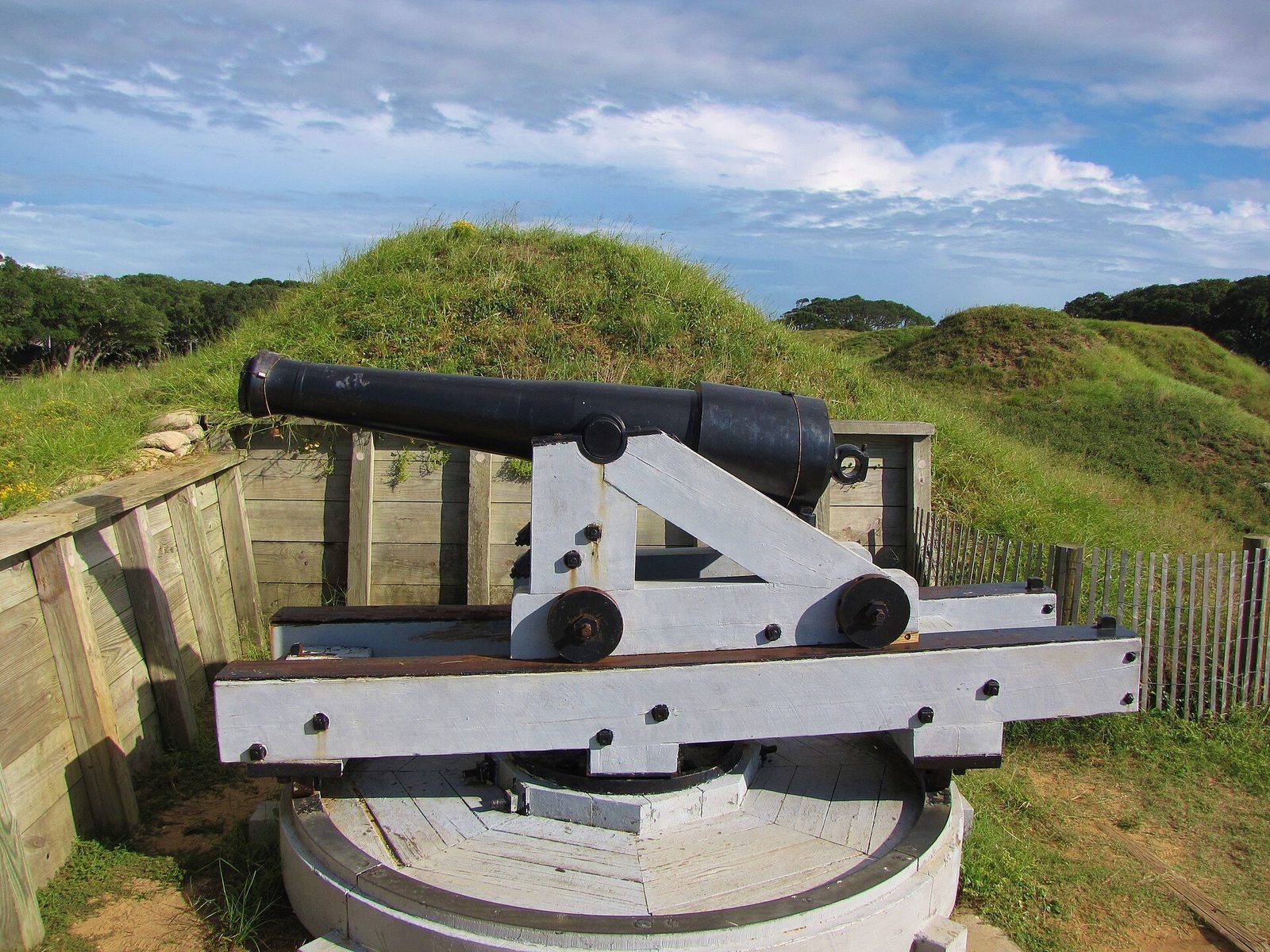
Natural erosion, construction of U.S. 421, and a World War II landing strip left few of the original sand mounds. Earthwork remnants remain, and part of the original fence along the land face has been reconstructed. The original 150-pound Armstrong gun is now at West Point, New York. A restored 32-pound seacoast cannon stands at Shepherd Battery.
Battle display and excavated finds
The site museum displays a map of the 1865 battle alongside three-dimensional models of Fort Fisher and Battery Buchanan. Narration and fiber-optic lights indicate troop movements and positions. The exhibits also include artifacts excavated at the fort.