Brunswick Town: Colonial Port and Political Center in North Carolina
Site at a Glance
- Rating
- 4.7
- Popularity
- Low
- Country
- United States
- Primary era
- Early Modern
- External website
- Open
- Eras represented
- Early Modern, Modern
- Civilizations
- British
- Site type
- City
On this page11 sections
History
Brunswick Town is an eighteenth-century colonial settlement and port at Winnabow, North Carolina, in the United States, established by European colonists in June 1726. Colonel Maurice Moore founded the town on 1,500 acres granted to him by the Lord Proprietors in 1725, and Cornelius Harnett Sr. purchased its first town lot. The settlement became a major port for the Cape Fear region, exporting longleaf-pine products such as tar, pitch, and turpentine for the Royal Navy and merchant shipping.
Colonial Foundation and Growth
The town took its name from Brunswick-Lüneburg, the German territory ruled by Great Britain’s King George I. During the 1730s, Brunswick Town became the political center of the Cape Fear region and the seat of New Hanover County. It served as the Province of North Carolina’s third capital from 1743 to 1770, meaning that the sitting governor resided there.
Brunswick’s importance was closely connected with the geography of the Cape Fear River. Shallow water near the mouth of Town Creek prevented large vessels from reaching Wilmington, helping Brunswick develop as the region’s principal maritime outlet. The Port of Brunswick later became North Carolina’s busiest port district, trading with Europe and the British West Indies.
The surrounding Cape Fear Native Americans had first allied with Carolina colonists during the Tuscarora War of 1711 to 1715. They later fought the colonists during the Yamasee War of 1715 to 1717. These conflicts formed part of the wider military and political setting in which the colonial settlements of the Cape Fear region developed.
The 1748 Spanish Attack
Spanish privateers, privately owned vessels authorized to attack enemy shipping during wartime, attacked Brunswick Town from September 3 to 6, 1748. Residents fled into the woods, leaving ships and houses open to raiding. Captain William Dry III organized about 67 defenders and led a counterattack with William Moore, Schenk Moore, Edward Wingate, Cornelius Harnett Jr., and William Lord.
The defenders killed ten privateers and captured thirty. Most of the crew of the retreating La Fortuna died when the vessel exploded. One defender, an enslaved man volunteered by George Ronalds, was killed when a small cannon exploded. Afterward, sailors recovered guns, anchors, and other goods from the wreck. The proceeds from the sale of the recovered goods and enslaved people helped pay for the construction of St. Philip’s Church in Brunswick Town and St. James Church in Wilmington.
Governors and Castle Dobbs
In 1758, Royal Governor Arthur Dobbs bought the unfinished Russellborough plantation from Captain John Russell, completed the house, and named it Castle Dobbs. After Dobbs died in 1765, Governor William Tryon occupied the property as Castle Tryon until his residence at New Bern was finished. Tryon then sold the plantation to William Dry III, who renamed it Bellfont. British forces burned the property in 1776.
Resistance to the Stamp Act
Brunswick Town became a center of opposition to the Stamp Act, the 1765 British law that taxed printed materials in the American colonies. In November 1765, residents prevented stamps from being unloaded from the HM Sloop Diligence. In February 1766, they refused to unload stamps from the Dobbs and Patience.
On February 20, Patriot leaders John Ashe, Cornelius Harnett, James Moore, Captain Robert Howe, and Colonel Hugh Waddell led several hundred citizens in arresting royal officials, surrounding Governor Tryon’s residence, and placing him under house arrest. The protest ended collection of the stamp tax in the Cape Fear region and may have been among the earliest violent acts of colonial resistance to British rule.
Decline and Revolutionary War Destruction
Brunswick Town declined as Wilmington grew and Tryon moved to New Bern. By 1775, most of the remaining families had left because they feared a British attack. From July 18 to 21 that year, Patriots led by Robert Howe, Cornelius Harnett, and John Ashe attacked Fort Johnston while Captain Collett and Governor Josiah Martin observed from the Cruizer.
In the spring of 1776, a Royal Navy raiding party from HMS Cruizer, led by Captain Collett, burned most of Brunswick Town, including Russellborough and probably St. Philip’s Church. British forces later burned additional parts of the town under orders from Generals Clinton and Cornwallis. Two or three families returned after the war, and the port continued to function for a time, but the town was completely abandoned by 1830. The abandoned site was then sold to Frederick Jones Hill of Orton Plantation for $4.25.
Fort Anderson and Modern Investigation
In March 1862, Confederate engineers surveyed the abandoned town and built earthworks and trenches over the remains of several burned structures. An earthwork is a defensive installation formed mainly from compacted soil, often with trenches and embankments. The fortification protected Wilmington, about 10 miles upstream, and was first called Fort St. Philip before being renamed Fort Anderson in July 1863.
During the Union attack on Fort Anderson in February 1865, cannonballs fired from Union ships in the Cape Fear River struck the walls of St. Philip’s Church. In 1899, the Cape Fear Chapter of the North Carolina Society of The Colonial Dames of America visited the site to commemorate Revolutionary War casualties. The organization installed a marble plaque inside the roofless church ruins in 1902 in memory of Maurice Moore.
Dr. Lawrence Lee Jr. became interested in excavating Brunswick Town in 1952. In 1958, the State Department of Archives and History contracted him to clear the site and locate the town ruins, with assistance from archaeologist Stanley South. Extensive excavations began that year and exposed remains of the former settlement. Brunswick Town is now a state historic site, and the Brunswick Town Historic District and St. Philip’s Church are listed on the National Register of Historic Places.
Remains
The Brunswick Town Historic District preserves the remains of eighteenth-century commercial and residential buildings together with St. Philip’s Church, Russellborough, and the earthworks of Fort Anderson. The surviving features represent successive layers of colonial settlement, Revolutionary War destruction, and Civil War fortification across the former town.
Colonial Buildings and Russellborough
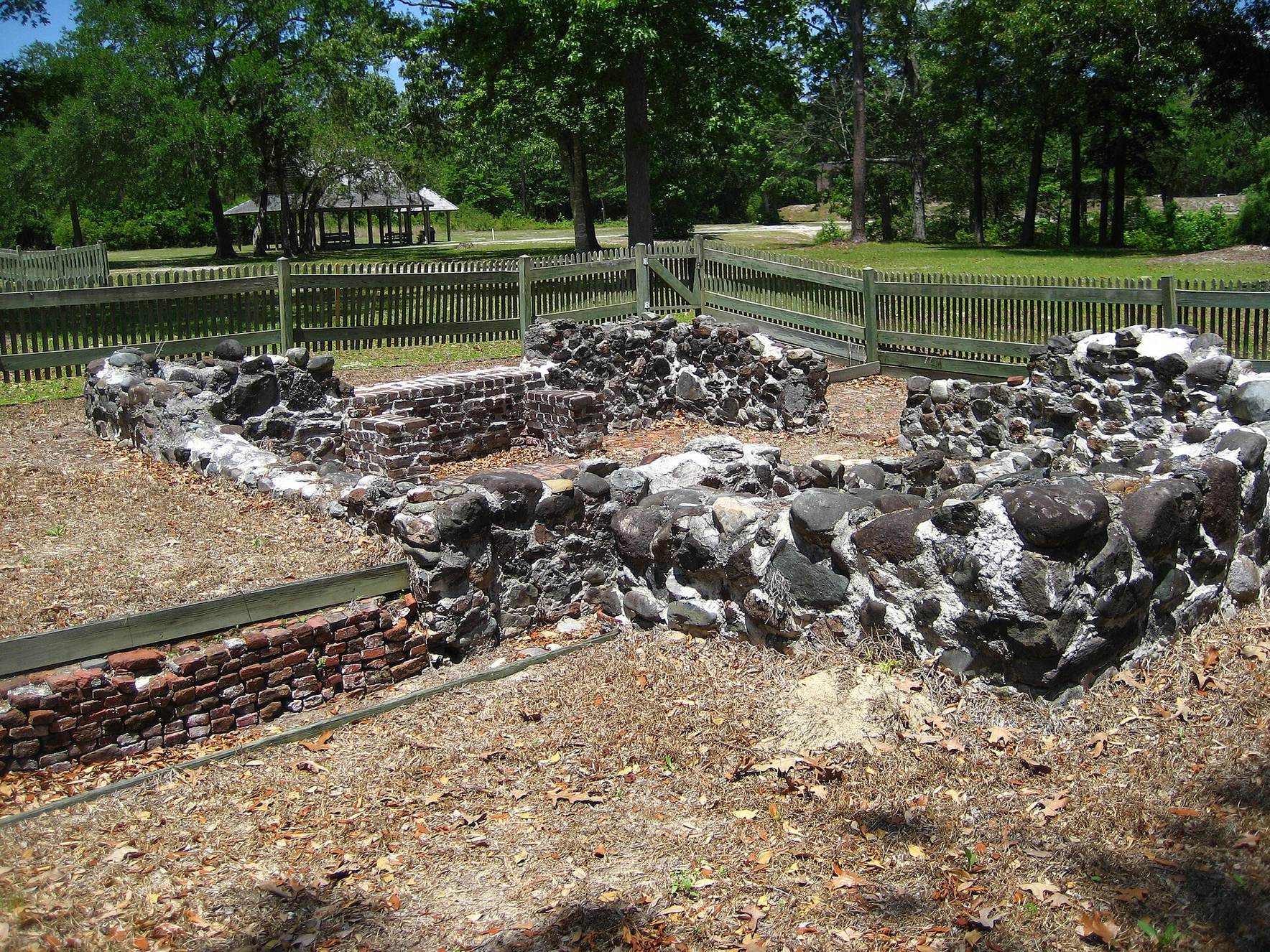
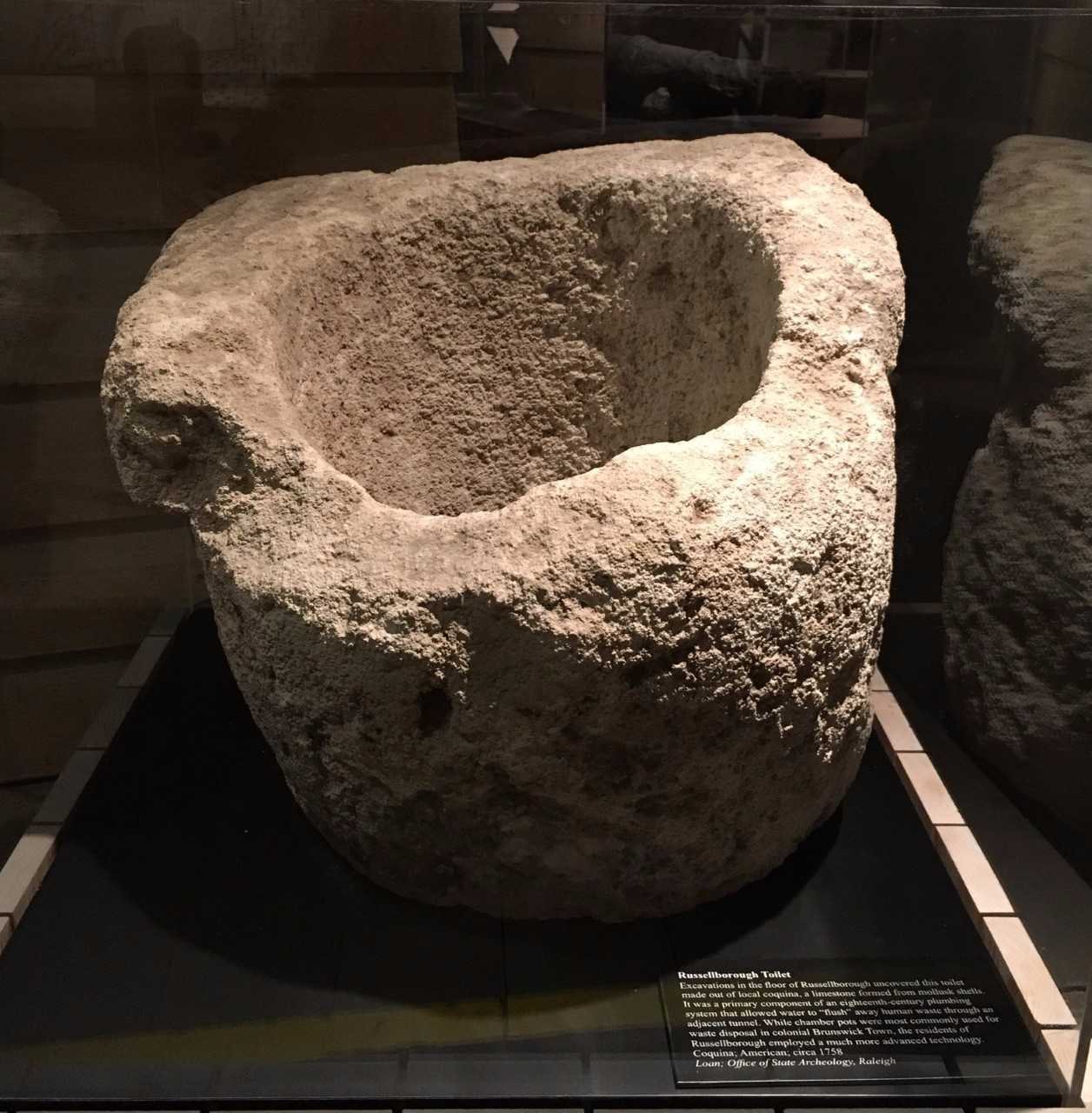
Excavated foundations and other remains mark the former commercial and residential parts of Brunswick Town. Russellborough, a grand two-story plantation house that became a governor’s residence, survives as excavated ruins visible at the Brunswick Town/Fort Anderson North Carolina State Historic Site. Artifacts recovered from the plantation are displayed in the site’s visitor-center exhibit hall.
St. Philip’s Church
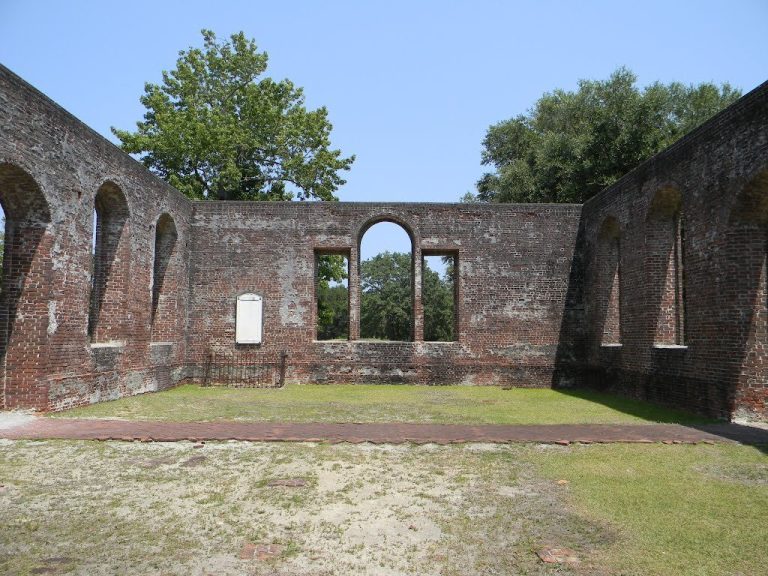
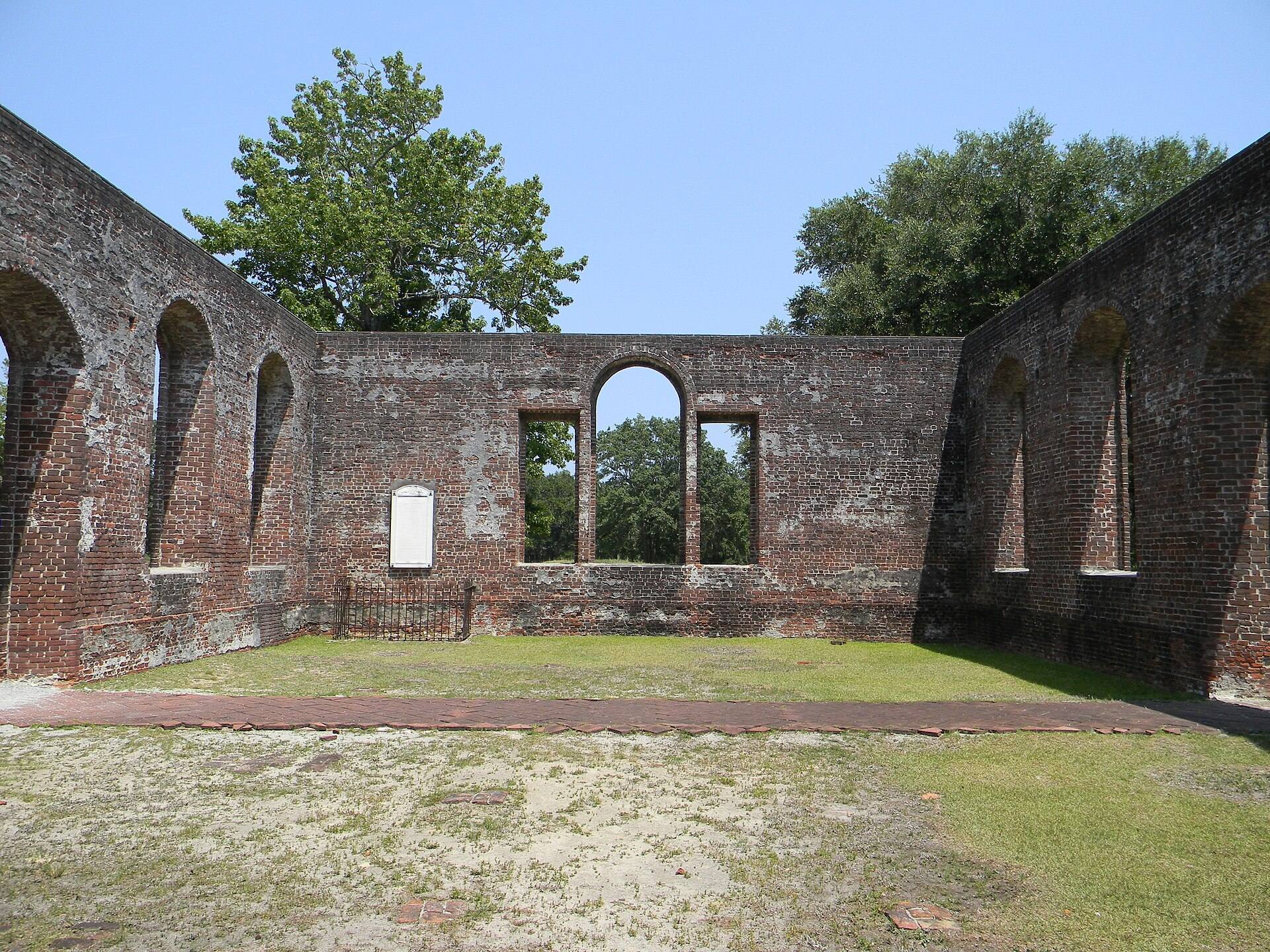
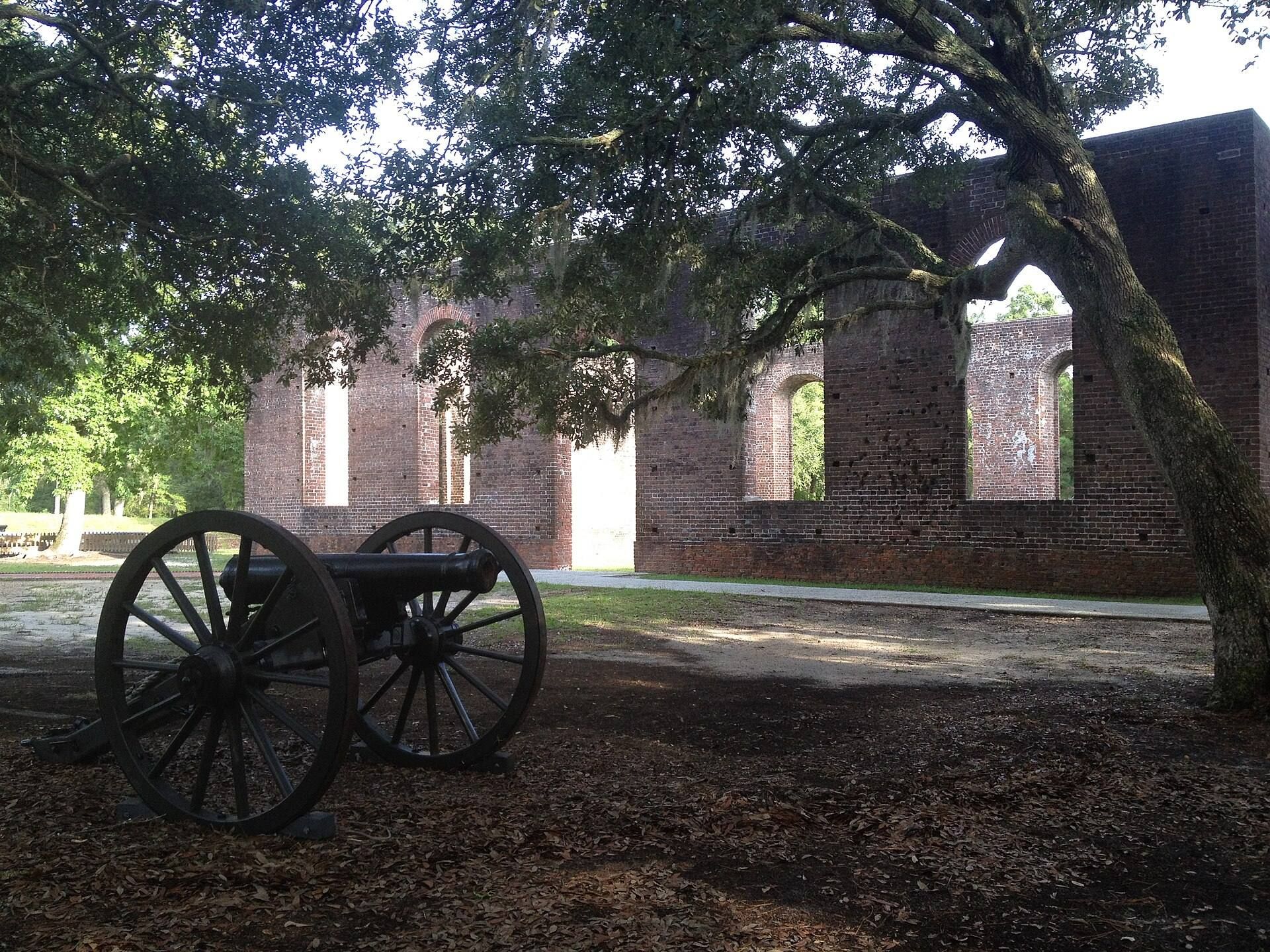
St. Philip’s Church survives as roofless ruins. The church was probably among the structures burned during the British raid of 1776. Its walls later received cannonball strikes during the Union attack on Fort Anderson in 1865, and the impacts remain visible. Archaeological excavation inside the church recovered bullets, buttons, and a cannonball.
A marble plaque installed inside the church ruins in 1902 commemorates Maurice Moore, who established Brunswick Town. Goods recovered from the abandoned La Fortuna also included a painting of the Ecce Homo, a Christian image of Jesus presented to the crowd before his crucifixion. The North Carolina General Assembly gave the painting to St. James Church in Wilmington, where it remains, making it an associated object rather than a surviving feature of Brunswick Town.
Fort Anderson Earthworks
Confederate earthworks and trenches cover a large portion of the former town. The defensive works conceal the remains of several structures burned during the colonial and Revolutionary periods, while St. Philip’s Church was left outside this covering. The earthworks preserve the later military use of the abandoned settlement and its role in protecting Wilmington during the Civil War.