St. Peter’s Church, Bosau: A Romanesque Vicelin Church and Former Episcopal Seat


Site at a Glance
- Rating
- 4.7
- Popularity
- Very Low
- Country
- Germany
- Primary era
- Medieval
- External website
- Open
- Eras represented
- Medieval, Early Modern
- Civilizations
- Holy Roman Empire
- Site type
- Religious
- Remains
- Cathedral
On this page20 sections
History
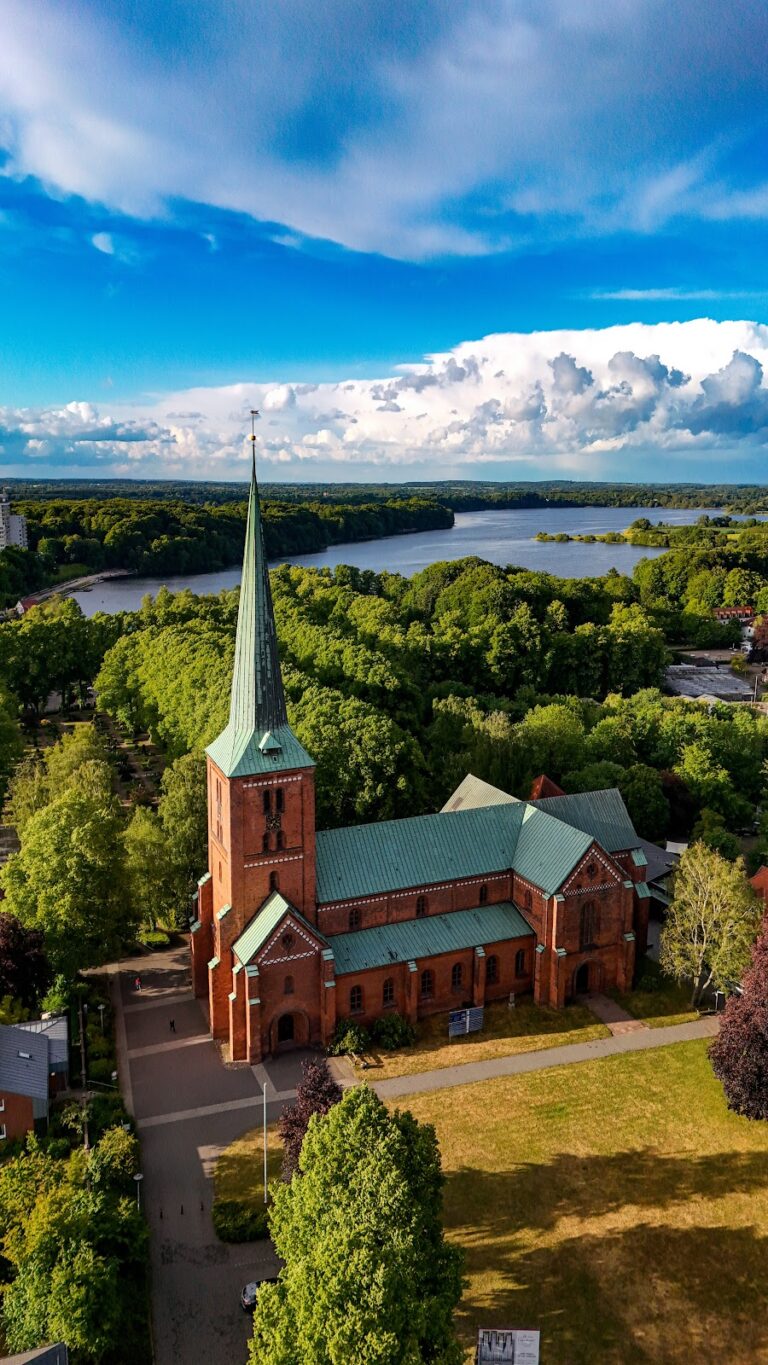
St. Peter’s Church is a Romanesque church in Bosau, Germany, founded by the missionary bishop Vicelin in 1151 during the twelfth-century Christianization of the Wendish territories. Standing at the southern end of the Great Plön Lake, it became the seat of the Bishopric of Oldenburg from 1150 to 1156 and is therefore known as a former episcopal church, sometimes described as the “smallest cathedral in the world.”
The Oldenburg Mission
The Bishopric of Oldenburg in Holstein was established in 972 by Archbishop Adaldag of Hamburg on behalf of Emperor Otto I. Its purpose was to support the Christianization and colonization of the territories inhabited by the Wends, West Slavic peoples living around the southern Baltic. Oldenburg’s church was burned during a Slavic uprising in 983, and after another revolt led by the Liutizens in 1066, the bishopric disappeared from the historical record for more than 80 years.
The Bosau peninsula was once an island and may have served as a Wendish cult site before the arrival of Christianity. During the tenth century, a bishop of Oldenburg established a protected economic estate there, but Slavs destroyed it in 1066. The name Bosau developed from the Slavic settlement name Bozowe. Suggested meanings include “under the beeches,” “God’s field,” and “settlement of Boz.”
Vicelin and the Episcopal Residence
The Oldenburg missionary bishopric was formally restored during the twelfth-century colonization of the Slavic territories. Vicelin became bishop in 1149 and moved the episcopal residence to Bosau because Oldenburg remained insecure. He began St. Peter’s Church in 1151, and the building was sufficiently advanced for consecration in 1152, after Vicelin returned from the imperial assembly at Merseburg. Craftsmen and building materials came from Segeberg and Neumünster, and the church was dedicated to Saint Peter.
Bosau remained the seat of the Bishopric of Oldenburg under Vicelin and his successor Gerold. In 1156, Gerold began residing in Eutin, and the episcopal seat was transferred from Oldenburg to Lübeck in 1160, or possibly in 1163 according to more recent research. Gerold died at Bosau in 1163. His friend Helmold lived there and encouraged him to write his chronicle. Between 1167 and 1172, Helmold wrote the Chronica Slavorum at Bosau. He died in 1177.
Later History
The church was shelled during the Thirty Years’ War in 1627, the conflict that devastated much of central and northern Europe during the seventeenth century. The original round tower was almost completely destroyed. A replacement tower was later built on an almost square plan, with a curved Baroque roof. The church’s richly decorated pulpit was carved in 1636.
St. Peter’s Church has hosted the Bosau Summer Concerts for more than 40 years. It is protected as a cultural monument in Schleswig-Holstein, while its historical importance rests especially on its association with Vicelin and its former role as an episcopal church.
Remains
Romanesque Structure and Tower
Fieldstone Church
St. Peter’s is a Romanesque fieldstone building whose surviving masonry preserves much of its original character. Excavated foundations in the nave indicate that the first design may have been a three-aisled basilica, a church with a central nave flanked by aisles. The plan was changed during construction, and the building was later remodeled several times. Around 1200, the west tower, choir, and apse were added as the three-aisled design was converted into a single-aisled church with one principal interior space.
The fieldstones were set in wooden formwork and bonded with gypsum mortar made from limestone quarried at Segeberg. The resulting white surface could be seen across the Great Plön Lake. Where the gypsum surface was lost, damaged masonry was repaired with brick. In 1970, the church received a uniform white lime coating, bringing its appearance, apart from the tower, close to that of earlier periods.
West Tower
The oldest surviving depiction of the church, dating from 1559, shows a round tower with a pointed conical roof. Excavations confirmed the foundations of this first tower, while fieldstones around the present tower mark its former position in the ground. After the round tower was destroyed by shelling in 1627, the present replacement was constructed on an almost square plan and covered with a curved Baroque roof.
Medieval Paintings and Altars
Apse Paintings
Small remains of original Gothic wall painting survive in the apse, the curved end of the choir. They include foliage ornament and an incomplete depiction of Saint Peter with a donor. The paintings were discovered and exposed in 1952.
Main Altar
The main altar is a former winged altar, a decorated altar structure with hinged panels, and is regarded as one of the oldest and most important in eastern Holstein. Its present carved retable, the structure placed behind an altar, is not arranged as it originally was. Until 1915 it stood neglected against the south wall. The figures were then remounted in a substantially different sequence, and another restoration around 1968 rearranged the prophets while retaining the basic grouping.
The central scene shows Christ enthroned in a mandorla, an almond-shaped frame, as judge of the Last Judgment. Mary and probably John flank him, while the Apostles stand farther outward. Beneath Christ, a panel shows the resurrected and the damned. Busts of prophets occupy the zone below the central shrine, and the wings contain the five wise and five foolish virgins, holding full or empty oil lamps. The figures were carved around 1370. Their narrow heads and elongated bodies belong to a style described as distinctive and foreign to northern Germany.
The carving has been displayed without visible color since its renovation in the 1960s, although it was probably originally painted in several colors. Parts of the framework were renewed. The outer faces of the wings were overpainted in 1664, while older painted layers uncovered on the right wing in 1915 showed scenes of the Crucifixion, Entombment, Mass of Saint Gregory, and Christ’s Descent into Hell. The Mass of Saint Gregory is described as one of the earliest representations of that subject.
Subsidiary Altar
A subsidiary altar is dedicated to the Apostles Peter and Paul and is associated with an eternal vicarage, an endowed foundation intended to support a continuing priestly office. Parishioners established it in 1493 with 350 Lübeck marks, a medieval monetary and accounting unit used in the region. The large carved figures correspond stylistically to that date, while the wing paintings date from 1722. Their inner faces depict the four Evangelists, and their outer faces show the Apostles Bartholomew and Thomas.
Sculpture and Liturgical Furnishings
Triumph Cross
A large Triumph Cross made around 1470 by a sculptor from the circle of Bernt Notke hangs before the chancel arch. Three lilies growing from Christ’s head represent purity and innocence, while four angels collect blood from his wounds in Communion chalices. The expanded ends of the cross carry the symbols of the Evangelists: a winged human for Matthew, a lion for Mark, an ox for Luke, and an eagle for John. Leafwork growing from the cross forms a Tree of Life and represents Christ’s victory over death.
Restoration in 1916 revealed five relics inside the head of the figure of Christ, each accompanied by a parchment label. They were identified as bone fragments associated with Saints Laurence, Maternianus, and Mauritius, fragments attributed to the Eleven Thousand Virgins martyred near Cologne, and a small piece of limestone said to come from Mount Tabor.
Figures and Choir Stalls
Late Gothic carved figures stand on either side of the apse arch. Mary, carved from walnut, stands on a crescent moon, while Bishop Vicelin was carved from oak. A model of a church was placed in Vicelin’s hand in the nineteenth century. The fifteenth-century choir stalls have finely carved heads on their cheek pieces.
Pulpit and Organ
The richly decorated pulpit was carved in 1636. Niches between its corner columns contain Christ, the Evangelists, and the Apostles Paul and Andrew. A small hourglass on the parapet indicates the length of sermons. A parishioner donated it at Christmas in 1734.
The present organ was built by Becker in 1972. Its darkened-oak case contains 18 stops on two manuals and a pedal. A Zimbelstern and a nightingale stop were added, and the instrument was renovated in 2000.
Gallery and Memorials
North Gallery
The north gallery was built in 1656 with roughly timbered supports. Twenty painted panels between its columns depict scenes from Christ’s life, particularly his Passion and death. Hans Welcker painted them in a popular style and also produced the original painting of Christ’s Baptism, now placed on the west side of the gallery. Most of the panels were based on models by Marten de Vos.
South-Wall Epitaphs
Three seventeenth-century epitaphs, commemorative monuments honoring deceased people, hang on the south wall. The most elaborate commemorates Henning Meyer, who died in 1687. Its painted central panel shows a Crucifixion group, with the donor kneeling beside the mourning women before a sculpted cross. Vine-covered columns and five fully modeled carved figures form the frame. Meyer was the episcopal bailiff of the Bishopric of Lübeck in Eutin and also commissioned similar epitaphs for the churches at Bosau, Malente, and Neukirchen.
The Mackohm epitaph, installed by Paul Mackohm in 1662 for his wife Anna Margretha, uses a rare purely emblematic composition. The arm of Death restrains a woman’s hand, while her husband’s hand offers a heart and laurel. A young shoot grows from a tree stump below. Anna Margretha, the daughter of Pastor Gerhard Janus, died at the age of 23, one month after giving birth to a daughter. Mackohm was administrator of the Ascheberg estate.
A simply designed late-Renaissance inscription epitaph commemorates the parents of the Lübeck citizen Jochen Brockes, who died in 1621 and 1631. The monument was renewed in 1869.
Baptismal Font
The oldest object in the church is a medieval baptismal font made of Swedish granite and dated to the twelfth or thirteenth century. It stands beside the main altar on a later limestone base from the island of Gotland.