St Munn’s Parish Church, Kilmun: A Collegiate Church and Campbell Burial Place
Site at a Glance
- Rating
- 4.7
- Popularity
- Medium
- Country
- United Kingdom
- Primary era
- Modern
- Eras represented
- Medieval, Early Modern, Modern
- Civilizations
- British, Kingdom of Scotland
- Site type
- Religious
- Remains
- Church
On this page17 sections
History
Early community and collegiate church
St Munn’s Parish Church, Kilmun, is a historic church in the United Kingdom, occupying the site of a Christian community founded in the seventh century by St Munn, an Irish monk also known as Fintán of Taghmon. Visible remains include parts of a church dating to the twelfth century, and a church stood at Kilmun by the thirteenth century.
By the fifteenth century, Kilmun had become an important Christian centre for the surrounding area. It was closely linked with Paisley Abbey, a major religious house, and Clan Campbell, a powerful Scottish clan, made it their spiritual home. The Campbells adopted St Munn as their patron saint.
In 1442, Sir Duncan Campbell of Lochawe endowed Kilmun as a collegiate church. Its clergy were priests who lived together as a community, rather than monks. A provost led five chaplains, who held prayers and masses and may also have served local people. The medieval tower west of the church housed the six clergy and could shelter local residents in dangerous times.
Campbell burial traditions and parish use
The Campbell family’s burial tradition at Kilmun began in 1442, when Archibald, eldest son of Sir Duncan, died. A severe snowstorm prevented his funeral party from reaching Inishail, and he was buried at Kilmun instead. Duncan, later the first Lord Campbell, died in 1453 and was buried near the church altar. His burial established a custom of interring Clan Campbell chiefs there.
Recorded burials span twenty generations and about five centuries. Among the early interments were Duncan’s wives, Marjorie and Margaret Stewart, and Colin Campbell, the second Lord Campbell and first Earl of Argyll, who died in 1493. Later burials included the eighth Earl and first Marquess of Argyll, executed in 1661; the ninth Earl, who died in 1685; and the tenth Earl, who became the first Duke of Argyll and died in 1703. The fifth Duke was buried at Kilmun in 1806, followed by later dukes, including the ninth in 1914 and the tenth in 1949.
Almost all Campbell chiefs were buried at Kilmun from 1442 to 1949. The earliest chiefs are believed to have been buried first at Kilchrenan and then on Inishail, in Loch Awe. Most chiefs’ wives and other close relatives are also thought to lie at Kilmun. Exceptions among the dukes include the second, buried at Westminster Abbey, and the eleventh and twelfth, who chose Inishail.
During the Reformation, a major religious transformation in sixteenth-century Scotland, church burials were forbidden in 1588. Campbell burials continued for a time, and the family later used a burial aisle attached to the church. By 1669, the ninth Earl of Argyll had built a private chapel and family vault beside the nave. In 1688, the collegiate church choir was rebuilt for use as a parish church.
The Argyll Mausoleum and a larger church
John Campbell, fifth Duke of Argyll, commissioned the Argyll Mausoleum for the dukes and earls of Argyll, Clan Campbell chiefs, and their families. Designed by James Lowrie, it was built in 1795–96 around the family vault. When the chapel was later replaced by the separate mausoleum, some remains, including the carved memorial figures of Duncan Campbell and his wife, were moved there.
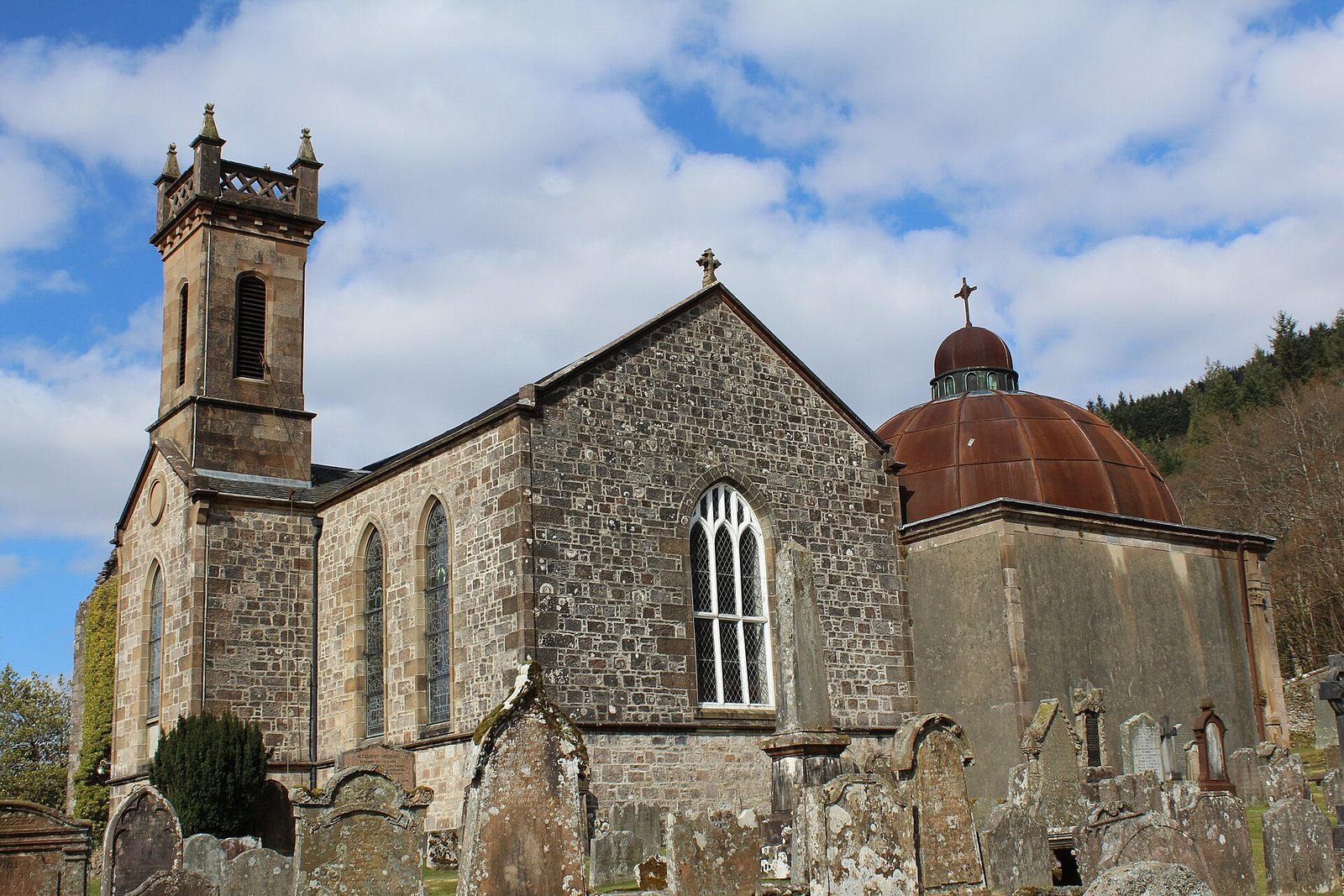
In 1841, most of the collegiate church was demolished and replaced by a larger church designed by Thomas Burns. The new building occupied part of the earlier church site and included two walls of the Argyll Mausoleum. Its greater size was intended in part to serve the increasing number of summer visitors to the Holy Loch, a long inlet of the sea.
Restoration and later stewardship
The church and mausoleum underwent extensive restoration in the 1890s under the Marquess of Lorne, the courtesy title of the heir to the dukedom of Argyll, who later became the ninth Duke. In 1898–99, architect Peter McGregor Chalmers rearranged the church interior and designed much of its carved chancel furniture and panelling. Historical and archaeological study followed in 2012, with conservation work on the mausoleum in 2013.
Water began entering the mausoleum after its roof was altered in the 1890s, and the church began to be affected by water in the 1970s. Ownership of the mausoleum passed to Argyll and Bute Council in the 1920s, followed by a dispute lasting about thirty years before the council conceded its ownership. The church received Category A listing in 1971, Scotland’s highest listed-building grade; the medieval tower is separately protected as a scheduled monument.
Remains
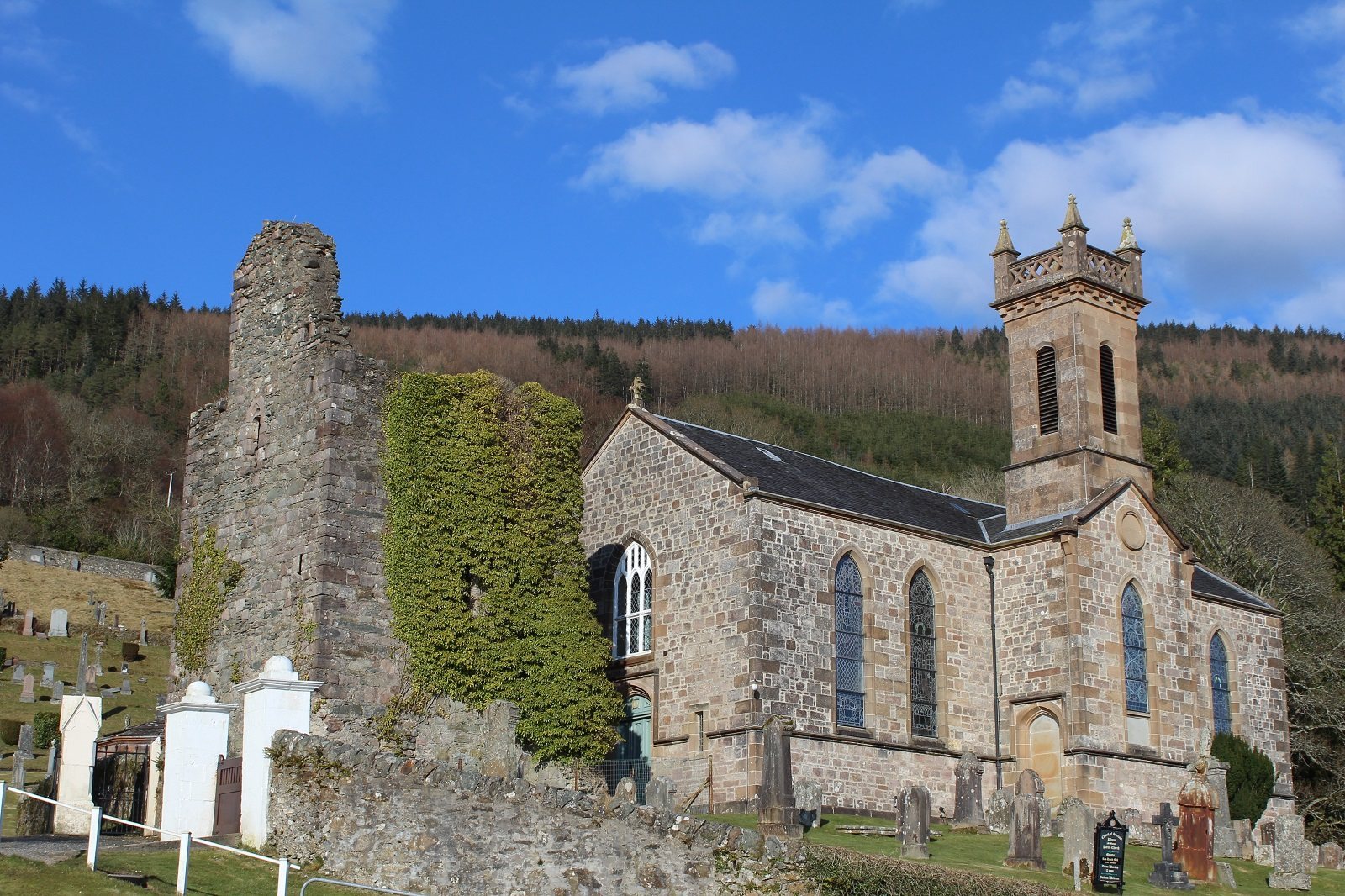
The site brings together the T-shaped parish church, a partly ruined medieval tower to its west, and the Argyll Mausoleum attached at the church’s north-east corner. The church is built of squared sandstone rubble in courses, using stones of different sizes, with finely dressed stone around openings and other details. Its roof is covered in grey slate.
Church building
Exterior and halls
The church’s nave extends north from its T-shaped plan. A projecting central section with a gabled roof carries a small square bell tower, topped by ornamental corner finials and a stone parapet pierced with openings. The south wall has tall, narrow windows with pointed tops. Wider pointed windows in the east and west gables have tracery, decorative stonework that divides and ornaments the openings.
Halls built at the church’s north-west angle in 1909–10 follow Chalmers’s design. They have hipped roofs and leaded windows divided into sections by stone bars.
Interior
Chalmers’s 1898–99 changes opened the former enclosed vestry on the south wall into a choir space and added arcades supporting galleries on the east and west. Much of the carved chancel furniture and panelling also follows his designs. A flat ceiling rests on decorative Tudor arches, low, broad pointed arches, carried by projecting stone supports. The walls are rendered, with exposed sandstone around openings and panelling along their lower portion.
The stained glass includes scenes from the life of Christ and a portrait of George Miller of Invereck as St Matthew, one of the four Gospel writers in Christian tradition. Many of the windows were made by Stephen Adam. Later windows by his successor, Alfred Webster, include a war memorial in the north gable. A water-powered organ made by Norman & Beard in 1909 is probably one of only two such organs still in use in Scotland, alongside the instrument at St Mary’s, Dalkeith.
Medieval tower
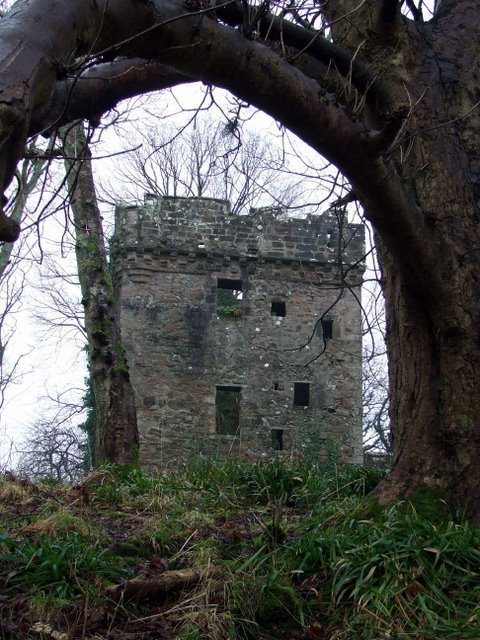
The partly ruined tower west of the church is built of finely dressed sandstone. It is associated with the earlier church and the collegiate establishment of 1442, although its own construction date is uncertain. Its historical use included housing the six clergy and providing refuge for local people.
Argyll Mausoleum
Structure and burial spaces
The mausoleum has a square plan and a pointed-arch entrance on its north side. Two sealed, window-shaped panels with decorative stone divisions flank the entrance, along with shallow attached columns. Inside, raised platforms run along the side walls, with coffin niches covered by inscribed sandstone slabs. Further graves lie beneath the stone floor.
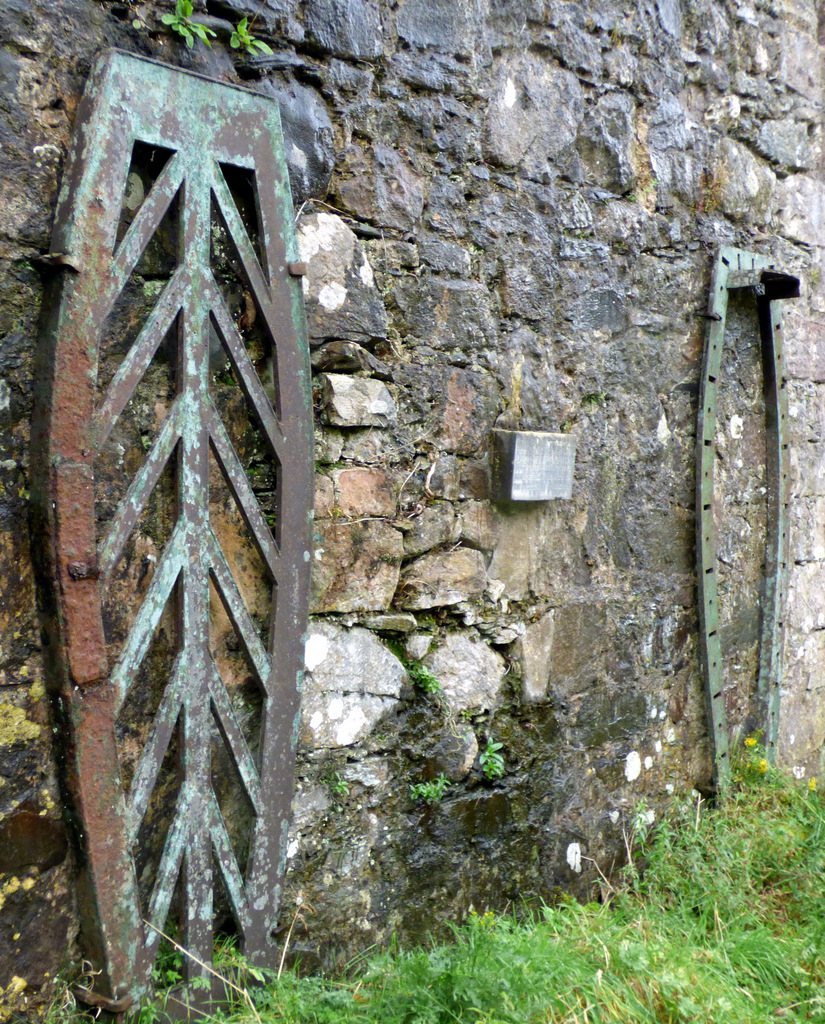
The original slate pyramid roof was replaced in 1891–93 by a roof with rooflights and a large cast-iron dome at its peak. The dome improved the interior lighting, and its makers’ marks remain visible inside the roof. It is believed to have been forged at a Glasgow shipyard foundry and transported to Kilmun. Although its weight raised concern, it caused little damage to the supporting walls. The dome was not properly sealed against them, allowing water to enter.
Campbell memorials and interments
A metal cross among the floor slabs bears the inscription “Archibald, Marquis of Argyll” and “Beheaded 1661.” Archibald, the eighth Earl and first Marquess, was executed in Edinburgh in 1661 and buried at Kilmun; his head was placed there three years later. His resting place was rediscovered during excavation in the 1890s. A skeleton, a skull with a hole made by a spike, and a yellow wig were found beside an interior wall, and his remains were reburied in the centre of the mausoleum. A plaque low on the east side of the burial aisle records words he spoke before his execution.
Effigies and sculpture
A broad arch with lobed curves frames a niche in the south wall containing two fifteenth-century effigies, carved figures representing the dead. One shows Duncan Campbell, first Lord Campbell, in full armour; the other depicts a woman believed to be his second wife, Margaret Stewart, daughter of Sir John Stewart of Ardgowan. The arch’s decoration was added in 1892. The figures are considered among the last Scottish medieval burial effigies of comparable quality.
A life-sized sculpture by Princess Louise, Queen Victoria’s daughter and a sculptor, depicts an angel lifting Christ from the Cross. It now stands in a glass case. Three casts were made from her design: another commemorates colonial soldiers of the Second Boer War, fought in southern Africa in 1899–1902, at St Paul’s Cathedral in London, and one is a memorial to Prince Henry of Battenberg at St Mildred’s Church, Whippingham. The Kilmun sculpture may have been intended to commemorate Louise’s father-in-law, the eighth Duke of Argyll.
Churchyard
Burial ground and graves
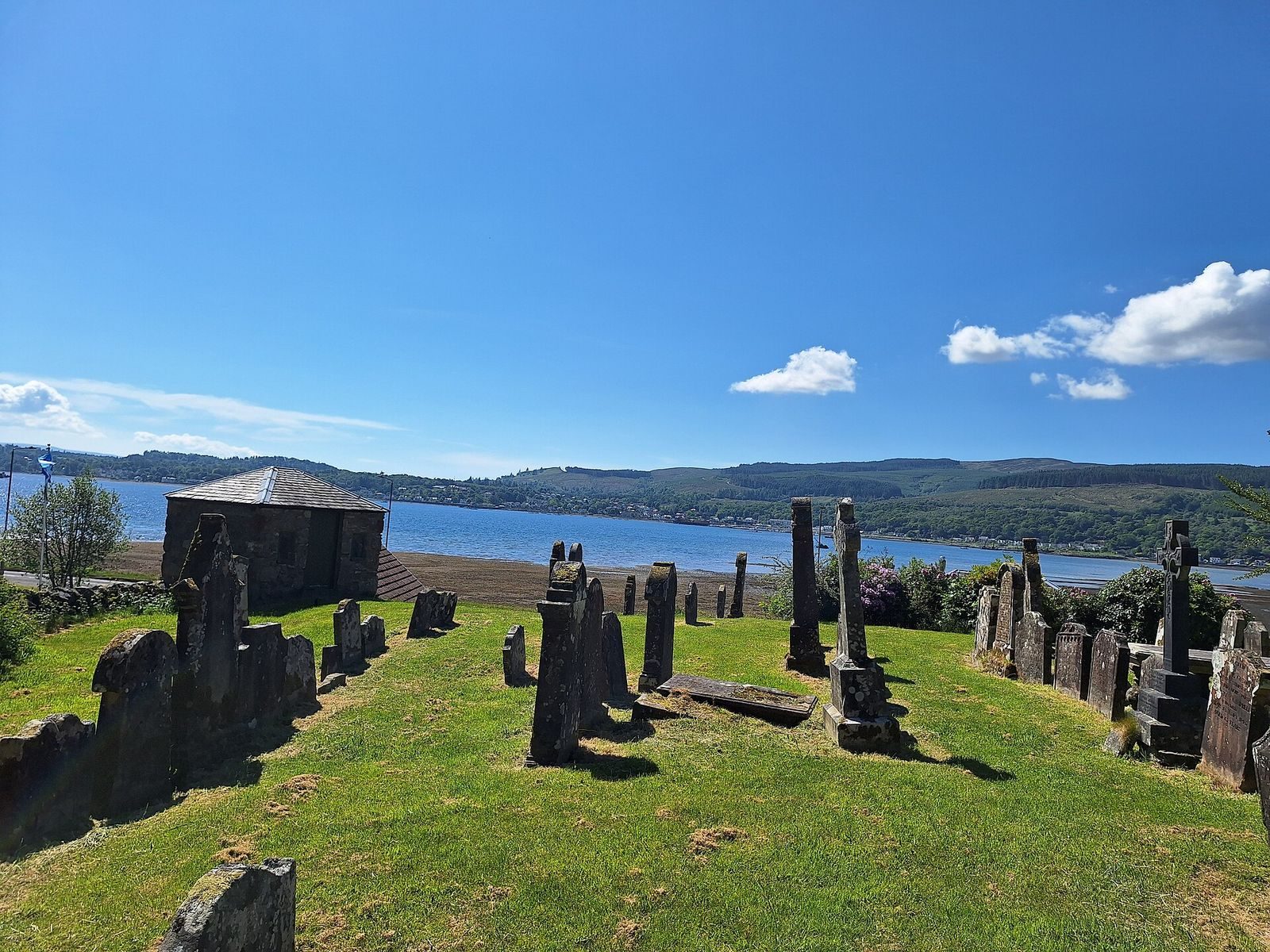
The churchyard contains tapered grave slabs from the later medieval period, many headstones from the seventeenth and eighteenth centuries, and raised table tombs with carved trade tools. It is said to include St Munn’s burial place. The ground was extended northward and later westward into part of the grounds of Old Kilmun House, just beyond the cemetery’s north-west edge. Its walls probably date to 1818–19, when the grounds took their present form. The churchyard also contains the grave of Elizabeth Blackwell, a pioneer of women’s medical qualifications in the United States.
Douglas Mausoleum
North-west of the church stands the octagonal Douglas Mausoleum, built of red sandstone in 1888. Its walls have a rock-cut, finely dressed finish, and its studded timber door has a carved heraldic panel above it. Stone slabs form the roof. The mausoleum contains General Sir John Douglas of Glenfinart, a military commander during the Indian Mutiny, the 1857–58 uprising against British East India Company rule in India.