St. Catherine’s Church: A Neo-Gothic Roman Catholic Church in Eindhoven
Site at a Glance
- Rating
- 4.6
- Popularity
- High
- Country
- Netherlands
- Primary era
- Modern
- External website
- Open
- Eras represented
- Modern
- Civilizations
- Dutch
- Site type
- Religious
- Remains
- Church
On this page13 sections
History
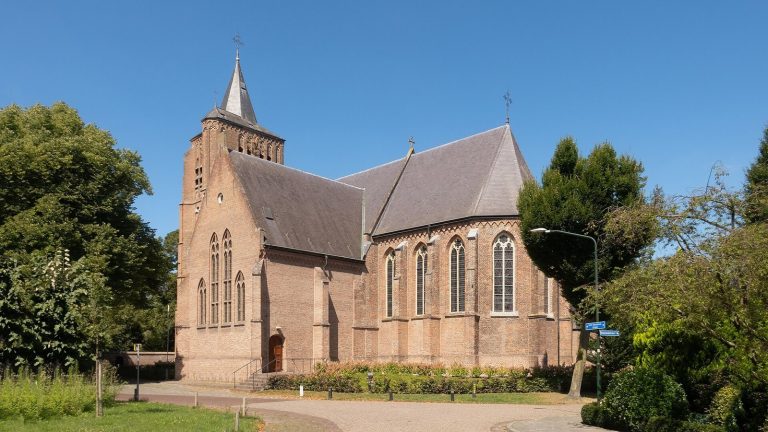
St. Catherine’s Church is a Neo-Gothic Roman Catholic church in central Eindhoven, Netherlands, built between 1861 and 1867 to replace a medieval church on the same site. Dutch architect Pierre Cuypers designed the building with reference to French Gothic churches. Dedicated to Catherine of Alexandria, it follows the Roman rite, the principal liturgical tradition of the Latin Church, and belongs to the Diocese of ’s-Hertogenbosch.
Medieval church and pilgrimage
Eindhoven was founded in 1232, when the area had been sparsely inhabited. The new town’s residents initially belonged to the parish of St Peter at Woensel, and the church at this site began as a dependent church within that parish. The predecessor church is first mentioned in 1340. In 1399 it became a collegiate church, served by a chapter of clergy, and attracted pilgrims to an image of Our Lady of the Presentation. A cemetery was established at the church.
Damage and changes of worship
Forces from the Duchy of Guelders burned the church in 1486; repairs were completed in 1515. Its tower was blown over in 1526. In 1543, Guelders forces under commander Maarten van Rossum plundered the church, and a city fire damaged it in 1554. During the 1566 iconoclasm, the destruction of religious images, the image of Our Lady of the Presentation was destroyed and later restored.
After the Peace of Münster in 1648, a treaty that formed part of the settlement ending the Dutch Revolt against Spain, Protestants took the church and adapted it for their worship. French forces seized it late in the eighteenth century and used it successively as a courtroom, stable, bakery, residence, and military storehouse. It returned to Catholic use in 1798 and was reconsecrated in 1810. The parish regained its tower in 1836.
The nineteenth-century replacement
The medieval church had served a parish of as many as 3,000 people but was considered too small. A temporary church came into use, and the old building was demolished before construction of Cuypers’s replacement began. Work ran from 1861 to 1867, and the new church was consecrated in 1867.
Wartime damage and restoration
Bombing damaged the church heavily in 1942 and 1944. After the war, architect C.H. de Bever led its restoration. The building became a Dutch national monument in 1972, a protected status under the country’s heritage system. In 1974 it was transferred to the municipality of Eindhoven under an agreement permitting worship to continue there for 50 years. Major restorations followed in 1980–82 and 2000.
Remains
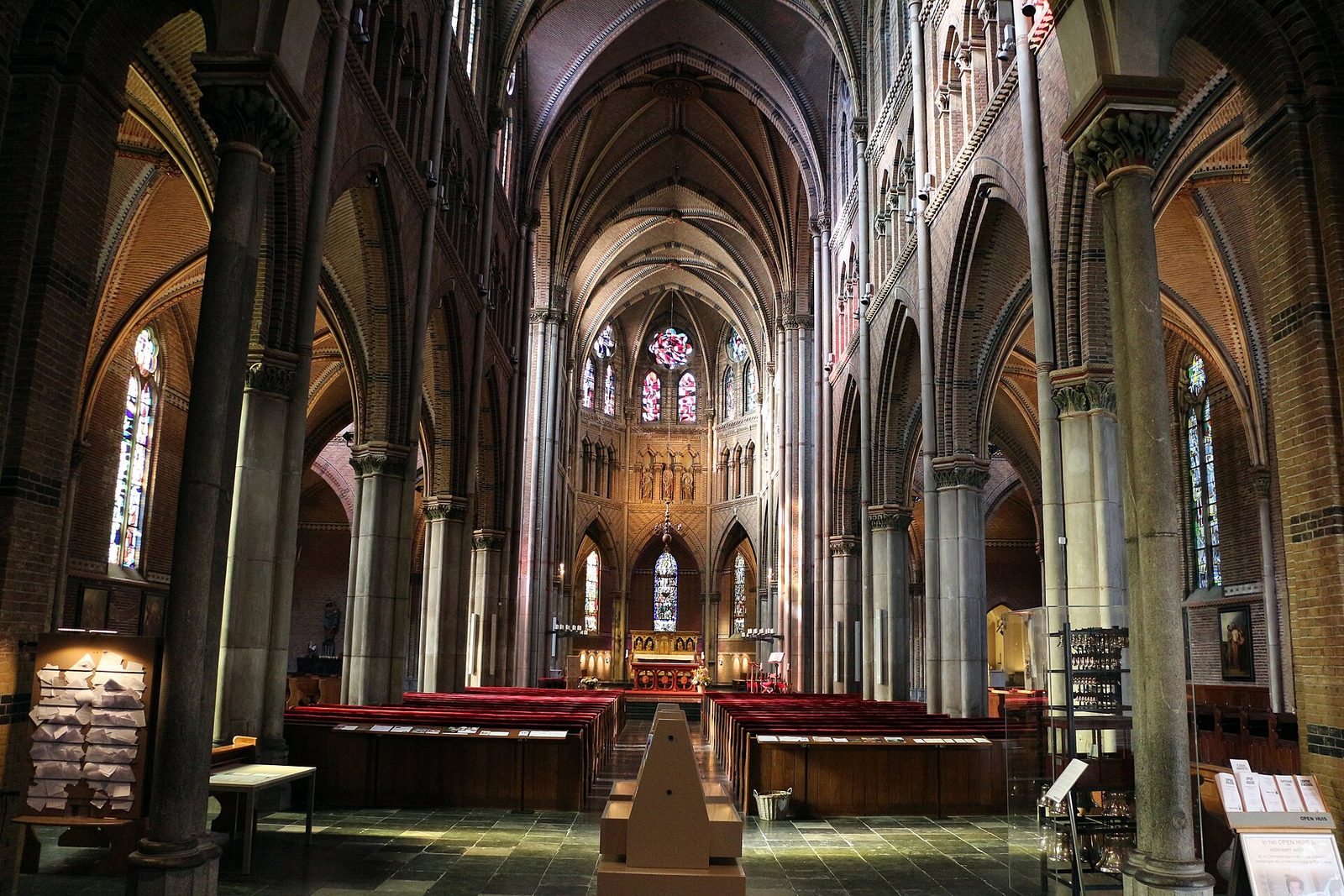
The present church is a three-aisled basilica, with a central nave flanked by two side aisles, on a Latin-cross plan, where a shorter axis crosses the longer main one. Its Neo-Gothic design takes inspiration from French Gothic churches, including those at Chartres and Reims.
Plan and exterior
Orientation
The choir faces west, rather than following the conventional orientation. The design also incorporates Catholic symbolism associated with Joseph Alberdingk Thijm, a Dutch Catholic writer and art theorist.
Towers and rose windows
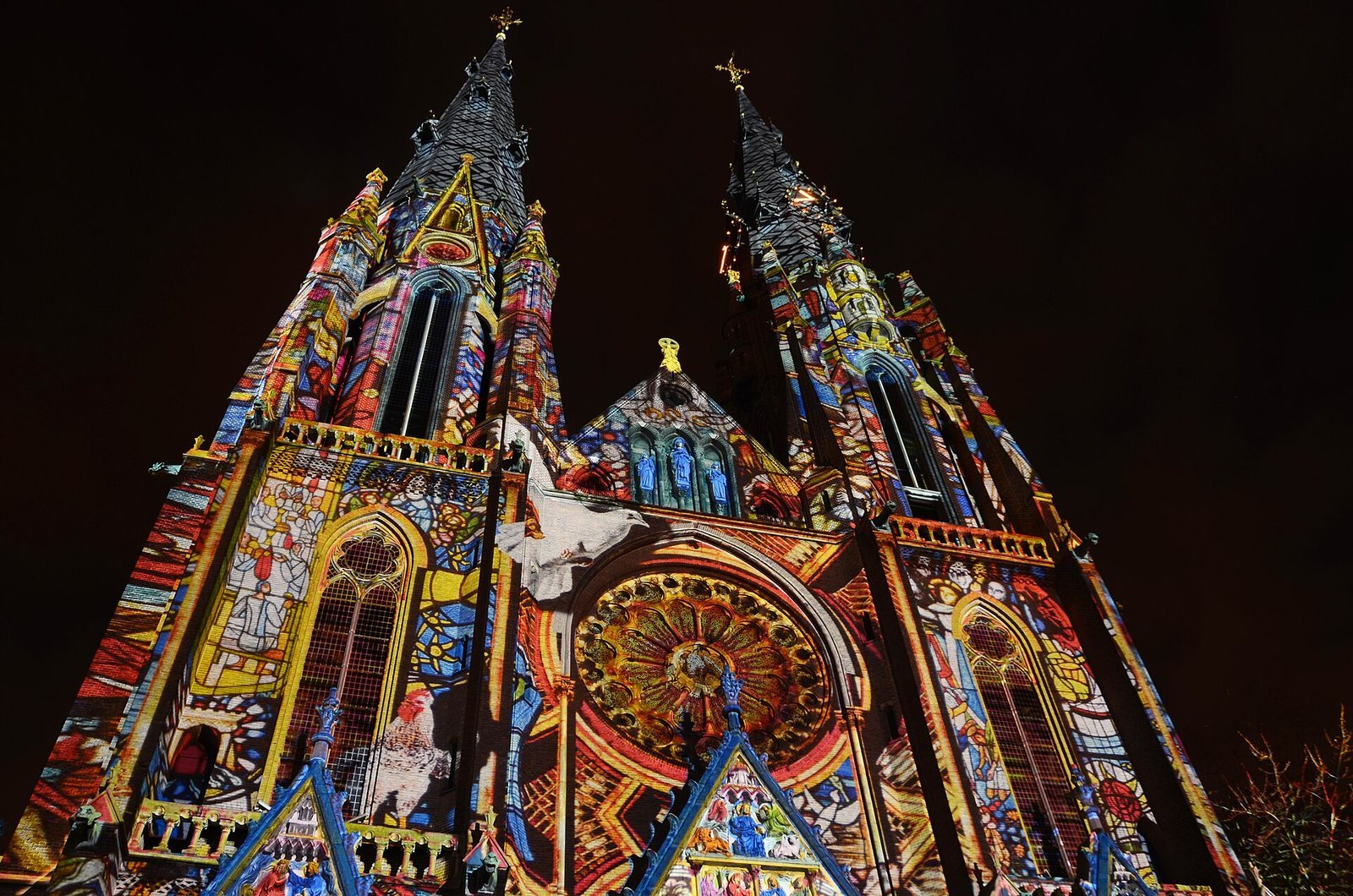
The façade has two differently shaped towers, each 73 metres high. The southern tower is dedicated to Mary and represents an ivory tower. Its companion, David Tower, has battlements and turrets that give it a defensive appearance. The design presents the towers as female and male forms, respectively. Rose windows, large circular windows divided by radiating patterns, refer through their wheel shapes to Catherine of Alexandria’s traditional wheel attribute.
Windows and organs
Stained glass
The church’s earlier windows were lost in wartime damage. During the postwar restoration, they were replaced with stained-glass windows, including works by Charles Eyck and Pieter Wiegersma.
Organs
The large organ was built by Verschueren in 1936 and completely rebuilt after war damage destroyed it. It has 5,723 pipes and is among the largest organs in the Netherlands. A smaller Neo-Gothic altar organ stands near the sacristy, the room where clergy prepare for services and keep vestments and sacred vessels.
Earlier church and burial remains
A brick church stood on the site by the thirteenth century. Foundations and grave remains of the predecessor have been identified; its choir faced east. Excavations beneath the square in 2003 uncovered hundreds of human skeletons. Some were reconstructed, including one later known as Marcus van Eindhoven.