St Baglan’s Church, Llanfaglan: A Medieval Church in Wales
Site at a Glance
- Popularity
- High
- Country
- United Kingdom
- Primary era
- Medieval
- Eras represented
- Medieval, Early Modern, Modern
- Civilizations
- British, English
- Site type
- Religious
- Remains
- Church
On this page17 sections
History
St Baglan’s Church, Llanfaglan, is a redundant Church in Wales church in the United Kingdom, about three kilometres south of Caernarfon. Tradition links it to the seventh-century Welsh saint Baglan ap Dingad, but the present church was built in phases, with its nave, the main area for the congregation, probably dating from the thirteenth century.
Tradition and the early site
According to local tradition, Baglan travelled from Llancarfan in Glamorgan toward Bardsey Island with Dyfrig, an early Welsh religious leader and saint. He is said to have founded a religious cell, meaning a small settlement or hermitage, at Llanfaglan. Tradition also made him a descendant of Macsen Wledig, a figure in Welsh tradition associated with the Roman general and emperor Magnus Maximus.
A verse in the Red Book of Hergest describes the way to Llanfaglan as leading to heaven. One interpretation connects the saying with the difficult approach across the Saint and Gwyrfai rivers and through wet ground. The church and churchyard stand within an enclosure thought to be about 2,000 years old. Its discovery during an aerial survey in 2005, together with the size of the churchyard and an early inscribed stone, has contributed to the view that one or more earlier churches may have occupied the site.
The medieval church and later building phases
The nave is the oldest part of the present building and probably dates to the thirteenth century. The southern part was added in the first half of the sixteenth century, probably around 1510–1540. The church’s wider medieval setting is reflected in a letter of 27 October 1284. Anian, Archbishop of Bangor, appointed his chaplain Elias and Matthew (Madog), Archdeacon of Anglesey, a senior cleric overseeing part of a diocese, to collect compensation for damage to church property during the war between the Welsh prince Llywelyn ap Gruffudd and Edward I, king of England. A receipt records Anian’s receipt of £250 at Chester on 3 November.
Around 1801–1808, the chancel, the part of the church around the altar, was rebuilt and a north porch was added. The rebuilt chancel was about a metre shorter to the east than its predecessor. The church escaped Victorian-era restoration, leaving its eighteenth-century furnishings unusually intact and its interior little altered since about 1800. Cadw, the Welsh government’s historic-environment service, cited this survival and the church’s isolated setting when it gave the building Grade I status in 1968. Grade I is the highest listed-building category in Wales.
Church and community in later centuries
People associated with the church are remembered in its memorials and local history. David Jones of Cefn Coed, a widower who had married twice before, courted Margaret Hughes of Bodfan, Llandwrog. They married there in December 1764, when he was 52 and she was 20, and had nine children. Their surviving correspondence includes David’s requests for her company. Susannah Jones of Cefn Coed, Richard Jones’s wife and a generous supporter of the church, was also remembered in the churchyard. Her husband died in Dublin after being sent to Ireland for surgery.
Local farm names changed during a movement to honour Welsh place-names associated with the religious revival of 1904–1905. Maps show Cae Cock as Bronydd by 1919, while a neighbouring farm’s name changed from Cocksidlia to Muriau. David Pritchard, also known as Dafydd “Rabar,” operated a ferry across the Afon Saint estuary at Caernarfon before a bridge was built in 1900.
Redundancy and care
After the church became redundant, it was vested in the Friends of Friendless Churches in 1991. The charity, founded in 1957 to care for historic churches no longer in regular use, has held the freehold since 7 February that year. The building has since received repairs with financial assistance from Cadw. On 20 January 2017, it hosted the funeral of Antony Armstrong-Jones, 1st Earl of Snowdon, who was buried in the churchyard family plot.
Remains
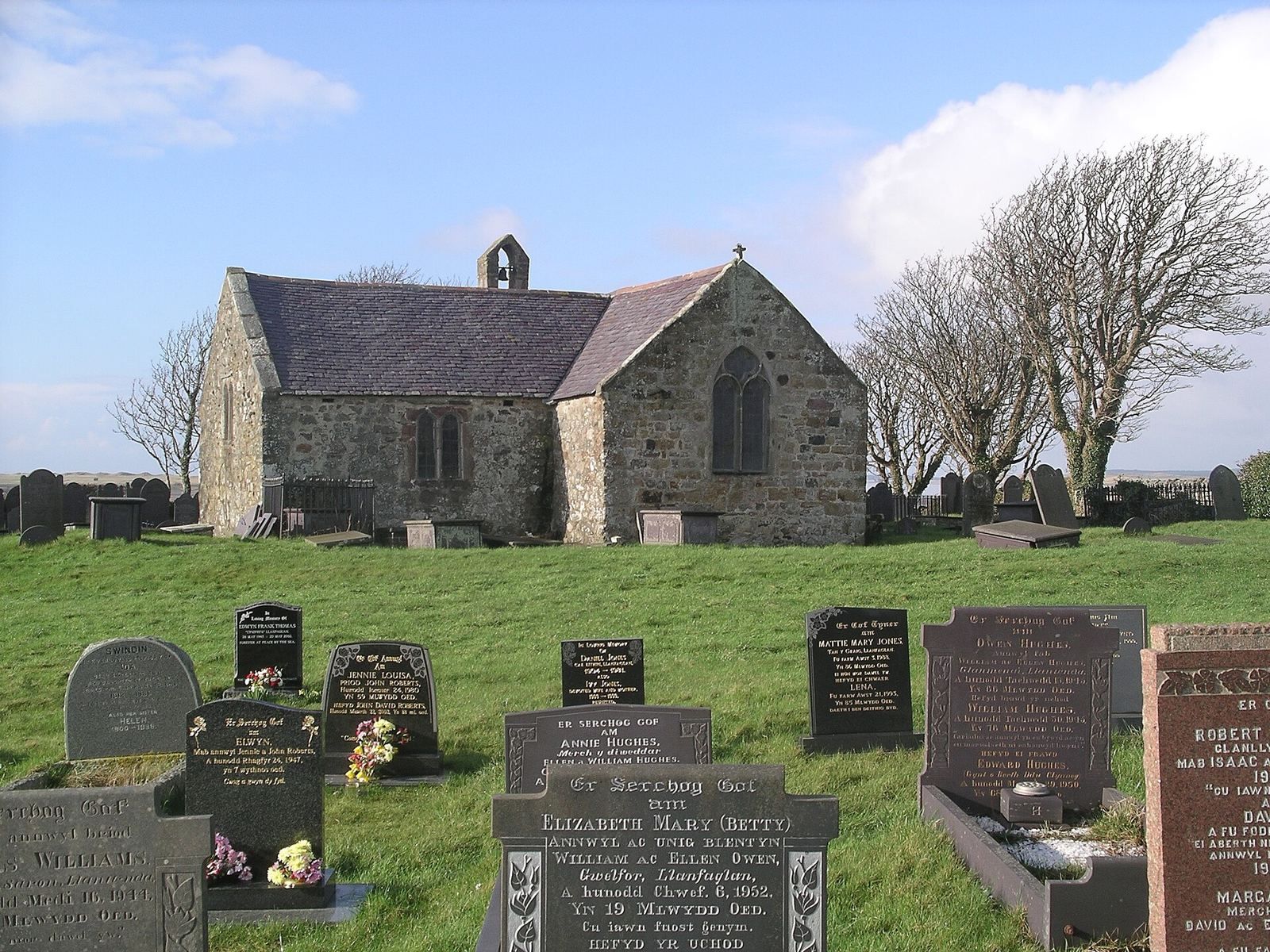
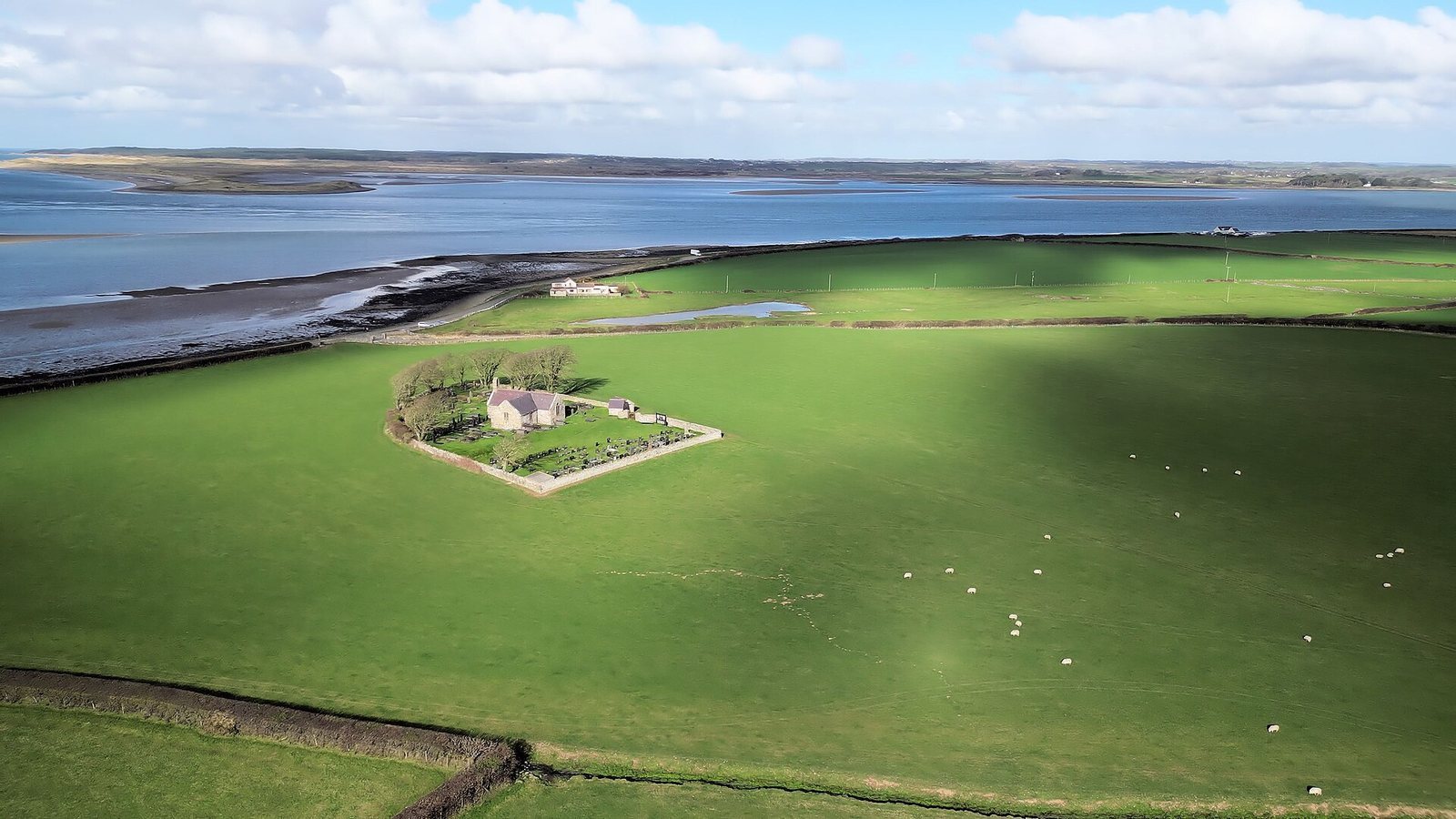
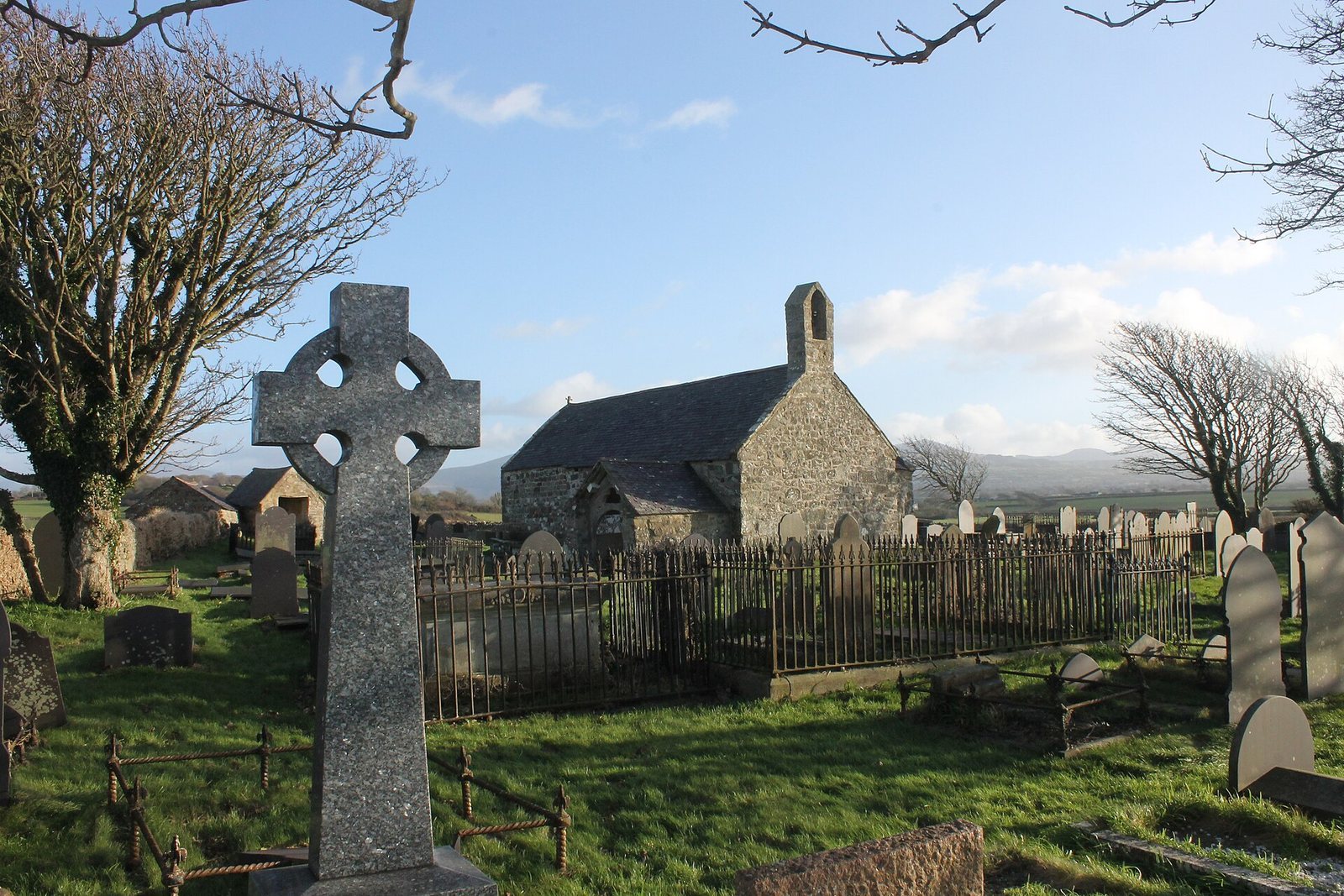
The church stands on a hill in an isolated field, about 150 metres from a minor road. Its stone walls and slate roofs form a plan with a nave and chancel beneath one continuous roof, a south transept, a crosswise section used as a chapel, and a north porch. The building overlooks Y Foryd beach and Caernarfon Bay, with views toward Snowdonia, including Snowdon, the Nantlle ridge, Yr Eifl and Ynys Llanddwyn.
Church exterior
Walls, roof and openings
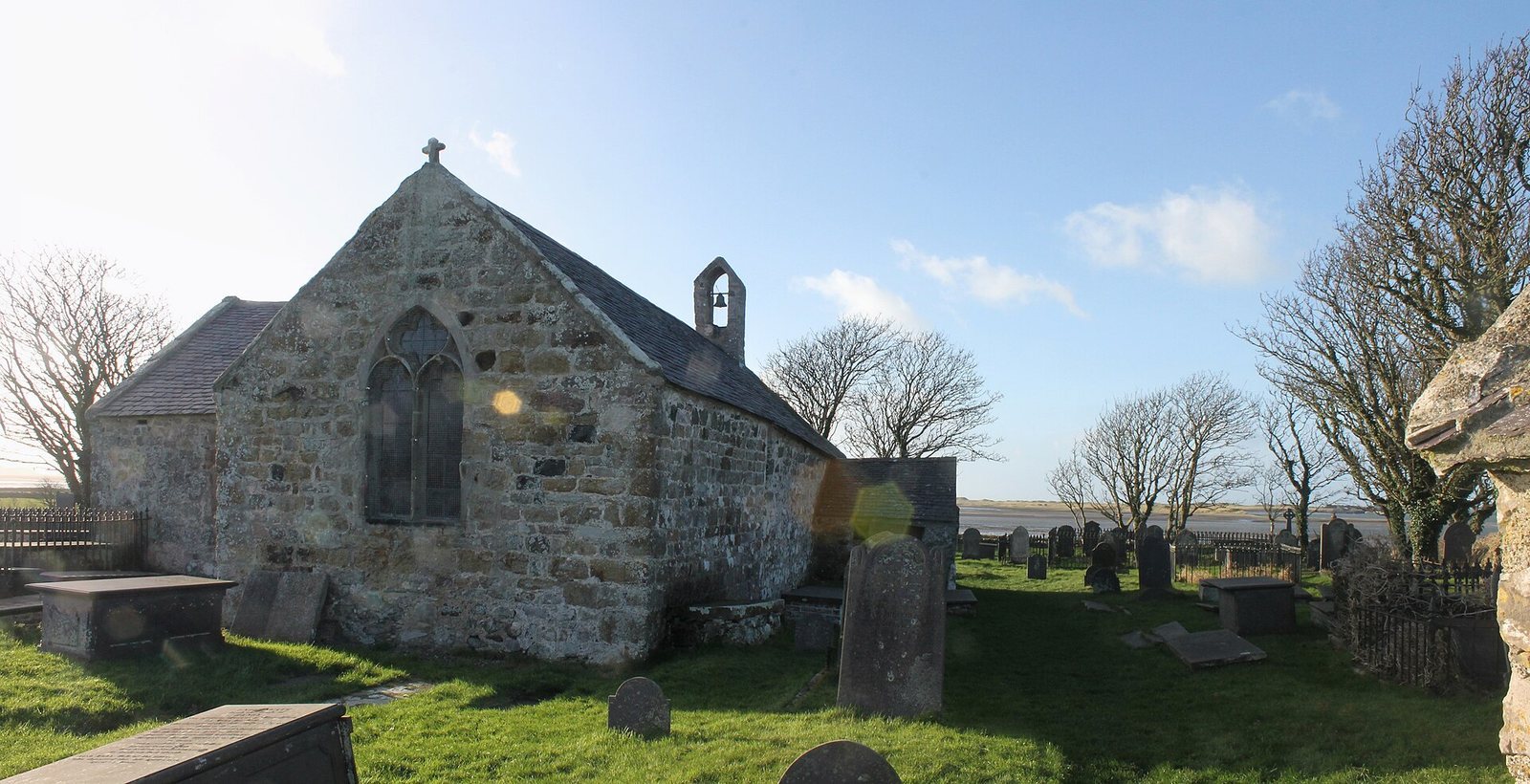
A bellcote, a small structure for hanging a bell, rises above the west gable, while a weathered cross stands on the chancel gable. The chancel has a two-light east window, divided into two main sections, dating from the fourteenth century. It was moved when the chancel was rebuilt. Small two-light windows also appear on the south and east walls of the transept. Curved windbraces, braces supporting the roof frame, in the southern part indicate its early-sixteenth-century construction.
Dressed stones in the north wall came from Caernarfon Castle, and a joint in the masonry marks where they were used. The porch incorporates older roof timbers from the former chancel. At the opening to the left on entering, two gravestones bearing Celtic crosses have been reused: one forms a shelf and lintel, the horizontal support over an opening, and has a boat carved on it; the other bears a Celtic cross. The early-nineteenth-century wooden door has a distinctive pattern, and graffiti on it is partly obscured by thick paint.
The inscribed doorway stone
Above the doorway, a local basalt gravestone serves as a lintel. The volcanic-rock stone dates to the late fifth or early sixth century. In its present position the inscription reads Fili Lovernii Anatemori; when read upright, it becomes Anatemori Fili Lovernii, interpreted as “Anatemori, son of Lovernius,” or “Anatemarios, son of Lovernius.” The stone is among the few inscribed stones to carry Brittonic personal names. Brittonic is the Celtic language group that includes Welsh, Cornish and Breton, making the inscription valuable to the history of Welsh. Anatemori has been explained as “great-souled,” while Lovernius is linked with forms meaning “fox” in Cornish and Breton.
Interior and furnishings
Interior arrangement
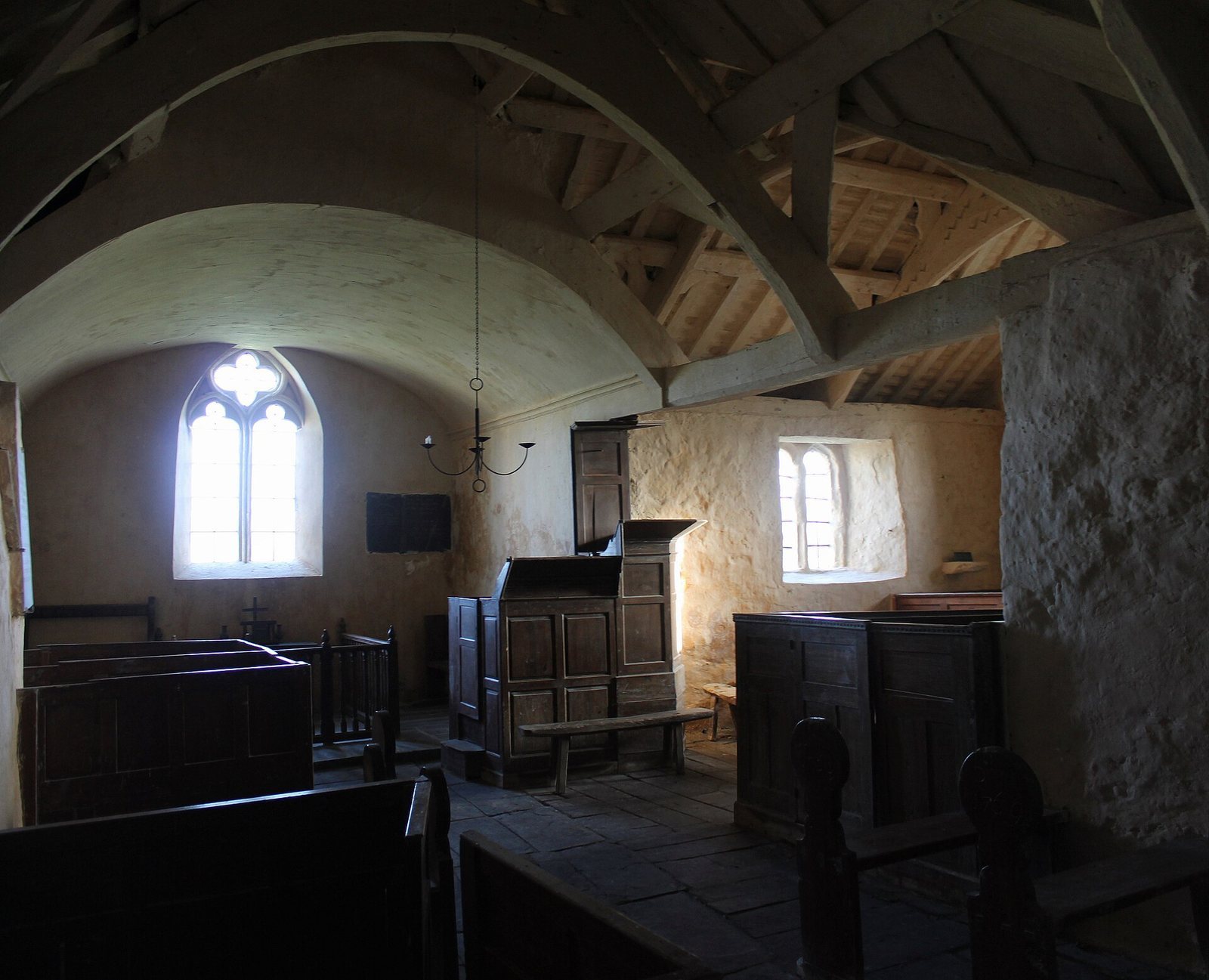
The interior walls and roof timbers are plastered and whitewashed, and slate slabs pave the floor. There is no partition between the nave and chancel, and the south transept opens fully onto the main body of the church. The oak altar is enclosed on three sides by communion rails. Their slender balusters, or short supporting posts, carry decorative finials at the corner posts.
Pulpit and seating
An oak pulpit and reading desk stand in the southwest corner of the chancel beneath a sounding board, a canopy intended to direct a speaker’s voice. The pulpit, dated 1767, came from St Gwyndaf’s Church at Dinas Llanwnda after that church was rebuilt in the nineteenth century. It is not shown on a plan of Llanfaglan’s church from 1788. Its two levels served Bible reading and preaching.
Box pews, enclosed high-sided seating compartments, and benches occupy the nave, chancel and transept. Some are marked with family names, initials or dates. Several bear the initials I/D M and the date 1767, linking them to David and Margaret Jones’s family. The family used a richly made pew of local oak, while servants sat on simple backless benches. One son scratched “R I 1784” into a pew when he was about ten.
A pew marked Fron was associated first with the Cefn Coed family and later with the home of Ieuan Gwyllt, the pen name of hymn writer and musician John Roberts. At the far end of the south transept, the pew marked H/W A 1808 belonged to the Humphreys family of Plas Llanfaglan. It is the church’s youngest pew and the only one that differs from the 1788 plan: two sides appear to have been added, and the doorway once crossed a corner. It has a wooden floor. An older bench to the right of the altar has “Glanrafon” on its back, which has been turned around, probably after the bench was reused by another family. Some benches carry the initials I.G. and the date 1737, possibly referring to John Gryffudd, who may have rung the bell.
Font, bell and memorials
The font, used for baptism, has a seven-sided bowl of gritstone, a coarse-grained sandstone, on a seven-sided shaft. It dates from the thirteenth or fourteenth century, and its seven sides represent the seven sacraments, sacred rites recognized in some Christian traditions. Its eight-sided lid was made in 1935 by Mr Lort of Bontnewydd in memory of his wife. It came from a newer church after that church closed in the 1980s, and a brass plaque marks the gift; the font formerly had a round lid. A bell dated 1790 was refitted in 2003.
Slate memorial tablets are fixed to the walls. A large white-marble memorial honours David and Margaret Jones of Cefn Coed, and another stone gives a date in both Julian and Gregorian calendar forms, 1738/9. Three objects formerly kept in the church, an early-nineteenth-century brass candelabrum, a chalice dated 1723 and a silver salver dated 1752, are now in the care of Bangor Cathedral.
Churchyard and surrounding ground
Enclosure, boundary and entrance
The churchyard occupies part of the ancient enclosure. A drop in the ground at its eastern end marks the former boundary. Its entrance is through a lychgate, a roofed churchyard gateway, dated 1722. A stone records that year’s wardens; a seat is built inside, and carved graffiti appears on the door. A stone by the main cemetery gate commemorates the 1930 gift of a quarter-acre extension by Frederick George Wynne of Glynllifon.
Graves and epitaphs
A substantial white stone for Susannah Jones lies north of the porch, to its right, within iron railings. Its inscription names her two husbands. The Cae Glas family grave, associated with the ancestors of photographer Philip Jones Griffiths, lies south of the church. David Pritchard’s large slate grave is west of it, and Megan Bonner Pritchard, described as the first woman to be mayor of Caernarfon, is buried in the churchyard. Snowdon’s burial is in a family plot. Below the east window, an unnamed gravestone bears a skull and crossbones and is locally said to mark a pirate’s grave. The image serves as a reminder of death. Welsh verse epitaphs include a poem by Emrys Edwards in the newer part of the churchyard.
Baglan’s well
The adjacent field contains the site of Baglan’s well, once a structure with seats. The well was said to have healing powers and was filled in during the nineteenth century.