Spalding War Memorial: A First World War Memorial
Site at a Glance
- Popularity
- Medium
- Country
- United Kingdom
- Primary era
- Modern
- Eras represented
- Early Modern, Modern
- Civilizations
- British
- Site type
- Civic
- Remains
- Monument
On this page10 sections
History
Spalding War Memorial is a First World War memorial in the United Kingdom, commemorating servicemen from its namesake town. Designed by British architect Edwin Lutyens in pavilion form, it was unveiled on 9 June 1922.
Proposal and public choice
The project began in January 1918, when Barbara McLaren proposed a memorial to Spalding’s war dead. Her husband, Francis McLaren, had represented the Spalding division in Parliament and served as an officer in the Royal Flying Corps, the British Army’s flying service during the First World War. He died in a flying accident near RAF Montrose in 1917, aged 31. Lutyens had designed the couple’s London home in 1911 and later Francis’s headstone. Barbara, a niece of garden designer Gertrude Jekyll, hoped families might add epitaphs, but this proved impractical because of the space required. She also insisted that Francis should receive no special memorial apart from the one shared with other casualties.
Lutyens’s first proposal placed a Stone of Remembrance inside a U-shaped shelter, in front of a circular pool with a cross at its centre. Once made public after the war, the plan prompted debate over other ways to commemorate the dead. Suggestions included a youth centre at Ayscoughfee Hall, a clock on the corn exchange, an obelisk or cenotaph in the market place, and support for war widows. Ayscoughfee Hall had been bought by Spalding Urban District Council in 1897 to mark Queen Victoria’s Diamond Jubilee.
At a public meeting on 1 August 1919, about 300 people considered the leading proposals. A ballot on 23 August gave 459 votes to a reduced version of Barbara’s design, paired with a clock for the corn exchange. The original design received 286 votes; an obelisk and clock was the only other proposal to attract more than 200. The chosen memorial was placed in the Hall’s formal gardens, where it replaced the nineteenth-century garden folly called the Owl Tower.
Construction and dedication
The Spalding War and Victory Memorials Committee was established in September 1919 to manage the work. The £3,500 cost was met through donations and public subscription. Barbara McLaren and her father-in-law, Charles McLaren, 1st Baron Aberconway, each gave £1,000. Sir Herbert and Dame Agnes Jekyll contributed £100, Barbara’s brother-in-law Henry McLaren donated the painted stone flags, and public subscriptions covered the balance by 1922.
Hodson Limited of Nottingham built the memorial. General Sir Ian Hamilton presided at its dedication on 9 June 1922, and the Reverend Alfred Jarvis, Assistant Chaplain-General to Northern Command, led the service. Jarvis spoke of the war dead among the Western Front’s poppies as a sign of oblivion. Hamilton urged an end to hatred as a necessary step towards ending war and securing peace. A bugler played the “Last Post,” the crowd sang the national anthem, and Barbara McLaren, her sons and other dignitaries laid flowers around the Stone of Remembrance.
The design marked a departure from Lutyens’s other war memorials. Its initial form appeared in a 1919 Royal Academy exhibition of war memorials, and its pavilion arrangement later influenced shelter buildings he designed for cemeteries on the Western Front.
Later changes and recognition
The selected commemorative scheme also included a clock and a carillon, a musical instrument made up of tuned bells, at the corn exchange, a building used for trading grain. Installed in 1922, the carillon had 23 bells. Three carried the names of casualties chosen to represent Spalding’s dead, while others named people involved in the commemorations. After the corn exchange was demolished in 1972, the clock and bells were moved to a tower on the roof of the South Holland Centre. Following refurbishment in 1998, they were installed in a new glass tower after the bells had been cleaned. On Armistice Day that year, the Western Front Association unveiled a plaque at the centre explaining the tower’s commemorative importance.
Before Remembrance Sunday in 2014, research by a member of the local Royal British Legion branch led to 24 additional First World War casualties being added to the memorial’s central panel. The research identified 50 names for consideration. The memorial was listed at Grade II in 1975 and upgraded to Grade I in 2015, when Lutyens’s free-standing war memorials in England were recognised as a national collection and their listing status reviewed. In England, Grade I denotes exceptional interest. Ayscoughfee Hall is also Grade I, while its gardens are listed at Grade II on the Register of Historic Parks and Gardens of special historic interest in England.
Remains
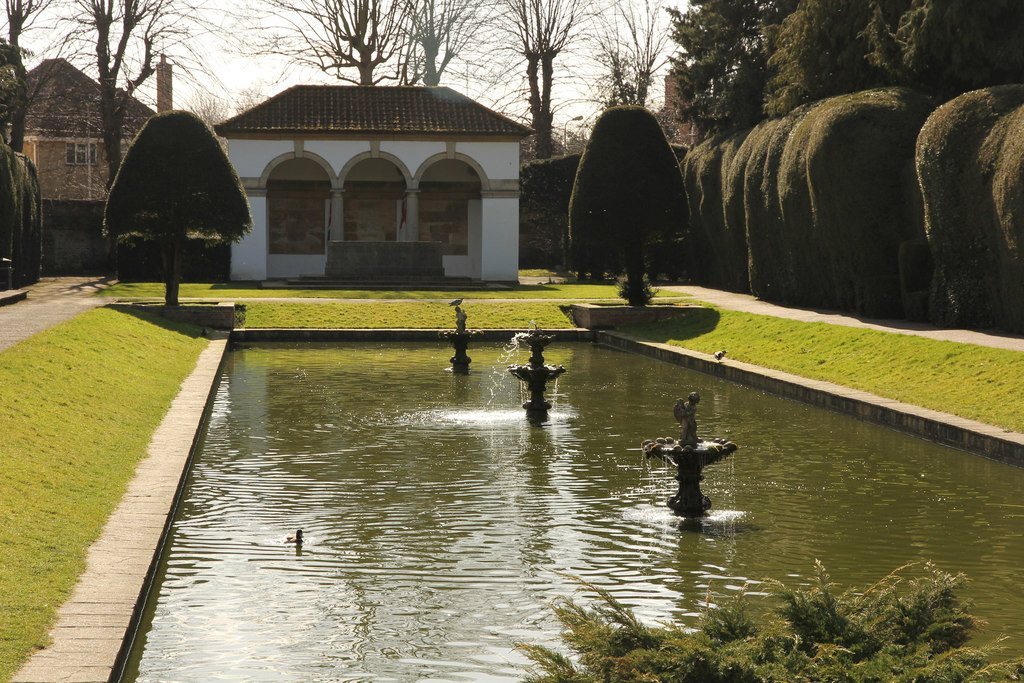
At the south end of Ayscoughfee Hall’s formal gardens, the memorial’s brick pavilion and Stone of Remembrance stand at the head of a long reflecting pool. The composition combines an open-sided shelter, inscribed memorial stones and a formal garden water feature.
Pavilion and memorial stones
The pavilion
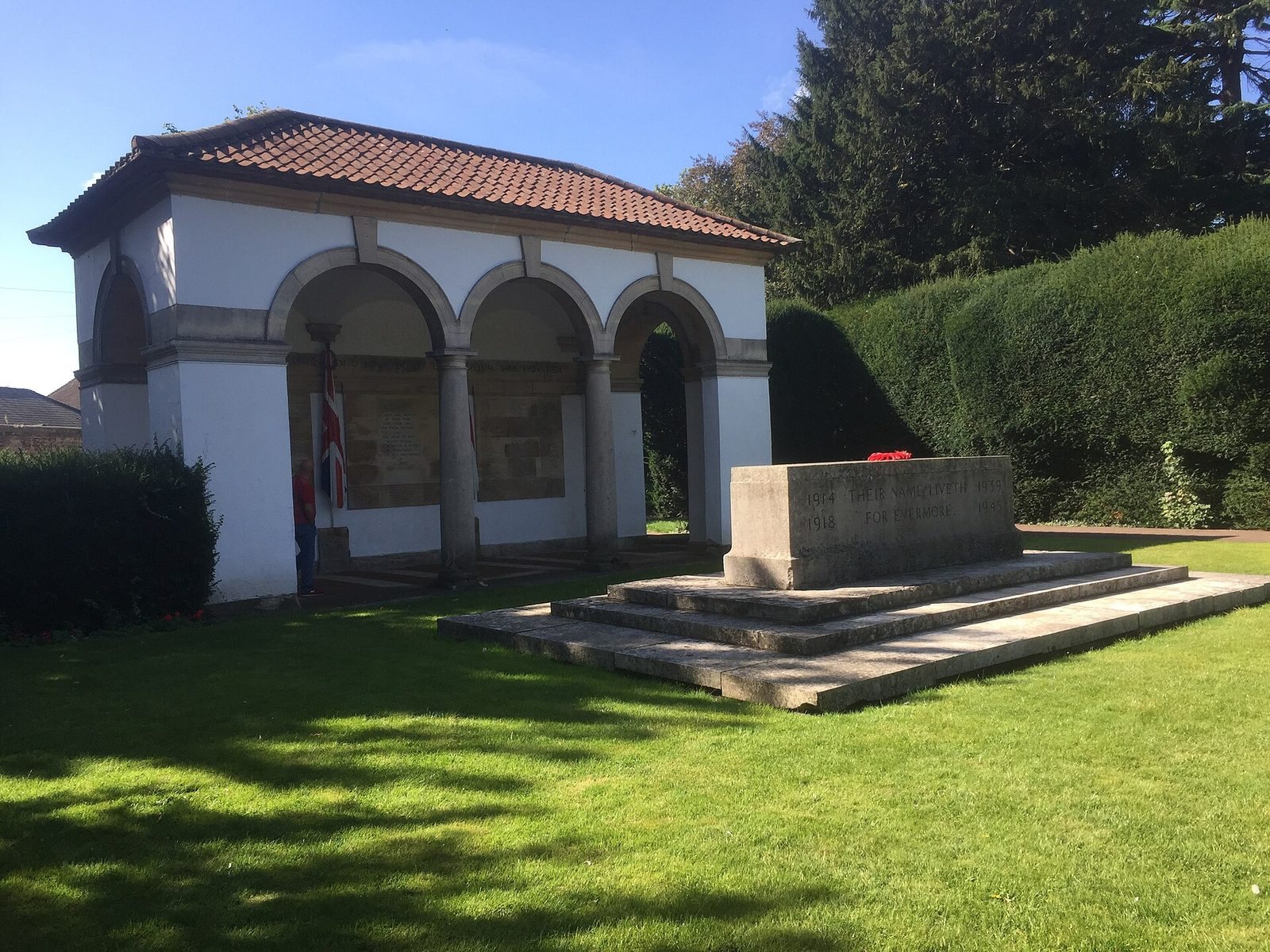
The brick pavilion has a hipped roof covered with red pantiles and a floor of red bricks set in a herringbone pattern. Three stone arches face the pool, with one more in each side wall. Their Tuscan form uses a plain classical architectural order. The solid rear wall carries two painted stone flags, the Union Flag on the left and the White Ensign, traditionally flown by Royal Navy ships, on the right. Three inscribed panels name more than 200 Spalding servicemen who died in the First World War. The central panel dedicates the memorial to those who died for their country during the war years 1914-1919 and states that the town’s men and women raised it in their home. An interior frieze asks God to grant the dead rest and everlasting light.
Stone of Remembrance
In front of the pavilion, Lutyens’s Stone of Remembrance, a type of memorial stone he designed for war cemeteries, rests on a platform of three steps. Its inscription expresses the lasting memory of the dead, and the stone also bears the dates of both world wars. The Second World War dates were added later; the stone does not name casualties from that conflict. Carved from one piece of stone, it measures 12 feet (3.7 metres) long and has a very slight convex curve, known as entasis. Its inscription is its only decoration.
Francis McLaren memorial
A separate stone commemorates Francis Walter Stafford McLaren, Member of Parliament for the Spalding division from 1910 to 1917. Its inscription records that he died in the service of his country at the age of 31.
Reflecting pool and garden
The reflecting pool incorporates the remains of an eighteenth-century garden canal, first recorded in 1732. Lutyens reshaped the former canal as a pool in the manner of an Italian formal garden, and three low fountains were added later. Yew hedges enclose the pavilion and pool. On the eastern side, iron gates set at regular intervals interrupt the hedges and lead to a peace garden added in 1994. The view of the pavilion at the pool’s head has been compared with Bodnant Garden, the Welsh home of Lord Aberconway and the childhood home of Francis McLaren. The pavilion’s covered porch uses a form also found in Lutyens’s cemetery work; a shelter at Anneux British Cemetery has been described as notably similar.