Sophienholm: A Manor House and Exhibition Venue in Denmark


Site at a Glance
- Rating
- 4.3
- Popularity
- Medium
- Country
- Denmark
- Primary era
- Modern
- External website
- Open
- Eras represented
- Early Modern, Modern
- Civilizations
- Danish
- Site type
- Domestic
- Remains
- Manor House
On this page11 sections
History
Sophienholm is a former manor house and exhibition venue in Denmark, located north of Lake Bagsværd in Lyngby-Taarbæk Municipality on the northern outskirts of Copenhagen. The estate was established in the late 1760s as a neoclassical country retreat for the physician, naturalist, and court-connected administrator Johan Theodor Holmskiold. Its construction is dated variously to 1767–1768 and 1769.
Holmskiold’s country retreat
Holmskiold named the estate after his fiancée, Sophia Magdalena de Schrødersee. They married in 1770 and owned Sophienholm until 1790. By then, Holmskiold had built a larger country residence nearby, following a successful career at the Royal Court in Copenhagen and service as director of several prominent state enterprises.
The original country house was built in the classicist, or neoclassical, style, an architectural movement inspired by the forms and proportions associated with ancient Greece and Rome. Its garden was later transformed into an English landscape garden, changing the character of the estate’s surroundings.
The Brun era and cultural life
In 1790, the merchant Constantin Brun became Sophienholm’s owner. Originally from Germany, he had come to Denmark as royal administrator of trade in the Danish West Indies. He accumulated his fortune through commerce during the early Napoleonic Wars, when Denmark’s neutrality benefited his business. He had married Friederike Brun, née Münther, in 1783.
Around 1800, Constantin Brun commissioned the French architect and landscape designer Joseph-Jacques Ramée to redesign and enlarge the estate. Completed in 1805, the project gave the main building its present appearance, reshaped the park, and introduced several smaller structures. Two lateral wings were added to the main building after the reconstruction.
During the Brun era, Sophienholm became a lively cultural venue during the Danish Golden Age, the period when Denmark achieved major accomplishments in literature, art, music, and intellectual life, especially in the first half of the nineteenth century. Friederike Brun, a writer and salon hostess, held literary salons at the estate. The gatherings were partly inspired by her friendship with Madame de Staël, whose salons at Château de Coppet had brought together influential literary and political figures.
The salons attracted celebrated poets, students, composers, foreign diplomats, artists, and members of the royal family. Frequent guests included Jens Baggesen, Adam Oehlenschläger, Schack von Staffeldt, the young Johan Ludvig Heiberg, Just Mathias Thiele, and Bernhard Severin Ingemann. Conversation, poetry readings, and musical performances formed part of the gatherings, while Friederike Brun also read letters from prominent friends abroad. Guests used the park for excursions and assembled for meals, tea, hot chocolate, and coffee.
Ida Brun, Constantin and Friederike’s eldest daughter, was an important figure in this cultural life. She sang and performed “attitudes,” staged presentations combining still poses, dance, and acting, which she had learned from Lady Hamilton in Naples. After Ida married Louis Philippe de Bombelles, the Austrian ambassador to Denmark, and left the country, the salons at Sophienholm declined.
Ownership and public use
The Brun era ended in 1836, when Constantin and Friederike Brun died within a few months of one another. Ida Brun inherited Sophienholm but sold it immediately. In 1882, Carl Aller, founder of the expanding publishing house Carl Allers Etablissement, purchased the estate. The Aller family retained it until Lyngby-Taarbæk Municipality acquired Sophienholm in 1963.
At the initiative of mayor Paul Fenneberg, the building was renovated and opened to the public as an exhibition venue. Sophienholm continues to function as an exhibition complex, hosting four or five exhibitions annually, while the park is used for concerts. The preserved estate remains in Lyngby-Taarbæk Municipality, Denmark.
Remains
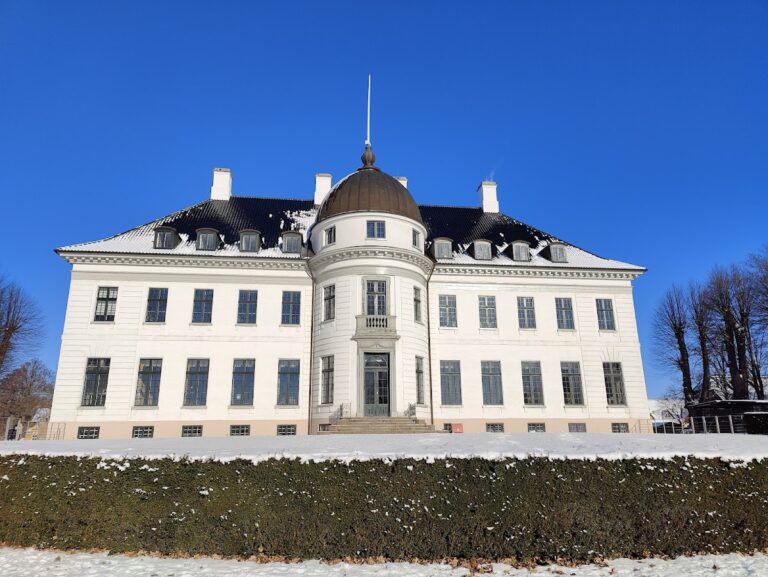
Sophienholm consists of a neoclassical main building, lateral wings, a landscaped park, and several smaller structures added or altered during Ramée’s redesign of 1800–1805. The park forms an integral part of the estate’s physical and cultural setting, linking the main house with the buildings and outdoor spaces associated with its history as a country retreat and salon venue.
Main building
The main building began as a classicist country house and was enlarged and altered during Ramée’s reconstruction. The work completed in 1805 established the building’s present appearance, while two lateral wings were added after the reconstruction. The building now functions as an exhibition venue within the preserved estate.
Picture Room
The Picture Room occupied the ground floor on the side facing the forest. Its position formed part of the main building’s arrangement during the estate’s later development.
Smaller structures
Norwegian House
The Norwegian House was one of the smaller structures introduced during the redesign of the estate. It served as a place where guests drank tea or hot chocolate during the salon gatherings held under the Bruns.
Other garden buildings
Ramée’s work also added a Chinese pavilion, a Swiss cottage, and a gatehouse. These structures belonged to the redesigned park and contributed to the arrangement of the estate beyond the main building.
Park
The garden was transformed into an English landscape garden, and Ramée redesigned the park as part of the early nineteenth-century enlargement. During the Brun period, it was used for walking and excursions connected with the estate’s cultural gatherings. In its present use, the preserved park provides the setting for concerts.
Nearby sites