Skjern Runestones: Viking Age Memorial Stones in Denmark
Site at a Glance
- Popularity
- Medium
- Country
- Denmark
- Primary era
- Medieval
- Eras represented
- Medieval
- Civilizations
- Danish
- Site type
- Civic
- Remains
- Monument
On this page7 sections
History
Memorials in the Viking Age
The Skjern Runestones are two Viking Age memorial stones at Skjern, Denmark, dated to approximately 970–1020. Skjern 2 was raised by Sasgerðr, daughter of Finnulfr, in memory of Óðinkárr, son of Ásbjǫrn. The inscription praises Óðinkárr as valued and loyal to his lord. That lord may have been a king or another person of high rank; Odin is a possible but less likely identification.
Sasgerðr is otherwise unknown, and her name may be a variant of the more common Ásgerðr, perhaps shaped by children’s speech. Óðinkárr’s name combines references to Odin, a principal god in Norse pagan religion, and a curl of hair. It may originally have referred to cultic initiates who wore their hair long.
The inscription ends with a curse on anyone who breaks the stone, calling the offender a practitioner of seiðr, a form of Norse pre-Christian sorcery. In Viking society, men’s practice of seiðr could be condemned as unmanly and at odds with ideals of direct male conduct.
Skjern 1 is dated to the same period and is probably contemporary with Skjern 2. Its surviving text includes parts of the names Ásbjǫrn and Harald. Harald may refer to Harold Bluetooth, king of Denmark from about 958 to 985 or 986, but that identification is uncertain.
Reuse and rediscovery
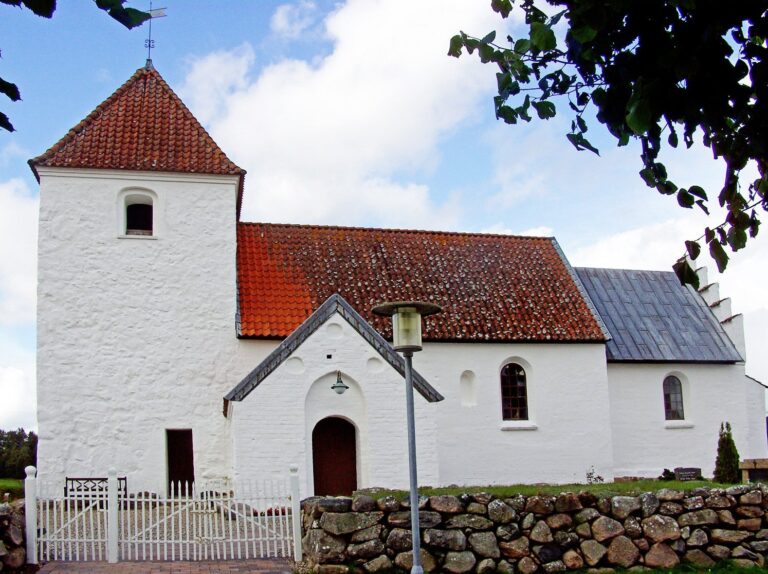
Skjern 1 was found in the 1830s in the foundation of a church at Skjern, where it had been reused as a building stone. Skjern 2 came to light in 1843 in the foundation of a staircase among the ruins of Skjern Castle. The fourteenth-century castle stood in Skjern Enge in the Nørreå valley and was razed in 1626 during the Thirty Years’ War, a major European conflict fought from 1618 to 1648.
Remains
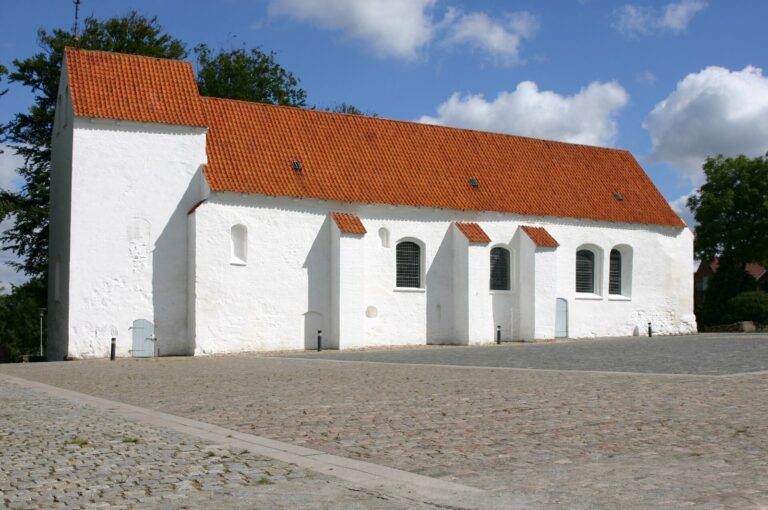
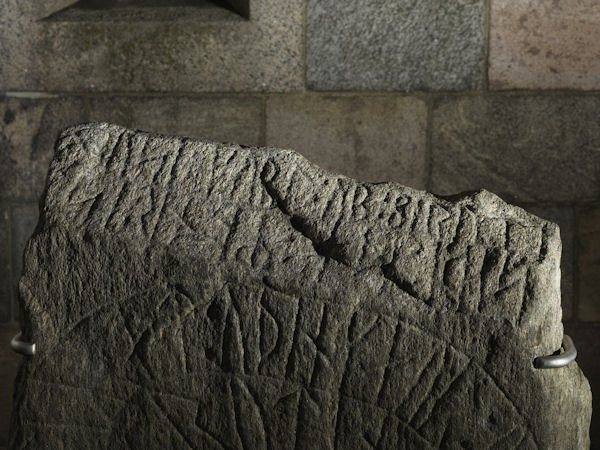
Both stones are granite and now stand together in the churchyard of Skjern Church, beside its south wall near the porch. Steel-pipe frames secure them against falling.
The inscribed stones
Skjern 1
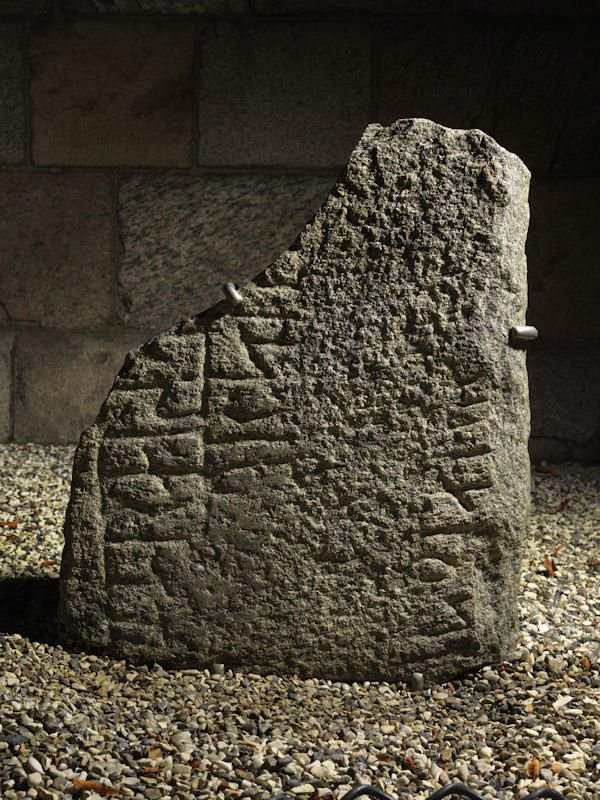
Skjern 1 survives as a fragment measuring 96 cm high, 77 cm wide, and 14 cm deep.
Skjern 2
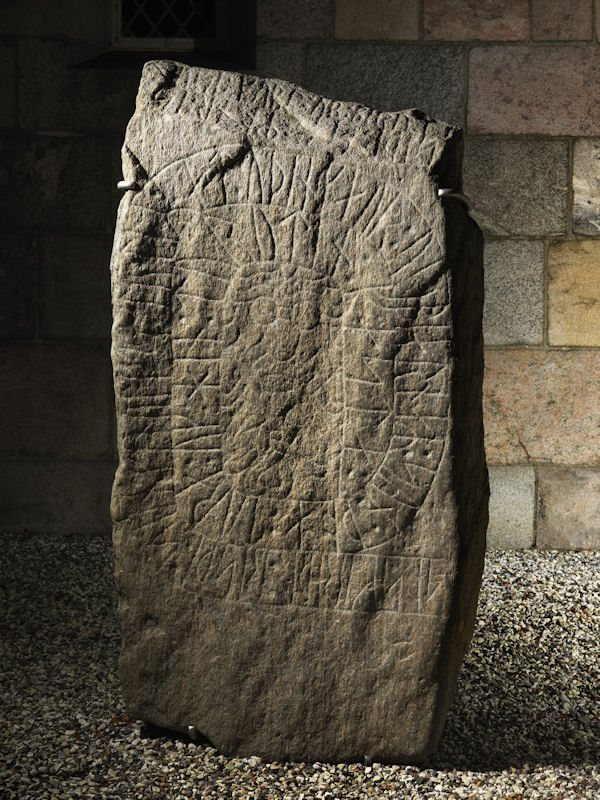
Skjern 2 remains whole, measuring 177–193 cm high, 93 cm wide, and 27–47 cm deep. Its inscription covers two sides and uses the Younger Futhark, the runic alphabet used in Viking Age Scandinavia. The runic text encircles a carved facial mask, with the section known as line B placed at the top of the stone.
The inscription’s ornament is classified as RAK style, the earliest category in a system for classifying runestone decoration. Its runic bands end plainly, without attached serpent or animal heads. The facial mask is carved in Mammen style, a Viking Age Scandinavian art style characterized by intertwined animal and plant ornament. Facial-mask motifs also appear on other Scandinavian runestones.