Tanum Church, Bærum: A Medieval Parish Church in Norway
Site at a Glance
- Popularity
- Medium
- Country
- Norway
- Primary era
- Medieval
- Eras represented
- Medieval, Early Modern
- Civilizations
- Denmark–Norway, Norwegian
- Site type
- Religious
- Remains
- Church
On this page14 sections
History
Tanum Church is a Romanesque medieval parish church in Bærum, Norway, dating to about 1100–1130. It is one of Bærum’s two medieval churches and was dedicated to the Virgin Mary; it was formerly known as St. Mary’s Church. The church belongs to the Evangelical Lutheran Church of Norway and serves Tanum parish in the Diocese of Oslo and Bærum deanery. For many years it also served as a votive church, a church associated with the fulfillment of a vow.
Medieval foundation and use
The church’s Romanesque design belongs to a medieval European architectural style. Its dedication to Mary shaped its former name, St. Mary’s Church, while its use as a votive church continued for many years.
Expansion and family burials
In 1674, the Krefting family built a sacristy with a burial chamber beneath it on the north side of the chancel. When that chamber became too small, the family added a larger burial chapel in 1713, beside the sacristy and on the north side of the nave. Nearly 40 family members were buried in the two chambers. In the early 18th century, the nave was also extended eight metres westward.
Decline, restoration, and cultural heritage
After the municipality took over the church in 1850, a plan proposed using part of its walls for a new church with a cross-shaped plan. Bryn Church was built instead, and Tanum Church remained unused until the 1890s. Restoration work followed in 1901–02.
Norwegian painter Harriet Backer painted the church interior several times. Two of her works from 1892 are Christening in Tanum Church and Churching Women, which depicts two women receiving communion from a priest. The church and its surrounding burial ground are regarded as important cultural heritage by Norway’s Directorate for Cultural Heritage and are protected by law.
Remains
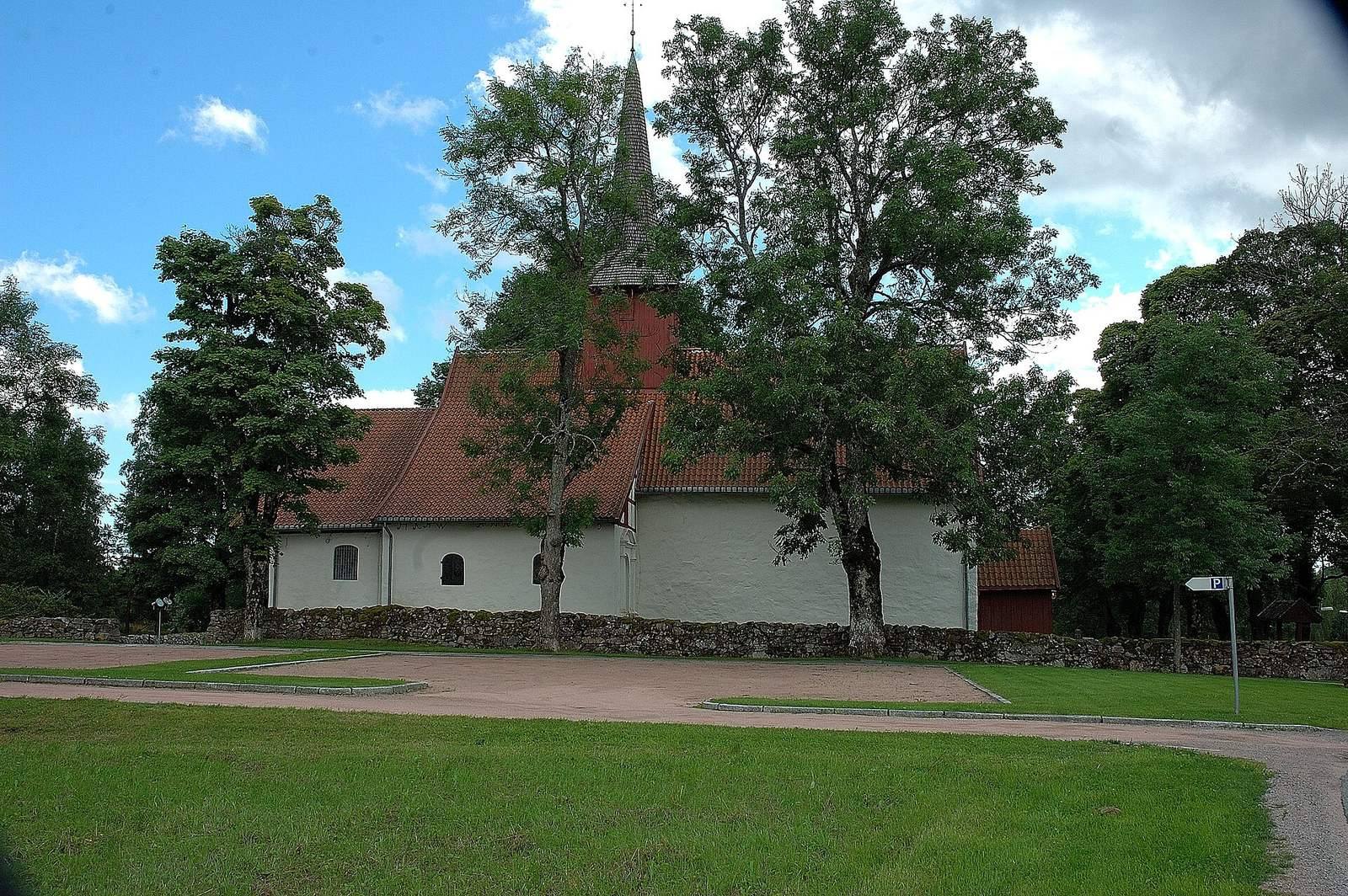
The church is a rectangular stone building with one main nave, a gallery, and a chancel with a straight end. Its walls have inner and outer stone faces with stone filling between them. The building is Romanesque; its style is also sometimes described as Anglo-Saxon, a reference to early medieval English architecture. It has seating for 250 people.
Roof and entrances
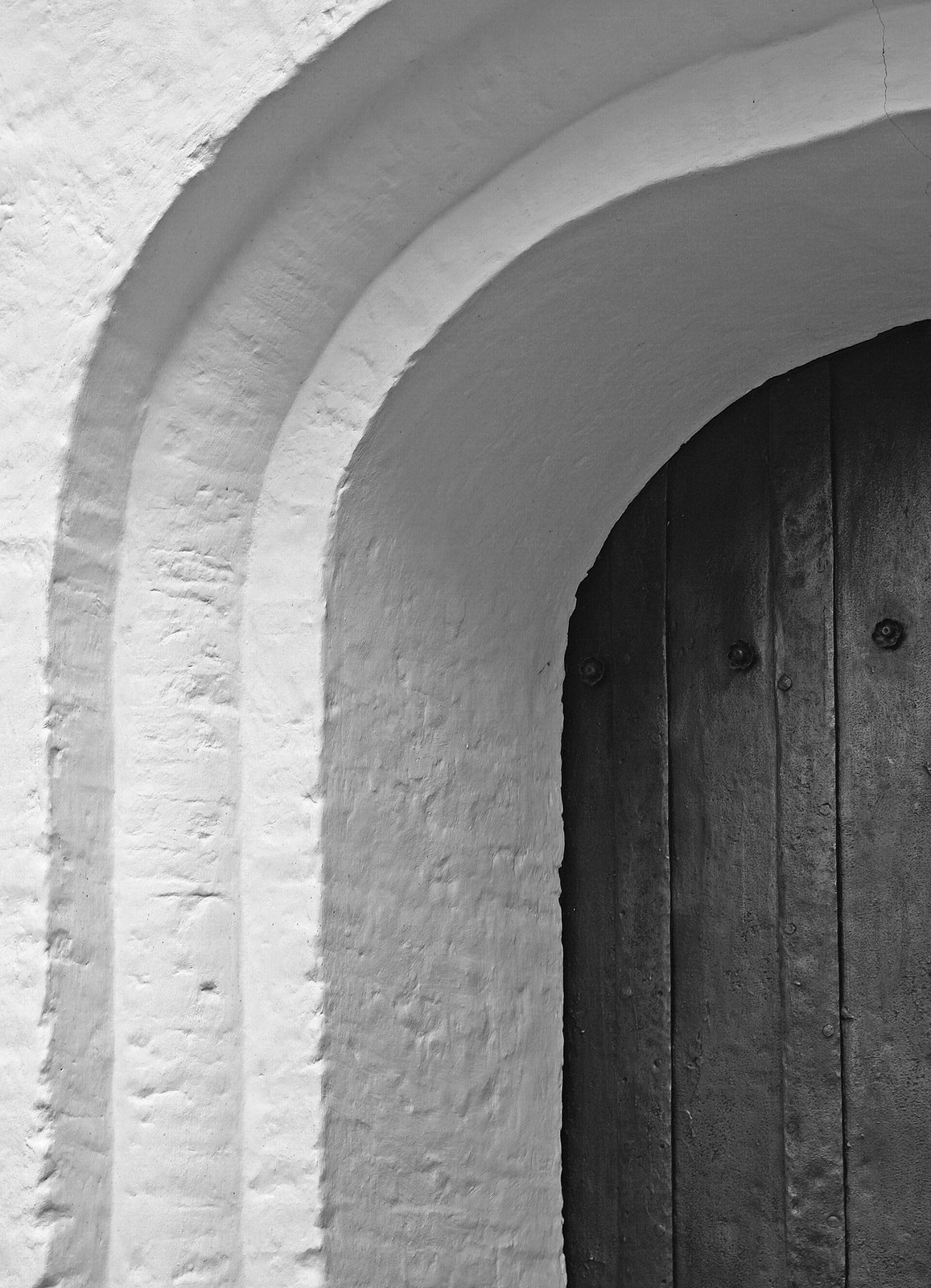
A square turret stands at the centre of the nave roof and supports an octagonal spire dating to 1625, attributed to Christoffer Thornebøger. Two simple, round-arched medieval doorways pierce the south wall, one opening into the nave and the other into the chancel.
Burial spaces and landscape
Family burial chambers
The sacristy stands on the north side of the chancel, above a burial chamber. A larger burial chapel adjoins it on the north side of the nave.
Burial ground and roads
The burial ground around the church has been used for burials since pre-Christian times. It covers about 0.6 hectares and contains approximately 3,000 graves; its oldest preserved grave monuments date to the late 17th century. Several large burial mounds from the Early Iron Age, the earlier phase of the Iron Age in Scandinavian archaeology, lie nearby.
A medieval road beside the church linked Oslo through Bærum toward Asker and onward to Lier by way of Krokskogen; its original route led to Ringerike. Part of Tanum Church Road remains in use between local farms, and the road and farmyards are protected.
Furnishings and artworks
Altarpiece
The Renaissance altarpiece, a work placed behind or above the altar, dates to 1663 and is attributed to Frederich Zebal. Its central image shows Christ on the cross, with the Virgin Mary and Saint John the Apostle beside him.
Pulpit, font, and organ
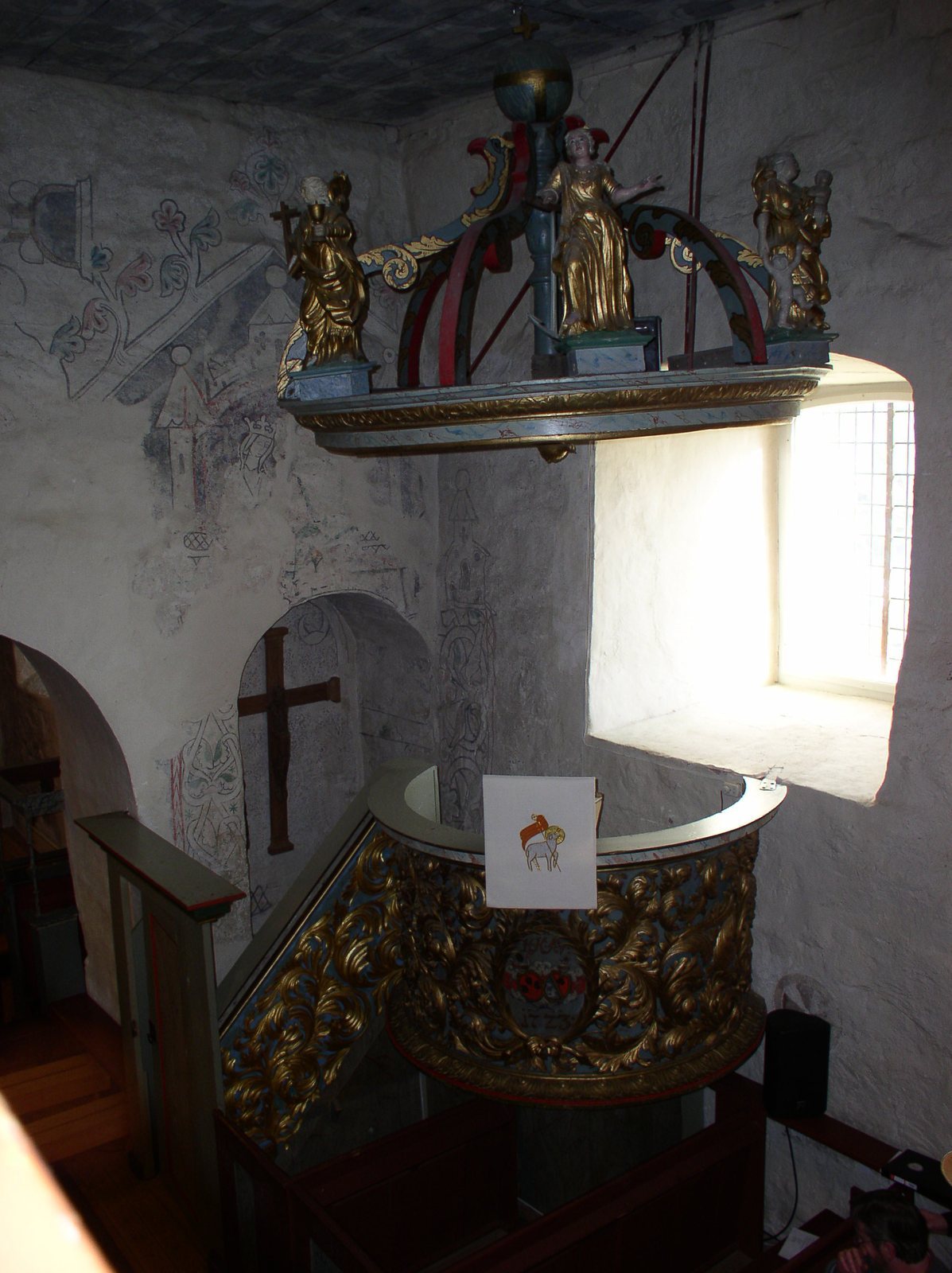
The round pulpit has a sounding board, a canopy intended to direct the speaker’s voice. The pulpit and baptismal font both have canopies and date to 1723; they are attributed to the Norwegian woodcarver Svend Erichsøn Svanneberg. A small organ has eight stops.
Medieval sculptures
The church preserves a crucifix from the 12th century and a figure of the Madonna from the 13th century.
Wall paintings
Wall paintings dating from the 12th to 14th centuries were uncovered in 1971–72. Their subjects include Christ on the cross with Mary and John, the Annunciation, and the Coronation of Mary. Seven consecration crosses, marks associated with a church’s dedication, are also painted on the walls.