Sint-Walburgakerk: Oudenaarde’s Collegiate Church
Site at a Glance
- Rating
- 4.2
- Popularity
- Very Low
- Country
- Belgium
- Primary era
- Medieval
- External website
- Open
- Eras represented
- Medieval, Early Modern
- Civilizations
- County of Flanders
- Site type
- Religious
- Remains
- Church
On this page13 sections
History
Sint-Walburgakerk is a collegiate church in Oudenaarde, Belgium, dedicated to Saint Walburga, an eighth-century Anglo-Saxon missionary associated with the Christianization of the Germanic lands. It is the city’s principal church and belongs to the Roman Catholic tradition in the Diocese of Ghent. Its history combines an early Gothic predecessor, a largely unfinished fifteenth- and sixteenth-century rebuilding campaign, later Baroque furnishing, and repeated repairs after war and fire.
The early church and its medieval renewal
Construction of the early Gothic predecessor began in the first half of the twelfth century. A fire in 1126 led to rebuilding around 1150, while the surviving choir belongs to the thirteenth century. In 1404, the church’s triple apse was replaced by the present polygonal apse. An apse is the rounded or many-sided end of a church choir.
During the fifteenth century, Oudenaarde decided to replace the older church with a much larger building in Brabantine Gothic, a regional form of Late Gothic architecture developed in the Duchy of Brabant. The project reflected the city’s wish to present itself as a prosperous, medium-sized urban centre. Oudenaarde had 5,737 inhabitants in 1458, and the renewed church was intended to express its elevated status.
The unfinished rebuilding campaign
The tower body and its two flanking stair turrets were constructed approximately between 1422 and 1500. The older church was then partly demolished between 1501 and 1506, and work on the new western section began in 1506. The south aisle and its chapels were completed in 1509, the north aisle in 1510, and the vaulting in 1514.
After 1514, construction slowed greatly. By 1532, the attempt to complete the planned church had been abandoned, and the unfinished new section was joined to the choir of the older building. Only about one-third of the ambitious design was realized. Had the plan been completed, the church would have reached the middle of the Grote Markt.
Later changes and damage
The medieval interior was destroyed during the iconoclasm of 1566, a period of attacks on religious images and furnishings. The church was subsequently refurnished in Baroque and late Baroque styles. In 1620, Simon I de Pape designed and added a Baroque roof structure over the Gothic tower.
A lightning strike caused the tower’s spire to burn in 1804. It was never rebuilt, leaving the tower 88 metres high. During the Battle of the Scheldt on 1 November 1918, Sint-Walburgakerk suffered severe damage, especially to the tower and choir, and its windows had still not been restored to their former condition. The church was shelled again in 1940 during the Second World War. That damage was relatively limited, but repairs were not completed until 1949. A further restoration took place in 2019.
Remains
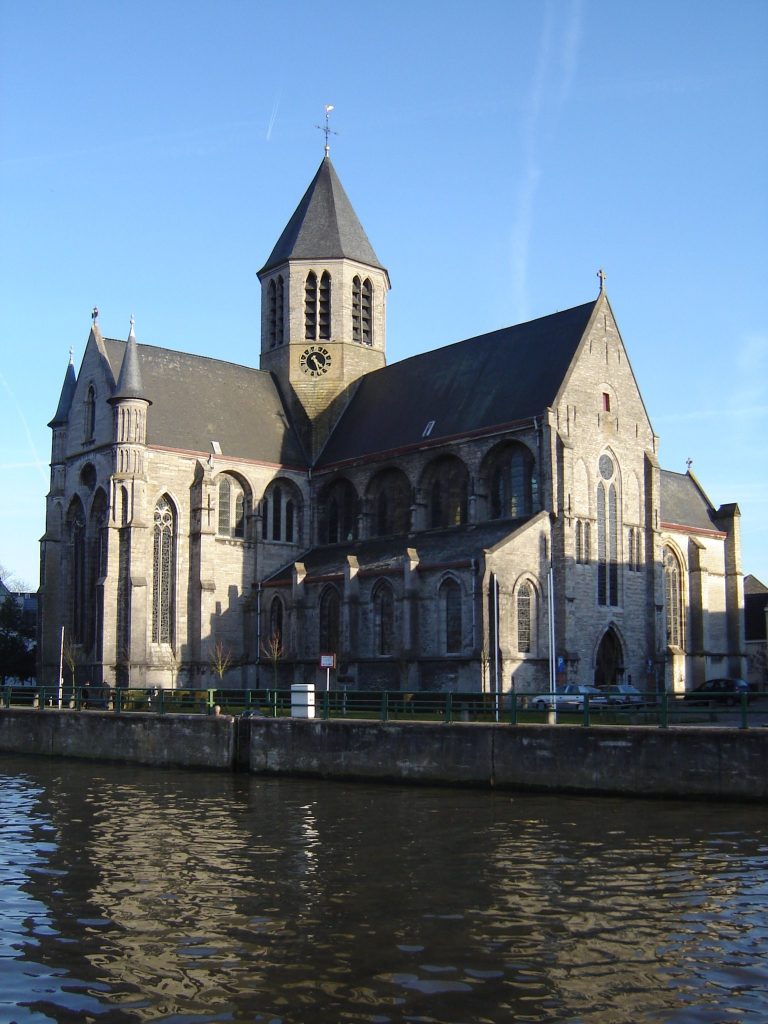
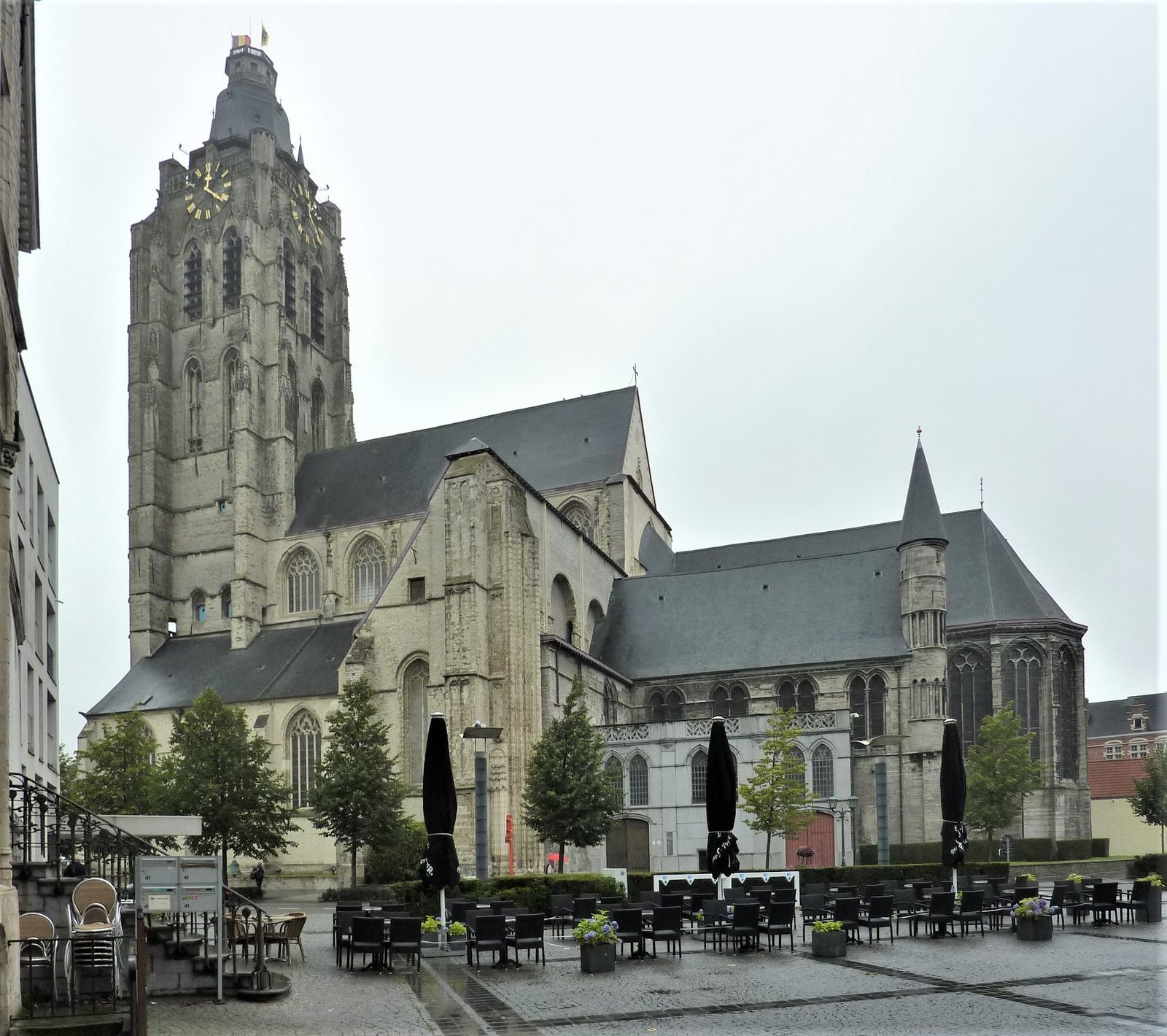
The surviving church consists of two historically distinct parts: the older choir and the later, unfinished western section in Brabantine Gothic style. Their junction remains clearly visible on the exterior. The older sections use Tournai limestone transported along the Scheldt, while the newer parts are built from Balegem stone, which has been heavily damaged by acid rain.
Choir, western church, and tower
The older choir
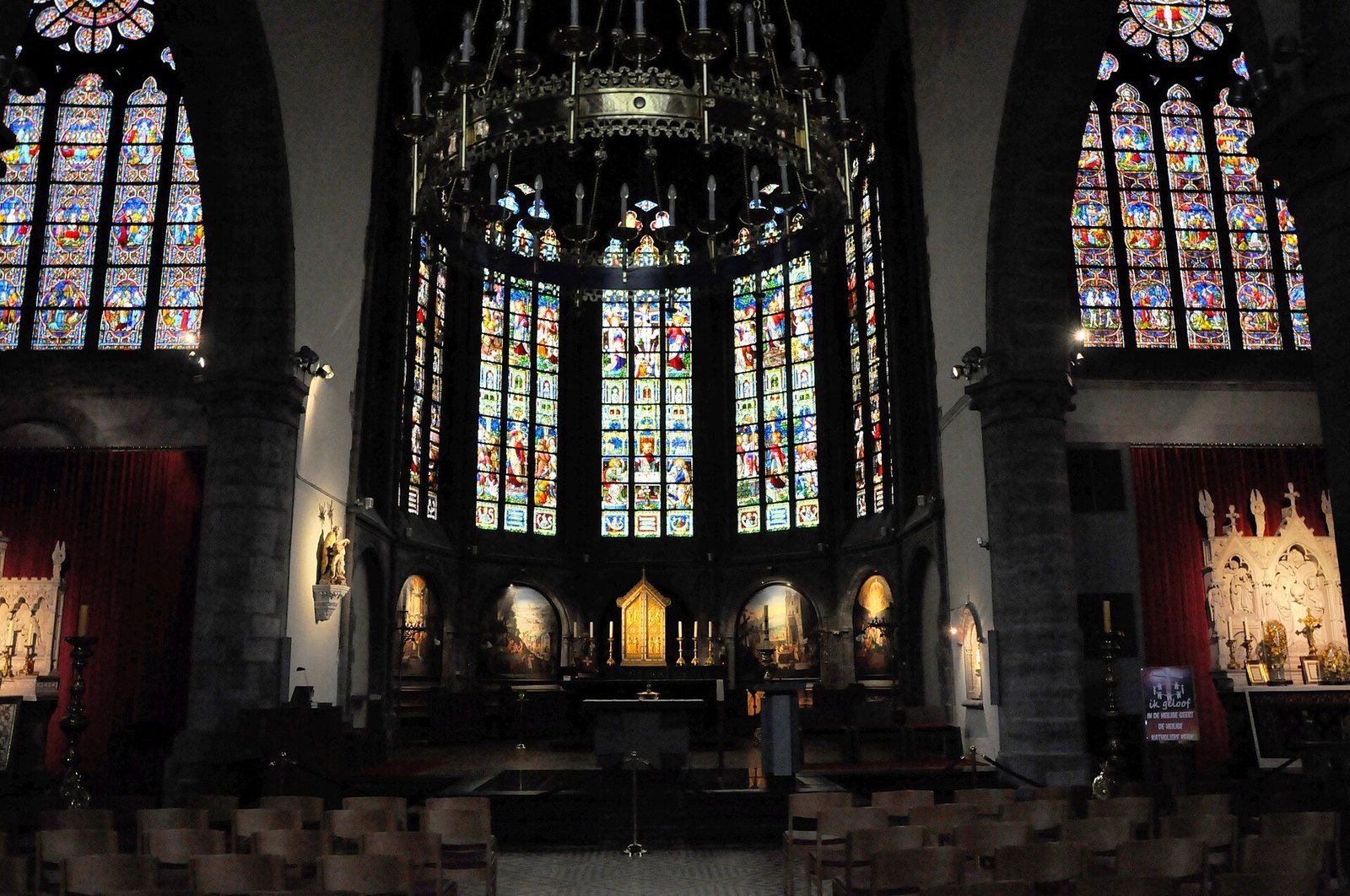
The older part contains the surviving thirteenth-century choir and the polygonal apse introduced in 1404. Inside, the choir forms part of an arrangement with three aisles, a small transept, and an apsidal end. Its darker interior contrasts with the brighter and more spacious Gothic nave.
The unfinished western section
The western or lower church was built between 1506 and 1514, although the larger design was never completed. Its three-aisled interior is divided by cylindrical piers carrying large cabbage-leaf capitals. Above the arcades runs a false gallery, a decorative gallery-like feature rather than a full passage, closed by a balustrade in place of a triforium, the narrow upper-level passage traditionally found above a church’s main arcades.
The Gothic tower
The 88-metre Gothic tower has two lateral stair turrets and is crowned by the Baroque roof structure added in 1620. This roof terminates in an octagonal lantern, a small raised structure crowning the tower. The spire destroyed by lightning in 1804 was not reconstructed. The tower remains a landmark in Oudenaarde and the surrounding landscape.
Interior furnishings and musical heritage
Sculpture, paintings, and textiles
The present interior contains sculpture, polychrome statues, paintings, and tapestries. Among its paintings is The Descent from the Cross by Simon II de Pape, the son of Simon I de Pape, who designed the Baroque roof structure over the tower.
The organs
A large organ was already in the church by 1498, when Josse de Buus carried out maintenance. Around 1542 or 1543, Master Cornelis de Moor built another large organ. It was rebuilt several times, including by the Ghent organ builder Pieter Van Peteghem in 1757, before being sold in 1910.
The present organ dates from 1912 and was built by the Brussels organ builder Georges Cloetens. It has 32 stops, three manuals, or hand-operated keyboards, and a pedal division played with the feet. During its restoration in 2013, the Orphéal reed stop specified in the original design was reconstructed. A reed stop uses vibrating reeds to produce its sound, and this type is described as unique in Flanders, with only two additional examples known, in Viroinval and Cairo.
The choir organ and carillon
Since February 2019, the winter chapel has contained a choir organ built by Hendrik Jan Vierdag in 1963. It originally served the Protestant district congregation De Ontmoeting in Geuzenveld-Slotermeer, Amsterdam Nieuw-West. The instrument has 14 stops, two manuals, and pedals.
Oudenaarde’s first hand-played carillon is traditionally associated with a keyboard supplied by Jan van Spiere on behalf of the city council in 1510. That instrument was installed in the town hall. In 1967, Oudenaarde received a new carillon of 49 bells weighing 15,000 kilograms, cast by Petit & Fritsen of Aarle-Rixtel.