Sillustani: A Qulla Funerary Complex in Peru
Site at a Glance
- Rating
- 4.7
- Popularity
- Medium
- Country
- Peru
- Primary era
- Medieval
- Eras represented
- Medieval
- Civilizations
- Inca
- Site type
- Religious
- Remains
- Tomb
On this page12 sections
History
Sillustani is a pre-Hispanic funerary complex on the Umayo Peninsula in southern Peru, associated especially with Qulla society and the late development of Altiplano funerary monumentalization. The complex occupies a prominent place in the history of the Lake Titicaca basin, where local traditions later intersected with Inca political and architectural influence.
Earlier traditions and Qulla development
Materials associated with Tiwanaku, a major pre-Inca civilization centered in the southern Lake Titicaca region, have been found around Sillustani. The later occupation connected with the Qulla kingdom dates approximately from the twelfth to the fifteenth century. The cemetery therefore developed from older social and ritual traditions rather than appearing as an isolated creation.
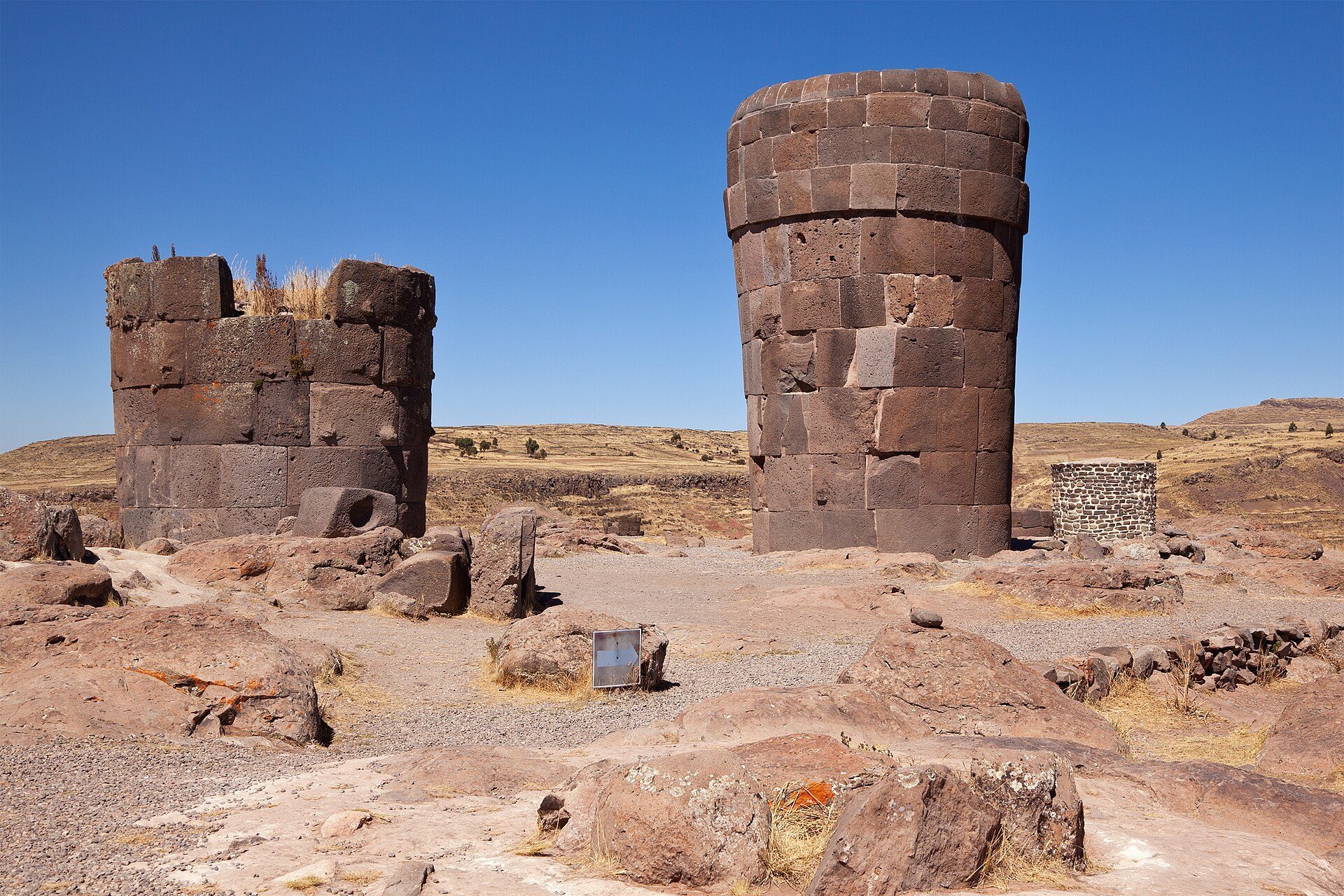
Sillustani became one of the major funerary centers of the Altiplano. Its elevated stone towers, known as chullpas, were mausoleums for high-status individuals and groups linked by lineage. They expressed relationships with prestigious ancestors and may also have supported collective burials, annual pilgrimages, and ceremonies of ancestor worship. Their construction demanded organized labor, the extraction and transport of stone, and the authority to claim prominent places in the landscape.
The nearby center of Hatuncolla placed Sillustani within a wider political territory of settlements, roads, administrative centers, local communities, and ritual places. The cemetery belonged to a regional network that included other ceremonial centers, such as Cutimbo in the Lupaqa sphere, and helped connect funerary practices with political authority, territorial legitimacy, and collective memory.
Inca incorporation
Sillustani was later incorporated into the Inca Empire and the Collasuyu, its southeastern quarter. Local funerary customs continued, but they were reorganized within the new political order. Some structures adopted techniques and visual forms associated with Cusco, while local practices remained active. The complex is therefore best understood as the result of interaction between Altiplano traditions and Inca intervention, rather than as the product of a complete replacement of one culture by another.
Funerary activity involved enclosed chambers, preserved bodies or funerary bundles, and offerings of food, ceramics, metals, and other goods. The towers served not only as places for the dead but also as durable monuments through which ancestors remained connected to ritual, memory, descent, and the social landscape.
Modern investigation and conservation
Nineteenth- and early twentieth-century travelers and investigators brought Sillustani into modern archaeological discussion. Adolph Bandelier published a study of the ruins in 1905, recording construction details, stone blocks, and unfinished structures. His suggestion that some towers had been used for storage was later rejected, but his observations remain part of the early modern record of the site.
Later archaeological work examined Sillustani’s cultural affiliations, chronology, construction methods, funerary practices, landscape, graphic remains, and conservation. Oscar Ayca Gallegos proposed an integrated interpretation that included differentiated sectors, quarries, work areas, habitation remains, paths, terraces, and funerary zones of varying scale. These studies also encouraged caution in reading the site’s architectural differences, since structures built with different techniques and associated with different dates or groups may have coexisted.
Cleaning and restoration in 1971 led to the discovery of the assemblage known as the Treasure of Sillustani near the Chullpa of the Lizard. Arturo Ruiz Estrada published the gold finds, and Wilber Bolívar Yapura later reassessed their composition, cultural affiliation, and relationship to the funerary clothing of a high-ranking Qulla person. Part of the assemblage was transferred to the Carlos Dreyer Municipal Museum in Puno.
Sillustani was declared Cultural Heritage of the Nation by Supreme Resolution 296/INC-2003. Its administration and maintenance fall under the Decentralized Directorate of Culture of Puno, part of Peru’s Ministry of Culture. Restoration, archaeological recording, inventory work, and conservation have shaped both the survival and interpretation of the complex. A 2005 project directed by Eduardo Arizaca Medina used temporary wooden ramps and pry bars to reposition stones. Current conservation concerns include the effects of the Altiplano climate, erosion, visitor circulation, tourism pressure, uncontrolled interventions, and the protection of disturbed or poorly studied funerary contexts.
Remains
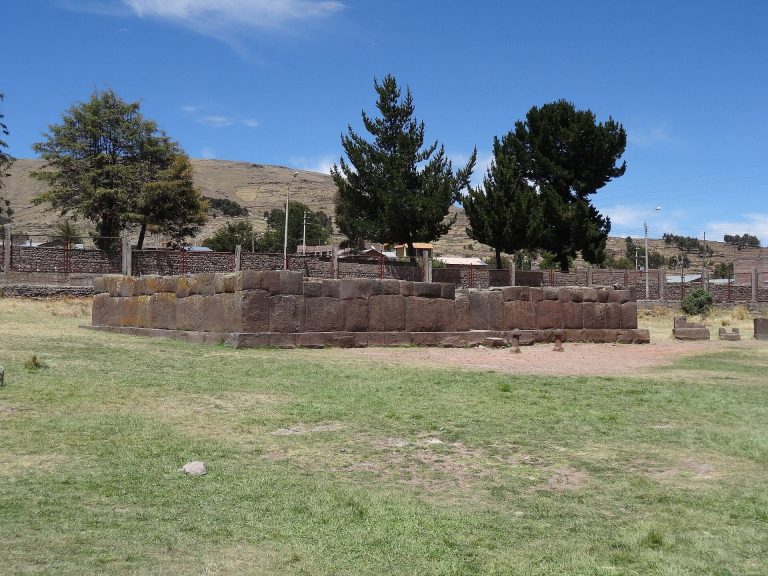
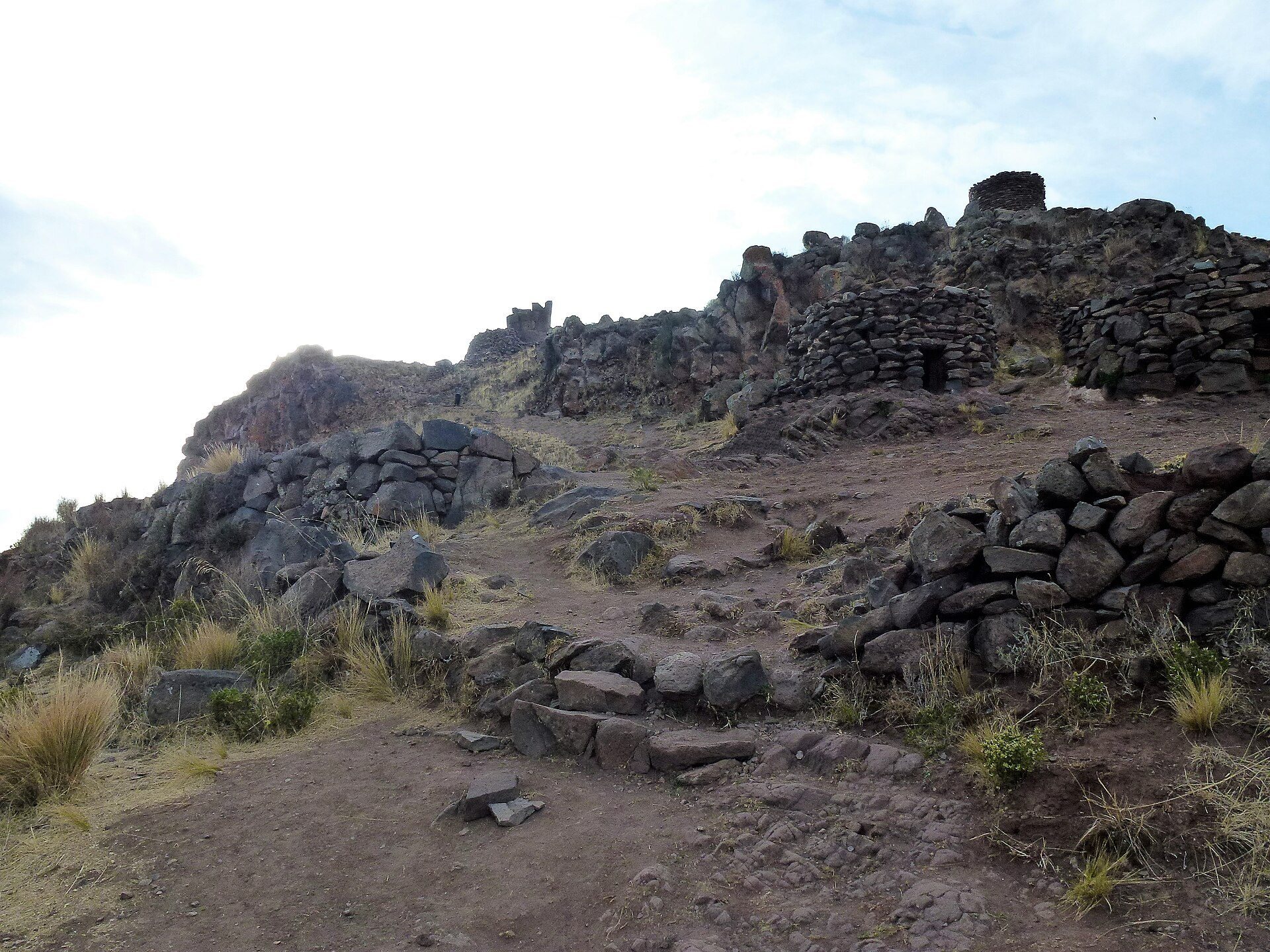
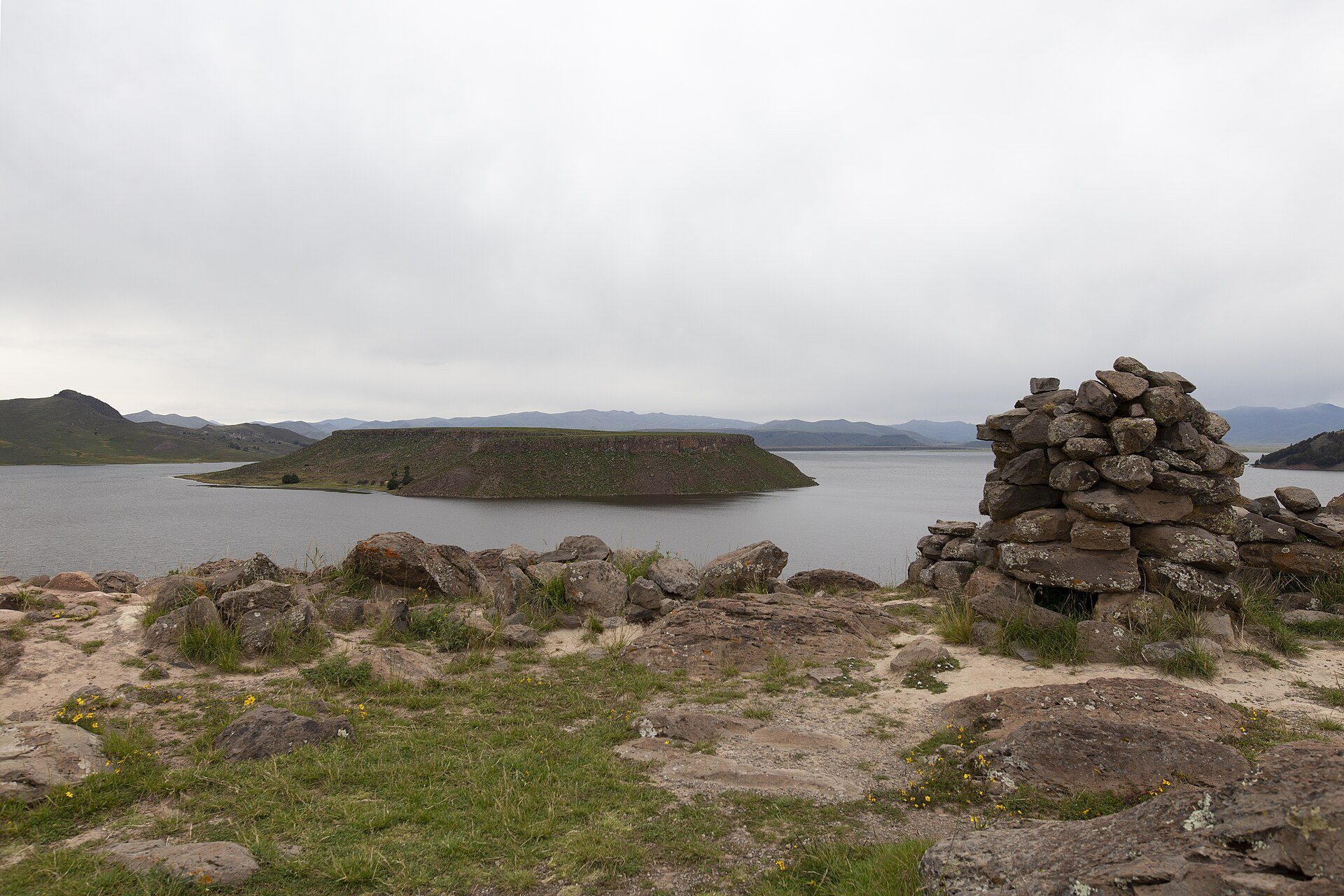
Sillustani covers approximately 60 hectares on the eastern shore of Lake Umayo, at an altitude of about 3,902 metres above sea level. The complex extends across a natural elevation, open ground, and peninsula slopes overlooking the lake and surrounding plateau. Its 91 recorded funerary towers stand among terraces, enclosures, stairs, internal paths, monoliths, intiwatanas, quarries, work areas, habitation remains, open spaces, and rock outcrops. Together, these features form a broad archaeological landscape of funerary, ritual, transit, observation, and construction areas.
Funerary towers and construction
Chullpa of the Lizard
The Chullpa of the Lizard is one of Sillustani’s most prominent towers. It rises approximately 12 metres and has a base diameter of 7.17 metres. Its name comes from a zoomorphic relief, or animal-shaped image, carved on one of its blocks. The tower also became associated with the 1971 discovery of the Treasure of Sillustani, found nearby.
Chullpas and funerary chambers
The characteristic chullpas are circular or slightly tapering stone towers built in several forms. Some use finely cut blocks, others rely on irregular masonry, and some were covered with mud or kaolinite plaster. A small opening frequently faces east. Its limited size indicates that funerary bundles were probably placed inside before the chamber was sealed, while the eastern direction was associated with the sun’s rebirth. The inner chambers generally used smaller stones, whereas the exterior walls could display larger, more carefully worked blocks.
Several towers combine a functional chamber of small or medium-sized stones with an outer facing of precisely finished blocks. This exterior surface provided structural protection while also displaying technical control, permanence, prestige, and authority. Cornices, projecting elements, and zoomorphic reliefs occur on some structures, including motifs linked with the Chullpa of the Amaru, while other towers have different forms and finishes. These variations reflect differences in construction, materials, social associations, and possibly chronology. More refined blockwork is associated in some cases with the Inca period or with Cusco-influenced interventions, although local and Inca architectural practices could exist together.
Landscape and building evidence
The towers occupy a high and exposed peninsula visible from different approaches and from Lake Umayo. Their arrangement with paths, terraces, and open spaces has been interpreted as supporting ceremonial movement, changing viewpoints, territorial marking, and the public presentation of ancestral monuments. The range of tower sizes and construction methods contributes to a landscape that includes both monumental structures and more modest funerary buildings.
Quarry areas, loose blocks, partially worked stones, unfinished structures, and a large construction ramp reveal how the complex was built. Stone had to be extracted, transported, shaped on visible surfaces, fitted into the outer walls, and used to close the funerary chambers. The ramp preserves evidence for stacking stones against the walls during construction and has helped reconstruct methods for moving and positioning heavy blocks. It also relates to projects that may have been interrupted before completion.
Other features include terraces, corrals or enclosures, stairs, internal paths, monoliths, open areas, habitation remains, and intiwatanas. An intiwatana is a ritual stone traditionally connected with the sun and with the ceremonial ordering of time and space. These elements show that Sillustani was organized as more than a group of isolated mausoleums.
Engravings and archaeological finds
Quilcas and carved imagery
Quilcas, Andean graphic marks or engravings made on stone, occur on walls, tower bases, isolated blocks, and natural outcrops. Some are directly connected with monumental architecture, while others appear on reused stones or in secondary settings. Their different groupings indicate that the peninsula was visually modified and reinterpreted at several moments. The imagery includes or relates to the zoomorphic reliefs of the Chullpas of the Lizard and the Amaru, linking Sillustani with visual traditions associated with the Tahuantinsuyu, the early colonial period, and other Andean regions.
Treasure of Sillustani
The Treasure of Sillustani was found near the Chullpa of the Lizard. Its initial inventory listed 501 gold pieces and two pieces of unidentified alloy. A later museum inventory counted 1,280 associated objects, a larger total that included beads, shells, bone, ceramics, and other materials beyond the principal metal objects in the first inventory.
The assemblage contains gold, silver, copper, and Spondylus, a brightly colored marine shell valued in the Andes for ritual and prestige purposes. Other materials include lapis lazuli, bone, and ceramic. The recorded forms include sheets, discs, bells, bracelets, tubes, pectoral pieces, beads, and ceramic fragments. The group has been interpreted both as an offering and as part of the clothing and funerary equipment of a high-ranking Qulla individual. Part of it is preserved and displayed in the Sillustani Room of the Carlos Dreyer Municipal Museum in Puno alongside objects from the complex, mummies, funerary equipment, and a reproduction of a chullpa used to explain Qulla funerary practices.