Shrine of the Cloak: A Sacred Relic Complex in Kandahar
Site at a Glance
- Rating
- 4.4
- Popularity
- Very Low
- Country
- Afghanistan
- Primary era
- Modern
- Eras represented
- Early Modern, Modern
- Civilizations
- Durrani
- Site type
- Religious
- Remains
- Sanctuary
On this page12 sections
History
The Shrine of the Cloak is an Islamic shrine complex in Kandahar, Afghanistan, formed around a relic brought to the city in 1768. The garment is traditionally identified as a cloak worn by the Prophet Muhammad during the Night Journey in 621, the Islamic account of his miraculous passage from Mecca to Jerusalem and through the heavens. The complex also contains the mausoleum of Ahmad Shah Durrani, the eighteenth-century ruler who founded the Durrani Empire and is commonly regarded as the founder of modern Afghanistan.
Traditions surrounding the relic
Islamic tradition holds that Muhammad entrusted the cloak before his death to Umar ibn al-Khattab and Ali ibn Abi Talib for delivery to Uways al-Qarani. Umar and Ali were early companions and leaders of the Muslim community, while Uways was revered for his devotion to Muhammad despite never meeting him personally. The relic was later associated with Yemen, the Cave of Hira at Mecca, Baghdad, Samarkand, Balkh, and possibly Bukhara.
The cloak’s earlier history remains partly uncertain within these traditions. One account places it in Bukhara before it was transferred to Kandahar, while another describes movements from Baghdad to Samarkand and then to Balkh. In 1024 Solar Hijri, an effort to move it from Samarkand toward Chinese Turkestan ended with its transfer to Balkh. In 1109 Solar Hijri, an attempt to take it from Badakhshan and Chitral toward India was intercepted, and the garment was placed in the Guzgun fortress. The surrounding place later became associated with the name Faizabad.
Transfer to Kandahar
In 1768, Amir Ahmad Shah Durrani received the cloak from Amir Murad Beg of Bukhara under a treaty between the two leaders. Another tradition says that Ahmad Shah secured it after promising its custodians that he would not carry it beyond a heavy stone slab. He then took both the cloak and the slab to Kandahar.
Ahmad Shah ordered the transfer because Murad Beg was encouraging unrest in Afghanistan’s northern regions, and the ruler wanted the relic kept more securely. He sent his grand vizier, Shah Wali Khan, accompanied by 6,000 horsemen, to recover it. During the journey, the cloak was reportedly kept in Kabul, first at an inn attached to a mosque and later beside a stone at the foot of a mountain. A well was dug and mulberry trees were planted at that location in 1187 Solar Hijri, where the Shrine of Sakhi Shah Mardan now stands.
The cloak reached Kandahar in 1768 and was initially placed in the old congregational mosque of the Ahmad Shahi city. In 1183 Solar Hijri, Ahmad Shah appointed Haji Abd al-Haq Akhundzada al-Kakuzai as custodian. Responsibility for the relic remained associated with his family for more than 250 years.
Creation of the separate shrine
Ahmad Shah first commissioned a two-storey building intended to contain both his tomb and the cloak. After his death, his successor Timur Shah Durrani assigned the structure to Ahmad Shah’s mausoleum and ordered a separate building for the relic. This arrangement was intended to prevent the cloak from being regarded as permanently attached to a particular ruler or royal tomb. The relic was moved from the old mosque to the new building in 1190 Solar Hijri.
Public viewings and political meaning
The cloak was removed from public view on three notable occasions described in the history of the shrine. It was presented during an epidemic in Herat in 1318 Solar Hijri, again in 1996 under Taliban leader Mullah Muhammad Omar, and once more in June 2018 during a three-day Eid ceasefire.
In 1996, Omar took the cloak from the shrine and held it before a large gathering of religious leaders and followers. The Taliban is an Afghan Islamist movement. The event became an important symbol in the movement’s rise and in Omar’s political authority, and the crowd proclaimed him Amir al-Mu’minin, an Arabic title meaning “Commander of the Faithful.” Waheed Muzhda stated that Omar held the garment but did not wear it.
Qari Shawali, then a keeper of the shrine, said that before Omar only Mohammad Zahir Shah and Pir Ahmed Gailani had seen the cloak during his lifetime. Zahir Shah, Afghanistan’s last king, opened the chest containing it twice without removing the garment. Gailani was a political leader and a relative of Zahir Shah.
In June 2018, President Ashraf Ghani opened the container and joined those present in prayers for peace during the Eid ceasefire from 15 to 17 June. The restricted display of the relic, together with these occasional public presentations, has sustained its religious and political importance. The 2018 presentation was the last publicly recorded viewing described here.
Remains
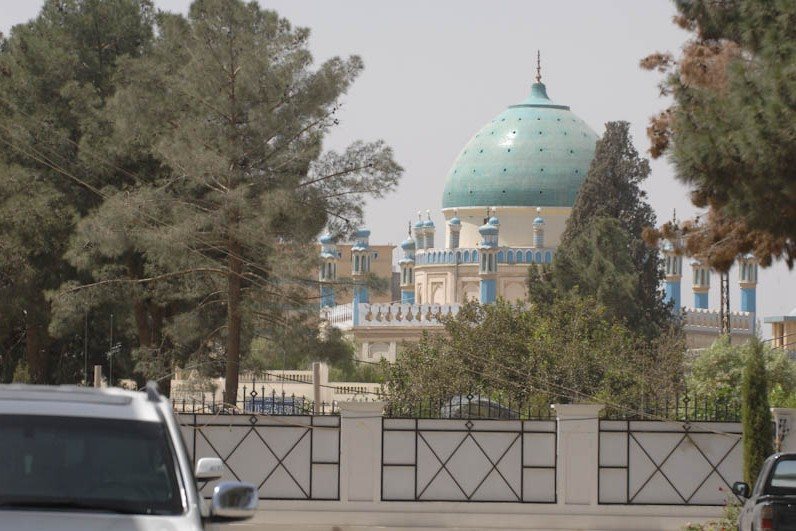
The shrine complex brings together a congregational mosque, the mausoleum of Ahmad Shah Durrani, and a separate building for the cloak. The buildings are Islamic in architectural character. The structure first planned for both the tomb and relic is a two-storey building. After the functions were separated, a distinct cloak building was erected to its east, while the earlier structure became Ahmad Shah’s mausoleum.
Relic building and associated objects
The cloak and its container
The cloak is kept inside a locked container within the shrine buildings and is rarely displayed. It is described as a loose, open garment made from soft camel wool. Its dark green surface has a pronounced sheen, and its sleeves are shorter than the lower hem. The garment is shorter than an ordinary full-length cloak and has no lining or hem padding. The two upper front sections are worn and repaired with wool thread.
Grille and entrance decorations
A silver grille for the relic was commissioned by Sardar Nasrullah Khan. Another tradition credits the shrine door, the grille, and a silver egg-shaped object to the goldsmith Ghulam Qadir Zargar. In the entrance hall, verses honoring Kandahar and the shrine were written in the early twentieth century in the calligraphy of Sufi Abdul Hamid Khan. They describe the cloak as a sacred garment associated with Muhammad and Uways al-Qarani.
Mausoleum and commemorative features
Ahmad Shah Durrani’s mausoleum
Ahmad Shah Durrani’s mausoleum occupies the original two-storey building commissioned for both his tomb and the cloak. It stands beside the separate building containing the relic and forms part of the same shrine complex.
Stone slab and literary associations
A stone slab linked to the tradition of Ahmad Shah’s transfer of the cloak is said to stand near the mausoleum. The shrine also has an association with the poet Muhammad Iqbal, who visited it in the early twentieth century and composed verses in its honor.