Chil Zena: A Mughal Rock Portico and Staircase in Kandahar
Site at a Glance
- Rating
- 4.5
- Popularity
- Very Low
- Country
- Afghanistan
- Primary era
- Early Modern
- Eras represented
- Classical, Early Modern, Modern
- Civilizations
- Mauryan, Mughal
- Site type
- Civic
- Remains
- Monument
On this page9 sections
History
Chil Zena is a Mughal rock-cut portico and staircase in Afghanistan, positioned at the western entrance to Kandahar. The complex was commissioned by Babur, founder of the Mughal dynasty in the Indian subcontinent, after his second conquest of Kandahar. Construction began during his reign and was completed after 25 years, in the Mughal period.
The Mughal Foundation
The site was originally called the “World-Showing Portico,” a name preserved in inscriptions inside the structure. It is also known as Forty Steps, Chilzina, and Chehel Zina. The staircase and portico were created as a ceremonial and commemorative work on the mountainous outcrop west of the city, north of the old citadel of Old Kandahar.
Inscriptions inside the portico describe Babur’s conquests and name Babur, Mirza Kamran, Mirza Askari, and Mirza Hindal as holders of Kandahar. They appear to date from the period of Babur’s son Humayun, who succeeded him and ruled in India. A Persian inscription on the western wall states that Kandahar passed out of the dynasty’s control when Humayun conquered Delhi, giving the monument a record of changing Mughal authority in the region.
Earlier and Later History
Chil Zena is also associated with the Kandahar Bilingual Rock Inscription of the Indian emperor Ashoka. The inscription, discovered near the site in 1963, helped confirm the presence of Greek communities in the vicinity during the third century BCE. It also supported the understanding that Ashoka’s rule extended to Kandahar and Arachosia, the ancient region surrounding Kandahar and parts of southern Afghanistan.
The side parapets along the staircase were added during the reign of Amanullah Khan, king of Afghanistan from 1919 to 1929, on the orders of Queen Soraya. The Afghan government later restored them. Years of war damaged several parts of Chil Zena, including areas deliberately struck by gunfire. Neglect, visitor traffic, and fires have continued to threaten the surviving fabric.
Remains
Rock-Cut Complex
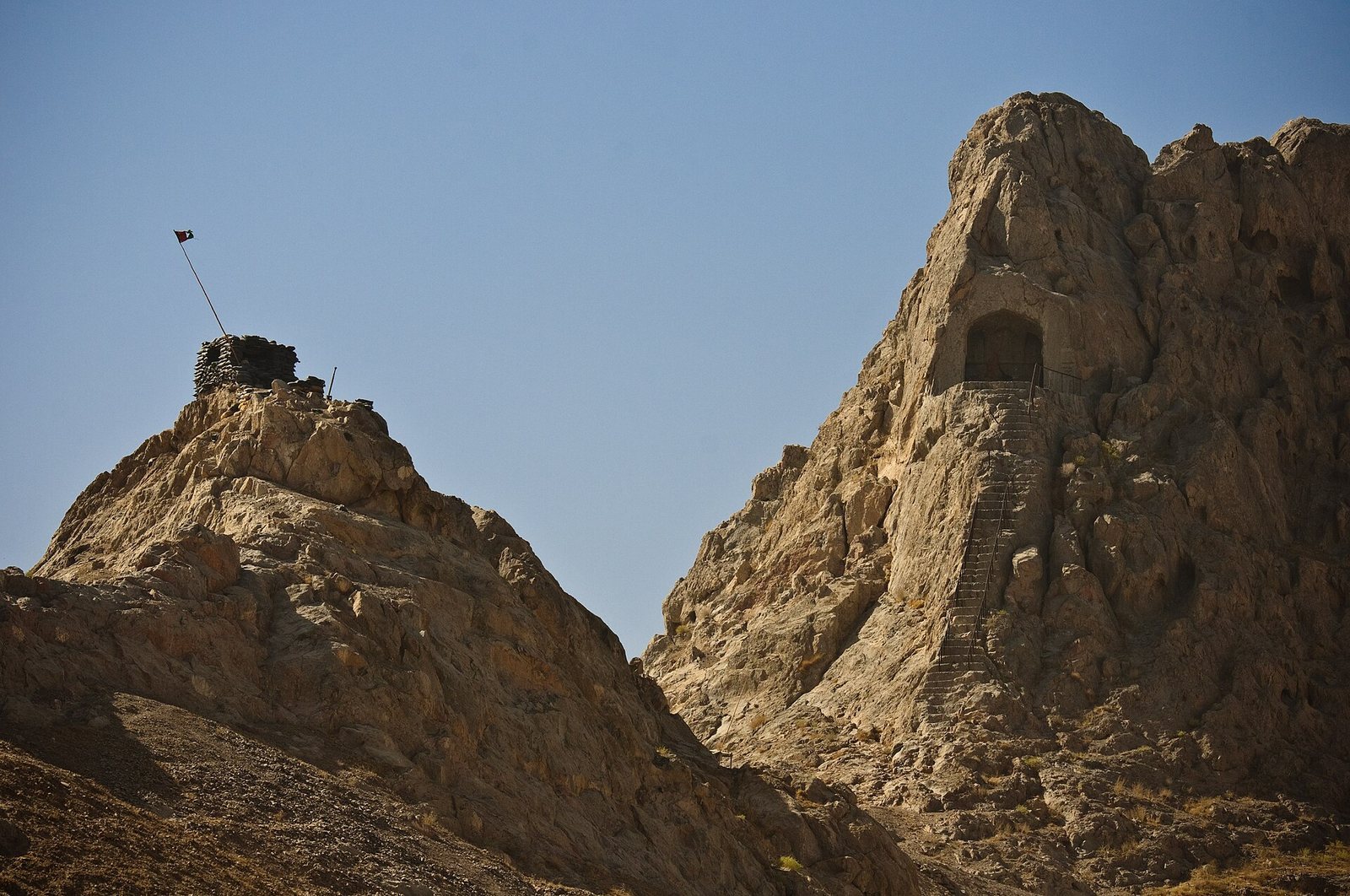
Chil Zena occupies a mountainous outcrop in a green setting near the Arghandab River. The north-facing complex overlooks the river, gardens, and agricultural fields. Its principal elements are a covered inner portico, an open rock-cut platform in front of it, and a staircase descending toward the foot of the outcrop. Together, these features form a compact approach to the carved structure.
Inner Portico
The covered inner portico is rectangular, measuring approximately 3 metres in length and 2 metres in both width and height. Its Persian inscriptions use Nastaliq, a flowing calligraphic style widely used for writing Persian, and contain historical narratives concerning Babur’s conquests and the Mughal family. The interior is described through its inscriptions rather than geometric or vegetal ornament, which was common in much Islamic-period heritage architecture. Two lion-like sculptures flank the outer entrance and are associated with the portico’s grandeur, splendour, and majesty.
Open Platform and Staircase
Immediately before the portico is an open platform cut into the rock, measuring approximately 5 by 4 metres. The complex is reached by a stone staircase traditionally linked with the name “Forty Steps,” although the staircase is described as having 44 steps. It connects the platform at the portico with the lower mountainside. The parapets or railings along its sides belong to the period of Amanullah Khan and were later restored.
Rock Inscriptions
Ashokan Inscription
The Kandahar Bilingual Rock Inscription is carved into the mountainside and remains in an open-air compound near Chil Zena. It is associated with Ashoka’s Kandahar edict and is written in two languages. Its location and content provide physical evidence for the ancient historical connections of the Kandahar area with the Mauryan Empire and with Greek communities during the third century BCE.