Shashtepa: An Early Settlement and Fortified Outpost in Uzbekistan
Site at a Glance
- Popularity
- Medium
- Country
- Uzbekistan
- Primary era
- Classical
- Eras represented
- Iron Age, Classical
- Civilizations
- Unclassified
- Site type
- Military
- Remains
- Citadel
On this page16 sections
History
Shashtepa is an archaeological site in Tashkent, Uzbekistan, preserving the remains of Chochkat, an early settlement and fortified village. Its history includes activity from the sixth century BCE to the sixteenth century CE, with periods of abandonment and renewed use. In the second and first centuries BCE, it developed into a fortified outpost and early town on the edge of the Tashkent oasis.
Early farming communities
Shashtepa’s earliest settlement evidence is associated with the Burgulyuk culture, an archaeological culture linked here to early farming communities. Settlements of this culture in the Ahangaran valley date to the ninth–seventh centuries BCE. The lowest layers on Shashtepa’s left-bank mound contain evidence of settled agriculture assigned to a later Burgulyuk phase, dated to the sixth–fourth centuries BCE. Early settlements were abandoned during the seventh–sixth centuries BCE for unknown reasons.
Burgulyuk communities grew barley and wheat and made textiles from wool, kenaf, a fiber-producing plant, and bast fiber, which comes from the inner bark of plants.
From cemetery to fortified outpost
In the third century BCE, Sarmatian groups, nomadic peoples of the Eurasian steppe, moved south from the southern Urals and eastern Aral region. They destroyed Chochkat and used the abandoned settlement as a cemetery. Burial evidence points to connections with the Ural and Volga regions.
Finds from the third century BCE make Shashtepa the earliest identified settlement in the area of modern Tashkent. This date has been used to reckon the city’s age, and Tashkent marked a 2,200-year anniversary in 2009. In the second and first centuries BCE, the settlement grew into an early town and a fortified outpost of the Qang state, an ancient polity associated with the middle Syr Darya region. At the boundary between steppe and oasis, it served as a stronghold, craft center, and marketplace connecting nomadic pastoralists and settled farmers.
Later occupation
The site’s material culture reflects centuries of interaction between steppe pastoralists and oasis farmers, known as the Qovunchi culture. Finds from the first and second centuries CE indicate literacy in Chach, the historical name for the region of modern Tashkent, and contacts with the Near and Middle East through caravan routes.
In the mid-fifth century, the southward movement of Hephthalite pastoralists, who expanded into Central Asia during that century, accompanied a change in the site’s use. Life at Shashtepa revived substantially from the sixth to the early eighth century, until the Arab Caliphate, an early Islamic empire whose conquests extended into Central Asia, devastated the settlement. Occupation returned to some extent in the eleventh and twelfth centuries. By the sixteenth century, the site was almost entirely in ruins.
Archaeological investigation
N. S. Likoshin first recorded the site, and N. P. Ostroumov excavated there in 1896. G. V. Grigoryev investigated it in 1934, followed by archaeological observations by N. I. Krasheninnikova in 1956 and G. Dadaboyev in 1970. Regular excavations began in 1978 under V. I. Sprishevskiy and M. I. Filanovich. Although the fortified settlement did not develop into a fully formed city, it remains important for understanding the emergence and development of urban planning in the Tashkent oasis.
Remains
Layout and setting
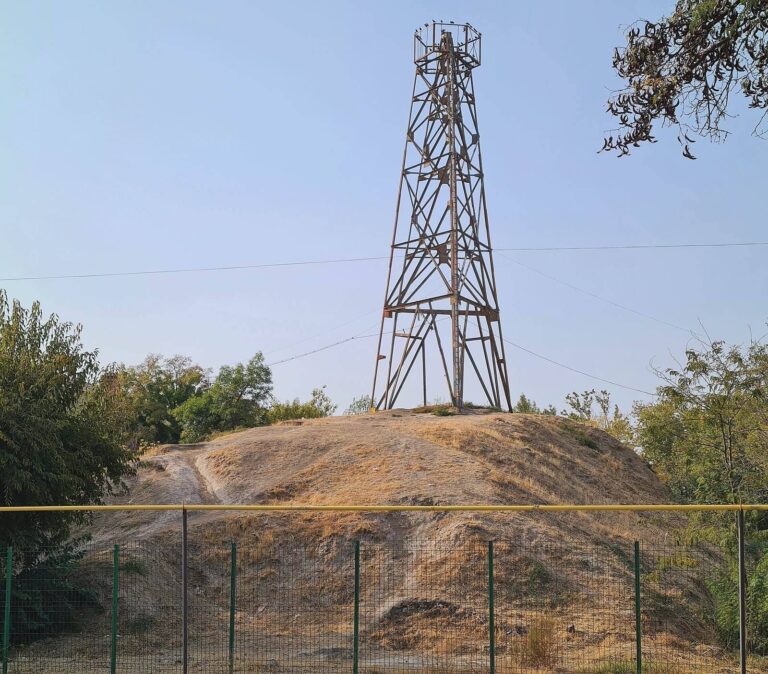
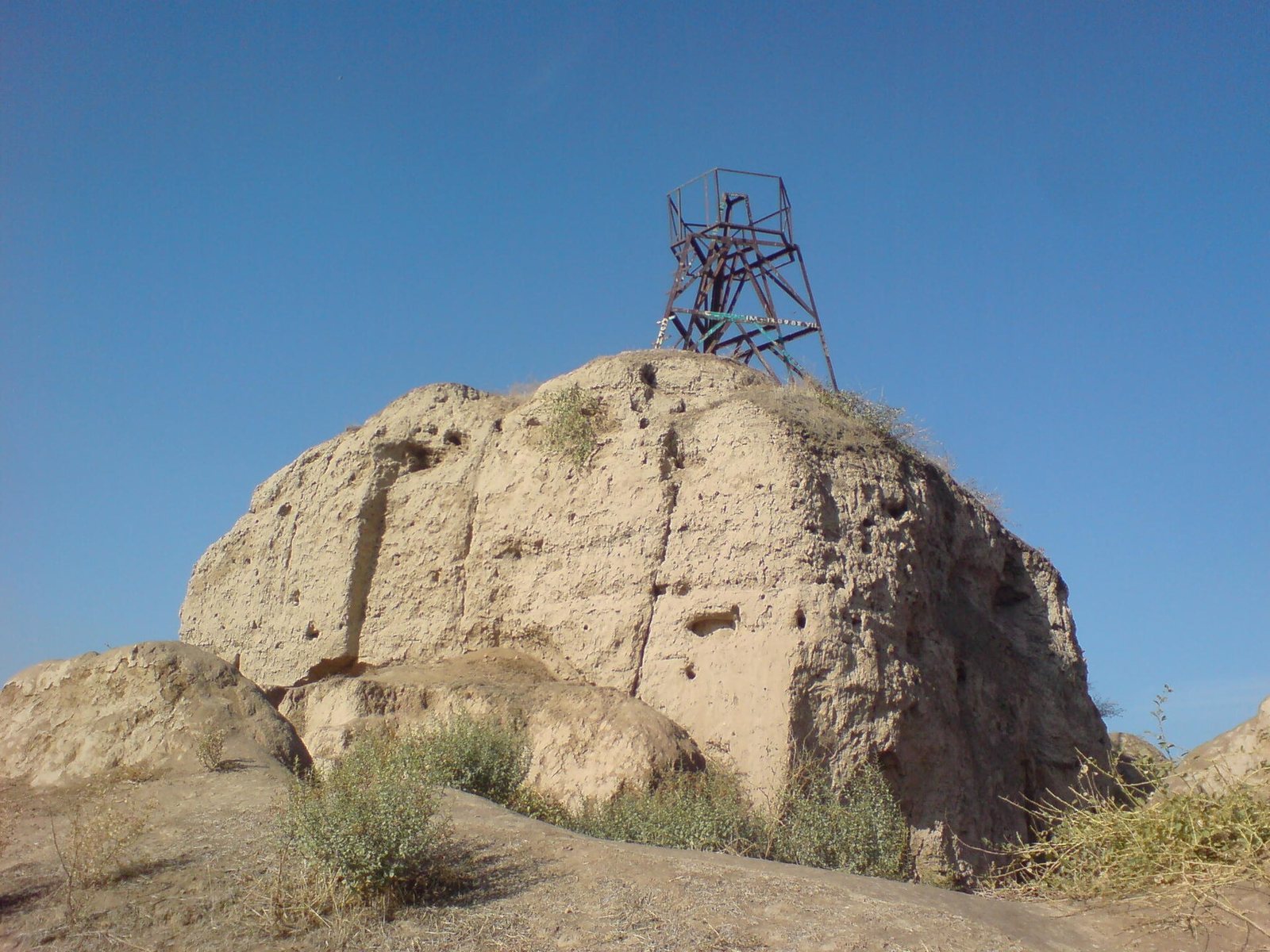
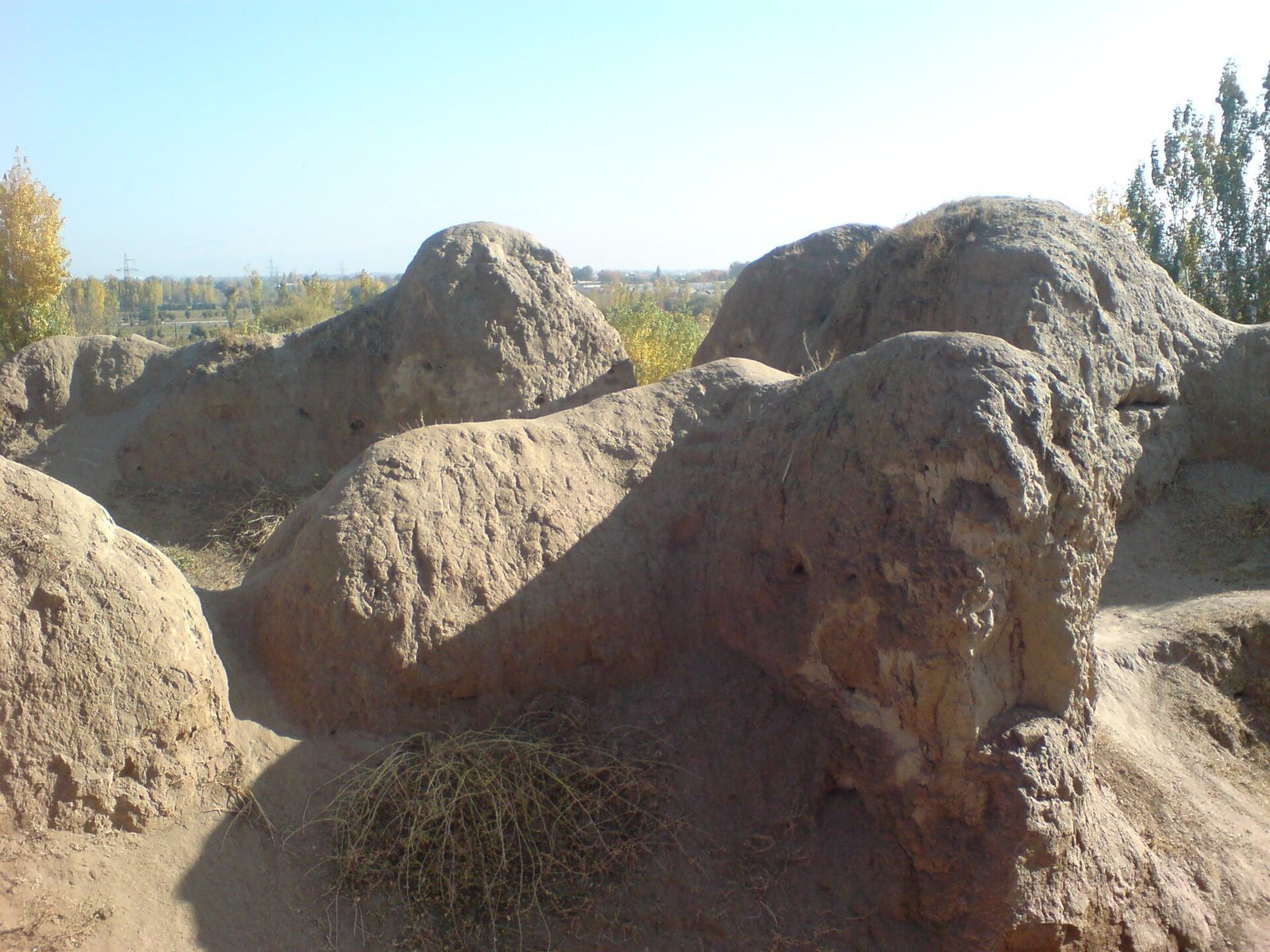
The archaeological site covers about 25 hectares on both banks of the Junariq channel. It consists of two large mounds, one steep and high and the other flatter. The steep mound on the left bank rises 18–19 metres and measures about 150 by 120 metres. Its surviving raised portion forms a 12-metre-high citadel, the fortified core of a settlement, while modern construction occupies the remainder of the settlement. The site’s central fortified complex combines a circular mud-brick enclosure with a cross-shaped building at its center.
Early settlement and burial features
Burgulyuk dwellings
Remains of the early village include small oval dwellings about 3 by 2 metres, partly sunk below ground and roofed with branches. Brick-built hearths and braziers were found inside. These structures lie among the settlement remains in the left-bank mound.
Sarmatian cemetery
The cemetery was laid out in rectangular graves cut into abandoned dwellings. The grave pits measured up to about 2 metres long, and the dead were placed on bedding made of reeds.
Fortified settlement
Circular enclosure and corridor
In the second and first centuries BCE, a circular fortress was built over the earlier village. Its enclosure wall, made from large mud bricks, was about 4 metres thick and 60 metres in diameter. A long corridor with an arched roof ran inside the wall. Divided into sections, it had gates opening outward from each section.
Central building
A monumental cross-shaped building stood at the center of the fortress. Its walls were about 2 metres thick, and an arched roof covered rooms and corridors within. The entrance was in the north wing, where an arched passage had arrow-shaped openings on either side. The central building was first a fire-worship temple and was converted into a cemetery in the mid-fifth century.
Objects and material life
Household and agricultural finds
Finds from the settlement layers include storage jars, small jars, pitchers, vessels with one handle or a spout, two-handled ceramic pots, pans, and containers for water. Other objects include ox-head-shaped kebab grills, curved hand-operated stones for grinding grain, iron knives and sickles, daggers, and arrowheads.
Ivory fragment and writing tool
A fragment of an ivory goblet, about 5 by 3.5 centimetres and dated to the first or second century CE, bears a raised portrait of a middle-aged man. He has a large headdress, broad forehead, prominent nose, almond-shaped eyes, and a beard and mustache. A bone stylus from the same period measures 15 centimetres. One end is pointed for writing; the other is shaped like a spatula, with a diamond-shaped form resembling a snake’s head.