Selje Abbey: A Medieval Monastery on Selja, Norway
Site at a Glance
- Popularity
- High
- Country
- Norway
- Primary era
- Medieval
- Eras represented
- Medieval, Modern
- Civilizations
- Norwegian
- Site type
- Religious
- Remains
- Monastery
On this page14 sections
History
Selje Abbey is a medieval Benedictine monastery on Selja island in Norway, probably established around 1100 by monks from England. It was among Norway’s earliest monasteries and may have been the first.
Sunniva and the pilgrimage tradition
Selja’s religious history is closely tied to the legend of Saint Sunniva and her companions, whose story survives in three medieval versions. The fullest, the Latin Acta Sanctorum in Selio, dates to about 1170; the legend probably took shape around 1100–1140 to associate the island with a particular saint. Its events are legendary rather than established history, although a historical basis has sometimes been considered.
In the tale, Sunniva, the daughter of an Irish king, fled a pagan suitor with her followers aboard three ships without sails, rudders or oars. Some reached Selja and hid in caves and hollows, while others settled on Kinn. After mainlanders accused the group of stealing sheep, Håkon Jarl, a Norwegian earl who ruled around 970–995, arrived with armed men. A landslide killed the party. Merchants later saw a column of light and found a radiant, fragrant human head.
Saga tradition credits King Olav Tryggvason with visiting Selja in 996, discovering the martyrs’ remains, placing them in a shrine and ordering a church built. Neither the visit nor that church’s existence is confirmed, and the medieval story does not clearly identify the remains as Sunniva’s. The tradition helped make Selja a pilgrimage destination, associated with Sunniva alongside St Olav’s shrine at Nidaros and the crucifix at Røldal. The island lay roughly halfway along the coast between Bergen and Nidaros and served as a stopping place for travellers.
The feast of the Selja martyrs, celebrated on 8 July, appears in calendars by the early 11th century and in regional laws by the mid-11th. It also features in a Christian law attributed to Olav Haraldsson, later venerated as St Olav, although that law is probably later than the 1024 assembly at Moster with which it is associated. Saga tradition also places Olav Haraldsson on Selja in 1015, but the story is probably not historical. King Sverre stopped on the island in 1176, before becoming king, and a priest there told him that the archbishop opposed his brothers.
The bishopric and monastic foundation
A bishopric was established at Selja around 1068, traditionally under King Olav Kyrre, who ruled from 1067 to 1093. The monastery’s foundation cannot be dated precisely but is generally placed around 1100. Olav Kyrre, his son Magnus Barefoot, or Magnus’s sons Sigurd Jorsalfare and Eystein may have initiated the building. Monks of the Benedictine order from England are considered likely, as are builders from the British Isles. The dedication to Albanus, an English martyr, supports this connection.
The episcopal seat moved to Bergen during Olav Kyrre’s reign, though whether bishops continued to live at Selja is disputed. Some evidence points to Selja as their home into the 12th century, and records continued to call its bishops bishops of Selja until at least 1152. The shrine containing Sunniva’s relics was transferred to Bergen in 1170, possibly by Bishop Pål or Bishop Nikolas Petersson.
Bjarnvard the Saxon is described as Selja’s first bishop. Magne appears in records from 1115 and 1128; Svein’s place in the succession is uncertain, while Ottar held office in the 1130s. Sigurd, who died in 1156, was followed by a contested succession. King Eystein Haraldsson supported his chaplain Pål, while King Inge Krokrygg backed Nikolas Petersson of Sogn. Pål was consecrated after Eystein’s death in 1157, later lost his position with Inge’s support, and regained it after Inge died in 1161. He was the last bishop known as bishop of Selja. Nikolas later became bishop of Bergen, as did Pål’s successor Martein.
Monastic life and decline
In the 13th century the community probably consisted of 10–15 monks and a similar number of lay brothers, members who generally undertook practical work rather than priestly duties. The monks prayed and worshipped, educated priests, copied and translated books, practised crafts, cared for the sick and cultivated land. A substantial enlargement of the complex began late in the century.
Selja’s abbots also moved through wider church careers. Sigurd Detmarsson left for Iceland in 1238 and later became bishop of Skálholt, where he served until 1268; how long he had been abbot at Selja is unknown. Jon Eindridsson, abbot in 1338, faced a complaint about the monastery’s management and became bishop of Skálholt the following year. He died in 1341. In 1339, after the monks failed to elect an abbot according to church law, Bishop Håkon appointed Orm.
A fire in 1305 destroyed much of the monastery. The timber west wing was rebuilt in stone, and the enlarged complex was completed in the first half of the 14th century. The Black Death, the plague pandemic that devastated Europe in the mid-14th century, reached Norway in 1349. It sharply reduced income from the monastery’s estates and contributed to the community’s decline.
In 1424 two monks met violent deaths, one beheaded and the other burned; the reasons for their sentences are unknown. The monastery probably dwindled or closed before the Reformation, the 16th-century religious transformation that ended Norway’s medieval Catholic establishment, in 1537, though a small community may have continued into the 15th century. Its last known abbot, Håkon, appears in a record from 1451. Bishop Finnboge Niklasson probably expelled the final abbot between 1461 and 1474. The last recorded transaction before the Reformation was the receipt of two sacks of fine flour from Bergen in 1522.
Estates and later use
The abbey owned 175 farms, including two-thirds of the farms in Selje and Vågsøy. In 1545 its estates passed to St George’s Hospital in Bergen, which cared for people with leprosy. Farmers later redeemed some properties. Part of the hospital’s wealth was eventually used to build a tuberculosis sanatorium at Harastølen, opened in 1902.
After the monastery closed, people removed valuable goods and building stone. Danish astronomer Tycho Brahe took stone for his observatory at Stjerneborg and castle at Uraniborg on the island of Hven. In 1643, a ship carried 518 dressed soapstone pieces from Selja and Lyse Abbey to Copenhagen. Since 1930 the Catholic Church has used Selja as a titular diocese, an honorary bishopric rather than a resident bishop’s seat. Pero Sudar took the title in 1993, succeeding Eurico dos Santos Veloso.
Remains
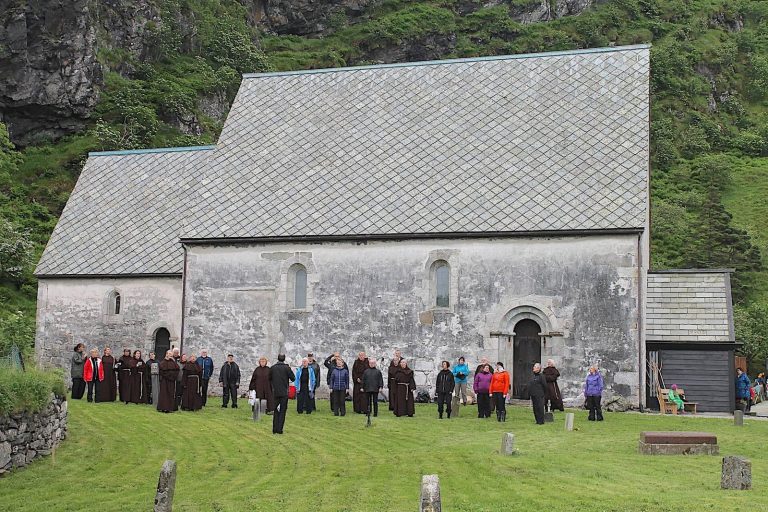
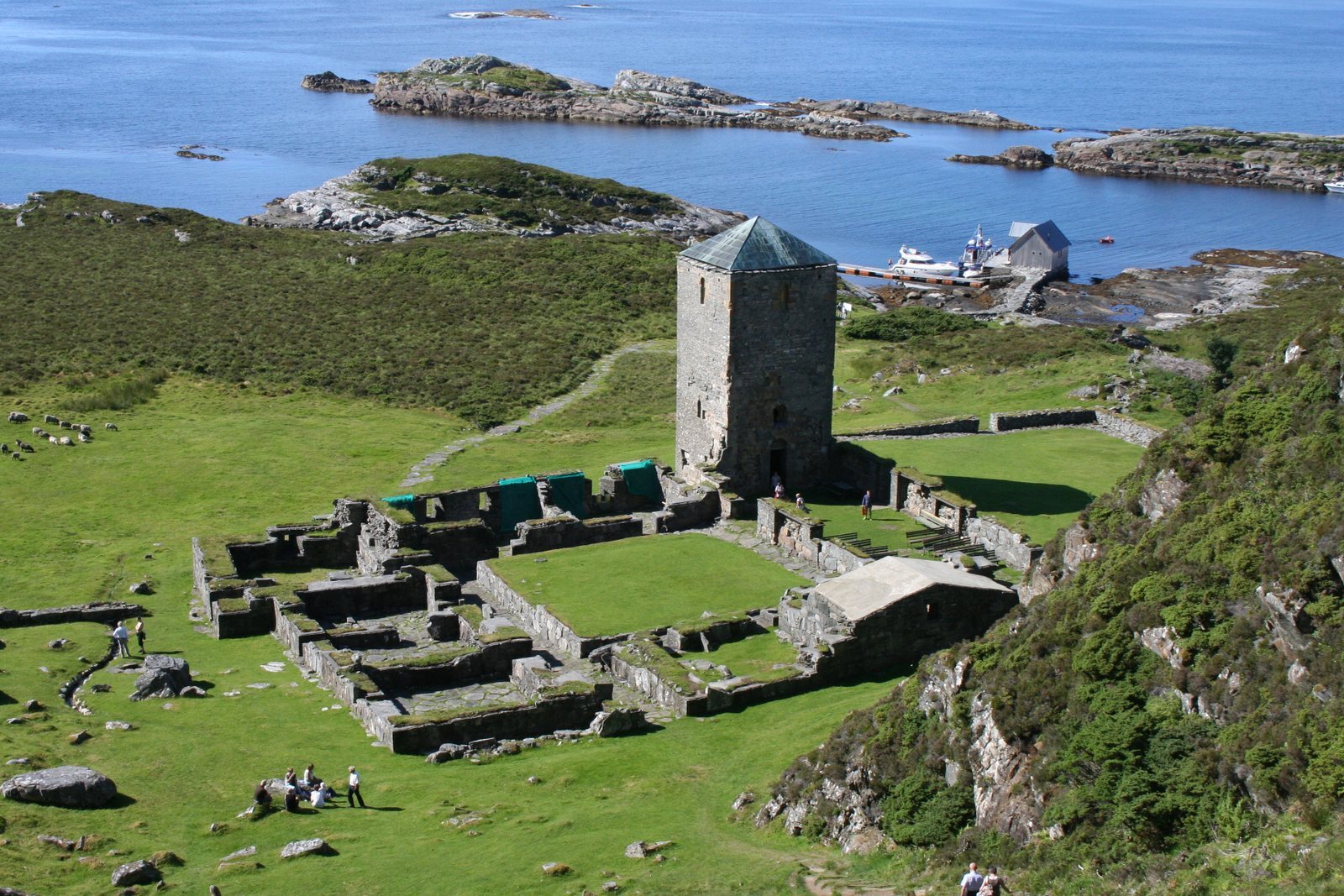
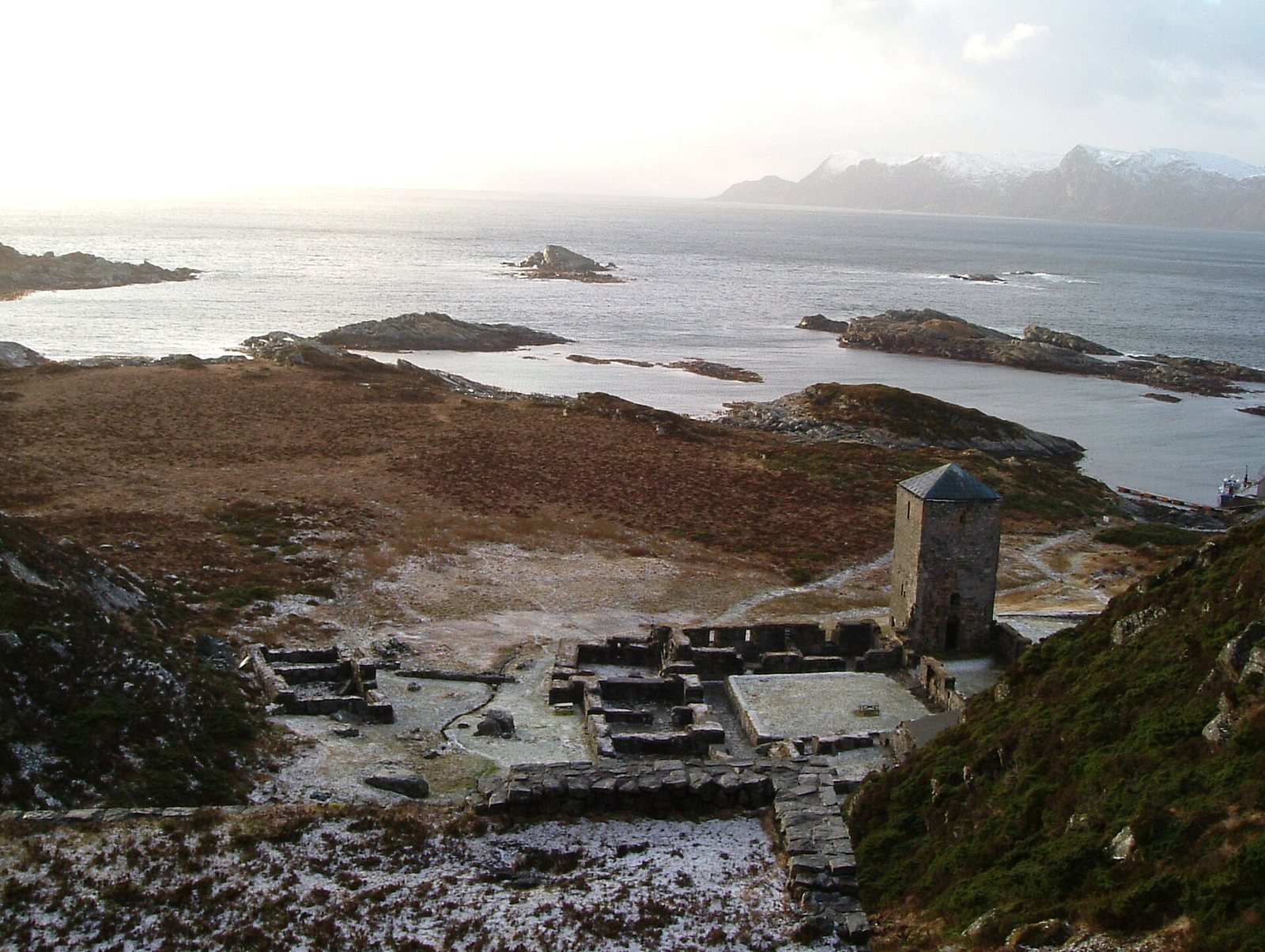
The abbey ruins occupy Selja’s western side, south of Stadlandet and facing Sildagapet and Stadhavet. The island covers 1.56 square kilometres; its landscape includes heather, marsh and woodland, and Varden rises to 201 metres above sea level. The monastery ruins and associated sanctuary extend across the site and remain exceptionally well preserved, in part because the island saw little later settlement. Local gneiss supplied much of the building stone.
Churches
Remains of four churches have been identified on Selja. A medieval description refers to five churches but names six; one explanation is that Albanus Church also went by the names Christ Church or Mary Church.
Michael’s Church
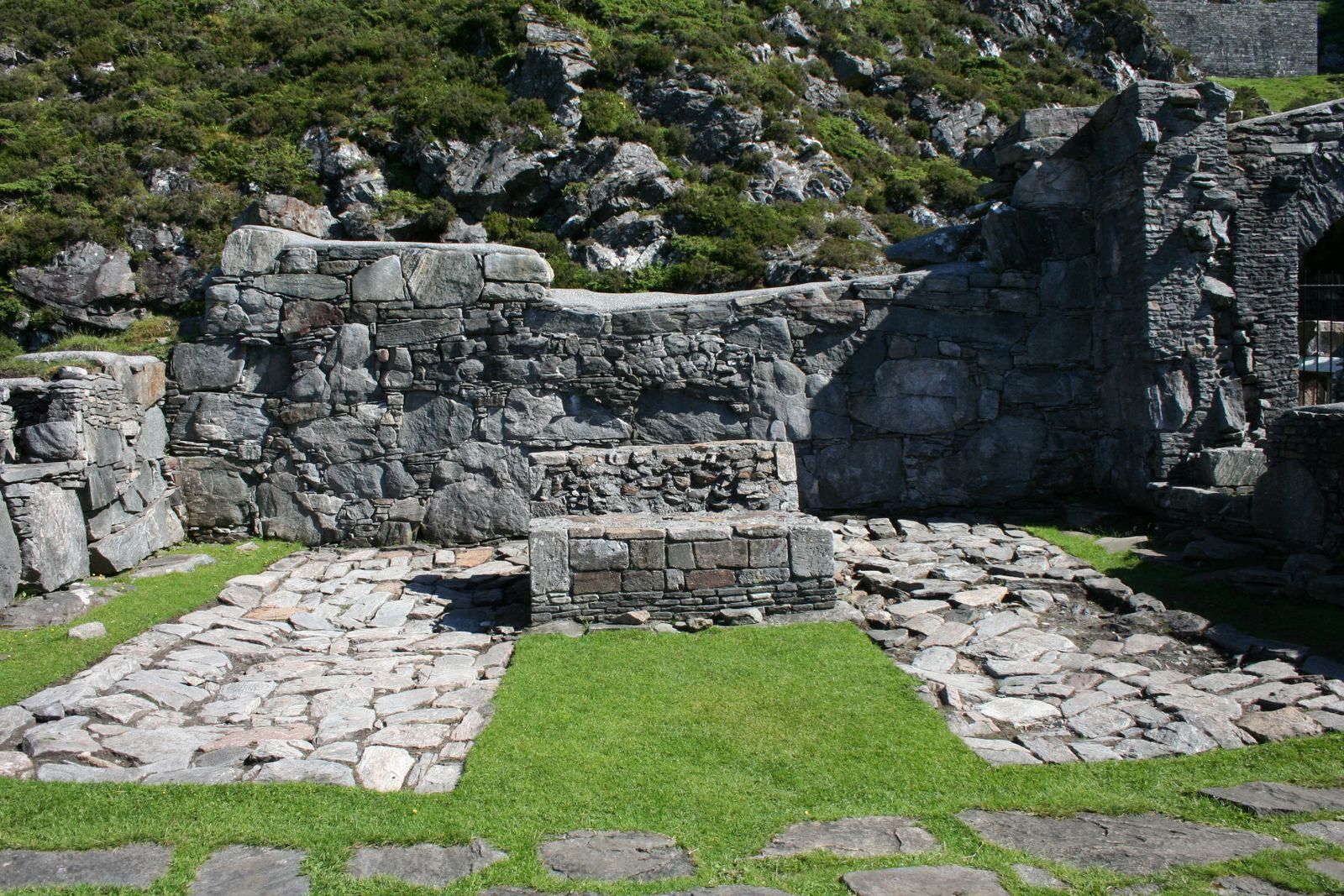
Considered the oldest church on the island, Michael’s Church occupies a cave about 59 metres above sea level, roughly 40–50 metres above the monastery area. An altar stands at the cave’s inner end, and masonry follows its southern wall. Painted decoration survives on the cave walls. Excavation in front of the overhanging rock shelter revealed settlement remains dating from AD 200–570. The cave church is also associated with the early worship of the archangel Michael.
Sunniva Church and terrace
Sunniva Church stands in ruins at the shrine site above the monastery, outside the cave shelter. Its masonry building probably dates to the late 11th century and measures 14 by 6.5 metres. During restoration work in the 1930s, a layer of fire debris was found north of the church.
A stone terrace was added in front of the church during the complex’s late 13th-century expansion. It may have provided room for pilgrims on major feast days.
Albanus Church
Albanus Church formed the monastery’s north wing. Building probably began in the late 11th century and continued into the 12th. Interpretations differ on whether the church served the bishop, the monastery, or both; one view assigns it chiefly to the bishop. It was built as a three-aisled basilica, with a central nave flanked by two side aisles. Round supports carried rows of arches, and the nave rose above the aisles, with windows in its upper walls. The nave measured 12.9 by 9 metres, its central aisle 4.4 metres across and each side aisle 1.4 metres. The choir, the area used by clergy for worship, measured 5.6 by 4.4 metres, with a 3-metre-wide opening. English craftsmen are associated with the first building phase; work from around 1120 is linked with craftsmen from Bergen working in German traditions.
The church was altered and enlarged around 1270, when its 14-metre tower was built. The church and tower were once whitewashed. A stone set into the ceiling at the base of the tower stairway carries an inscription in runes, an early Germanic writing system, translated as "Here is Tore’s resting place." An altar is also found within the church. A bell donated in 1993 by Norwegian philosopher Arild Haaland hangs in the tower; it was cast at the Olsen-Nauen foundry in Tønsberg. Olivine used in the tower came from Deknepollen, several hours’ sailing south of Selja.
Parish church at Bø
On the island’s eastern side at Bø, the 12th-century parish church was a timber building that may also have served as the regional church, serving a medieval administrative district. Its foundations remain visible. The parish priest lived at Bø. In 1654 the church was dismantled and rebuilt on the mainland as the parish church there.
Cemetery and other features
Monastery cemetery and pilgrimage badges
Five pilgrimage badges were found together in a grave in the monastery cemetery. They came from southern Germany, the Netherlands and Italy, indicating that the deceased had visited several European pilgrimage destinations. One shows Christ as a victorious king and is associated with the 12th-century Volto Santo crucifix in Lucca. Two related badges are held by the University Museum in Bergen; one was found at the monastery. A forge is another feature of the complex.
Spring associated with Sunniva
A spring beside the cave was associated with Sunniva and believed to have healing water. Its stream later ran underground and now emerges at a spring below the monastery.