Schloss Wespenstein: A Medieval Hilltop Castle in Germany


Site at a Glance
- Rating
- 4.2
- Popularity
- Low
- Country
- Germany
- Primary era
- Medieval
- Eras represented
- Medieval, Early Modern, Modern
- Civilizations
- Holy Roman Empire
- Site type
- Military
- Remains
- Castle
On this page13 sections
History
Schloss Wespenstein is a hilltop castle in Gräfenthal, Germany, built probably around 1250 by the Counts of Orlamünde as a medieval toll house on the site of an older Ludovingian lordly seat. It secured a pass on the military and trade route from Leipzig through Saalfeld to Nuremberg across the Thuringian Slate Mountains, near the border with Bavaria. The castle was first recorded in 1337 as Hus Greventhal.
Orlamünde and Wettin control
The Counts of Orlamünde initially enfeoffed the Lords of Gräfendorf with the castle. As the Lords of Gräfendorf gradually lost their ancestral lands in the Orla region to the Wettins, the Orlamünde family used Wespenstein as a residence in the southern Orla region, together with Lauenstein Castle.
After an inheritance division in 1414, Otto XI of Weimar-Orlamünde-Gräfenthal acquired Wespenstein and lived there until 1424. He sold the castle to Duke Frederick I of Saxony in 1426. His father, Otto X of Weimar-Orlamünde-Lauenstein, had already offered the castle, its settlements, and its rights to the Wettins as a fief in 1394, reflecting the family’s worsening economic position.
The Pappenheim residence
The Imperial Hereditary Marshals of Pappenheim acquired the castle and lordship in 1438. Conrad von Pappenheim became the first owner and established the Gräfenthal branch of the family. From 1517, Sebastian von Pappenheim greatly enlarged the residence. In 1530 he received Martin Luther, the German theologian and reformer whose teachings helped initiate the Protestant Reformation, as well as the Saxon elector Johann.
Sebastian’s sons Veit and Achatius II continued the expansion until 1541. In 1547, the enlarged castle received Emperor Charles V and the Duke of Alba. Joachim von Pappenheim died at Wespenstein in 1575, and Christoff Ullrich von Pappenheim, the last member of the Gräfenthal hereditary line, died there on 19 December 1599.
Sale to the Wettins and ducal administration
From 1612, Philipp von Pappenheim of the Rothenstein line ruled Gräfenthal jointly with his nephew Maximilian. After Philipp died in 1619, Maximilian became sole lord and sold the lordship in 1621 for 130,000 guilders to Duke Johann Philipp of Saxe-Altenburg, a member of the Wettin dynasty. The Wettins retained the feudal overlordship they had originally acquired from the Counts of Orlamünde.
After the sale, Wespenstein served as a residence of the Dukes of Saxe-Altenburg and as the seat of a ducal-Saxon bailiff and revenue official. A bailiff supervised a territorial district, while a revenue official managed fiscal matters for the ruling authority. The castle passed to the Duchy of Saxe-Gotha in 1679 and to the Duchy of Saxe-Saalfeld in 1680, later known as Saxe-Coburg-Saalfeld from 1735.
Fire, courts, and modern conservation
A major fire in 1686 destroyed much of the castle, which was only partly rebuilt. In 1826, the Gräfenthal district became part of the Duchy of Saxe-Meiningen. From 1829, the castle housed the town and regional court, and from 1879 to 1949 it housed the Gräfenthal local court. The administrative building acquired its present appearance between 1826 and 1829.
Schloss Wespenstein became property of the State of Thuringia in 1920, entered private ownership in 1994, and was transferred to the nonprofit Schloss Wespenstein Foundation in 2007. Conservation work has secured surviving masonry, cleared rubble from buried rooms and vaults, documented the exposed remains through excavation, filled breaches, and exposed and rebuilt gate arches, stair landings, and door lintels. The Pappenheim coat of arms above the former main gate, dating to around 1530, is being conserved.
Remains
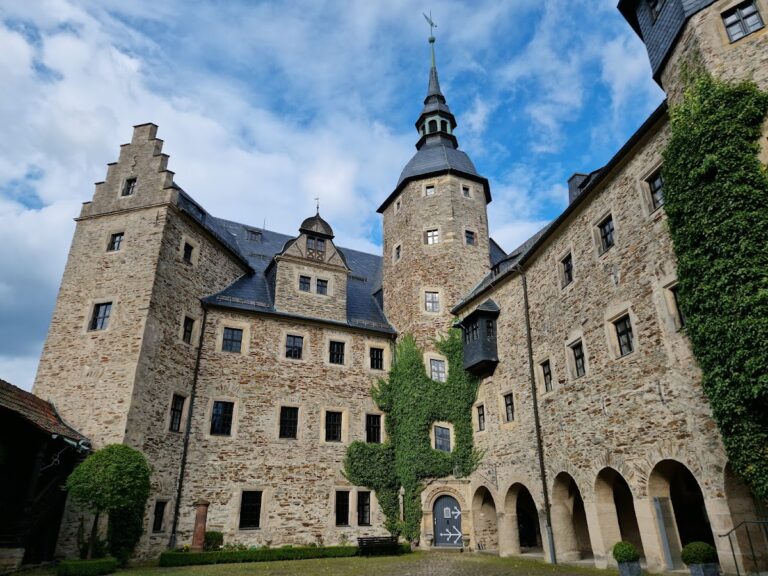
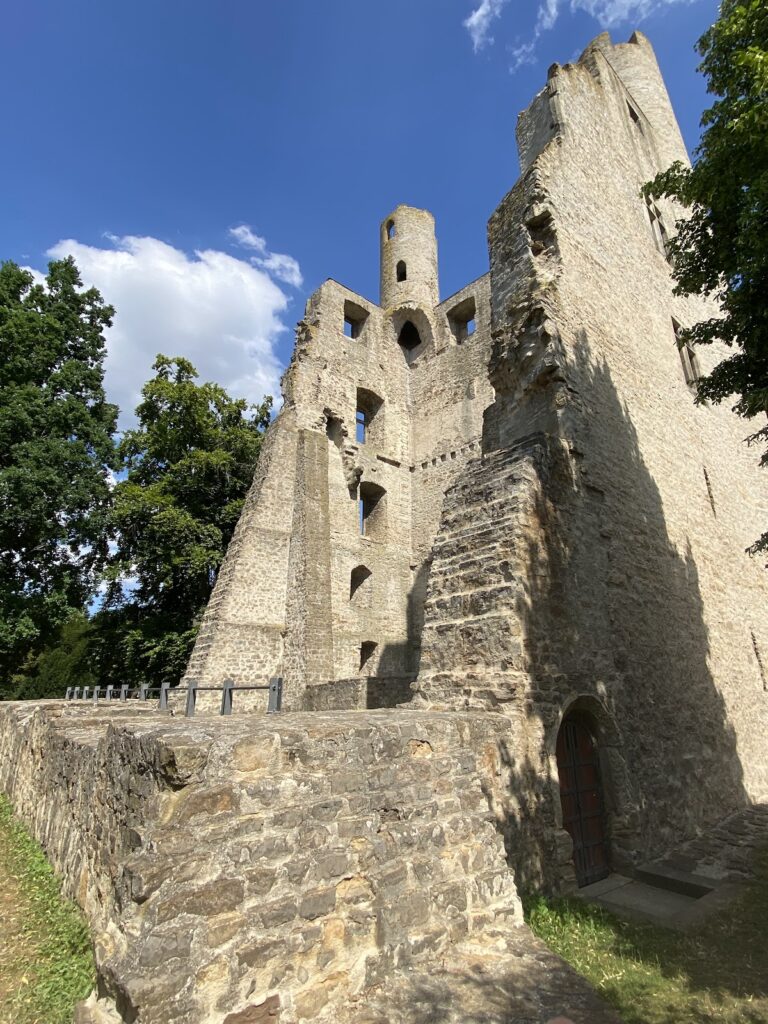
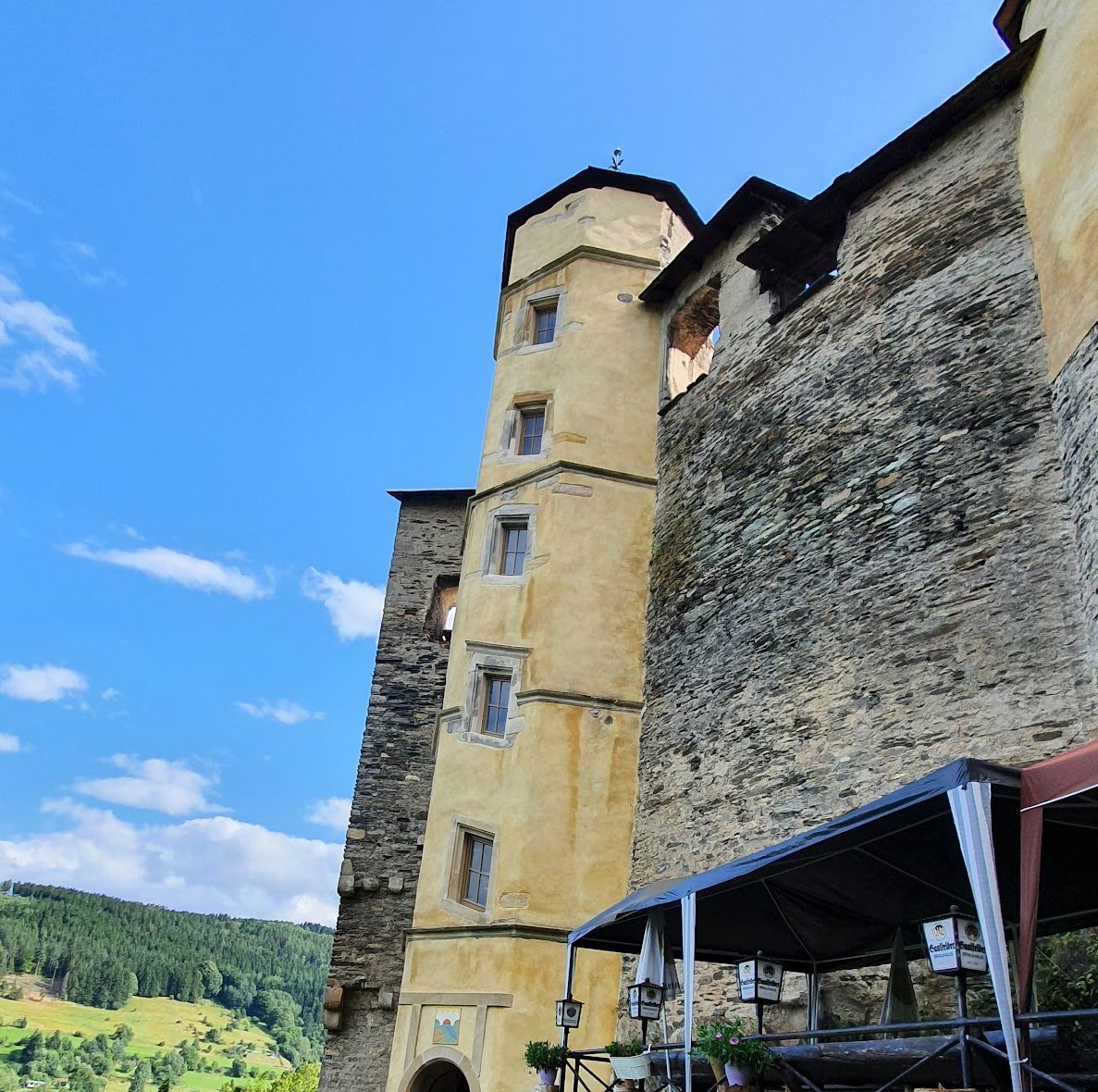
Schloss Wespenstein occupies a projecting spur at about 435 metres above sea level, a hilltop position extending from higher ground that could control approaches and routes. The complex survives as a ruin, although several buildings remain partly preserved. Its surviving elements include the castle chapel, the administrative building, the Fronfeste prison, and a cistern. Some damaged roof sections have been repaired, while parts of the enclosing walls have collapsed.
Surviving buildings
Castle chapel
The castle chapel is one of the surviving buildings within the ruined complex. Martin Luther preached there in 1530 during his stay at Wespenstein. The chapel has been renovated and continues to be used for weddings and religious services.
Administrative building
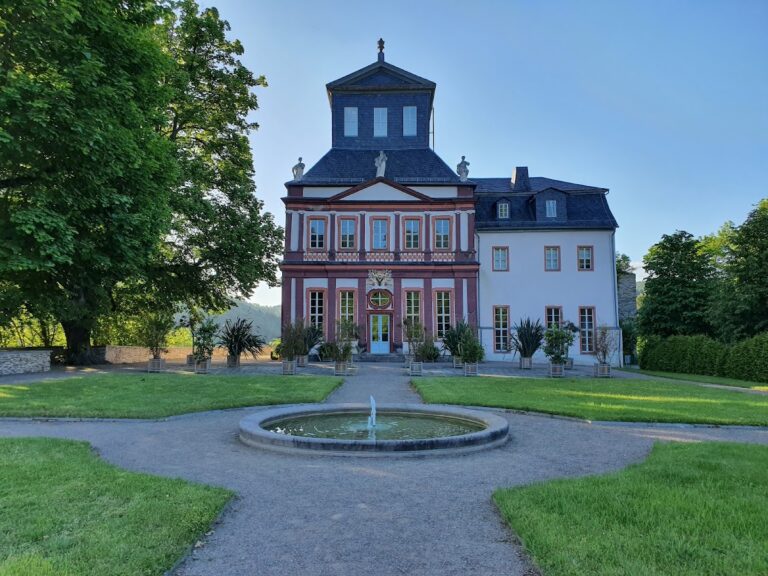
The administrative building survives as part of the castle remains and has the architectural appearance given to it between 1826 and 1829. Its later form reflects the period when Wespenstein housed the town and regional court and subsequently the Gräfenthal local court.
Fronfeste and cistern
The Fronfeste, a prison or detention building associated with the court and administrative complex, is among the preserved structures. A cistern also survives within the castle. Together with the chapel and administrative building, these features represent the castle’s religious, administrative, and custodial functions.
Walls, gate, and buried rooms
Enclosing walls and former main gate
Most of the enclosing walls around the former main entrance and on the eastern side have collapsed. Above the former main gate, the Pappenheim coat of arms dates to around 1530. Gate arches, stair landings, and door lintels have been uncovered and reconstructed in masonry, helping to clarify parts of the former circulation and entrance arrangements.
Stair tower and bailiff’s garden
Rooms in the structures around the stair tower and the bailiff’s garden are filled with rubble. Clearing work has exposed buried rooms and vaults, and their positions and functions are being examined through archaeological documentation. These spaces form part of the incompletely preserved fabric surrounding the surviving buildings.
Nearby sites