Roßla Castle: Seat of the Princes of Stolberg-Roßla
Site at a Glance
- Rating
- 4.4
- Popularity
- Very Low
- Country
- Germany
- Primary era
- Medieval
- Eras represented
- Medieval, Early Modern, Modern
- Civilizations
- Holy Roman Empire, Kingdom of Prussia
- Site type
- Domestic
- Remains
- Castle
On this page9 sections
History
Roßla Castle is a castle in Roßla, Saxony-Anhalt, Germany, rebuilt around 1420 for the Counts of Stolberg and later enlarged with a Neoclassical east wing. It became the seat of the Princes of Stolberg-Roßla, a branch of the German noble House of Stolberg.
Stolberg ownership and rebuilding
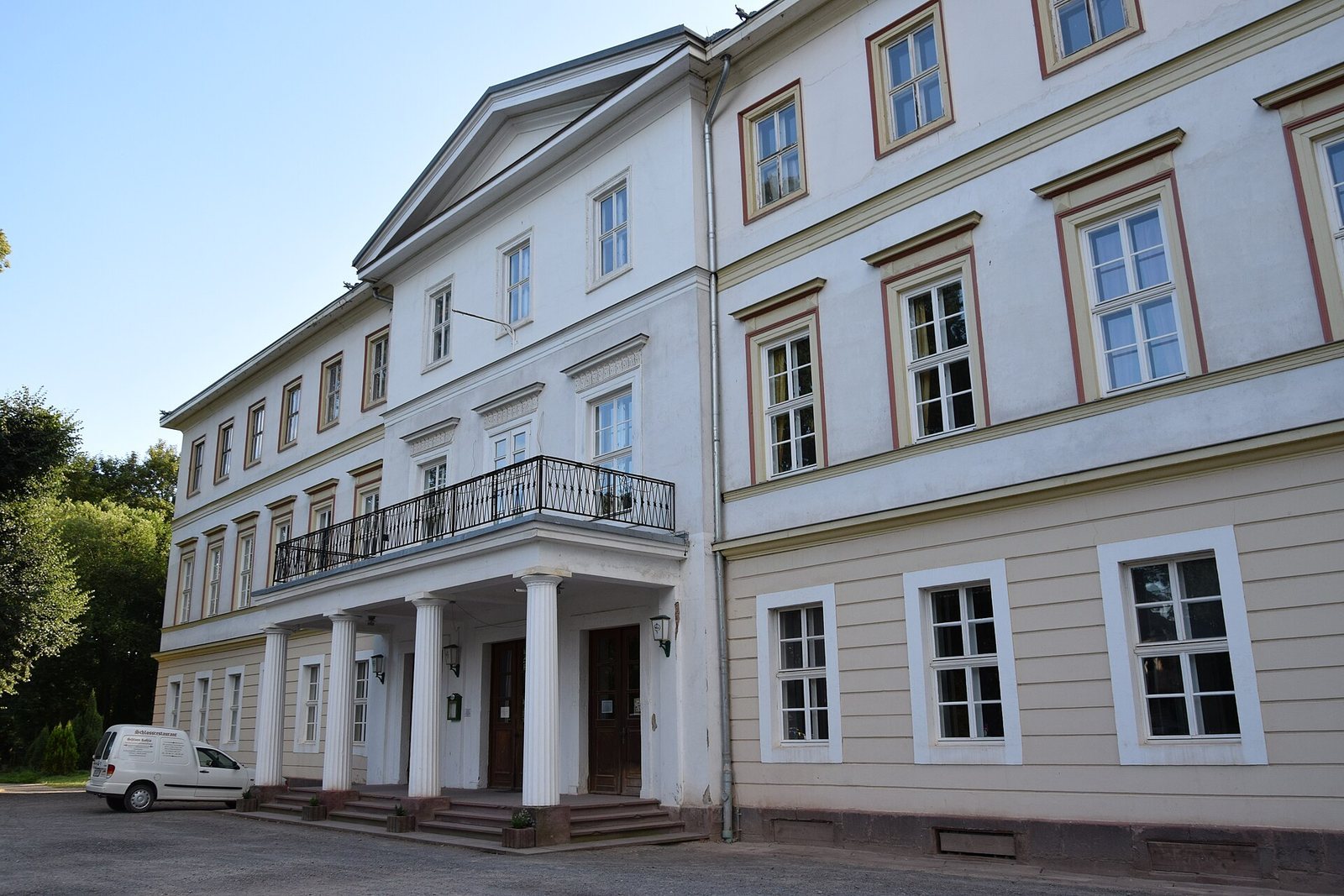
In 1341, the Counts of Hohnstein transferred Roßla Castle to the Counts of Stolberg. Around 1420, Count Botho zu Stolberg the Elder oversaw its rebuilding. The castle underwent a major renovation in 1766, and in 1826 August zu Stolberg-Roßla added an east wing in the Neoclassical style, which drew on ancient Greek and Roman forms.
Princely residence and wartime library
The castle remained the seat of the Princes of Stolberg-Roßla until 1945. After an air raid destroyed the Technical College of Berlin’s library in November 1943, the castle became an alternate location for the collection. Its information office continued preparing literature catalogs and responding to research requests there.
Nationalization and later use
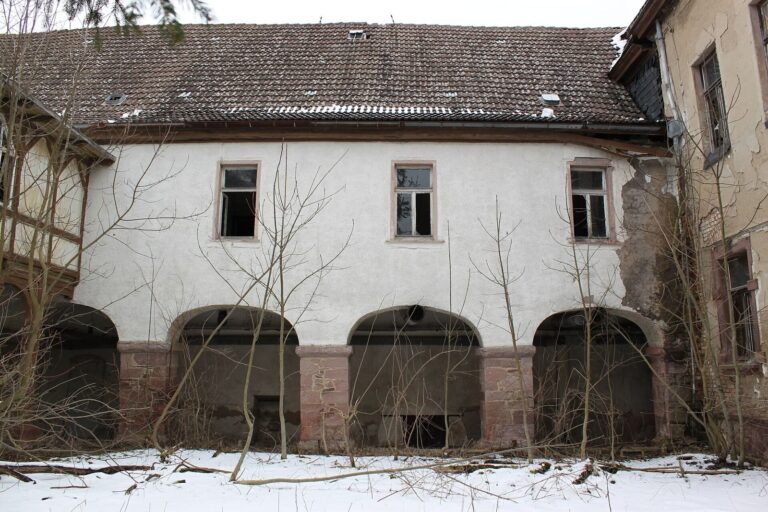
In 1945, the princes were expelled from the castle and their lands, and both were nationalized. From 1945 to 1990, the castle served as a cultural center; part of its ground floor was also used as a kindergarten in the early 1950s. It later stood vacant until a nonprofit association leased it in 2007 and established a restaurant, daycare, and multigenerational center. The municipality still owns the castle, which local cultural associations also use for meetings.
Remains
Castle and interior
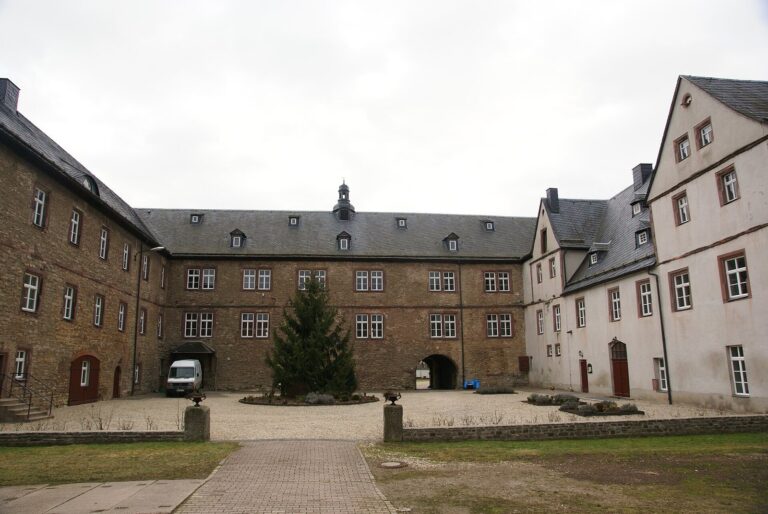
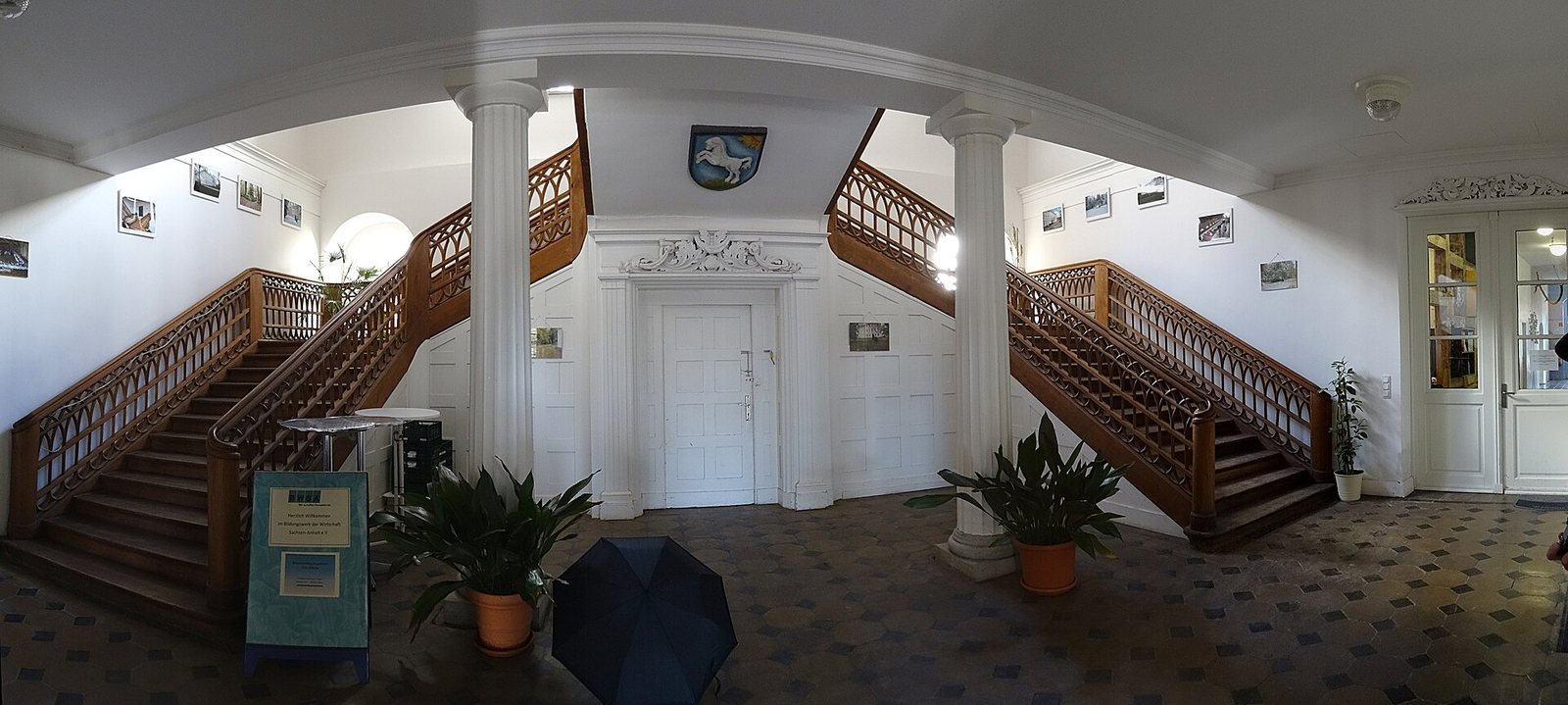
The castle has four wings arranged around a trapezoidal courtyard. Its east wing has a 15-part facade, a central section that projects outward, and a raised balcony supported by columns. A high tower rises above the complex, topped by a lantern turret and spire. The staircase has two flights. A water moat once encircled the castle complex and was filled in roughly two centuries after the rebuilding around 1420.
Associated buildings
West of the castle stands the former princely revenue and estate office, called the Rentkammer. This half-timbered building dates to around 1720 and is in the Baroque style, which flourished in Europe during the 17th and 18th centuries. Opposite the castle are the stepped-gabled buildings known as the Fronfeste, a historical term for a jail, and a coach house.
Park and church
An English-style park surrounds the site and contains rare tree species. Its area is given as six Morgen; a Morgen was a traditional unit of land area whose size varied by region and period. Trinity Church stands at the park’s northern entrance. Its name refers to the Christian doctrine that one God exists as three persons.
Collections
The castle housed numerous art treasures and a library of about 30,000 volumes. By mid-1944, the library held 30,000 books and journals, including more than 10,000 funeral sermons and thousands of printed sheets reproducing sermons by Martin Luther, the German theologian whose writings helped shape the Protestant Reformation.