Greifenberg Castle: A Former Fortress and Noble Estate in Bavaria
Site at a Glance
- Rating
- 4
- Popularity
- Low
- Country
- Germany
- Primary era
- Early Modern
- Eras represented
- Medieval, Early Modern
- Civilizations
- Duchy of Bavaria, Electorate of Bavaria, Holy Roman Empire
- Site type
- Domestic
- Remains
- Castle
On this page6 sections
History
Greifenberg Castle is a former fortress in the municipality of Greifenberg, Upper Bavaria, Germany, near Lake Ammersee. Its origins are attributed to the Counts of Andechs, a medieval noble house whose lands lay between the Amper and Paar rivers in the first half of the tenth century. Gripho de Andechs is also regarded as a possible founder and acquirer of the fortress.
Andechs origins and the Greifen family
Gripho was recorded in 1230 as a retainer and feudal vassal of Duke Otto II of Merania, a medieval duchy associated with the Andechs family. In 1257, he was named as Gripho de Greifenberg. After the last Count of Andechs died in 1248, the fortress passed by inheritance to one of the counts’ ministerial families. Ministerials were dependent nobles who served a lord, often in administrative or military roles. Grypho, also written Gripho, Griffo, and Greiff, was a common baptismal name in the family. Greif became its surname, the inherited castle took the name Greifenberg, and its members called themselves the Greifen von Greifenberg.
In 1396, Hans der Greif joined King Sigismund of Hungary’s crusading campaign against Ottoman forces that had invaded Hungary. The crusaders were defeated at Nicopolis in the Wallachian Danube plain. Sultan Bayezid I ordered thousands of prisoners executed, and Hans was probably among them. He was described as the last castle holder of the Greif name. A possible family connection to Eberhard, abbot of Wessobrunn from 1414 to 1416, is uncertain: an abbots’ list names Eberhard Stopfer as abbot during the same years.
Bavarian ducal control and the Perfall family
The Schweiker family of Gundelfingen inherited Greifenberg and divided its holdings in 1404. Georg von Gundelfingen held the fortress and sold it to the Bavarian ducal family in 1410. In 1468, Duke Albrecht IV transferred Greifenberg to his brother Wolfgang in return for Wolfgang giving up his claim to govern. Wolfgang received Greifenberg, Hegnenberg, and Planegg in 1477. Based at Lichtenberg, he appointed Erhard von Perfall as castle bailiff, an official responsible for the estate. In 1478, Wolfgang transferred the castle, its administrative district, and its manorial estates to Erhard for 4,000 guilders. The Barons von Perfall have occupied the castle since then.
In 1492, Albrecht IV’s forces stormed Greifenberg and Hegnenberg after Wolfgang joined the Löwler League, an association of Bavarian nobles opposed to Albrecht. Following the division of Bavaria-Landshut, a late-medieval duchy ruled by a branch of the Wittelsbach dynasty, Wolfgang’s possession of Greifenberg, Lichtenberg, and Hegnenberg was confirmed in 1506. In 1507, the ducal brothers sold the Greifenberg manorial estate to Erhard von Perfall as free and unencumbered property.
The Perfall lordship and later history
A member of the Perfall family held the lordship through the nineteenth century. As holder of the Hofmark, a manorial estate with local jurisdiction, the family was also responsible for its patrimonial court, a form of justice exercised by an estate’s lord. The court’s jurisdiction included Beuern, Eching, Pflaumdorf, and Oberschondorf, as well as part of Unterschondorf. It was dissolved in 1849.
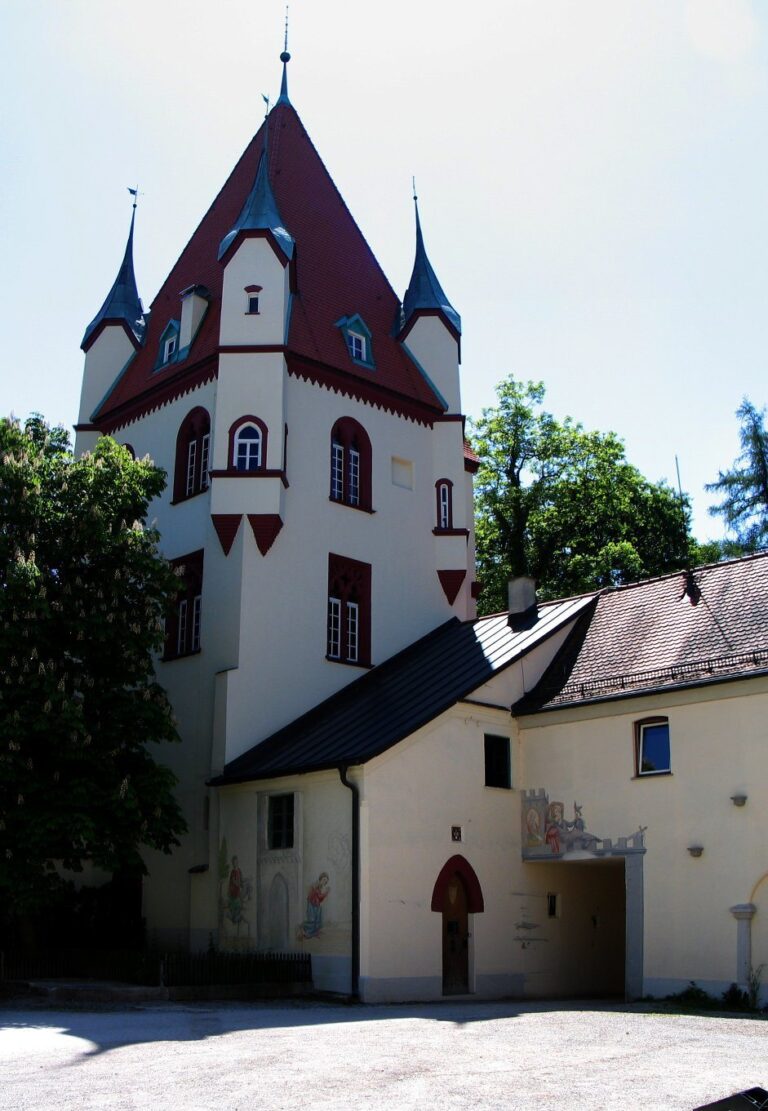
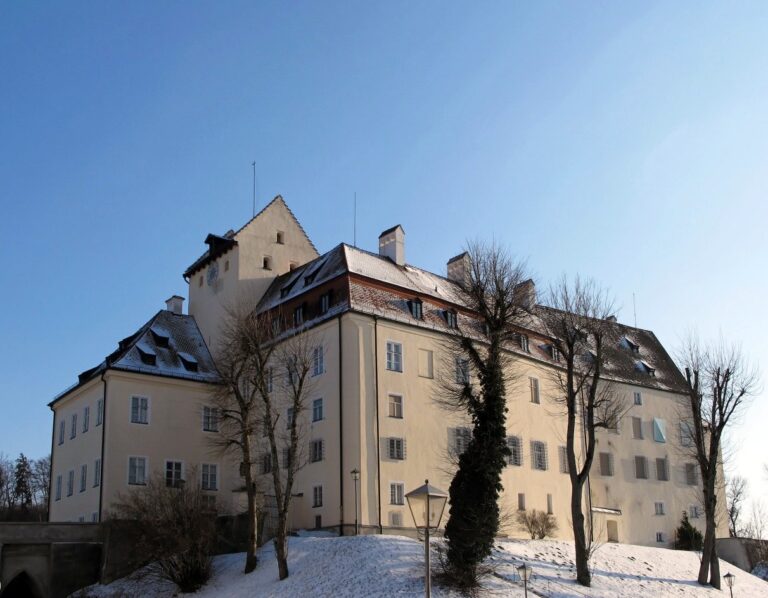
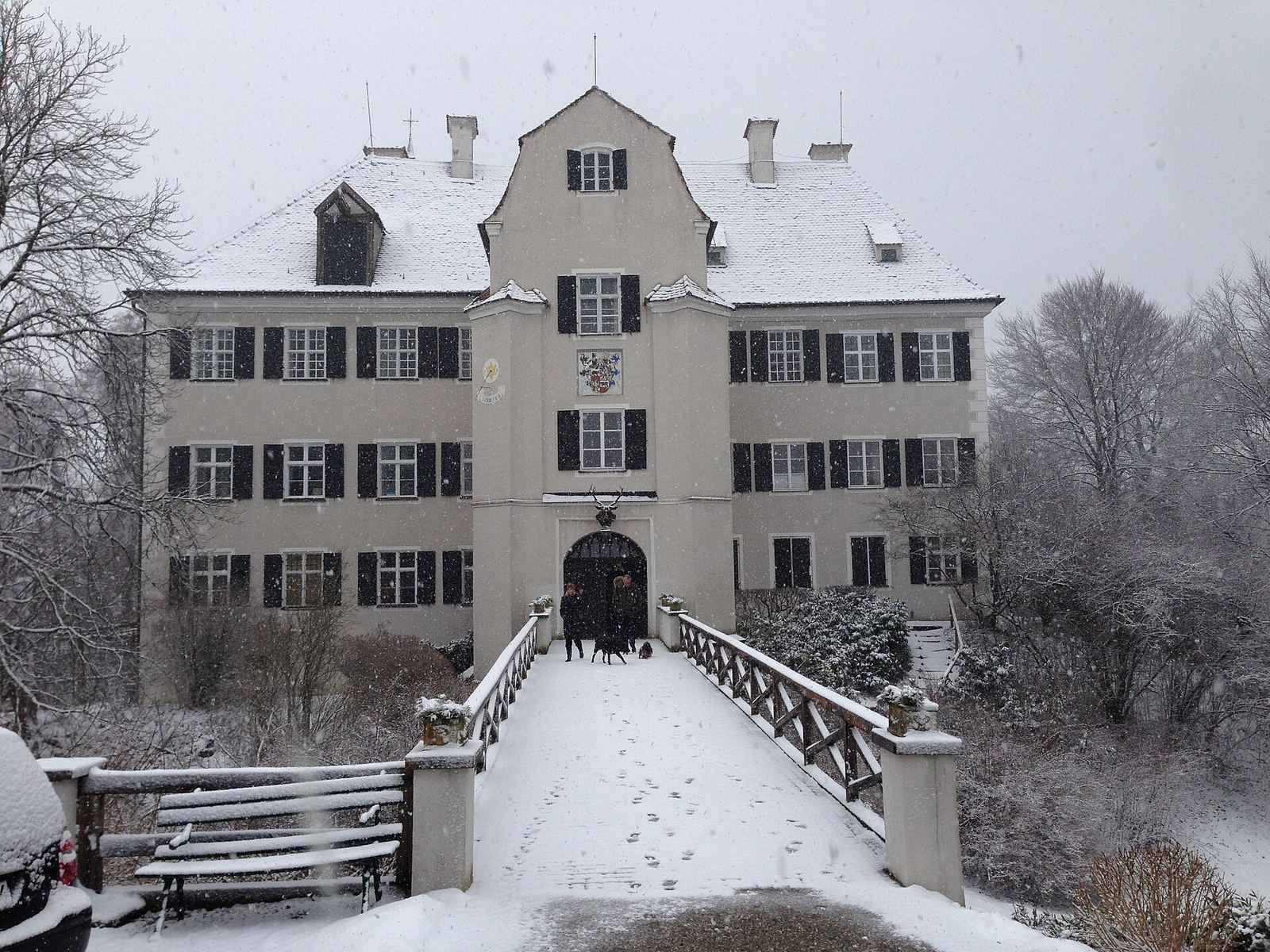
On 2 February 1760, fire destroyed the southern part of the main building, including its chapel. The castle was rebuilt, creating the form that survives today. Napoleon I stayed there in October 1805 during the War of the Third Coalition, a conflict between Napoleonic France and a coalition that included Austria and Russia. The castle is protected as an architectural monument, and the area also has archaeological monument status.
Remains
The rebuilt castle is a four-wing complex beneath a single hipped roof, which slopes downward on all sides.
Subsurface remains
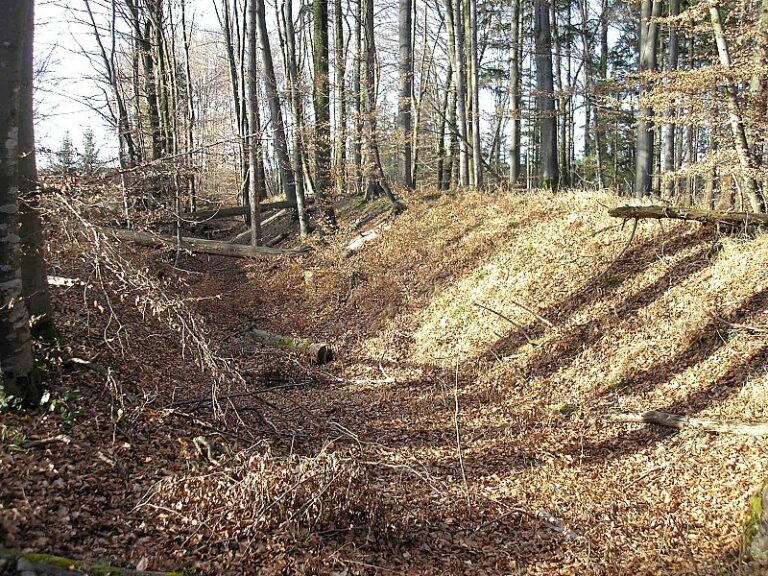
Medieval and early-modern remains lie beneath the area of the castle and its predecessor buildings, including the forecourt farmyard.