Eicks Castle: A Baroque Moated Complex in Germany
Site at a Glance
- Popularity
- Medium
- Country
- Germany
- Primary era
- Early Modern
- Eras represented
- Medieval, Early Modern
- Civilizations
- Holy Roman Empire
- Site type
- Domestic
- Remains
- Castle
On this page14 sections
History
Medieval lordship
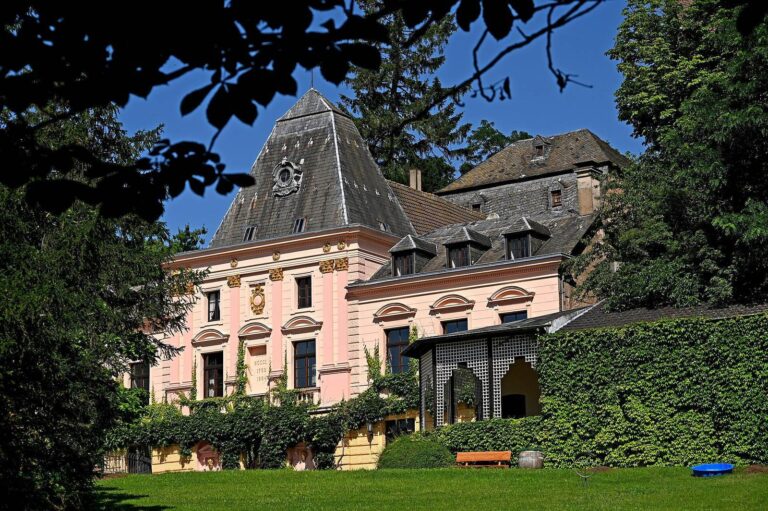
Eicks Castle is a late-Baroque moated complex in Germany, built by Hermann Dietrich von Syberg and Anna Freiin von Pallandt. Work began in 1680 and was completed in 1697. Baroque was a European artistic and architectural style that flourished especially in the 17th and 18th centuries.
The lordship of Eicks was first recorded in 1344. A medieval manorial estate occupied the site, meaning a landholding where the lord exercised authority over the estate and its dependents. Johann von Eicks held part of Eicks with jurisdiction of its own. The medieval water castle was partly destroyed in 1365.
Rebuilding and changing ownership
After the Eicks counts’ family died out, the castle passed between owners through inheritance divisions and sales. Jürgen von Syberg-Wischlingen acquired it in the 16th century. Hermann Dietrich von Syberg and his wife Anna Freiin von Pallandt, heiress to the houses of Wildenburg and Wachendorf, later built the present complex, incorporating usable parts of the medieval castle.
From 1701, Eicks came under the feudal overlordship of the Counts of Manderscheid-Blankenheim. This meant that the counts held superior authority over the land as a fief.
Eighteenth century and continuing occupation
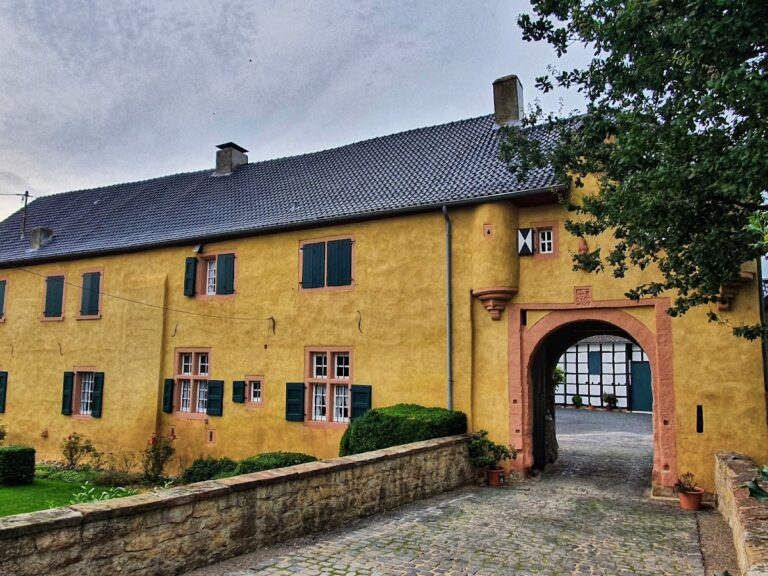
A new gatehouse was built in 1786. In 1794, the last feudal lady, Augusta Countess von Sternberg-Manderscheid, fled to Prague; the castle and its lands remained privately owned. The Syberg family has held the castle for more than 500 years, and descendants still live there.
In 2000, the former tithe barn was restored and converted into a café. A tithe barn stored tithes, payments traditionally made as a share of agricultural produce.
Remains
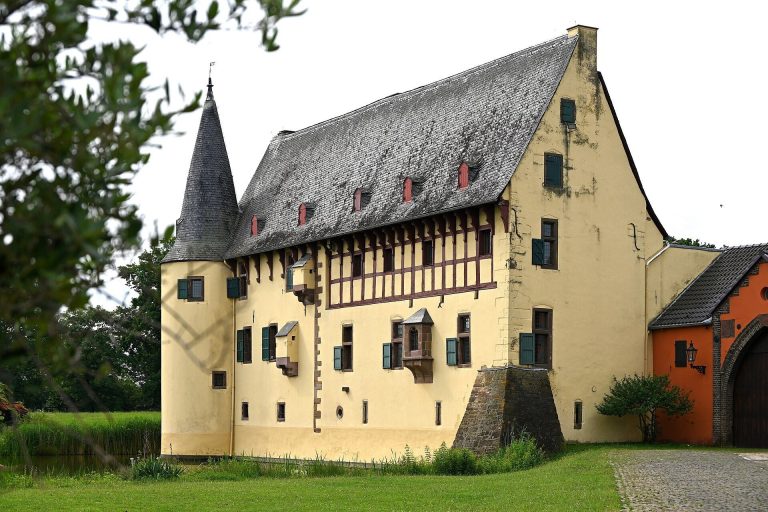
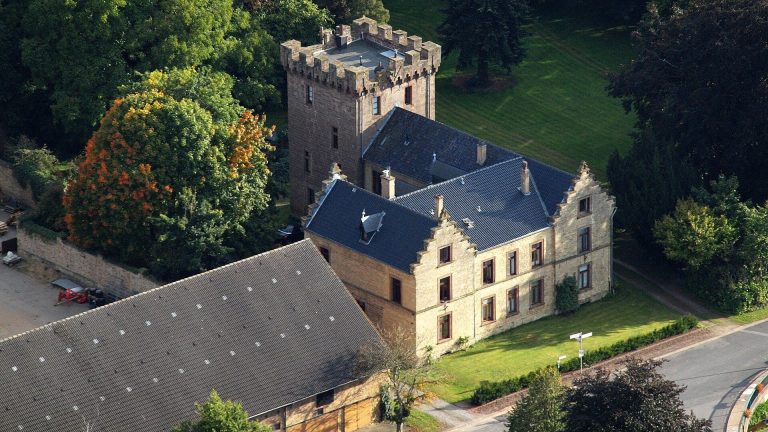
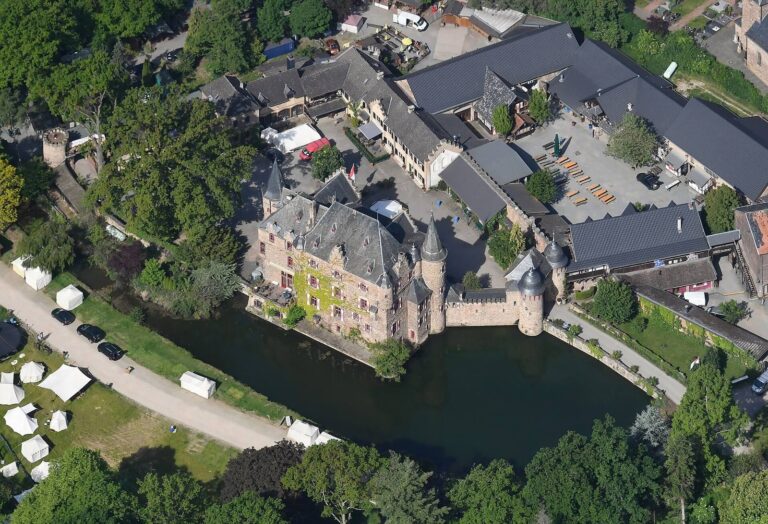
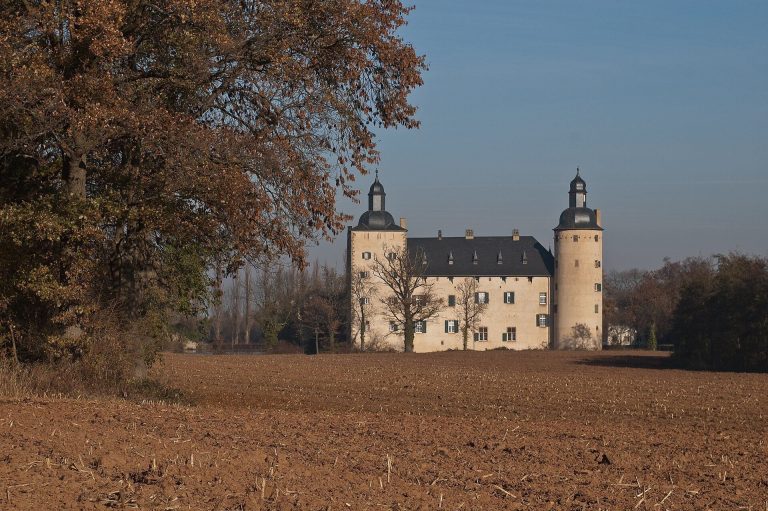
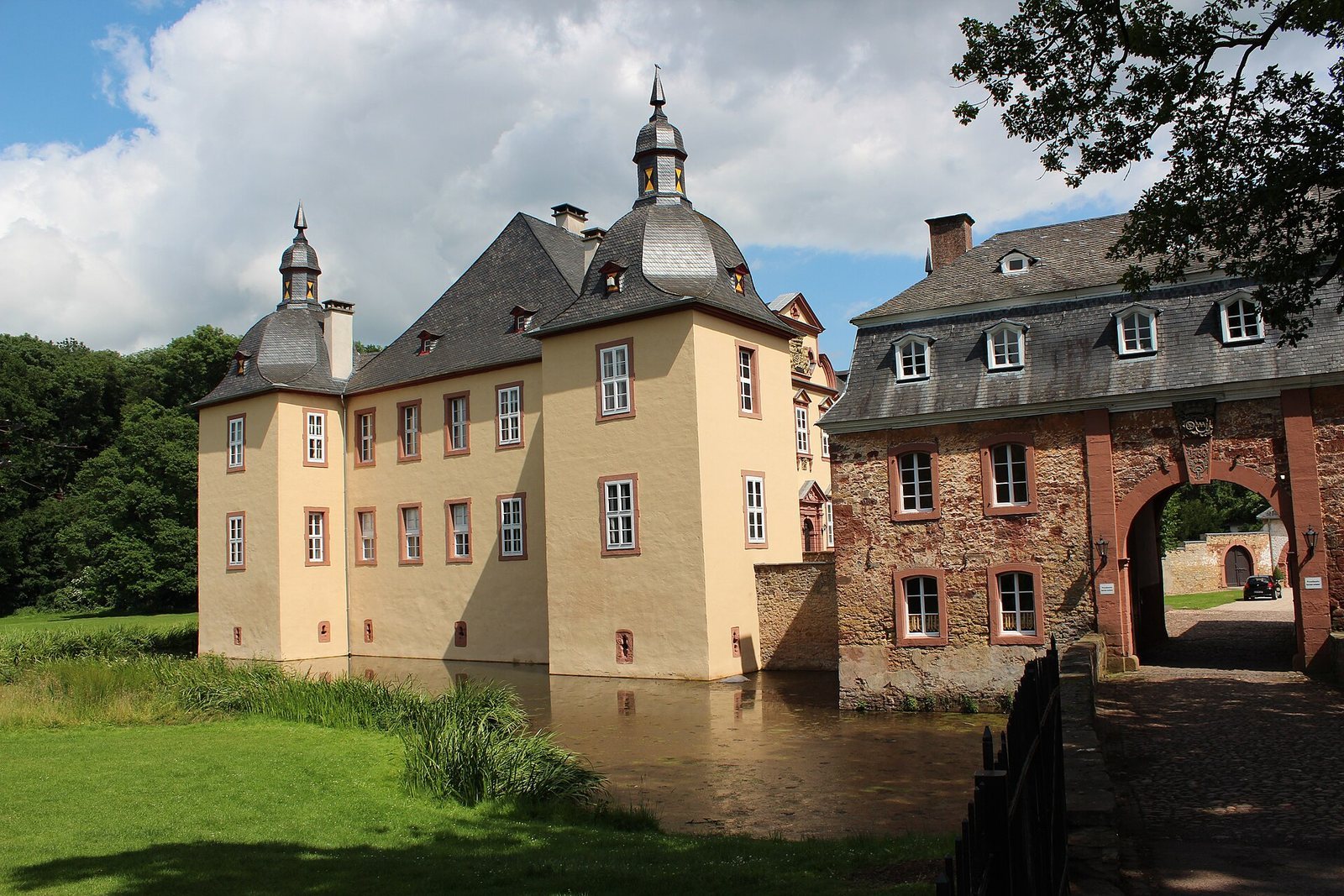
The moated complex has two main parts: a turreted outer bailey, an outer fortified court, arranged in three wings, and a separate manor house. Usable medieval building fabric was incorporated into the later complex.
Principal buildings
Outer bailey
The outer bailey forms the three-winged, turreted part of the complex. Its eastern passage bears an alliance coat of arms, combining the heraldic emblems of spouses or families.
Manor house
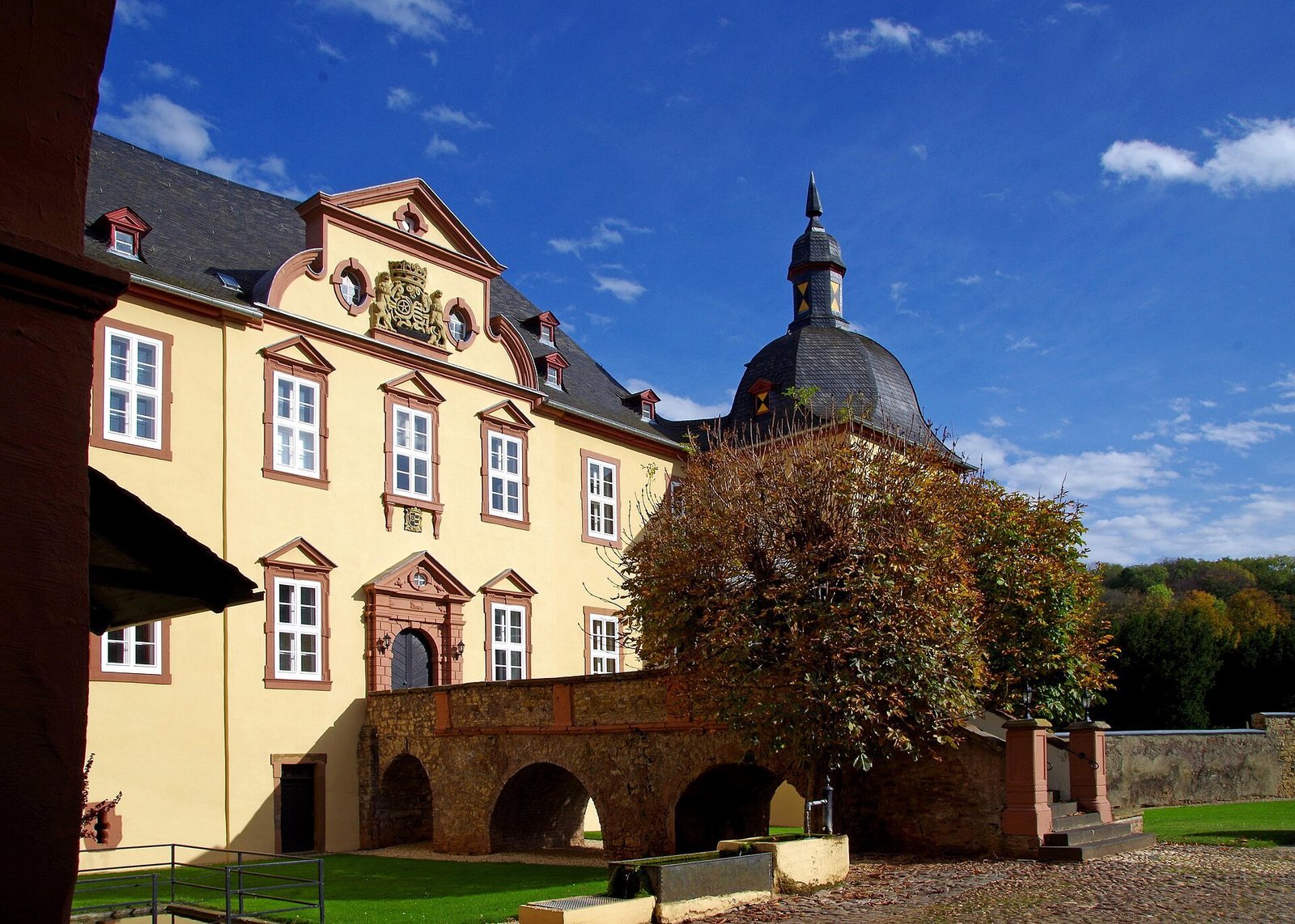
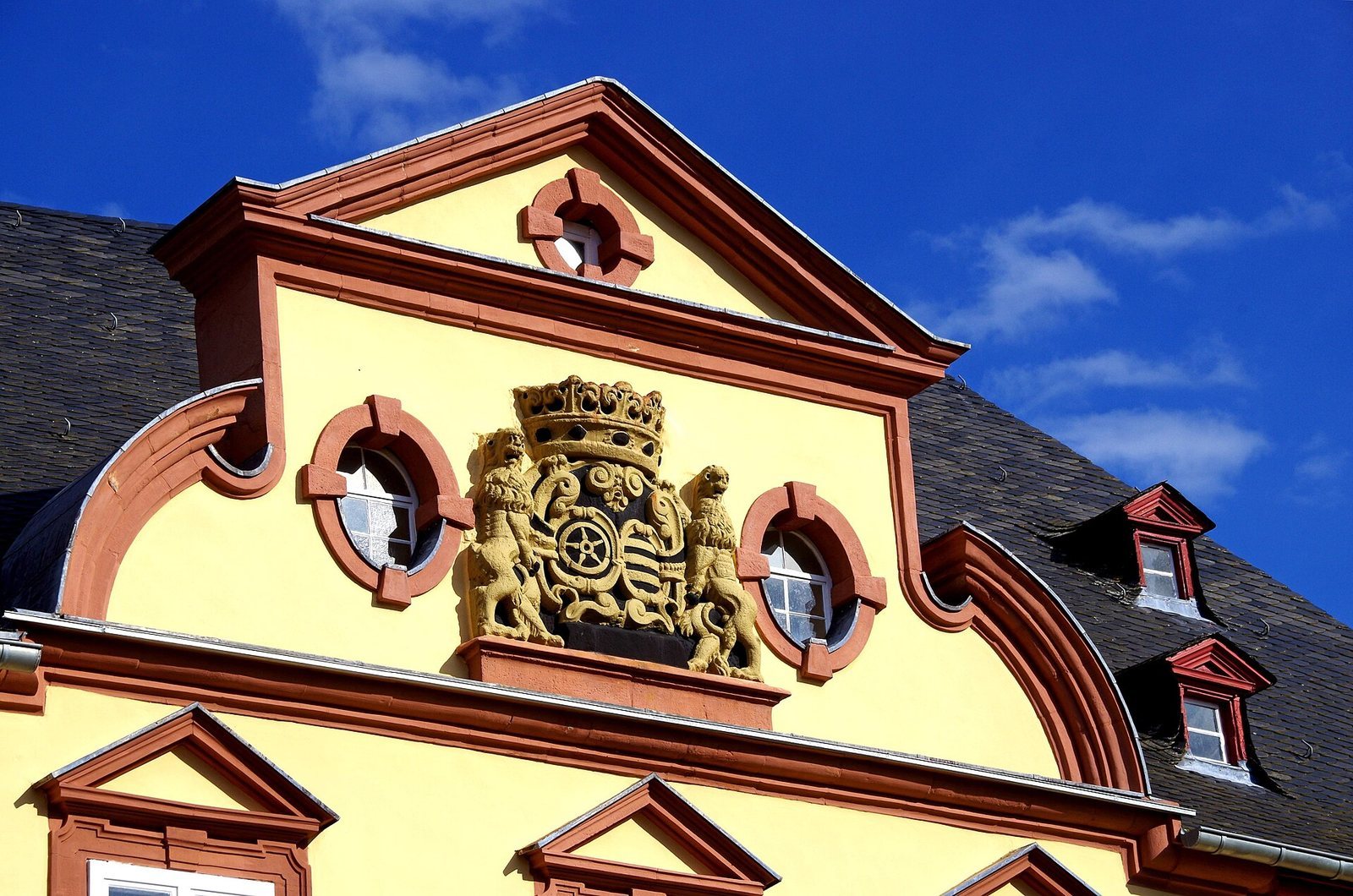
The manor house has an irregular quadrilateral plan and four projecting corner towers. An alliance coat of arms appears on the gable above its main façade. It combines the arms of Hermann Dietrich von Syberg-Eicks and his wife, Anna Franziska Johanna von Pallandt zu Wachendorf und Wildenburg. The Syberg emblem is a gold wagon wheel with five spokes against a black background. The more elaborate gable arms also have a rank crown and lions beside the shield.
Heraldry and commemorative features
1786 gatehouse arms
Above the gatehouse is a marriage coat of arms for Clemens August von Syberg-Eicks and his wife, Sophia Franziska von Bottlenberg, called Schirp. Clemens served as a chamberlain, a court official, and a privy councillor, a senior adviser, in the Electoral Palatinate, a territory of the Holy Roman Empire ruled by an elector. He was also Prussian district administrator for Gemünd and later a privy government councillor, directed the assembly of subordinate lords, and was a second-class Knight of the Order of the Red Eagle, a Prussian order of chivalry. Sophia was heiress to the noble houses of Scheppen and Luntenbeck and to the estates of Scheppen and Witten.
Bridge statue and arms
A bridge over the Bruchbach connects Eicks with the castle. On the base of its statue of Saint John of Nepomuk is an alliance coat of arms for Ferdinand Adolf Alexander Anton von Syberg-Eicks and his wife, Adriana Carolina von Harff zu Drimborn. The arms are dated 1736. Ferdinand was an Electoral Palatinate chamberlain and privy councillor, and chief administrator of Münstereifel and Tomberg. John of Nepomuk was a 14th-century Bohemian priest venerated as a Catholic saint and commonly associated with bridges.
Garden and estate buildings
Baroque garden
The garden has geometrically arranged paths edged with boxwood. It can be seen from outside across the moat.
Former tithe barn
The restored former tithe barn now serves as a café.