Savina Monastery: A Serbian Orthodox Monastic Complex in Montenegro


Site at a Glance
- Rating
- 4.8
- Popularity
- Medium
- Country
- Montenegro
- Primary era
- Early Modern
- External website
- Open
- Eras represented
- Medieval, Early Modern, Modern
- Civilizations
- Serbian, Venetian
- Site type
- Religious
- Remains
- Monastery
On this page9 sections
History
Savina Monastery is a Serbian Orthodox monastery in Montenegro, located near Herceg Novi on the Bay of Kotor. It belongs to the Metropolitanate of Montenegro and the Littoral, the Serbian Orthodox Church jurisdiction covering Montenegro and the coastal region known as the Littoral. The monastery developed through uncertain medieval origins, later rebuilding, and its role in preserving the identity of the Serbian Orthodox community in the Bay of Kotor, particularly during the eighteenth century.
Medieval Origins and Early Records
The foundation date and founder of Savina remain uncertain. Tradition connects the monastery with the eleventh century and Jovan Vladimir, an early medieval ruler and saint venerated in the Serbian Orthodox tradition. The Small Church has also been assigned a date in the mid-fifteenth century on stylistic grounds, and the monastery is associated with Stjepan Vukčić Kosača, the fifteenth-century Bosnian nobleman whose title of herceg gave Herceg Novi its name. The earliest surviving written mention of Savina dates from 1648.
The monastery’s later history was closely linked with Tvrdoš Monastery in Herzegovina. At the end of the seventeenth century, monks expelled from Tvrdoš arrived at Savina and began a period of restoration. They also brought relics and other sacred objects from Tvrdoš. This rebuilding continued until 1831, shaping the complex and its religious collections.
Expansion in the Eighteenth and Nineteenth Centuries
The Great Church of the Dormition of the Mother of God was constructed between 1777 and 1799 by Nikola Foretić of Korčula. Contributions for the work were collected in Serbian Vojvodina and Russia. In 1797, the monastery church was decorated and enclosed externally. The church and monastery remained active within the religious life of the Bay of Kotor. In 1838, Savina was the residence of Makarius Grušić, who served as episcopal pro-vicar for the Bay of Kotor and as an abbot.
The monastery also received practical care from members of the local community. In 1858, Nikola Andrović, a Serbian Catholic pharmacist from the area, repaired the clock on the church tower at his own expense. The restoration begun in the late seventeenth century was considered complete in 1831, while later repairs and additions continued to shape the complex.
War, Collections, and Modern History
Savina suffered a burglary in October 1937 that caused material damage estimated at 1.5 million dinars. Its religious and cultural holdings include icons by Russian, Italian, and Cretan artists, while the library preserves more than 5,000 rare manuscripts. Among them is a unique handwritten Gospel dated 1375. Archaeological work has also been carried out at the Church of St. Sava under the direction of the Regional Museum of Herceg Novi.
The monastery remains associated with the Serbian Orthodox Church and its medieval Serbian traditions. The Nemanjić dynasty, a medieval Serbian ruling family closely connected with the formation of Serbian Orthodox institutions, is represented in the monastery’s relic collection. On 6 May 2005, Serbian film director Emir Kusturica was baptized at Savina and received the name Nemanja Kusturica.
Remains
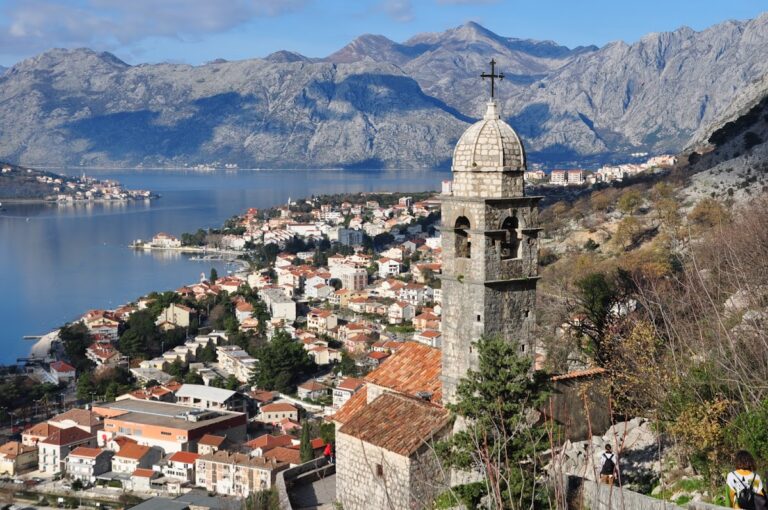
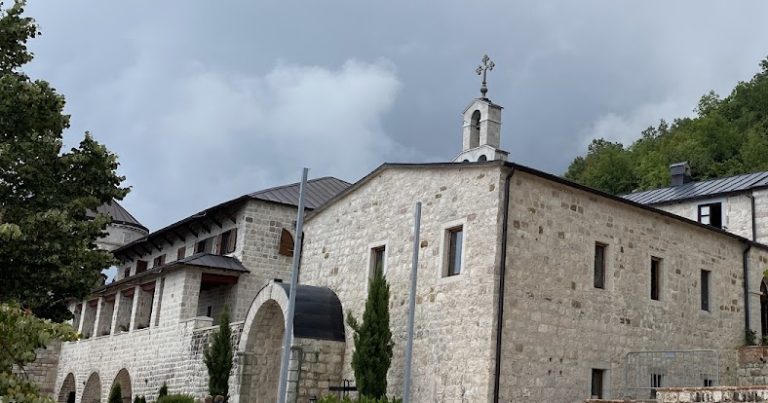
Savina lies near the shore among Mediterranean and woodland vegetation on the outskirts of Herceg Novi. The complex includes the Small and Great Churches of the Dormition of the Mother of God, a residential and service building with a treasury, and the Church of St. Sava outside the principal enclosure. The Church of St. Sava stands about 300 metres away, reached by an uphill stairway near the upper cemetery.
The Small Church
The Small Church of the Dormition of the Mother of God measures approximately 10 metres in length and 6 metres in width. It is a single-nave church with a semicircular apse and a small bell tower. Its date remains debated: tradition places it around 1030, while its architectural and painted decoration has also led to a proposed date in the mid-fifteenth century. Rebuilding began at the end of the seventeenth century and was completed in 1831.
The church contains frescoes from several periods. The oldest visible paintings, around the apse and transverse beams, date from the mid-fifteenth century and were made by the Kotor painter Lovro Dobričević. Their style combines Byzantine and Gothic elements. Further layers date from the second half of the sixteenth century and from 1831. The surviving wall paintings include Saint George, the Descent of the Holy Spirit upon the Apostles, scenes from the Passion cycle, Saint Sava, Saint Simeon the Myrrh-streaming, and Saint John the Baptist.
The iconostasis, the screen of icons separating the sanctuary from the nave, was assembled over different periods. Dimitrije Daskal made the royal doors, the central entrance to the sanctuary, and the large crucifix above them in 1703. His son Rafailo painted the icon of the Dormition of the Mother of God, the Eastern Christian observance of the Virgin Mary’s death and assumption into heavenly glory. Two other local icons were produced by Greek masters during the first half of the eighteenth century.
The Great Church
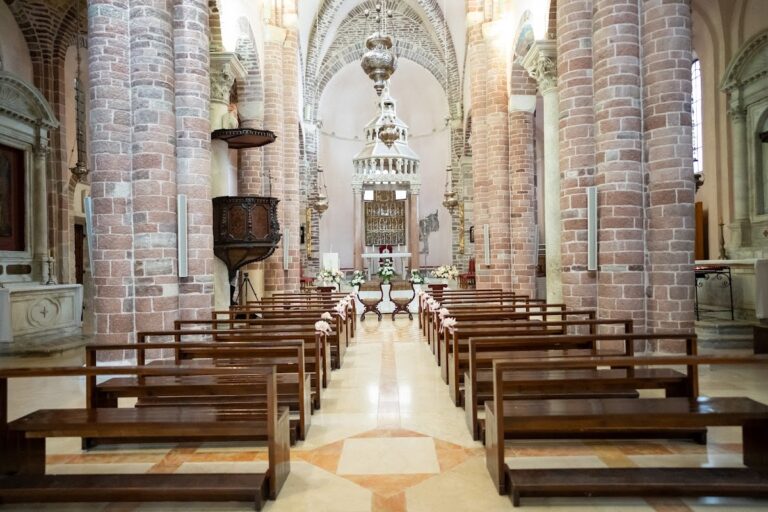
The Great Church of the Dormition is a single-nave building with a three-level bell tower on its western side. Its architecture brings together Romanesque, Byzantine, Gothic, and Baroque traditions. A rose window and semicircular arches appear alongside an octagonal dome over the nave, giving the building a distinctive combination of forms from different architectural periods.
Inside, the church has a Baroque iconostasis made by Simeon Lazović and his son Aleksej between 1795 and 1797. It is approximately 10 metres high and contains six rows of icons. Among its works is a highly valued Serbian Baroque icon of the Protection of the Mother of God, an iconographic type that is rare. The church also contains frescoes, including a portrait of Peter the Great.
The Church of St. Sava and the Cemetery
The Church of St. Sava stands outside the principal monastery complex. Tradition attributes its construction to the efforts of Saint Sava between 1169 and 1236. The existing church, however, was built on the site in the fifteenth century, and its porch was added during the nineteenth century. Saint Sava was the first archbishop of the Serbian Orthodox Church and one of its principal saints.
The cemetery contains a pyramid-shaped monument commemorating local patriots executed by Austro-Hungarian authorities during 1914 to 1918. Russians killed in the early nineteenth-century war against the French in the Bay of Kotor are buried around the Church of St. Sava above the monastery.
Treasury and Sacred Objects
The monastery treasury preserves old books, documents, icons, vestments, and other liturgical objects. Specifically noted pieces include a crystal episcopal cross dated 1219, a brocade shroud embroidered with gold and silver by Princess Despina in 1659, portraits of Peter the Great and Catherine II, and the Savina icon of the Mother of God.
Several relics are associated with the Nemanjić period, including those of Jelena Nemanjić Šubić and a cross associated with Saint Sava. A locally venerated icon of the Mother of God was traditionally regarded as wonder-working after a Venetian galley sent to destroy the monastery was reportedly struck and destroyed by lightning below it. These relics, icons, manuscripts, and liturgical objects form part of Savina’s continuing religious and historical character.
Nearby sites