Sanctuary of Santa Maria di Piazza: A Marian Shrine in Busto Arsizio
Site at a Glance
- Country
- Italy
- Primary era
- Early Modern
- Eras represented
- Medieval, Early Modern, Modern
- Civilizations
- Duchy of Milan, French, Italian, Spanish
- Site type
- Religious
- Remains
- Sanctuary
On this page18 sections
History
Early churches and religious foundations
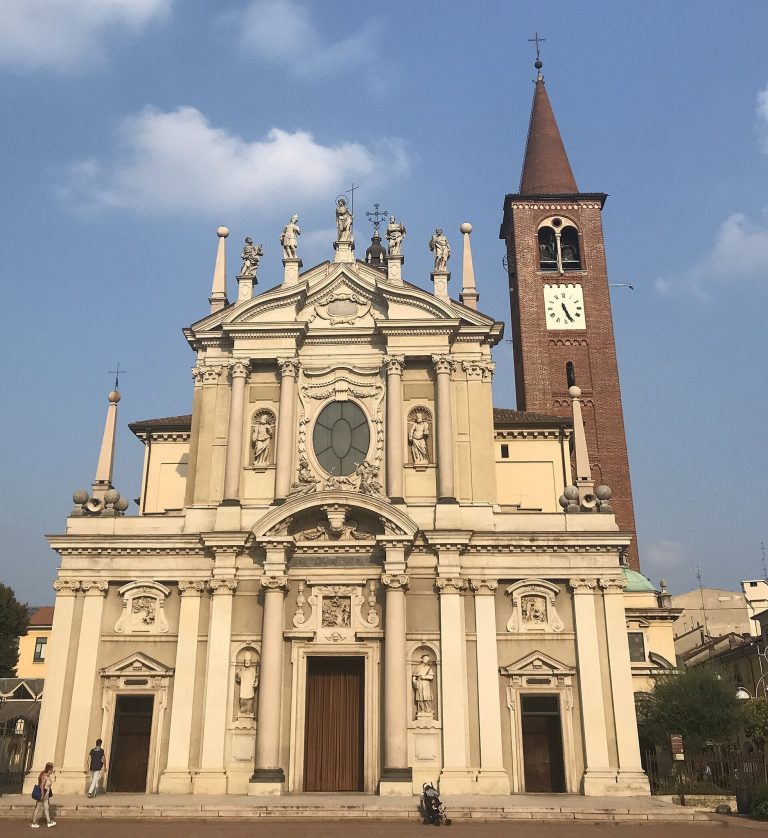
The Sanctuary of Santa Maria di Piazza is a Roman Catholic Marian shrine in Busto Arsizio, Italy, built by the town community between 1515 and 1522 during the Renaissance. A chapel stood on the site during the period of Christianization, followed by a church dedicated to the Virgin Mary. Around 1300, a list of Marian churches in the Diocese of Milan included the church among five places of worship in the Olgiate Olona parish district.
Seventeenth-century descriptions portray the earlier church as a square building about five metres across. It was probably a fourteenth-century rebuilding of the original chapel. In its Romanesque form, the church was consecrated in 1346 by Bishop Francesco, acting for Archbishop Giovanni Visconti. Antonio Crespi established a chaplaincy there in 1358, providing for a priest to celebrate daily services at an altar dedicated to Saint Catherine. Donato Crespi founded a second chaplaincy, dedicated to Santa Maria, in 1485. In 1504 the Milanese curia appointed Francesco Crespi Roberti, also known as de Robertis, to the position; he later became rector of the Basilica of San Giovanni Battista.
By 1399, the Consorzio di Santa Maria di Piazza was active as a religious association. Like similar groups in Busto Arsizio, it met in a church and collected members’ offerings, which could support members in difficulty, poor people, or churches.
Construction of the present sanctuary
Between the fourteenth and sixteenth centuries, Busto Arsizio expanded in wealth, population, and influence within the Duchy of Milan, a northern Italian state of the late medieval and early modern periods. The community undertook a new Marian church, constructed rapidly from 1515 to 1522; its foundation stone was laid in 1517. The initiative was promoted by Francesco and Bernardino Crespi, rectors of San Giovanni Battista and founders of its chapter library, together with the School for the Poor and the municipality. Galeazzo Visconti, Busto’s feudal lord from 1488, may also have supported the project, though his involvement is uncertain. Clergy and townspeople made further bequests, especially in 1524, when plague struck the town.
Construction was entrusted to Antonio da Lonate. The basic wall structure and central plan are associated with his work, while Tommaso Rodari is linked to the completion and embellishment, including the south and west portals. A design influenced by Bramante has also been attributed to the project, but that connection is uncertain.
Restoration and continuing devotion
A comprehensive restoration under Carlo Maciachini began in 1873. A project to raise the bell tower, commissioned in 1874, was delayed by disputes with the State Property Authority until work began on 23 March 1886. Further restoration between 1939 and 1943 altered the interior. The left side altar was removed, while the right altar and its Madonna dell’Aiuto image had been transferred to the Sanctuary of the Sacred Heart in Busto Arsizio in 1912. Frescoes above the south and west portals were detached during the later restoration and were not put back.
Local tradition tells that, during a severe plague, the Madonna dell’Aiuto image was carried through the town and raised its right hand, after which the disease ended. Residents are said to have displayed the statue again in memory of the event. Cardinal Andrea Carlo Ferrari crowned it in 1895, and Cardinal Alfredo Ildefonso Schuster did so in 1947. The sanctuary belongs to the Archdiocese of Milan and the parish of San Giovanni Battista. Its services follow the Ambrosian rite, the liturgical tradition associated with Milan, which differs from the Roman rite used across much of the Latin Church.
Remains
Beside the church of Sant’Antonio Abate, the sanctuary has a cubic exterior and a central-plan interior organized around a square lower space and an octagonal upper level. Its portals, dome, bell tower, paintings, and sculpture reflect successive phases of construction and restoration. The 1517 foundation stone remains in the east façade, and a carved stone image from the earlier church survives above the present presbytery.
Plan, entrances, and tower
Central plan and exterior
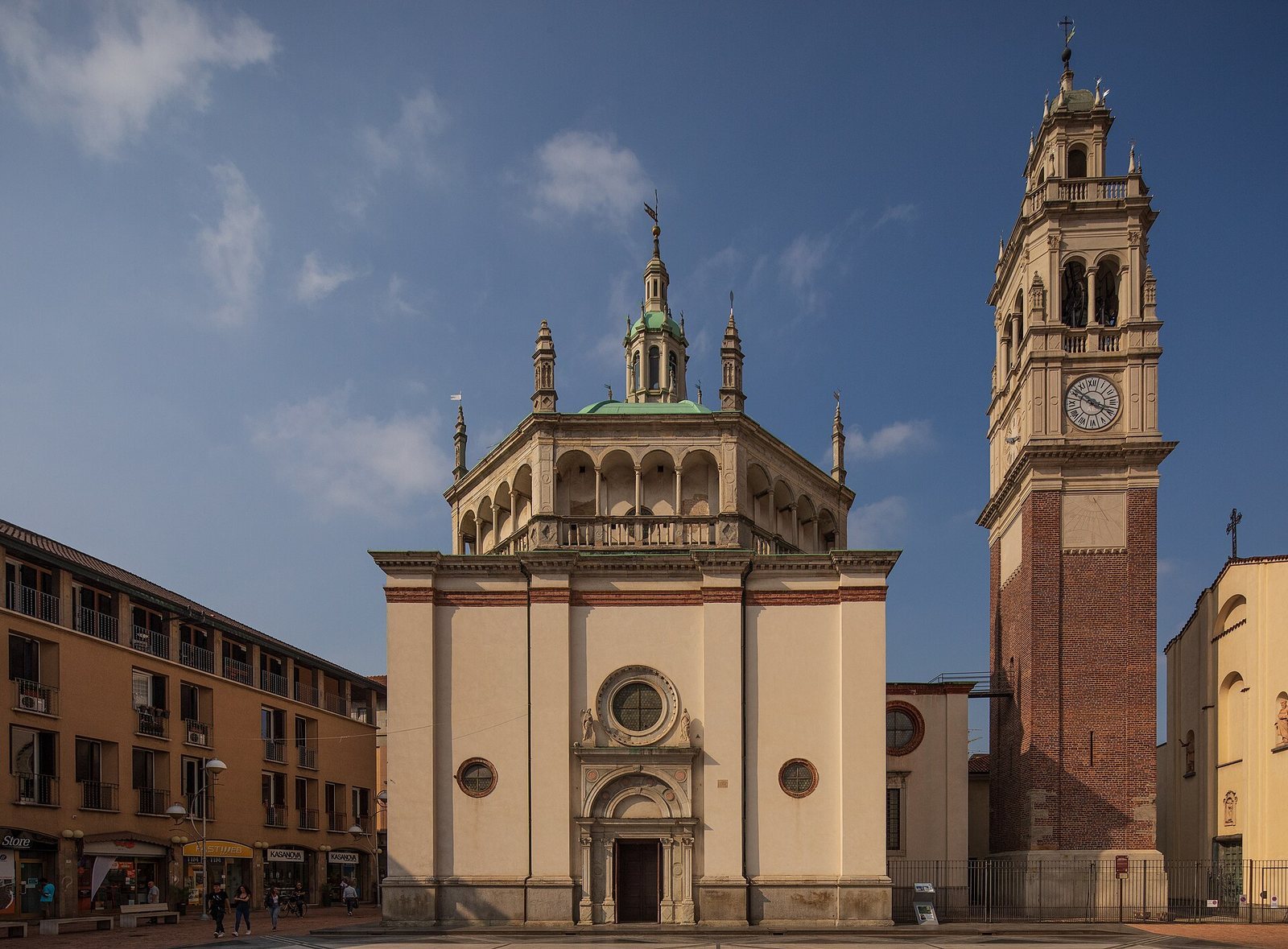
The interior’s square lower section has corners crossed by diagonal arches, which form niches and curved vault surfaces. Above it rises an eight-sided drum, the raised structure supporting the dome, with a ring of niches known as the crown of the twelve saints. The dome’s vault is divided into eight sections. Outside, flat pilasters, shallow wall strips resembling columns, articulate the cubic building. A raised, tower-like structure encloses the dome and is topped by small pinnacles and a lantern. Beneath the dome, the drum has an open gallery.
Portals and foundation marker
The south and west portals, attributed to Tommaso Rodari, share a two-part design. Their lower sections have pilasters and geometric Renaissance ornament; above are nested arches, circular ornaments, rectangles, and recessed panels. A beam above the larger arch rests over two triangular fields decorated with roundels of red stone. Latin inscriptions on the west portal appeal to the Virgin and seek prosperity for the church’s builders and their descendants. The south inscriptions ask Mary to hear those who pray to her and help her devotees. The 1517 foundation stone is set into the east façade. Above the presbytery, the area around the high altar, a carved roundel shows the Madonna and Child. It is the only element identified as surviving from the earlier church.
Bell tower
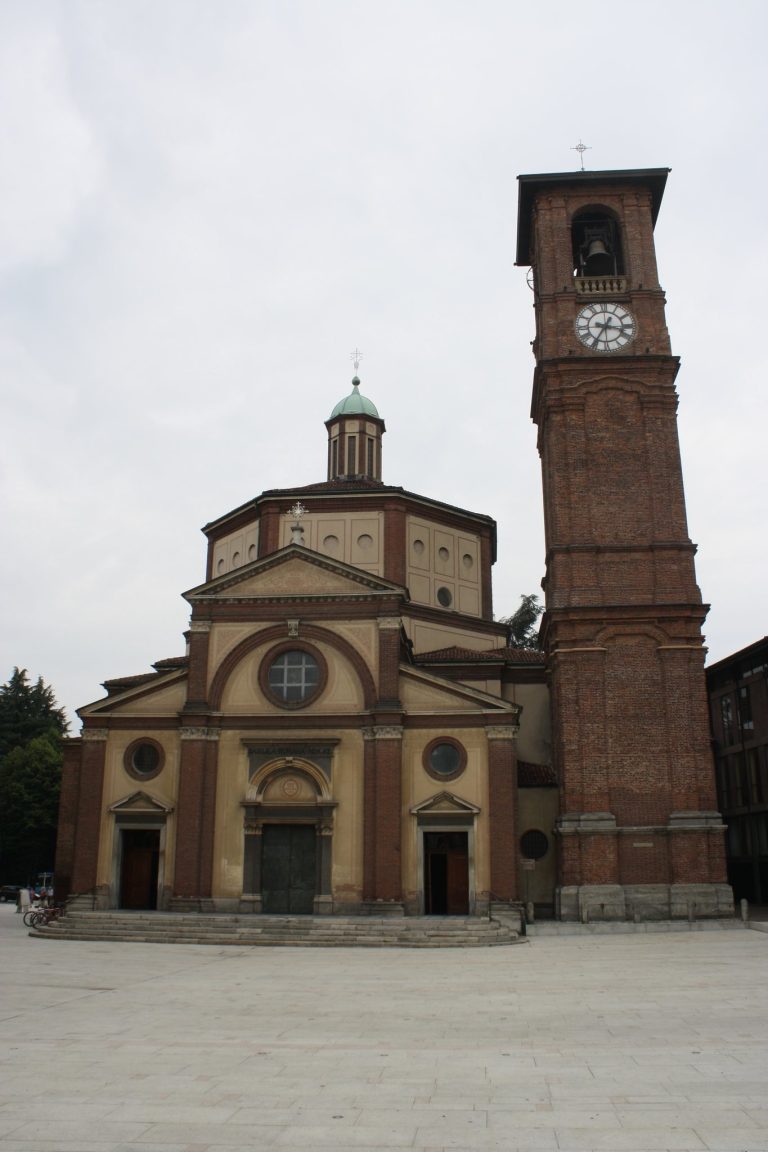
The brick bell tower dates to 1584 and also served for many years as Busto Arsizio’s civic tower. Maciachini’s work in 1886–87 added a high granite base and plaster imitating rusticated stone; the plaster was later removed. The raised upper portion includes a square clock stage that echoes the church’s plan, a bell chamber recalling its gallery and pinnacles, and a small top structure that repeats the dome and lantern motif. A new doorway and gate were made, the municipal bell was removed, and five bells tuned to E-flat were installed.
Paintings and devotional sculpture
Dome and drum decoration
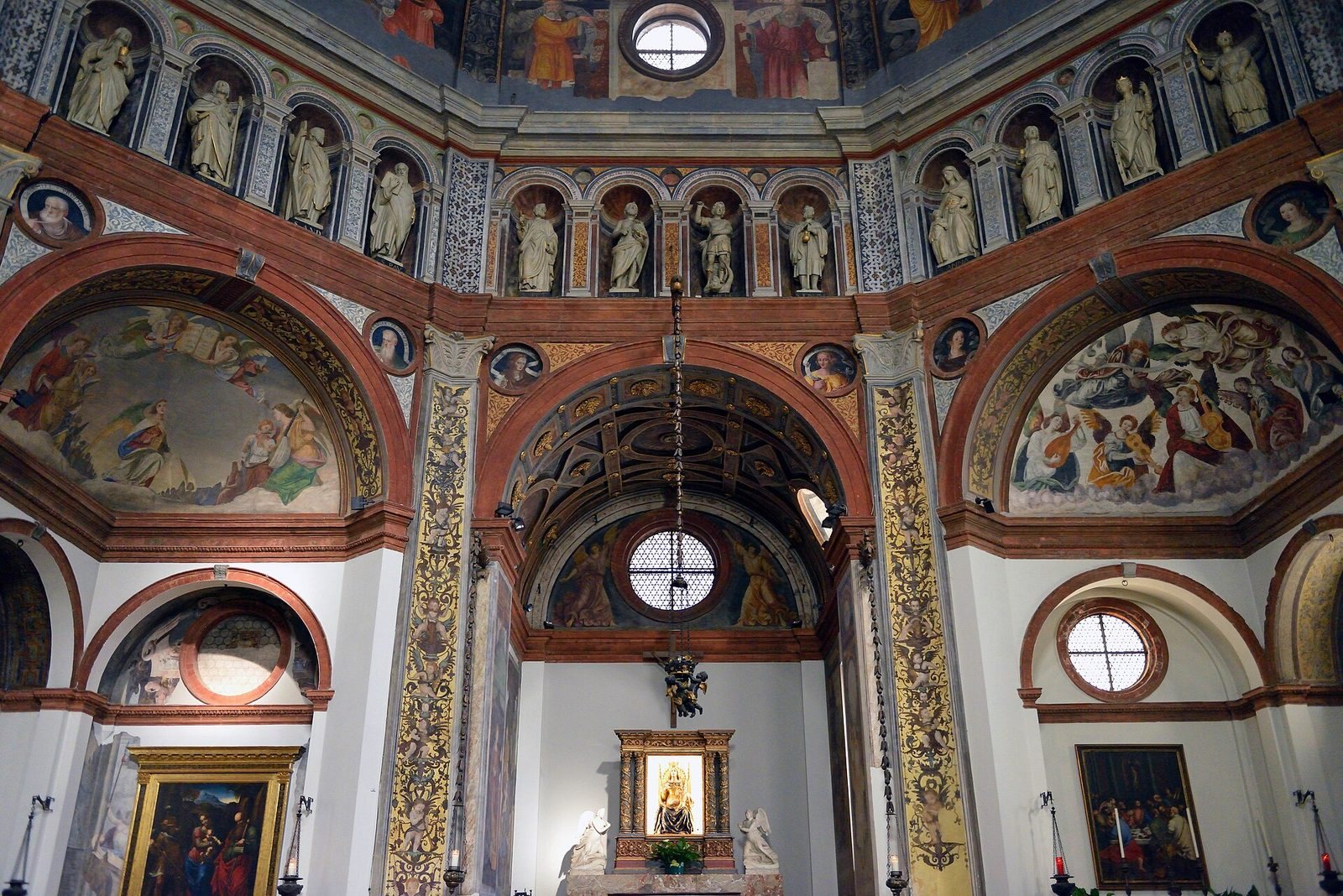
Giovanni Crespi frescoed the dome in 1531, and Francesco Tatti decorated the lower order. Gold stars cover the dome sections, while decorative grotesque figures and forms ornament the pillars. In the lower band of the drum, prophets and Sibyls, classical female prophetic figures adopted in Christian art, are arranged around circular openings and the eight arches below. The ensemble includes sixteen men and sixteen women. The men comprise eleven writing prophets, Moses, Aaron, David, Solomon, and Jonah; the women include Sibyls, Eve, Rachel, Esther, and Judith.
Presbytery paintings
Giovan Battista della Cerva painted the presbytery in 1542. The pillars show the Annunciation, with the Adoration of the Magi on the left wall and the Adoration of the Shepherds on the right. Della Cerva is also credited with musician angels in the curved section of the corner arch to the right of the presbytery, as well as angels and pilasters in the surrounding decoration.
Altarpieces and portal paintings
The Last Supper on the altar to the right of the high altar is attributed to Gaudenzio Ferrari and Della Cerva. On the opposite side of the presbytery is a copy of Giovanni Paolo Lomazzo’s lost Madonna delle Vittorie. A triptych, or three-part painting, of the Madonna and Child with Saints hangs on the right wall; formerly attributed to Francesco Melzi, it is on deposit from the Pinacoteca di Brera. Giacomo Francia’s 1544 Madonna and Child with Saints Gervase and Protase, Catherine, and Justina is on the left wall.
Raffaele Crespi is credited with the paintings once set in semicircular panels above the west and south portals. The west panel showed the Madonna and Child with Saint John and musician angels; the south showed the Madonna of the Rosary with Child and putti. They were detached because of their poor condition and have not been reinstalled.
Assumption polyptych
Gaudenzio Ferrari’s Assumption is a polyptych, a painting made of several panels, created between 1539 and 1540 and given to the sanctuary in 1541 by Donato Prandoni, a member of the Busto Arsizio council. It originally stood against the presbytery’s back wall and covered a circular opening. During the 1939–43 restoration it was moved to its present place on the north wall. The central scene shows the Eternal Father receiving Mary as angels carry her heavenward and crown her. On the left are John the Baptist with the Lamb of God and Jerome; on the right are Michael the Archangel and Francis of Assisi. Its gilded frame has four columns decorated with branches and leaves, a painted base panel, and three sections depicting the Nativity of Mary, her Presentation in the Temple and Marriage, and the Holy Family.
Madonna dell’Aiuto and octagonal statues
The painted wooden Madonna dell’Aiuto, dated 1602 and attributed to Fabrizio De Magistris, stands above the altar at the centre of the apse, the curved end of the church. A shrine protects the statue, which is flanked by two marble angels from the sixteenth century. Mary faces forward in a symmetrical pose, while the Child sits at an angle as if slipping across her knee; her right hand is raised in a stopping gesture. Thirty-two additional statues by De Magistris and his pupils occupy niches around the octagonal interior.
Later alterations and copies
Restoration and furnishings
During Maciachini’s restoration, the open gallery was rebuilt and work addressed the outer plaster, small dome, copper roofing, bases, doors, rainwater channels, windows, balustrade, floor, statues in the niches, and entrance vestibules. Doors opened on the west side in 1605 were later bricked up, while an entrance on the south side was reopened. The church’s organ was made at a later date and transferred to Sant’Edoardo in Busto Arsizio. Maciachini designed a small throne for displaying the Madonna dell’Aiuto and carrying it in procession. Luigi Cavenaghi restored the painted decoration across the interior.
Copies beyond Busto Arsizio
A smaller replica of the sanctuary was built at Crespi d’Adda. An exact copy of the Madonna dell’Aiuto statue is held in a church in the Cerro district of Montevideo, Uruguay.