Santuario della Madonna del Ponte: A Marian Shrine in Partinico, Italy
Site at a Glance
- Rating
- 4.7
- Popularity
- Very Low
- Country
- Italy
- Primary era
- Early Modern
- Eras represented
- Early Modern
- Civilizations
- Kingdom of Sicily
- Site type
- Religious
- Remains
- Sanctuary
On this page11 sections
History
Santuario della Madonna del Ponte is a Roman Catholic shrine in Partinico, Italy, dedicated to Mary under the title Madonna del Ponte. Associated with the Cistercian Order and the Archdiocese of Monreale, the sanctuary developed from medieval efforts to restore the area and strengthen devotion to the Virgin Mary.
Cistercian foundation and the rebuilding of Partinico
In 1306, King Frederick II of Aragon, also known as Frederick III of Sicily, granted the Cistercians lands near Altofonte so that they could establish an abbey and promote devotion to Mary. In 1309, he gave them further lands in the Partinico area, which had previously suffered destruction from Saracen attacks. The Cistercian abbots were expected to rebuild and repopulate the town. They provided Partinico with a coat of arms, placed monks in the surrounding woodland to administer their estates, and offered the new settlers civil and religious education.
Rebuilding began around 1430. Abbot Pietro Guzio also initiated the restoration of a small church so that Frederick II could attend Mass while hunting in the area. In 1669, the bishop of Mazara del Vallo authorized an altar dedicated to Maria Santissima del Ponte in Partinico’s Mother Church, further establishing the devotion within the town.
The eighteenth- and nineteenth-century sanctuary
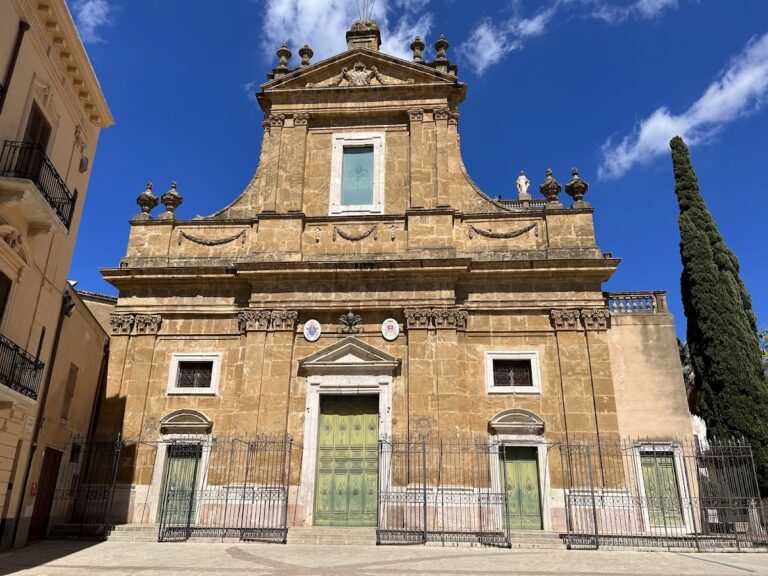
Royal financial support enabled the sanctuary to be restructured in 1774. The building was enlarged and given three naves. The people of Partinico later attributed their deliverance from the cholera epidemic of 1854 to the Virgin. A request to crown the sacred image followed, and the coronation took place in 1861 during five days of celebrations.
The sanctuary’s devotional image also changed over time. The original image was a painted or sculpted copy of the one venerated at Altofonte, but it deteriorated. A later painting was damaged by humidity, and in 1795 Domenico Ferrandina produced another copy on the old, worn canvas. The present painting was made by Vincenzo Manno in 1819 and has received several minor restorations.
Pilgrimage and local tradition
During the Great Jubilee of 2000, the sanctuary was selected as a pilgrimage destination for obtaining plenary indulgences. In 2010, it became associated with the Basilica of Santa Maria Maggiore in Rome.
The principal feast is held during the week after Easter, especially from Thursday to Saturday, when thousands of devotees from Partinico and neighboring towns join a torchlit pilgrimage to the sanctuary. Folkloric events form part of the celebrations. On the feast Sunday at noon, the painting is placed on a vara, a ceremonial platform used to carry a sacred image, and taken toward Partinico. It arrives in the evening and is received by civil authorities, clergy, and townspeople before being carried through the town. Around midnight, the procession reaches the Mother Church, where the painting remains while people pray before it. Further celebrations take place in Partinico in August, and the painting returns to the sanctuary in November.
The feast involves Partinico, Balestrate, Trappeto, and Alcamo. Tradition assigns possession of the painting according to the time of its departure from the small church: Partinico claims it when it leaves exactly at noon, Alcamo if it departs by 12:30, Balestrate when it leaves between 12:30 and 13:00, and Trappeto thereafter. Giuseppe Pitrè recorded a related legend in which the four communities disputed a statue of the Madonna found miraculously in a grotto. When the cart carrying the statue would not move toward any of their towns, they agreed to build a small church where all four communities could venerate it together.
Remains
Church and devotional painting
Three-nave church
The sanctuary stands in the territory of Partinico, near the Jato River and the road designated SP 63. Its present arrangement reflects the enlargement of 1774, which created a three-nave plan. Four columns support the vaults, and their stucco bases and capitals contribute to the interior decoration.
Madonna del Ponte painting
The principal devotional image is the painting of the Madonna enthroned. Mary holds the Christ Child with one arm and a heart in her right hand, while the Child reaches toward her. Saint Peter stands beside her with a book and keys. The other accompanying figure holds a book and a lily and is identified either as Paul the Apostle or, alternatively, as John the Apostle. Beneath the figures, a bridge recalls the former bridge over the nearby Jato River. During the annual feast, the painting is carried on the vara and temporarily housed in Partinico’s Mother Church before returning to the sanctuary.
Forecourt ceramics
Mysteries and sacred figures
The forecourt contains ceramic representations of the Mysteries made by Maria Fratusco of Altamura. The ceramic work draws on the style of Caltagirone, a Sicilian center renowned for decorative ceramics and tilework. Among the figures represented are saints and blessed people venerated by Partinico, including Pina Suriano, Mother Margherita Diomira Crispi, Mother Maria Rosa Zangara, Saint Leonard of Limoges, and Saint Joachim. The decoration also includes the Christ Pantocrator of Monreale, an image of Christ as universal ruler.
Staircase pavement
The broad staircase has a characteristic ceramic-tile pavement produced by local artisans Rossano La Verde and Giuseppe Castagna. Its decorative motifs include oranges, lemons, pomegranates, fishing boats, and local flowers, linking the sanctuary’s architectural setting with imagery associated with the surrounding community.