Santuario della Beata Vergine Addolorata: A Shrine to Our Lady of Sorrows in Bergamo
Site at a Glance
- Popularity
- Medium
- Country
- Italy
- Primary era
- Early Modern
- Eras represented
- Early Modern, Modern
- Civilizations
- Italian, Venetian
- Site type
- Religious
- Remains
- Sanctuary
On this page12 sections
History
The Santuario della Beata Vergine Addolorata is a Roman Catholic shrine in Borgo Santa Caterina, in lower Bergamo, Italy, dedicated to Our Lady of Sorrows. Its foundation stone was blessed in 1603, and the completed Renaissance building opened for worship in December 1605. The shrine is associated with the Benedictine order and forms part of the parish of the Church of Saint Catherine the Virgin and Martyr.
Origins and foundation
Tradition traces the shrine’s beginnings to a fresco of the Sorrowful Virgin painted by Giovanni Giacomo Anselmi in 1597 on a private house near the Stongarda bridge. The image was said to have been badly faded when, on 18 August 1602, a star with three rays shone upon it and restored its brilliance. A surviving autograph account attributes the recovery of her sight by Margherita Facchinetti to her prayers before the Virgin’s image. Donato Calvi later recounted the apparition in a chronicle covering events through 1676–77.
Religious activity in the area had already grown around the nearby Celestine monastery, where the Company of the Most Holy Virgin of the Agony was established on 1 March 1600. On 31 December 1602, local deputies and regents met to discuss the new church and devotion. Offerings followed accounts of miraculous events, and on 25 February 1603 land and buildings were bought from Claudio Benaglio on property belonging to Claudia Bonghi, sister of the Celestine friar Benedetto. After excavation began, Bishop Giovambattista Milani blessed the foundation stone on 11 July. Land was also purchased from the Celestines in 1604 for a road connecting their property with the shrine.
The shrine opened for worship in December 1605, and its original fresco was moved from the house to the high altar. That year also saw the beginning of an annual Feast of the Apparition. A wooden group based on the image was commissioned for a procession through the district on 18 August, the date associated with the apparition.
Disputes over parish authority
A papal bull, a formal decree issued by the pope, dated 11 July 1615 authorized lay representatives of the community to appoint the shrine’s chaplain. The choice was made by secret ballot for three-year terms by regents associated with the School of the Disciplines of Our Lady of Suffrage. This was a lay confraternity whose penitential practices included self-flagellation and whose devotion involved prayers for the dead. The parish priest, Don Tommaso Vecchiarelli, disputed the shrine’s autonomy and its control of service revenues, especially during Holy Week. The bishop upheld the bull but encouraged the parties to reach an agreement.
The conflict continued under later parish priests and bishops. After Tiraboschi died in 1668, Don Ventura Ferabò became parish priest on 14 February. That November he asserted the parish priest’s rights over Christian Doctrine. On 18 August 1670, Bishop Daniele Giustiniani ruled that only priests representing the parish could conduct services at the shrine. The regents called 77 household heads together and prepared a protest. Chaplain Don Francesco Benaglio appealed to Venice’s Collegio Maggiore. On 7 November 1671, Gio. Battista Lauro of the Sacra Rota, a Catholic Church tribunal, ruled that the parish priest had authority to officiate there. A compromise allowed the parish priest to abstain from services on the shrine’s feast days, while the chaplain refrained from administering sacraments from Palm Sunday through Easter. Giustiniani signed the decree with Don Sandrino Bettoni.
Tensions returned in 1676 when the parish priest objected to services at the shrine being held at the same time as those in the parish church. The regents were fined 550 ducats. On 18 August, the parish priest barred the chaplain from wearing a cope, a ceremonial cloak worn by clergy, in the procession; the regents insisted he wear it. The following January, the priest complained again, and the regents appealed to Venice. The chaplain bore the costs of the dispute. Giustiniani ordered him to remove the Blessed Sacrament, the consecrated Eucharist, from the tabernacle on pain of suspension and withdrew his permission to hear confessions, against local residents’ wishes. The dispute ended on 18 August 1679, when the regents arranged for Ferabò to celebrate Mass.
Restrictions on the Feast of the Apparition
A further dispute began after Giustiniani’s decree of 26 May 1690 prohibited celebrations of apparitions unless they appeared in the Roman Martyrology, the Catholic Church’s official list of saints and feast days, or had approval from both the Bergamo diocesan curia and Rome. The rule prevented the shrine from marking its anniversary on 18 August. The city podestà, a civic magistrate, supported the regents, but on 24 January 1691 the bishop told them to comply with Rome’s orders. The Apostolic Nunciature in Venice, the pope’s diplomatic mission, supported a celebration on the condition that it did not claim an apparition of the Virgin. The bishop referred the matter to Rome, which ordered all celebrations to stop on 24 November 1691; the ruling was published on 3 February 1692.
The regents appealed, and local residents petitioned the Doge, head of state of the Venetian Republic, arguing that the celebrations also honored the Republic. Venice supported their position. During a pastoral visit in 1699, Bishop Luigi Ruzzini described the shrine as poor and noted that litigation appeared to have cost more than 1,500 scudi.
Expansion and later changes
By the nineteenth century, the shrine was considered too small for the worshippers who gathered there, particularly in August. An expansion was planned, but the proposed designs were reviewed and revised, including the removal of a scheme for a large dome. Work began with a foundation-stone ceremony led by Bishop Camillo Guindani on 22 August 1886. Payment difficulties delayed completion until the following century. A dome was added in 1895–96, and Bishop Gaetano Camillo Guindani consecrated the shrine on 15 August 1903.
For the third centenary of the apparition, a golden crown was placed on the image of the Virgin and Christ. Cardinal Andrea Carlo Ferrari crowned the image of the Virgin on 17 August 1903. Late in the twentieth century, extensive remodeling altered the shrine’s orientation and interior arrangement.
Remains
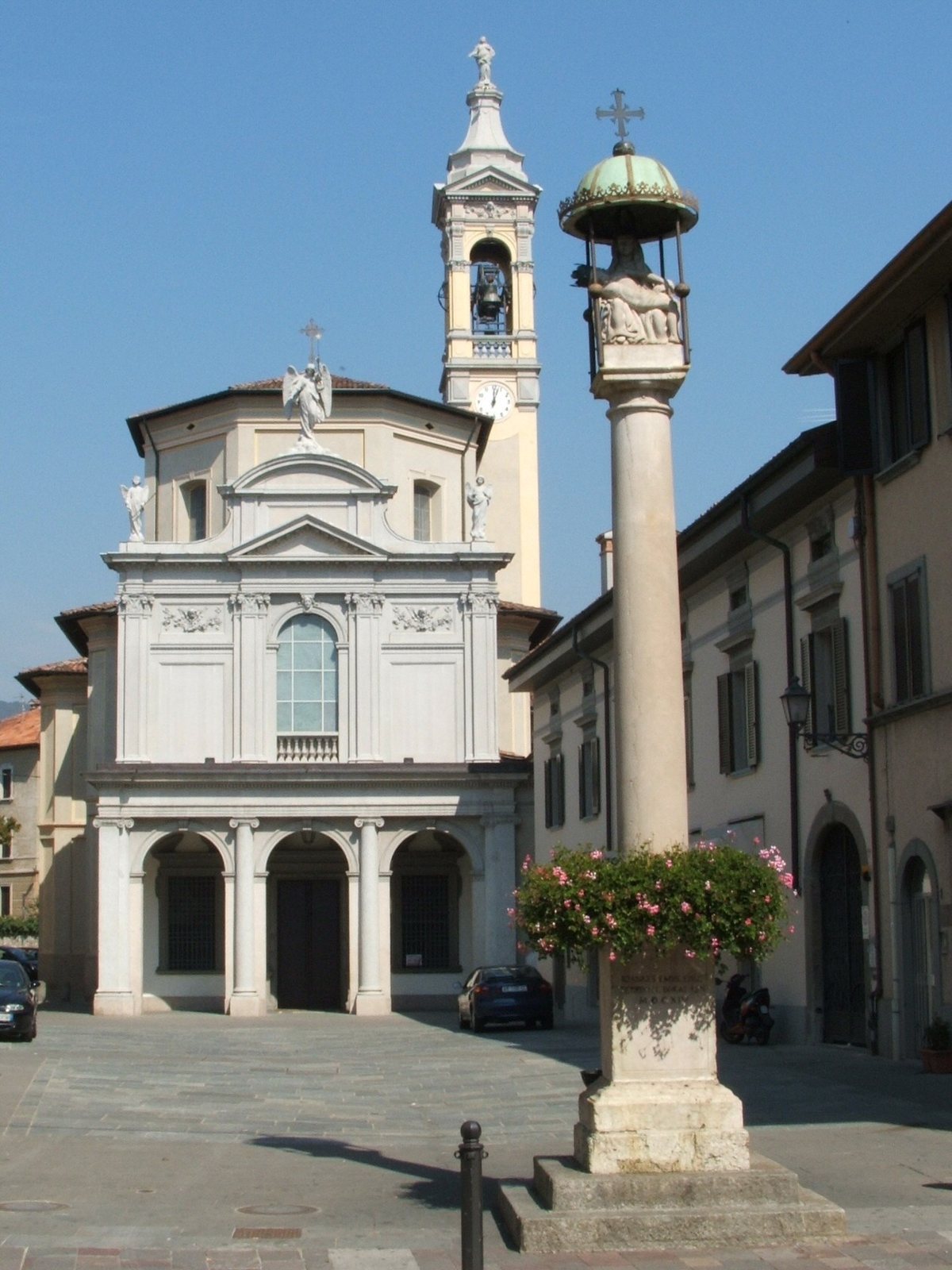
The shrine is a Renaissance building with a present plan shaped like a Latin cross, formed by a nave and crosswise arms. A large forecourt stands outside. The original building faced west, opposite the Church of Saint Nicholas of the Celestines. A plaque above the western portal commemorates the laying of the foundation stone.
Forecourt and column
A column in the forecourt carries a marble statue of Our Lady of Sorrows made by Antonio Abbati. Known as the Crocetta, it was first placed in the middle of the street on 24 December 1614, replacing a wooden cross thought liable to fall and cause damage. Bishop Giovanni Emo blessed it on 24 December 1615. Its base bears the inscription “Wounded by the spear of love.”
Interior and decoration
Nave and domes
Late-twentieth-century changes opened the southern chapels into the nave and created a new presbytery, the area around the main altar, to the north. Two side chapels were reshaped as the arms of the cross-shaped plan, ending in the Chapel of the Assumption, formerly the presbytery, and the Chapel of Our Lady of Loreto. Stuccowork by Francesco Fioroni decorates the nave and domes; he worked at the shrine for four years. Diamante Spinedi made the large dome, which is enclosed by a hemispherical outer structure. A smaller enclosing structure rises above the presbytery. The interior also has neo-Baroque decoration.
Chapel of Our Lady of Loreto
The Chapel of Our Lady of Loreto lies along the left transept, the crosswise arm of the church. The inhabitants of Pedrengo paid for its construction in fulfillment of a vow made during the plague of 1615; a payment to its mason is recorded on 9 July 1616. Its altarpiece by Francesco Zucco shows the Madonna of Loreto with the Child, Saint Catherine of Alexandria, Saint Mary Magdalene, Saint Evasio, a bishop, and Saint Sylvester.
Frescoes, paintings, and sculpture
The fresco of the Sorrowful Virgin that inspired devotion is on the high altar. The shrine contains twelve plaster statues of saints made by Antonio Rota in the early twentieth century. Among its seventeenth-century paintings by Francesco Zucco are Saint Charles Borromeo and Saint Bernardino and Madonna and Child with Saints John the Baptist and Benedict. Other works at the shrine are by Ponziano Loverini, Giuseppe Riva, Luigi Angelini, Tilio Nani, Antonio Rota, Giovanni Pezzotta, and Nino Nespoli.
Bell tower
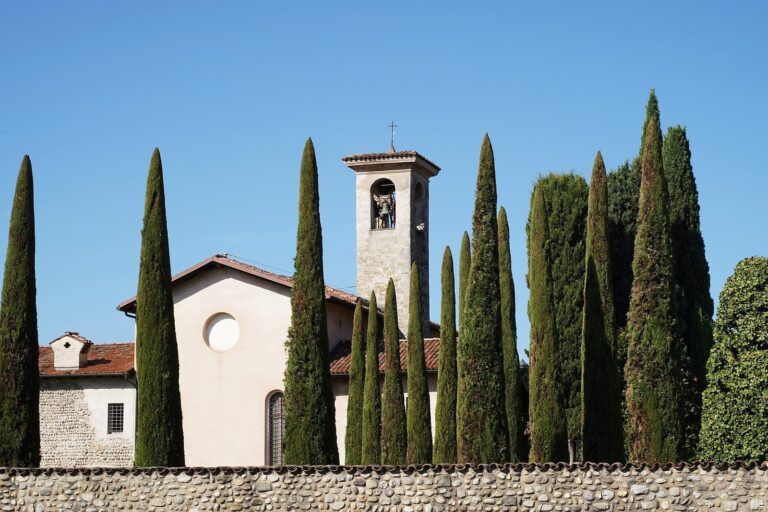
The bell tower dates to the late twentieth century. In 2015 it was strengthened, its bell frame was completely rebuilt, and three bells were added to complete the musical scale.