Santo Stefano: A Baroque Church on Capri
Site at a Glance
- Popularity
- Medium
- Country
- Italy
- Primary era
- Early Modern
- Eras represented
- Medieval, Early Modern
- Civilizations
- Byzantine, Kingdom of Naples, Spanish
- Site type
- Religious
- Remains
- Cathedral
On this page17 sections
History
Religious life before the present church
Santo Stefano is a Roman Catholic church on Capri, Italy, begun in 1688 in the Baroque style, an ornate European style prominent in the seventeenth and eighteenth centuries. Named for Saint Stephen, whom Christian tradition regards as the first Christian martyr, it is one of Capri’s two oldest churches, together with San Costanzo.
A church dedicated to Saint Sophia and a Benedictine monastery, an establishment of a Catholic monastic order, are believed to have occupied the site before Santo Stefano. The monastery dates to 580. In Christian usage, Sophia is associated with divine wisdom.
Construction and cathedral years
The present church was designed by Francesco Antonio Picchiatti and begun in 1688. Marziale Desiderio oversaw the building work, and the church was completed in 1697. Its interior was still being finished in 1751, when the choir was installed and other work continued.
On 17 May 1723, Bishop Michele Vandeneyndel consecrated Santo Stefano as the cathedral of the Diocese of Capri. A cathedral is the principal church and seat of a bishop, while a diocese is an area of church administration overseen by one. Santo Stefano held this role until the diocese was dissolved in 1818, after which it no longer served as a bishop’s seat.
Later role
The religious complex took shape around Piazza Umberto I during the seventeenth century. The archbishop’s palace, once part of that complex, is now Capri’s town hall. Santo Stefano remains Capri’s largest church and serves as a parish church and principal place of worship within the Archdiocese of Sorrento-Castellammare di Stabia, a church jurisdiction overseen by an archbishop.
Remains
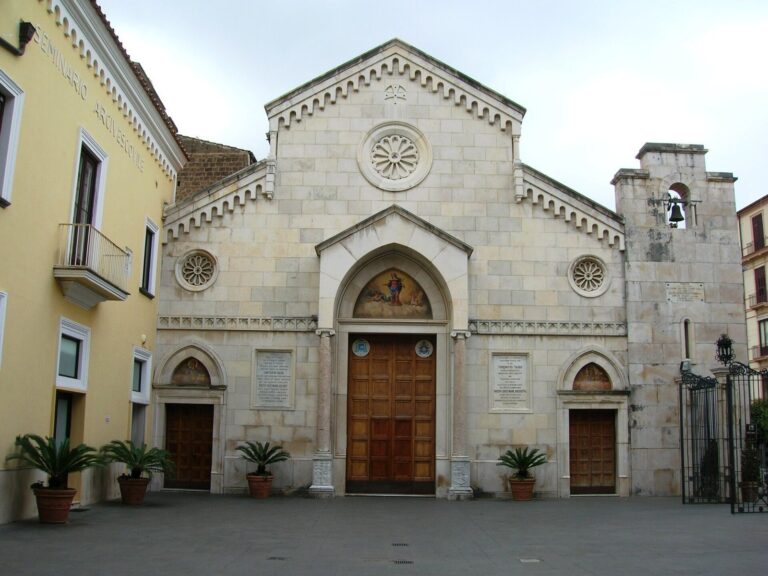
The surviving site brings together the Baroque church and the bell tower of the earlier Benedictine monastery, which stands on the Piazzetta. Within the church, three lengthwise aisles meet a crosswise transept, forming a cross-shaped plan. The church’s richly ornamented interior and its stucco-covered exterior preserve the character of its Baroque design.
Façade
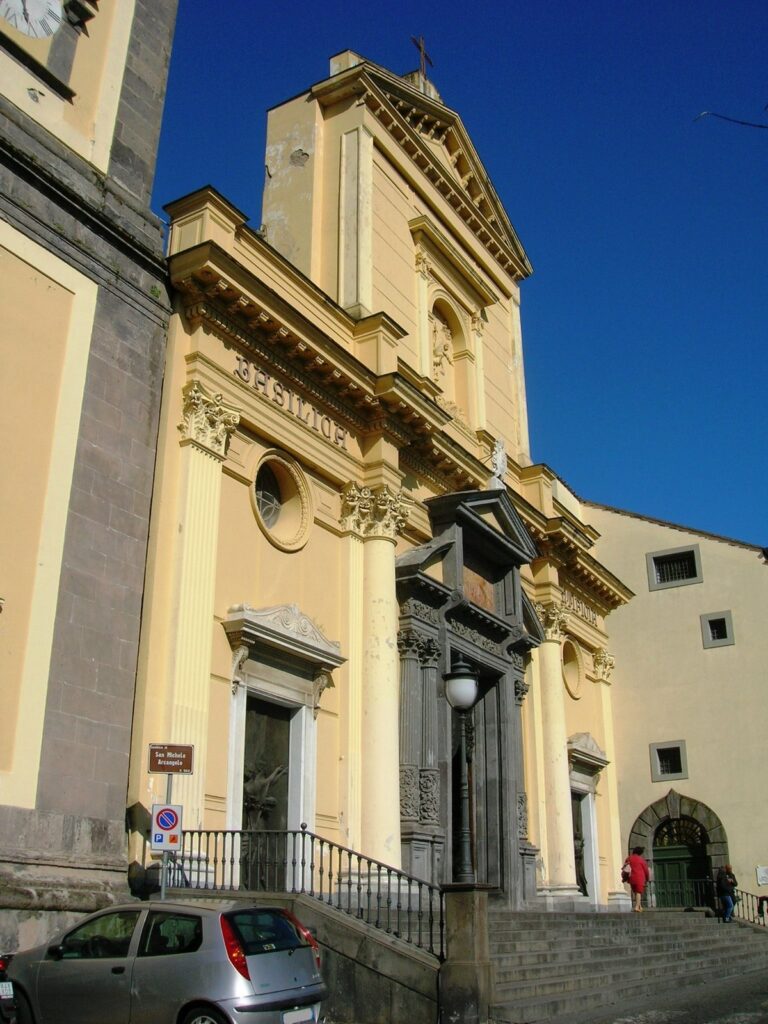
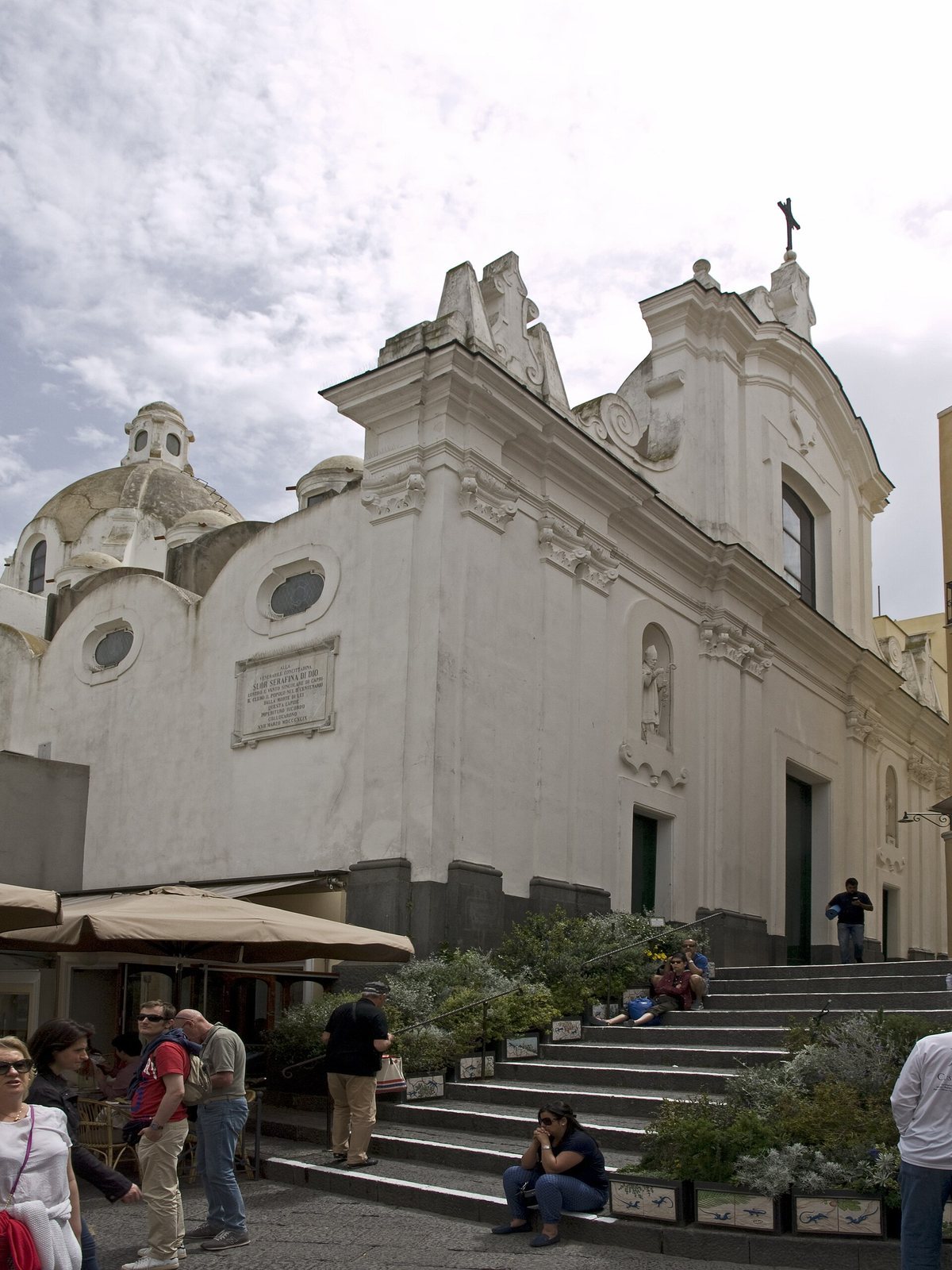
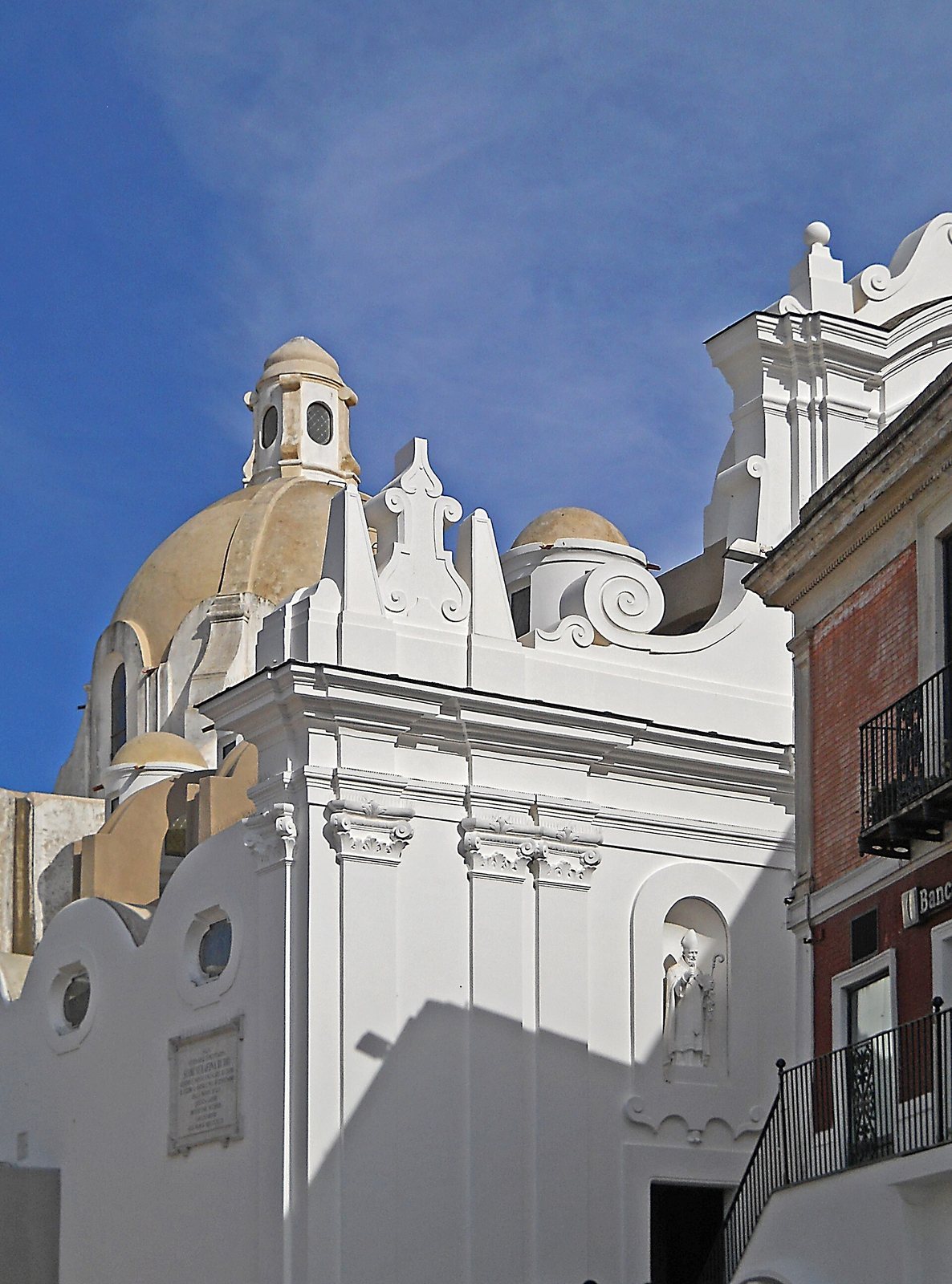
A horizontal architectural band divides the façade into two levels. On the lower level, faux-marble panels decorate the central entrance, flanked by two smaller portals. Niches hold statues of saints, and flat vertical supports called pilasters organize the wall. The narrower upper level has a large central window, with scroll-shaped forms at either end. Stucco ornament covers the façade.
Interior structure
Naves and domes
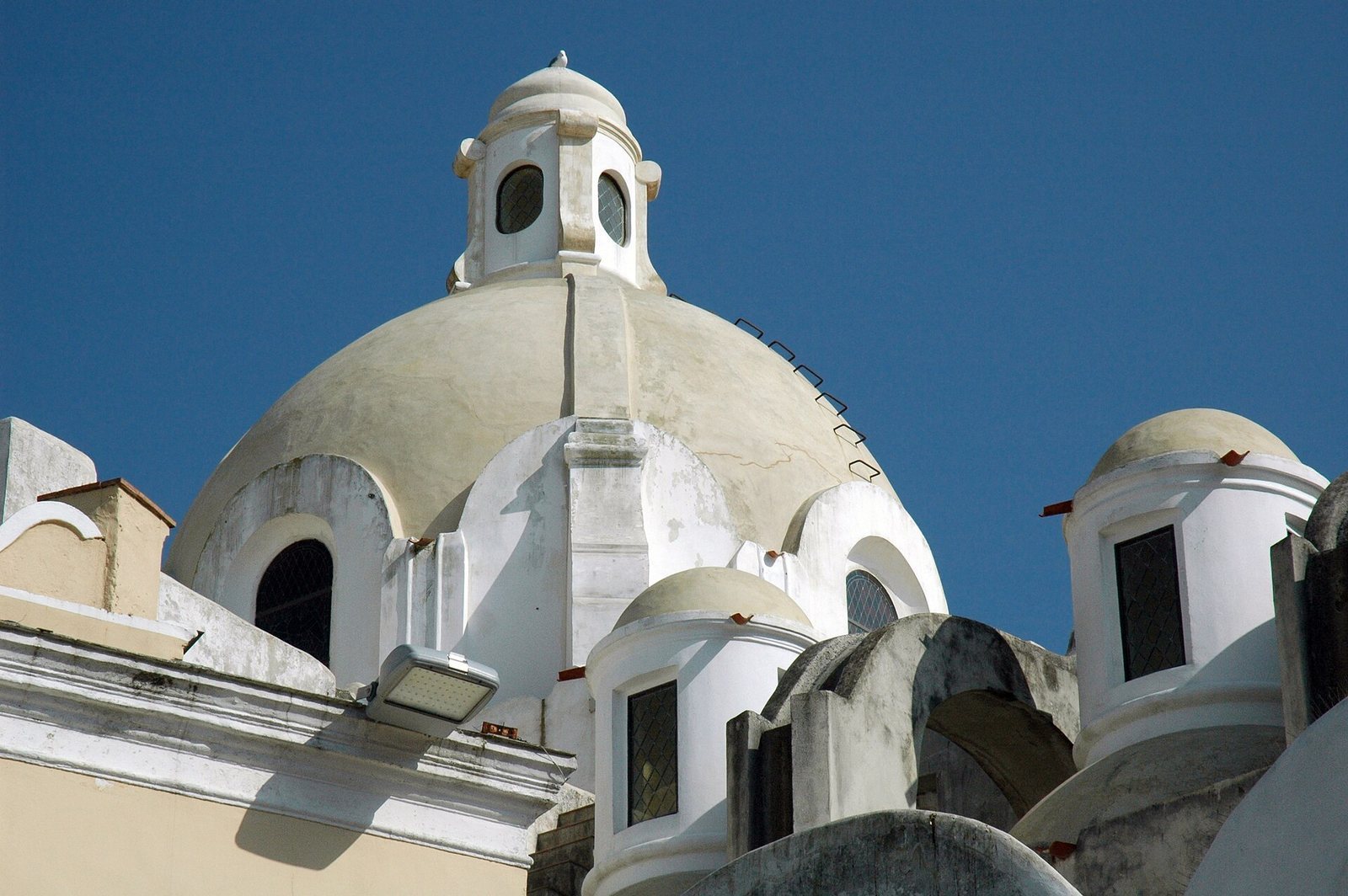
The central nave, the church’s main lengthwise space, has a barrel-vaulted ceiling, formed as a continuous curve. Four chapels line each side nave, along with a sequence of domes. Outside, the domes rise on upright bases marked by vertical grooves and supported by arched buttresses. The main dome stands above the crossing, where the nave and transept meet, and its outer shell is exposed.
High altar
The high altar occupies a rectangular apse, the recessed space at the end of the church. A yellow-marble column from San Costanzo forms part of its altar table, while the floor is made of colored marble taken from Villa Jovis. An organ stands behind the altar.
Nave chapels
Chapels in the right nave
The first chapel is dedicated to Saint Michael the Archangel and contains a painting by Paolo De Matteis. The next, dedicated to the Virgin Mary, has a nineteenth-century canvas showing her among angels. A second work by De Matteis occupies the chapel of Our Lady of Mount Carmel, depicting the Virgin of Carmel among souls in purgatory, understood in Catholic teaching as a state of purification after death. The fourth chapel is dedicated to the Sacred Heart of Jesus. Its side walls hold seventeenth-century wooden reliquaries, containers for sacred relics, including examples shaped as saints. One, made by Giacomo Colombo, depicts the Sacred Heart; it was first made to represent the Savior and later adapted.
Chapels in the left nave
The first chapel holds a fifteenth-century panel showing Saints Anthony and Michael beside the Virgin Mary and Child. A tradition says that sea raiders hurled the panel from a cliff, but it miraculously returned to its place. The second chapel contains a baptismal font and a painting of the Baptism of Jesus from the school of Solimena. The third is dedicated to Saint Nicholas of Bari. In the chapel of Saint Joseph, the altar image shows the Holy Family; the side walls depict Mary and the Child with Saints Joseph and Francis, and the Death of Saint Joseph.
Transept and side chapels
Right transept
On the right side of the transept are a canvas by Andrea Malinconico depicting Saint Andrew and another by Giacomo Farelli showing the martyrdom of Saint John. An inscription there commemorates the church’s consecration.
Chapel of the Holy Crucifix
The right transept opens into this chapel, whose altar has an altarpiece, an artwork placed on or behind an altar, dated to the seventh century. It depicts Mary, John, and Mary Magdalene at the foot of the cross. The chapel also contains a wooden crucifix made by Giacomo Colombo in 1691 and the tombs of Giacomo and Vincenzo Arcucci. In the first tomb, the founder holds a representation of the Charterhouse, a monastery of the Carthusian order.
Left transept
An altar on the left side contains relics of Saint Costanzo. A painting by Giacomo Farelli shows the saint driving out the Saracens, and a silver statue decorated with sapphires and garnets stands with the altar.
Chapel of the Blessed Sacrament
The left transept also opens into this chapel. Its altar painting depicts Our Lady of the Rosary. Paintings on either side represent the Christ Child, the Immaculate Conception, and Saints Joachim and Anne; the Immaculate Conception is the Catholic belief that Mary was conceived without original sin. These works come from the school of Luca Giordano.