Santa Maria in Domnica: A Carolingian Renaissance Basilica in Rome


Site at a Glance
- Rating
- 4.6
- Popularity
- Low
- Country
- Italy
- Primary era
- Medieval
- External website
- Open
- Eras represented
- Classical, Medieval, Early Modern, Modern
- Civilizations
- Papal States, Roman
- Site type
- Religious
- Remains
- Basilica
On this page8 sections
History
Santa Maria in Domnica is a Roman Catholic basilica in Rome, Italy, whose early Christian building stood beside the barracks of the Roman Vigiles on the Caelian Hill. Rebuilt between 818 and 822 under Pope Paschal I, it retains the plan established during the Carolingian Renaissance, the ninth-century revival of artistic and intellectual activity associated with the Carolingian world. The church is a minor basilica, parish church, titular church, and station church, and is regarded as one of Rome’s best examples of Carolingian Renaissance architecture.
Early Christian and Medieval Foundations
An early basilica occupied the site in antiquity beside the barracks of the Fifth Cohort of the Roman Vigiles, a Roman organization responsible for firefighting and night watch duties. The church appears in the acts of the synod held by Pope Symmachus in AD 499. In 678, Pope Agatho assigned it to deacons as one of seven churches under diaconal administration. This status as a titular diaconia, a church assigned to a cardinal as an ecclesiastical title, continued into the modern period.
Pope Paschal I rebuilt the basilica between 818 and 822 as part of the renewal and artistic embellishment of Rome associated with his pontificate. The rebuilding gave the church its ninth-century arrangement and included the mosaics that remain in the apse and on the triumphal arch. A small Olivetan monastery, belonging to a Benedictine congregation founded at Monte Oliveto, was established at the church in 1340. Benedict, who later became a legate to the Latin Empire, began his cardinalial career at Santa Maria in Domnica in 1200–1201.
Name, Local Tradition, and the Navicella
The name “In Domnica” has several proposed origins. It may derive from dominicum, meaning “of the Lord” and, by extension, “church”; from in dominica praedia, meaning “on imperial property”; or from dominica, the Latin word for Sunday, because the basilica serves as a station church on the second Sunday of Lent. Another tradition associates the name with Cyriaca, a wealthy Christian widow whose nearby home was used by early Christians. In this account, Saint Lawrence distributed alms there, and Cyriaca arranged his burial in her family cemetery.
The local designation “Alla Navicella,” meaning “near the little ship,” refers to a Roman ship sculpture that may have stood here since antiquity as a votive offering at an ancient temple. Pope Leo X converted the sculpture into the Fontana della Navicella. The fountain now before the portico was installed in 1931 and reproduces the sixteenth-century monument.
Medici Patronage and Later Restoration
Members of the Medici family substantially altered and embellished the church during the sixteenth century while holding its cardinal-diaconal title. Giovanni de’ Medici held the title from 1492 to 1513, followed by Giulio de’ Medici from 1513 to 1517. Giovanni de’ Medici later became Pope Leo X. Giovanni di Cosimo I de’ Medici held the title from 1560 to 1562 and died of malaria in 1562. Ferdinando I de’ Medici held it from 1565 to 1585 before becoming Grand Duke of Tuscany.
In 1513, shortly before his election as Pope Leo X, Cardinal Giovanni de’ Medici commissioned the entrance portico with Andrea Sansovino. Giulio de’ Medici and Ferdinando I de’ Medici directed further modifications and decoration between 1513 and 1517. A late nineteenth-century restoration led by Busiri Vici and the architect-engineer Gaetano Bonoli was completed with the church’s reopening on 5 March 1882. Santa Maria in Domnica is recognized as an Italian national monument, and its titular diaconia has continued into the present, held by Marcello Semeraro since 28 November 2020.
Remains
The basilica stands on the summit of the Caelian Hill at the present Piazza della Navicella. Its three-aisled plan has a central nave, two lateral aisles of equal length, and three apses. Eighteen granite columns separate the nave from the aisles. These are spolia, architectural elements reused from earlier buildings, taken from an ancient temple and crowned with Corinthian capitals, whose upper sections carry acanthus-leaf decoration.
Renaissance Facade and Exterior Features
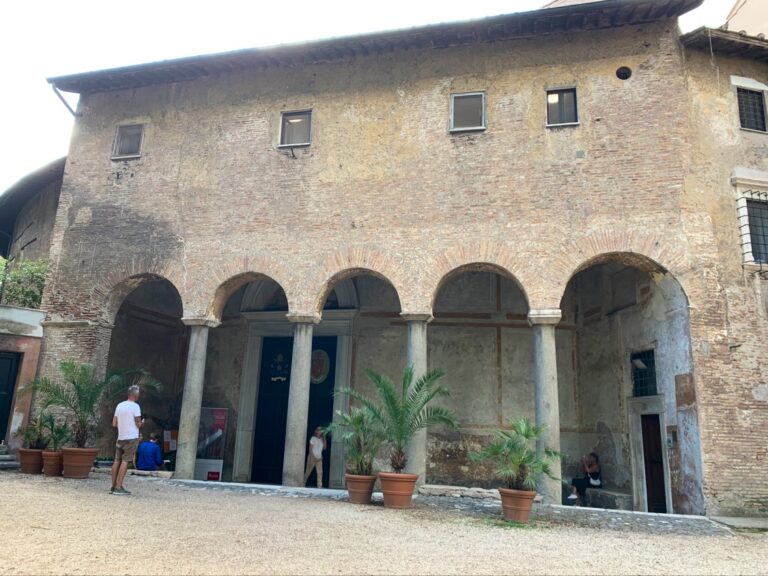
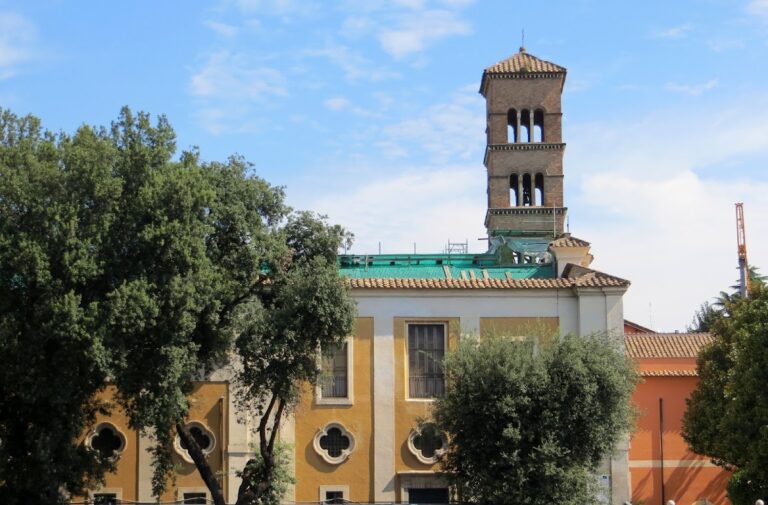
Andrea Sansovino’s Renaissance facade incorporates a portico with five arches divided by travertine pilasters. Above them is a simple entablature and a triangular pediment, together with two square windows and one round window. The center of the tympanum bears the coat of arms of Pope Innocent VIII, while the side sections display the arms of Cardinals Giovanni and Ferdinando de’ Medici. The inconspicuous bell tower contains a bell dated 1288. The Fontana della Navicella stands before the portico, with its present installation dating from 1931 and reproducing the sixteenth-century monument derived from the Roman ship sculpture.
Apse and Ninth-Century Mosaics
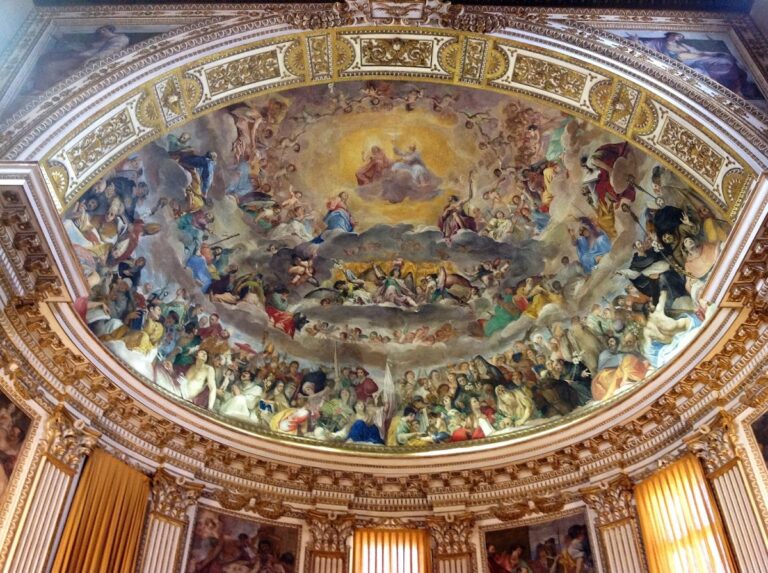
The apse preserves mosaics commissioned during Pope Paschal I’s rebuilding. In the semi-dome, the enthroned Virgin Mary holds the Christ Child and is surrounded by angels, while Pope Paschal kneels at her feet. His square halo indicates that he was alive when the mosaic was made. The triumphal-arch mosaic shows Christ with two angels and the twelve Apostles, with Moses and Elijah below. Its imagery reflects Byzantine influence, and the arch is flanked by two porphyry columns. The lower apse contains frescoes by Lazzaro Baldi depicting John the Baptist and the Apostle John.
Renaissance Interior Decoration and Archaeological Remains
The nave retains a coffered ceiling dated 1566. Its white relief decoration is set against a blue ground, with the Medici coat of arms at the center and symbolic representations of Noah’s Ark and Solomon’s Temple. The ceiling is associated with a donation by Ferdinando I de’ Medici. Additional frescoes by Lazzaro Baldi occupy the nave, while frescoes above the windows were painted by Perin del Vaga after designs by Giulio Romano.
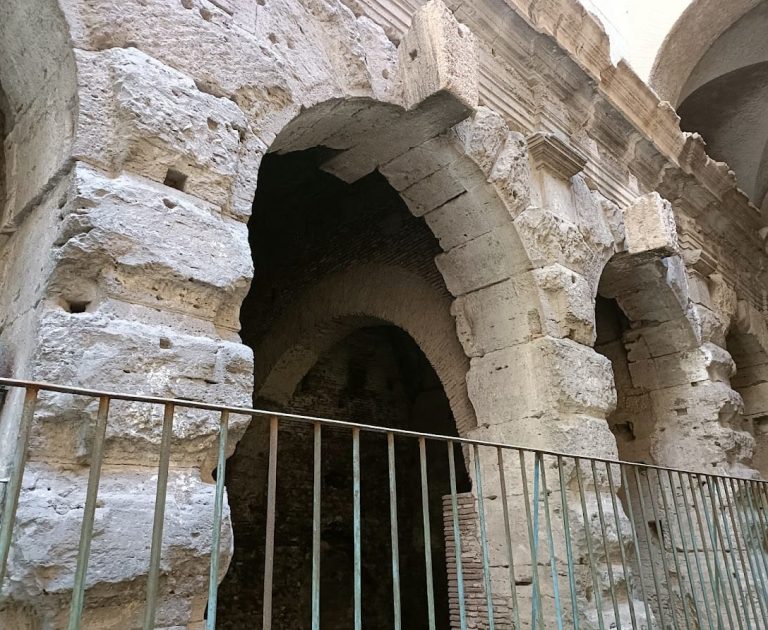
Two ancient Roman sarcophagi discovered during excavations stand in one of the side aisles. The crypt contains remains of third-century structures, providing physical evidence of earlier activity beneath the later basilica.