Church of Saint Francis: A Medieval Franciscan Church in Pescia, Italy

Site at a Glance
- Rating
- 4.9
- Popularity
- Very Low
- Country
- Italy
- Primary era
- Medieval
- External website
- Open
- Eras represented
- Medieval, Early Modern, Modern
- Civilizations
- Grand Duchy of Tuscany, Republic of Florence
- Site type
- Religious
- Remains
- Church
On this page19 sections
History
The Church of Saint Francis is a Roman Catholic church in Pescia, Italy, whose construction began in the thirteenth century and continued over several decades. Dedicated to Francis of Assisi, the founder of the Franciscan movement, it combines Romanesque, Gothic, Renaissance, and Baroque phases within the history of the city and its diocese.
Foundation and Franciscan beginnings
Local tradition places Francis of Assisi in Pescia in 1211, when he reportedly stayed for three days as the guest of Venanzio degli Orlandi, a wealthy and devout merchant. Francis was then travelling toward Pisa. Orlandi is said to have given him a small oratory and a house so that a Franciscan community could be established. Francis summoned two friars from Florence to care for the oratory, which probably included an attached hospice.
The first oratory stood north of the city in the area known as Giocatoio, beyond the Pescia River. The Francis Bridge connected it with the town and remained associated with the church until its demolition after the Second World War. After Francis was canonized by Pope Gregory IX, the oratory was enlarged, traditionally through the support of Venanzio degli Orlandi. The church and adjoining convent then developed over successive decades.
Medieval Pescia and the developing church
The construction of the church began during the thirteenth century, while its chapels and furnishings took shape through later commissions. Prominent Pescia families, including the Albizi, Mainardi, Della Torre, Orlandi, Cardini, Barba, Obizzi, and Nucci, financed or embellished chapels and altars. Their patronage brought together different periods of religious art, from the medieval church to Renaissance commissions and the more controlled devotional approach associated with the Counter-Reformation, the Catholic response to the Protestant Reformation.
The church’s history was also connected with the political struggles of medieval Tuscany. In 1328, representatives of Guelf communities in the Valdinievole and the Florentine Valeriana formed a league against Lucca. Guelfs generally supported the papacy, while Ghibellines generally supported imperial authority. The territory was annexed to Florence in 1339, a change that formed part of the wider political history of Pescia.
Saint Dorothy became regarded as Pescia’s protector after the Florentine entry into the city on 6 February 1339. In 1561, Pompeo della Barba, a physician and scholar born in Pescia who served as physician to Pope Pius IV, obtained a relic of the saint. The relic was preserved in the Church of Saint Francis and later became associated with the Della Barba altar.
Chapels, devotion, and later transformations
The Orlandi-Cardini Chapel was commissioned by Antonio and Giovanni Cardini in memory of their father, Berto, a wealthy apothecary from Colle di Val d’Elsa. It was built approximately between 1453 and 1458. Tradition attributes its design to Andrea Cavalcanti, known as il Buggiano, while later studies identify the participation of craftsmen from the workshop of Bernardo Rossellino. Its decoration reflects the close relationship between family commemoration and the religious life of the church.
The Church of Saint Francis continued to receive commissions during the Renaissance, the Counter-Reformation, and the Baroque period. Successive families sponsored the high altar and individual chapels, shaping the interior over several centuries. A wooden fifteenth-century image of the Virgin and Child also acquired a powerful devotional association. After reportedly producing signs on Easter Monday, 13 April 1506, it was regarded as miraculous. The event led to the foundation of the Company of Mercy and to the construction of an adjoining chapel at the nearby Collegiate Church of Saints Stephen and Nicholas.
The church and convent were suppressed in 1810. Major restoration took place during the first decades of the twentieth century and sought to recover earlier forms. The work also revealed medieval and Gothic-period decoration that had previously been concealed. The Chapel of the Immaculate Conception was deeply restored in 1929 and 1930 and converted into a chapel commemorating the fallen. Much of its Baroque decoration was removed during that conversion, while early twentieth-century work added the coats of arms of Pescia’s noble and patrician families.
The bell tower belongs to the church’s later architectural history. Designed by Carlo Antonio Arrighi, it was built in 1718 and 1719, adding an eighteenth-century element to the complex’s medieval and early modern fabric.
Remains
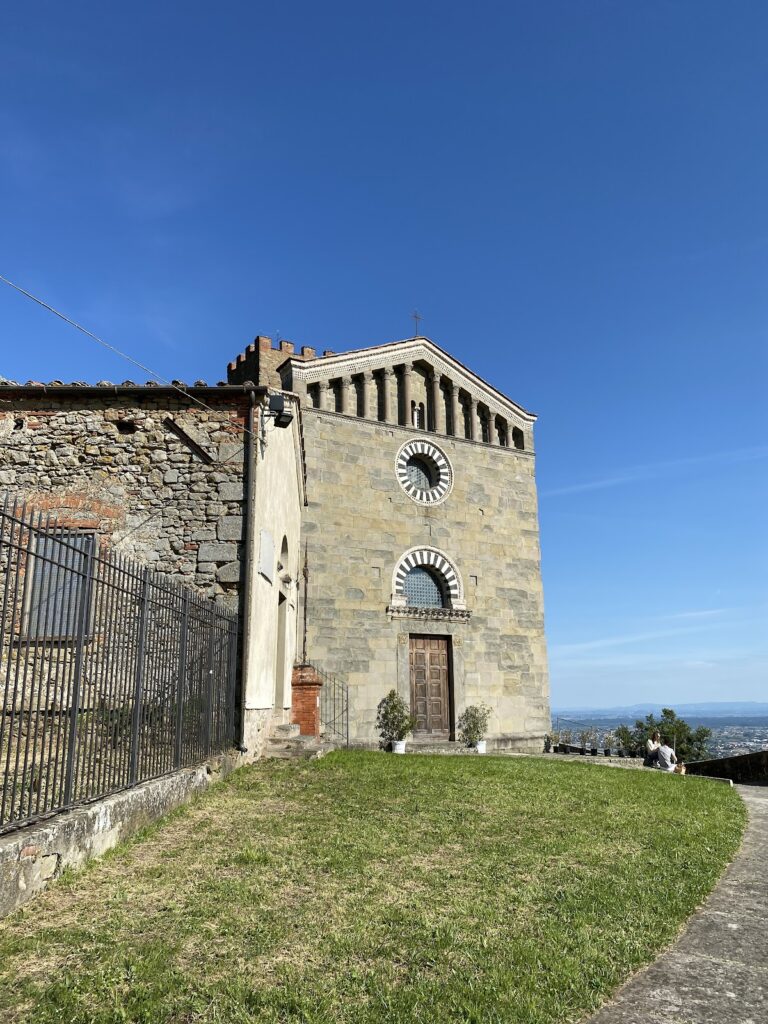
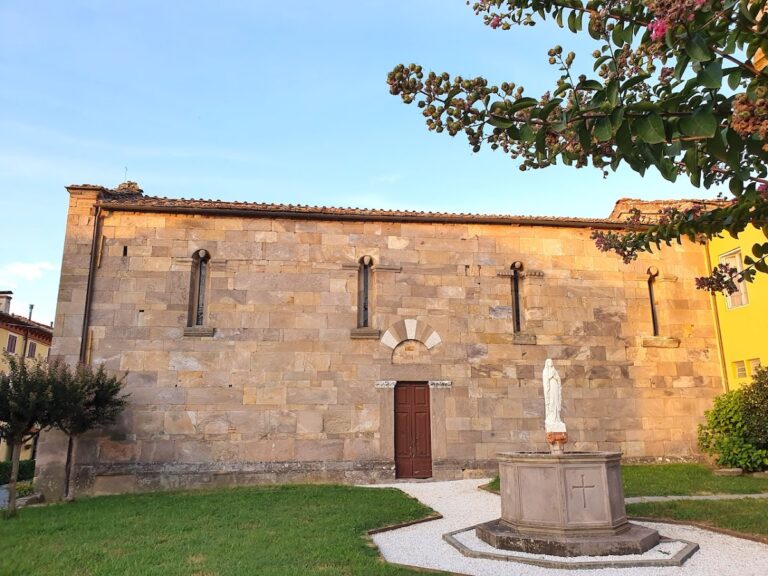
The surviving church has a single nave covered by timber roof trusses and a broad transept. Three chapels open from the transept, while additional monumental chapels line the left side of the nave. Altars made from pietra serena, a gray Tuscan sandstone widely used for columns, moldings, and architectural fittings, occupy the right side and the remaining areas on the left. The facade is decorated with corbelled arches containing zoomorphic figures, and the bell tower rises from the later phase of the complex.
Medieval fabric and painted decoration
Former Franciscan oratory
The medieval oratory forms part of the present church. Its position is between the Chapel of the Immaculate Conception and the Chapel of the Corda Pia, also called the Cardini Chapel. This surviving incorporation preserves the physical connection between the first Franciscan foundation at Pescia and the later church.
Saint Francis panel
At the Mainardi altar, near the end of the right side of the nave, is the original of a thirteenth-century panel by Bonaventura Berlinghieri, dated 1235. It shows Saint Francis surrounded by scenes from his life and is an early surviving example of Franciscan narrative imagery. The panel has been restored several times. A copy occupies the Chapel of the Immaculate Conception, where the original was formerly displayed.
Nave and transept frescoes
The pointed arch separating the nave from the transept contains fourteenth-century frescoes associated with artists who worked in the transept chapels. Their ornament echoes the decoration above those chapels, linking the painted surfaces of the nave and crossing. A sacristy wall contains a Crucifixion fresco associated with Puccio Capanna and Antonio Vite, although its attribution remains uncertain.
Chapels on the nave and transept
Orlandi-Cardini Chapel
The Orlandi-Cardini Chapel opens onto the nave through a round arch. Its barrel vault directs the eye toward a crucifix on the rear wall, while two equal side sections are separated from the central space by a double row of columns. Seating in the side sections faces an altar at the center. The unusual plan is probably an allusion to the Trinity and visually recalls the painted architecture of Masaccio’s Trinity in Santa Maria Novella.
The rear-wall crucifix is associated with the circle of Giuliano da Maiano. Neri di Bicci’s frescoes, dated 1458, frame it with figures of Saints John the Baptist, Policronius, and Albert of Colle, together with the two Cardini patrons. Dolphin and horse motifs symbolize Pescia and Colle. The Cardini coat of arms, showing two crossed thistles within a crown, appears at the center of the vault, on the exterior face of the arch, and carved on the second step of the altar. The chapel also contains the venerated fifteenth-century stucco Corda Pia Crucifix, traditionally associated with miraculous events.
Chapel of the Immaculate Conception
Rebuilt in the second half of the sixteenth century, the Chapel of the Immaculate Conception has a Madonna altar remade between 1564 and 1577. Surviving eighteenth-century decoration is attributed to Giovan Battista Ceceri. The chapel contains the fifteenth-century wooden Virgin and Child, a seventeenth-century canvas attributed to Alessandro Bardelli surrounding the sculpture, Cristofano Allori’s Pietà, painted approximately between 1600 and 1630, and Bardelli’s Glory of Angels, dated 1624.
Della Barba altar
At the left end of the transept, the Della Barba altar contains Jacopo Ligozzi’s Martyrdom of Saint Dorothy, dated 1595, together with the saint’s relic. Beneath the altar table is a sixteenth-century fresco of the Dead Christ, probably also by Ligozzi. Fourteenth-century tomb slabs of knights from the Florentine Obizzi family are mounted along the adjacent wall. The family had been exiled to Pescia because of its sympathies toward Lucca.
Serponti altar
On the opposite side of the transept, the sixteenth-century Serponti altar contains the large canvas Saint Charles Borromeo at Prayer by Rodomonte Pieri and Francesco Nardi, dated 1642. The work belongs to the later history of chapel patronage that shaped the transept’s appearance.
Chapel of Saint Anne
The Chapel of Saint Anne, to the left of the high altar, was built in the fourteenth century and has a cross-vault. Its altar contains the Gothic triptych Madonna and Child with Saints Anne, Simon, Thaddeus, Lawrence, and Dominic, a three-part altarpiece by the Pistoian painter Nanni di Jacopo. It dates to the beginning of the fifteenth century and has also been attributed to Angelo Puccinelli, with a proposed date of 1335.
The chapel also contains Passignano’s Deposition, dated 1595 and formerly in the Church of Mercy, and Giovanni Imbert’s Martyrdom of Saint Bartholomew, dated 1760. A small door opens onto the Stiavelli Chapel, which contains an eighteenth-century Saint Francis with a particular view of Pescia.
Presbytery and major chapels
Major, or Obizzi, Chapel
The major chapel, also called the Obizzi Chapel, was restored in the 1930s, when frescoes by Antonio Vite were uncovered. Dating approximately to 1388, they depict the Evangelists in the compartments of the vault and include fragments of a Massacre of the Innocents and other scenes. The exterior piers carry full-length figures of Saints Benedict and Anthony Abbot. The Saint Benedict figure belongs to the Neo-Gothic restoration, while the chapel’s colored windows date from the 1930s.
Presbytery paintings
On the right wall of the presbytery is an early fifteenth-century fresco of two novices carrying thuribles, containers in which incense is burned during Christian ceremonies. It stands beside a niche formerly used for liturgical objects. The same wall also displays an early eighteenth-century copy of Lorenzo Pasinelli’s Miracle of Saint Anthony of Padua.
The opposite wall contains Giovanni Martinelli’s Miracle of the Mule, signed and dated 1632. The painting was originally made for the Franciscans of Sant’Andrea at Cennano in San Lodovico, Montevarchi, and is regarded as an important example of seventeenth-century Florentine painting.
Nucci Chapel
To the right of the high altar, the Nucci Chapel belonged to the Nucci-Salutati family. Its fresco cycle dates to the 1430s and is attributed to Bicci di Lorenzo. The central image above the altar is the fragmentary Transit of the Virgin, showing Mary during the Dormition, the Christian subject of her death or passage from earthly life. Jesus stands behind her and holds her soul in the form of a small child. The vivid colors and detailed treatment reflect late Gothic culture.
The vault contains the Evangelists, and the cycle continues outside the chapel above the arch with a Coronation of the Virgin. Other scenes include the Meeting at the Golden Gate, the Nativity of Mary, the Expulsion of Joachim, the Presentation of Mary at the Temple, and the Marriage of the Virgin. Together, these paintings preserve the chapel’s fifteenth-century focus on the life of the Virgin.