Santa Maria Maddalena: The Parish Church of Porretta
Site at a Glance
- Popularity
- Low
- Country
- Italy
- Primary era
- Early Modern
- Eras represented
- Early Modern, Modern
- Civilizations
- Papal States
- Site type
- Religious
- Remains
- Church
On this page12 sections
History
Santa Maria Maddalena is the Roman Catholic parish church of Porretta, Italy. The present building was constructed between 1690 and 1696, replacing an earlier church established in the 1430s.
Early church and parish status
Porretta’s population grew during the fourteenth century as people came to its thermal baths. In the 1430s, Don Pellegrino di Signorino, parish priest of Casola, initiated the building of the town’s first church. In 1435, local worshippers sought a parish church of their own, but their petition was refused.
The church was enlarged in 1535 and initially remained under the parish of San Michele Arcangelo in Capugnano. It was dedicated to John the Baptist and Mary Magdalene, although the dedication to John the Baptist had been dropped by the late fifteenth century. In 1585, Cardinal Gabriele Paleotti made it a pieve, a historically important parish church serving surrounding communities, and placed it at the head of a vicariate, an ecclesiastical district grouping parishes. Santa Maria Maddalena is the parish church of Porretta and belongs to the Archdiocese of Bologna and the Vicariate of the Upper Reno Valley.
Rebuilding in the late seventeenth century
By the late seventeenth century, the old church was in such poor condition that it risked collapse. Since parishioners could not afford to rebuild it, they transferred their patronage rights to Count Ranuzzi. He raised money for the work by imposing a tax on local residents.
In 1689, parish services moved temporarily to the Oratory of the Confraternity of the Sacred Stigmata of Saint Francis. A confraternity is a religious association; the stigmata are wounds resembling Christ’s crucifixion wounds, traditionally believed to have appeared on Francis. The old church was then demolished. The replacement’s foundation stone was laid in spring 1690. Work was nearly complete by 1694, paused for the winter, and resumed in 1695. The church was finished in 1696 and officially inaugurated on 22 July that year.
Changes since the nineteenth century
Archpriest Raffaele Pizzirani commissioned a reorganization of the interior in 1885. During the Second World War, the dome collapsed in 1944 and was rebuilt in 1950. The Oratory of Saint Francis, from which paintings now held in the church originated, was later converted into a parish theatre.
Remains
Building and layout
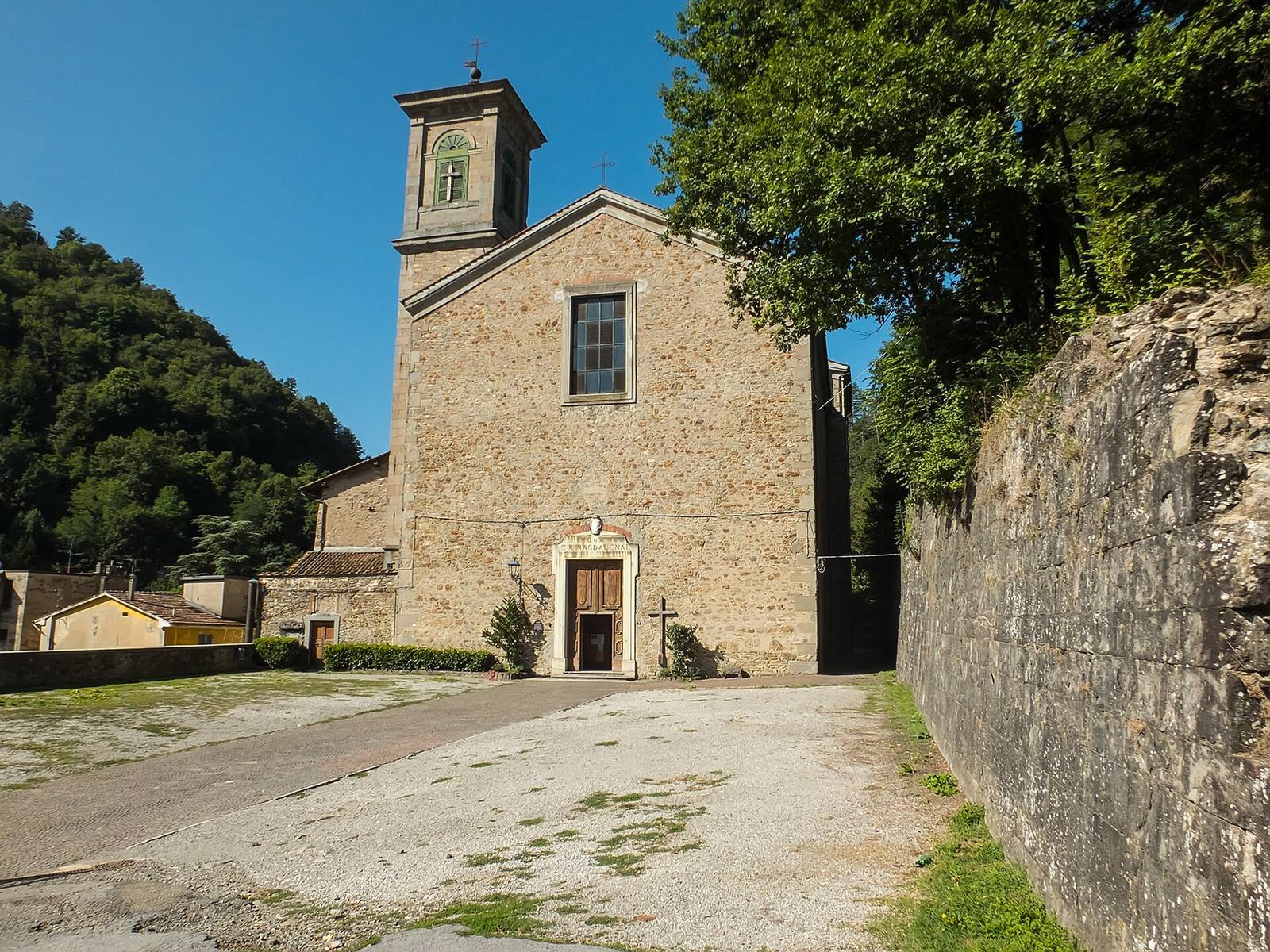
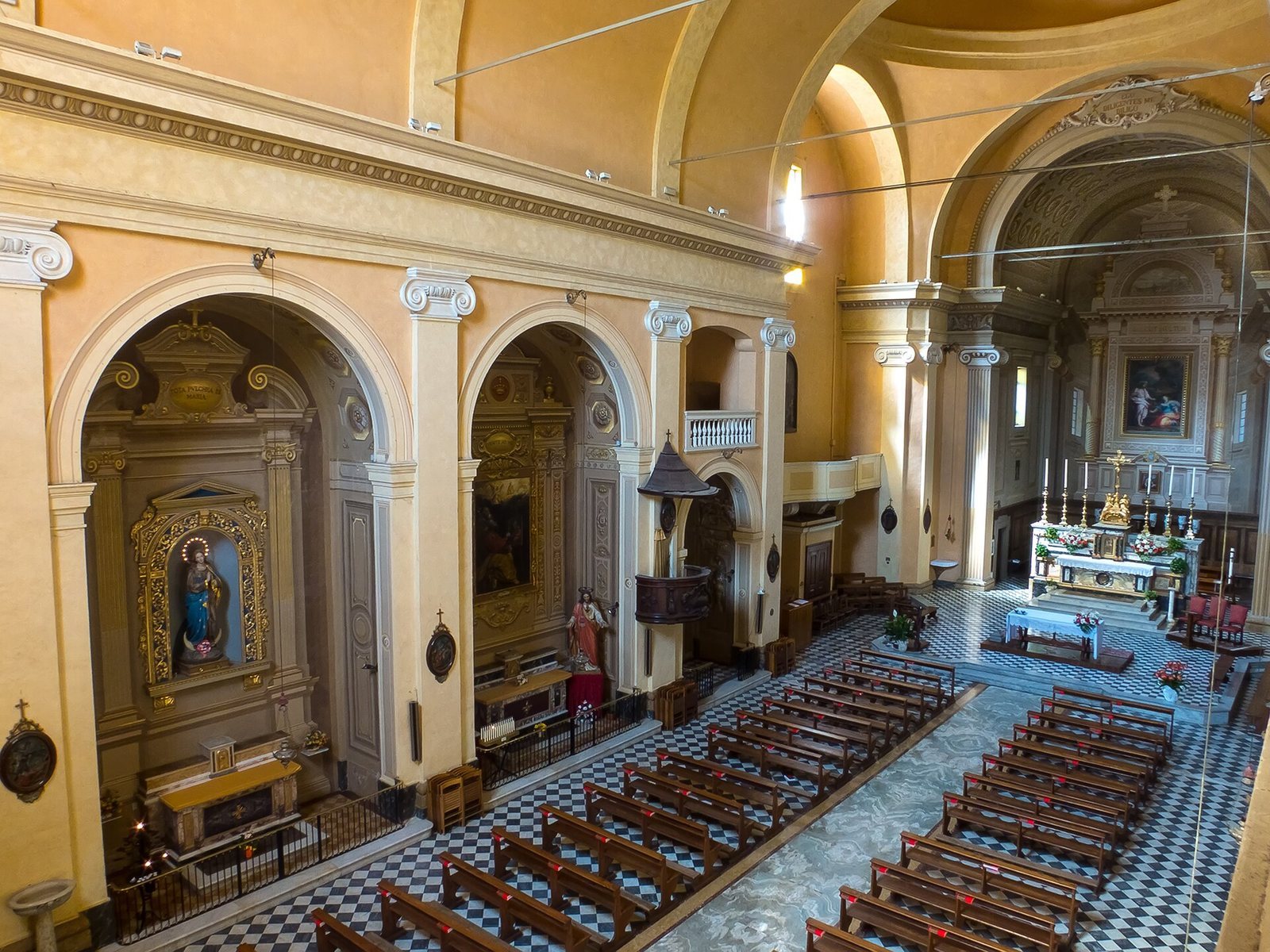
The church has a gable-fronted facade with a rectangular window and a marble entrance portal bearing the Ranuzzi family coat of arms. Inside, a single nave, the church’s main central hall, is divided by pilasters, or shallow wall supports, into four sections. A barrel vault, a continuous curved ceiling, covers the nave, while four side chapels have similar vaulted ceilings.
Bell tower
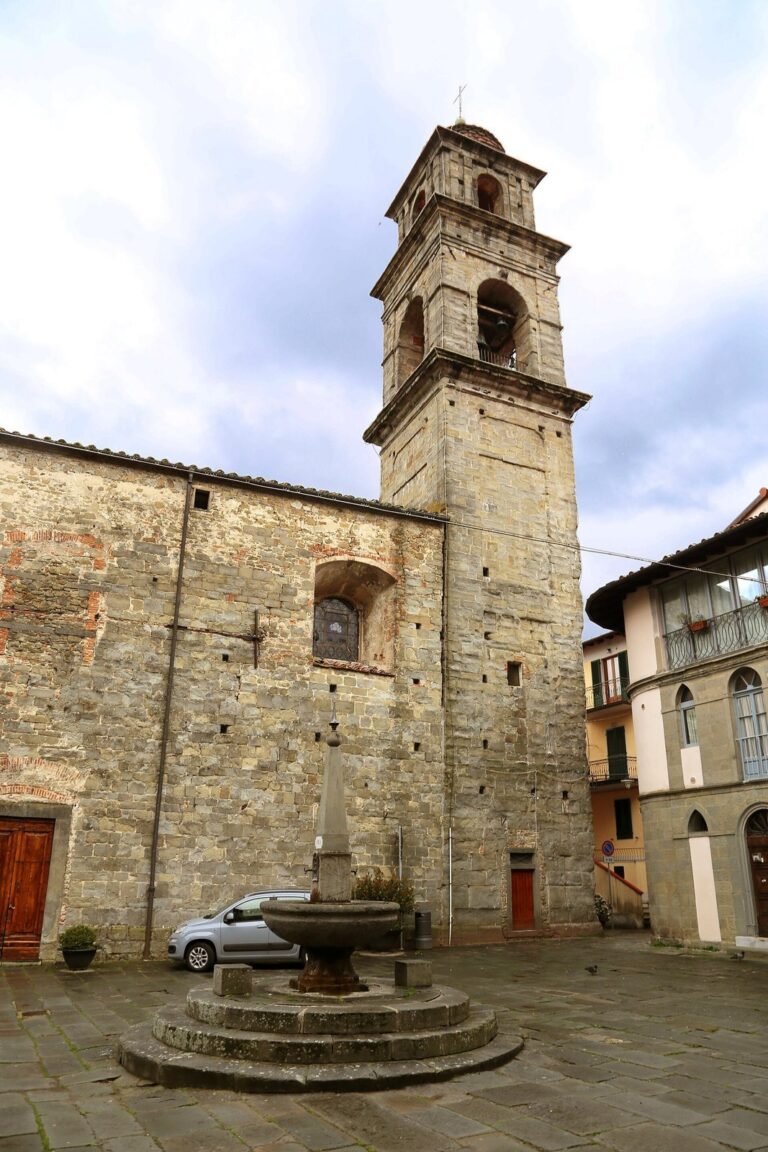
The church’s bell tower was erected in 1848.
Art and furnishings
Liturgical furnishings and sculpture
The church preserves a holy-water basin dating to 1462 and a marble baptismal font from 1618. A wooden crucifix was carved in 1630 by the friar Innocenzo da Petralia.
Paintings by Pietro Maria Massari
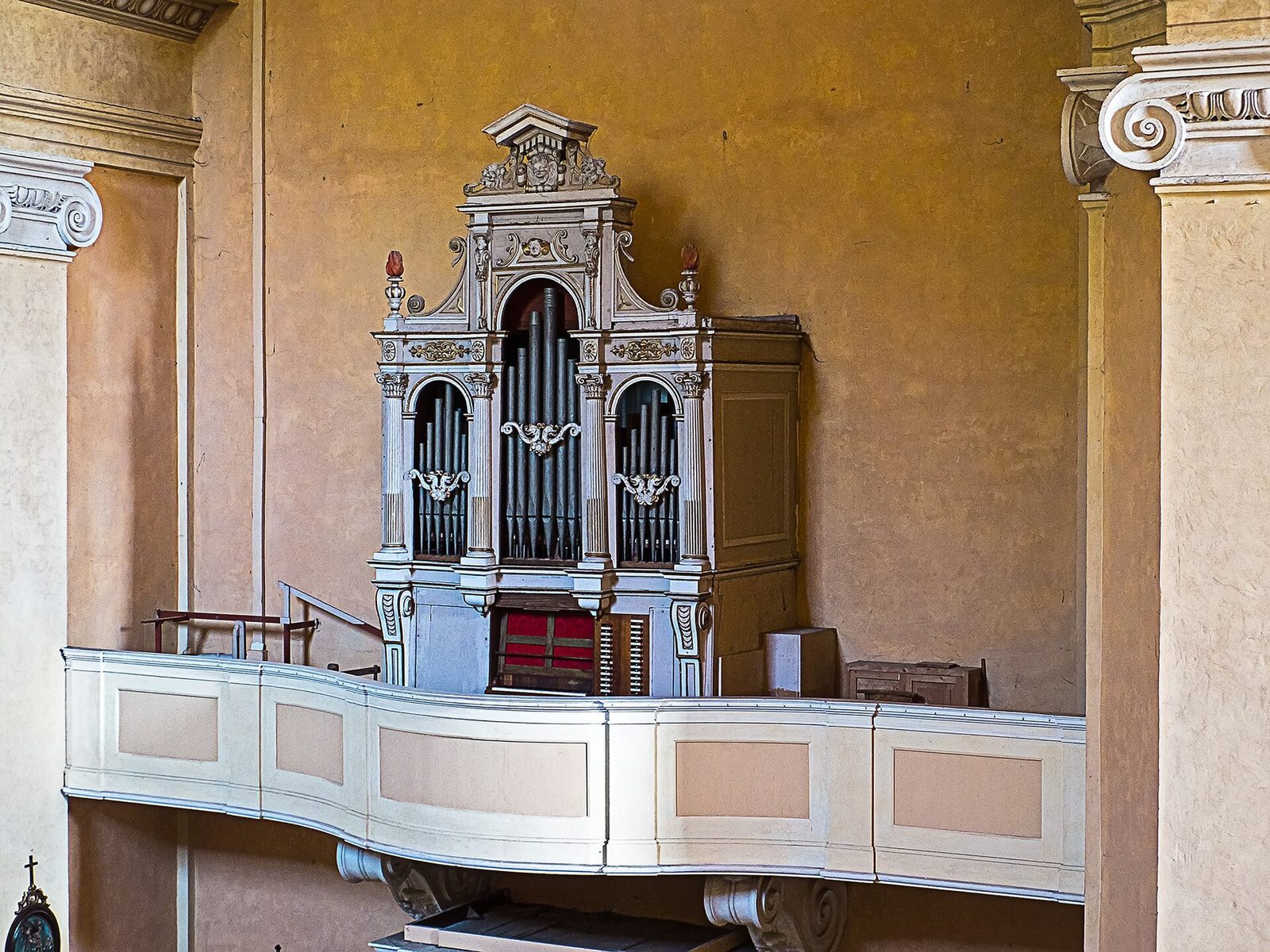
Three works are by Pietro Maria Massari, known as the Porrettano, who died young. A pupil of the Carracci, a family of Bolognese painters whose teaching influenced other artists, he painted Saint Anthony Abbot, now in the sacristy, for the Sabatini family’s third chapel on the left; the work is dated 1589. His signed and dated 1590 painting The Presentation of the Virgin in the Temple was made for the Bartoli family’s fifth altar on the right and restored in 1977–78. The Madonna of the Rosary with Saints Mary Magdalene, Francis, Dominic, Sebastian, and Roch, probably painted around 1591–92, hangs above the left choir loft. It was first placed in the fifth chapel on the left. Saint Sebastian in the painting may portray Massari himself.
Other paintings in the church
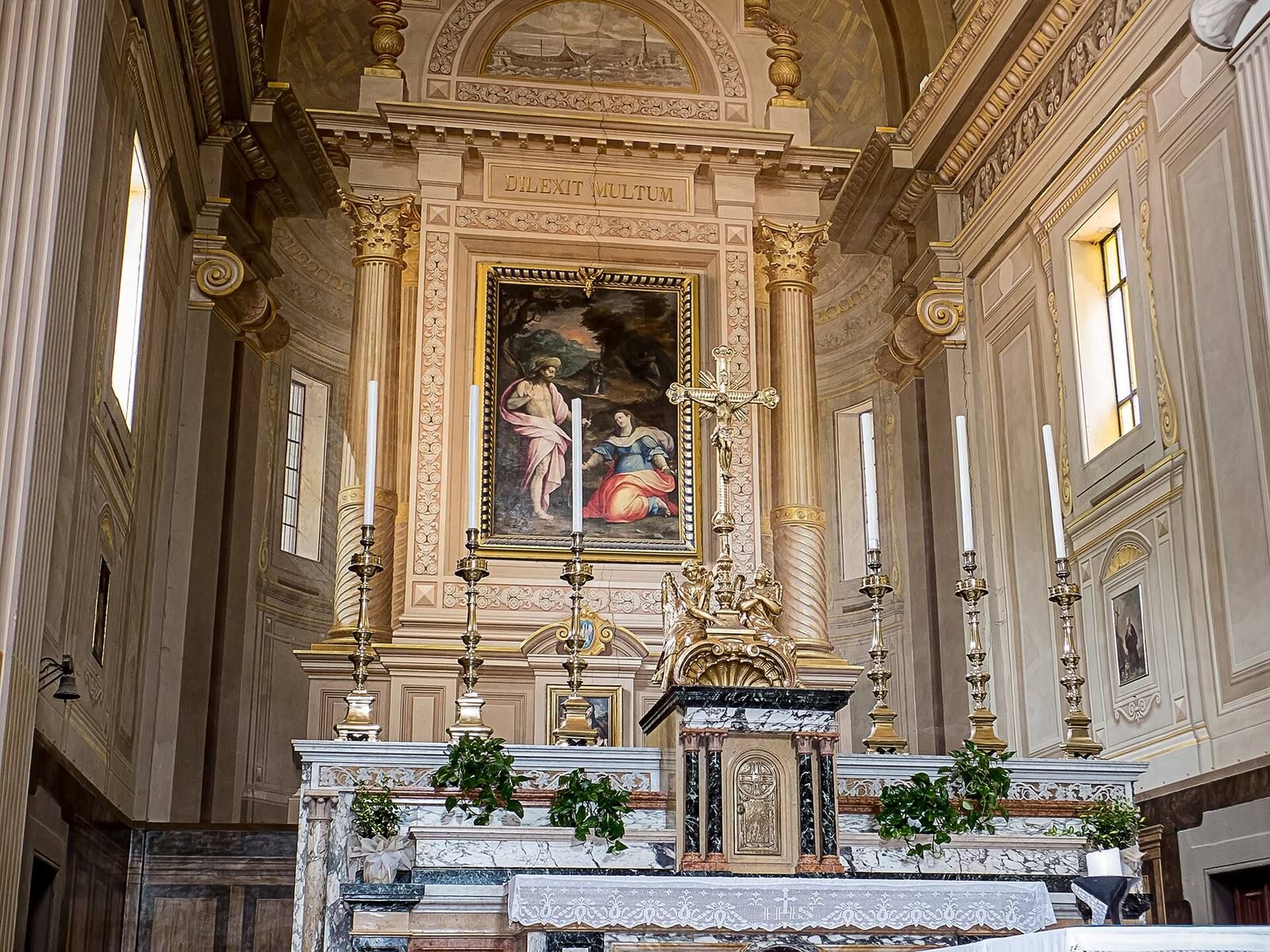
Above the high altar is Ercole Procaccini the Elder’s Do Not Touch Me (Noli me tangere), painted in the second half of the sixteenth century and no later than 1587. A painting of Christ and the Centurion, attributed to Francesco Brizio, a follower of the Carracci and pupil of Ludovico Carracci, hangs opposite the entrance. It came from the Oratory of Saint Francis. A sixteenth-century panel depicting the Marriage of Saint Catherine was given to the church by a devotee in the late nineteenth century; it is attributed to the brothers Giacomo and Giulio Francia. An altarpiece showing Saint Anne with the infant Mary may be a nineteenth-century work by the Bolognese painter Alessandro Guadassoni.
Oratory of the Blessed Sacrament
The adjacent Oratory of the Blessed Sacrament contains an altarpiece by Alessandro Tiarini depicting the Madonna and Child with Saints Francis and Bernardino of Siena. The canvas came from the Oratory of Saint Francis and is dated variously from the 1620s to the 1640s. It sits in a large gilded frame associated with the women’s Company of Our Lady of Mount Carmel, based in this oratory. The frame once held an altarpiece by Giovan Francesco Gessi that is now lost. A smaller early-seventeenth-century painting of the Virgin with bowed head occupies the frame’s upper section and may be by Ferdinando Berti.