Santa Maria in Castello: A Medieval Church in Marano, Italy
Site at a Glance
- Popularity
- Very Low
- Country
- Italy
- Primary era
- Medieval
- Eras represented
- Medieval, Early Modern, Modern
- Civilizations
- Italian, Papal States
- Site type
- Religious
- Remains
- Church
On this page16 sections
History
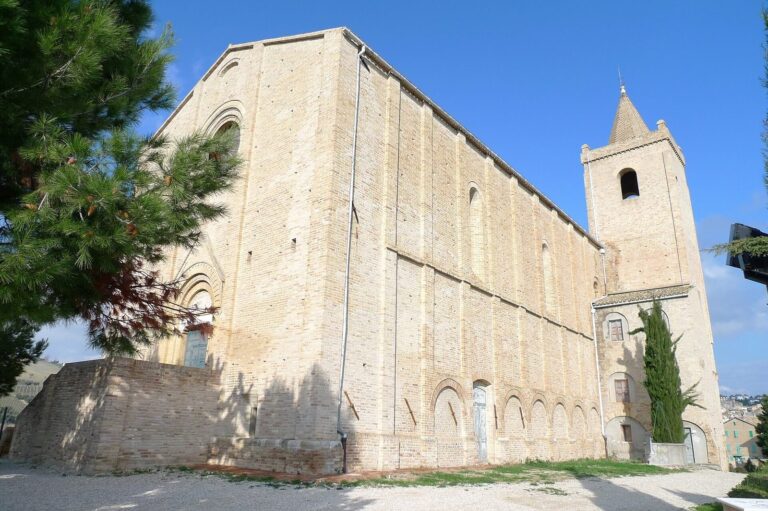
Santa Maria in Castello is a Romanesque church in Marano, within Cupra Marittima, Italy, with Gothic and transitional Romanesque-Gothic features. Its origins probably predate its first known written mention in 1227, which names its chaplain, Bernardus. The church’s history connects it with both religious authority and civic life in medieval Marano.
Origins and medieval role
Tradition holds that the body of Saint Basso rested briefly at Santa Maria in Castello before being taken to the parish church. The saint’s body was apparently brought to Marano from a local rural parish in the tenth century, when the Benedictines abandoned that church. A document from 1063 records books and bells associated with the rural church.
Later records identify Santa Maria in Castello as the mother church of Castel Marano. It lost that position, along with revenues from the benefices of Saint Lucia and Saint Catherine, when the church of San Basso was built. A benefice was an ecclesiastical office or endowment linked to income or other benefits.
On 22 November 1254, the town’s General Assembly met at the church. Its 137 household heads, led by consuls Faraldo Fiorentini and Palmiro Gentili, ratified an agreement made with Fermo the previous day to protect the rights and duties of Marano’s people. Consuls were civic officials who could preside over assemblies.
Restoration and changes in parish use
The church underwent major restoration in 1330 and again toward the end of the fourteenth century. In 1614, its poor condition led the bishop to order that it be shortened. The work was funded by selling the church garden south of the road, an area that had previously included a small cemetery.
During extensive work at San Basso around 1621-1625, Santa Maria in Castello temporarily served as the parish church. At that time it was called the church of Saints Basso and Margaret in Santa Maria.
Ownership and modern restoration
After the mid-nineteenth century, the church became municipal property. The parish returned in 1872 and remained until 1888, when it moved to the church of the Annunciation. In 1904 it transferred permanently to the seaside area, to Santa Maria del Sacro Cuore, also known as Sant’Egidio.
The church remained abandoned until the 1930s, when it became private property with the adjoining villa. A major restoration began in 1946 and was completed in 1948. The building was also known as the Church of Saint Philip, in memory of Blessed Antonio Grassi, a formally beatified priest of the Oratory, a Catholic religious congregation, and an ancestor of its present owners. It remains privately owned and closed to worship.
Remains
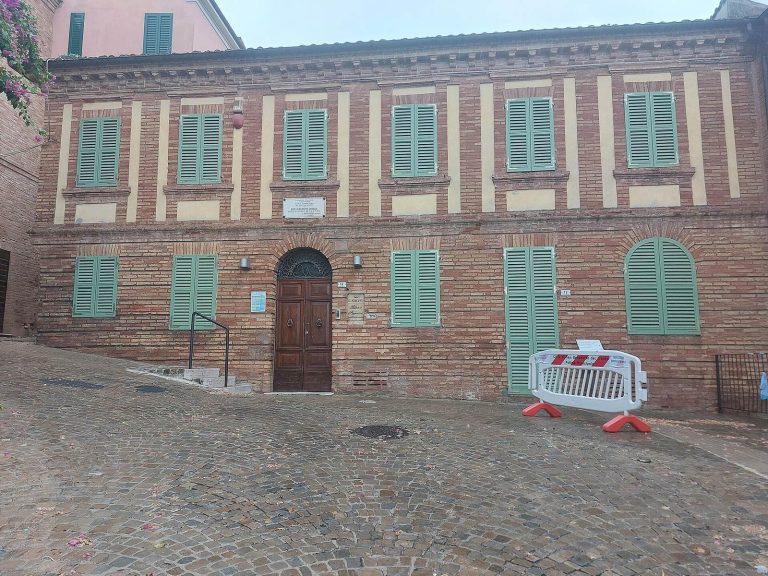
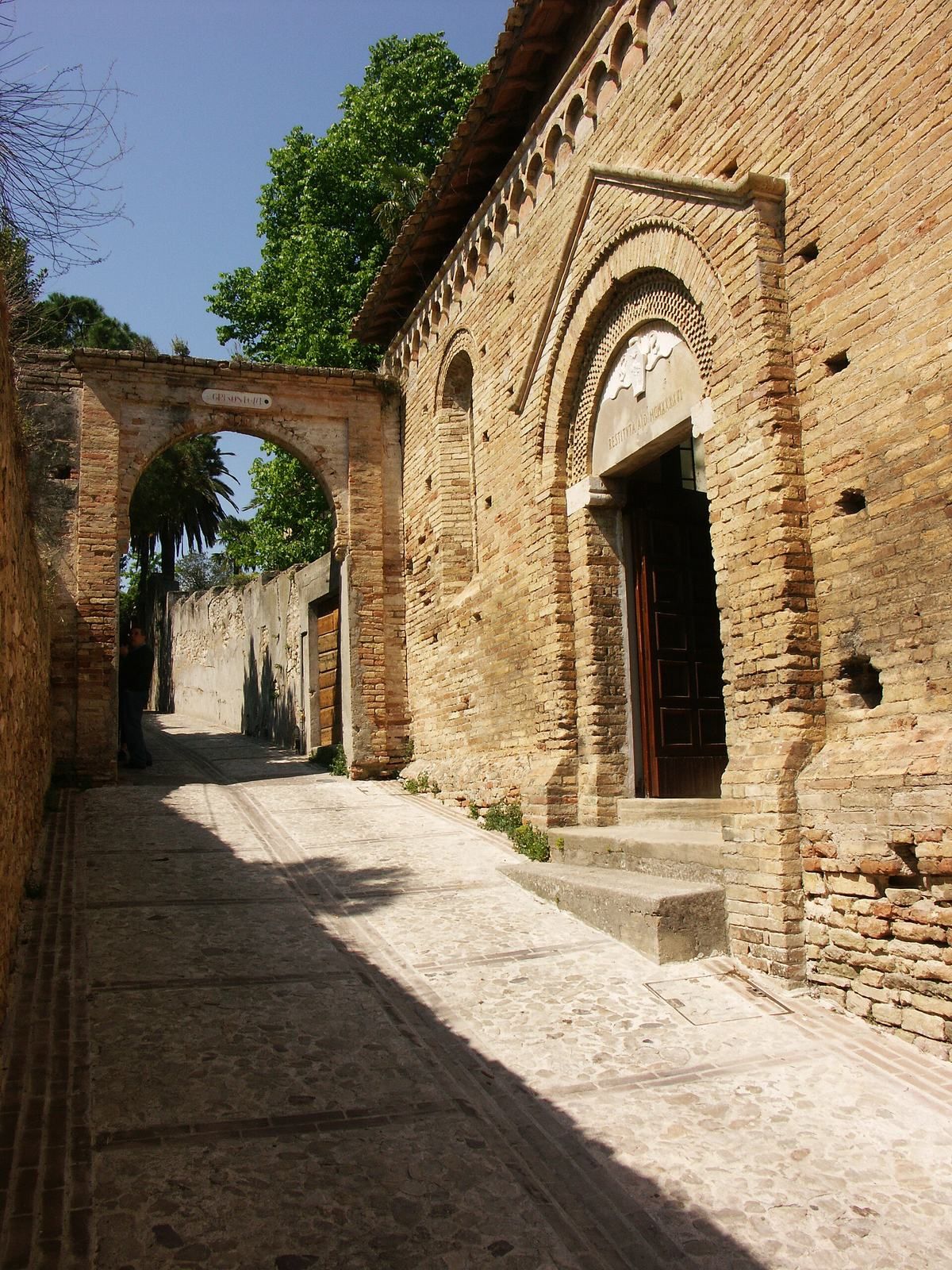
The physical group comprises the church and an adjoining villa, with the church’s south side facing a public road and a raised, narrow passage running along its north wall. The church combines Romanesque forms with Gothic and transitional features. The eighteenth-century villa, formerly a hunting lodge, developed from a group of medieval weavers’ cottages.
Exterior and adjoining grounds
Road-facing exterior
The south-facing exterior retains splayed windows with single openings that widen inward. Dating to the first half of the thirteenth century, these windows and the semi-Gothic main doorway carry geometric terracotta decoration. Much of the series of rounded arches projecting beneath the roof cornice was reinstated. A small wall-like bell structure was built to hold the bells, and the doorway’s upper frame bears the owners’ coat of arms.
Villa and burials
When the church floor was renewed, burials were found beneath it and were later found to extend into the villa garden. The villa’s development from medieval weavers’ cottages into an eighteenth-century hunting lodge links the adjoining property with several periods of the site’s history.
Interior structure and access
Arches and columns
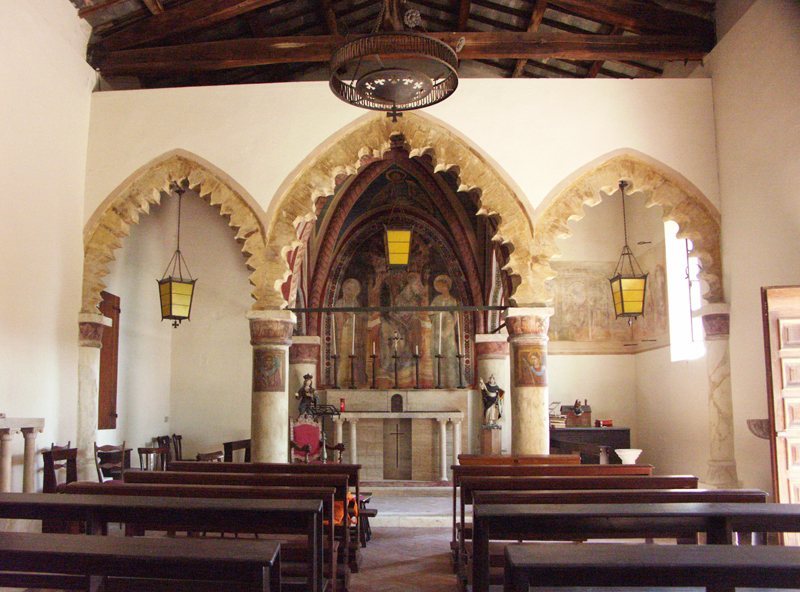
Three large arches with profiles formed by multiple curved lobes stand on terracotta columns. Their Arab and eastern character has been linked to a presence in the area described in medieval European usage as Saracen, a broad term for Muslim peoples. That presence continued until the early thirteenth century.
North passage and former entrance
Along the north wall, a narrow open passage sits above the main interior level and retains arches and pillars from a small portico. The passage’s west side is now walled up. Until 1819, that side opened onto a road and provided another entrance.
Painted decoration and later fittings
Presbytery fresco
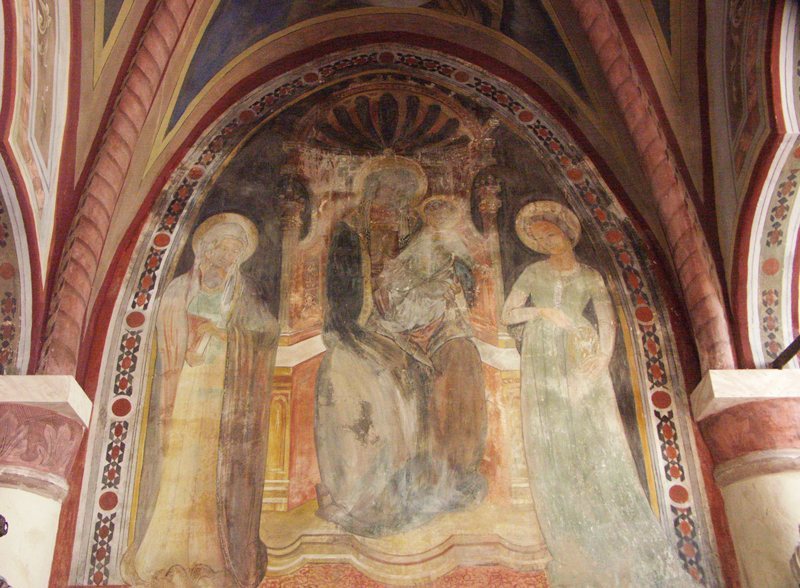
Beneath the canopy over the presbytery, the area around the altar reserved for clergy, a fresco shows the Virgin and Child with Saint Lucia and Saint Catherine of Alexandria. The painting dates to the first decades of the fifteenth century. Its anonymous artist’s work reflects contact with Venetian painting and International Gothic, an ornate style that spread across Europe in the late fourteenth and early fifteenth centuries.
Other painted surfaces
Frescoes in the southeast corner are Romanesque in style and have no known artist. Before a damaging collapse of the roof, paintings attributed to Giuseppe Vergani decorated vaulted ceilings built over a reed framework.
Roof and fresco restoration
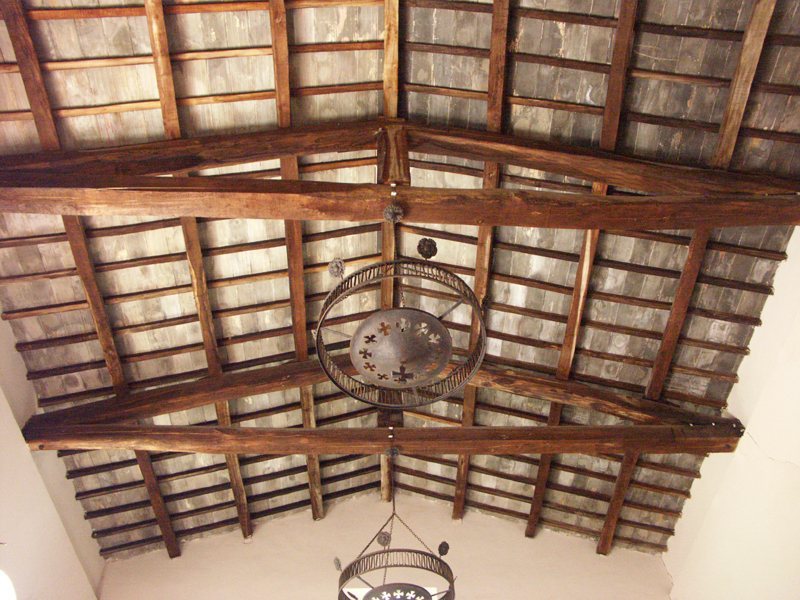
The church ceiling was reconstructed during the restoration, and the roof trusses were returned to their original form. Surviving frescoes were restored, with figurative compositions reassembled and supplemented. A plaque at the rear of the nave records the restoration dates, 1946-1948.
Altars and paintings
The eighteenth-century altars were removed and replaced with new furnishings. Beneath the presbytery canopy, statues of the Virgin and Saint Vincent stand on either side of the altar. Above a side altar is a painting of Blessed Antonio Grassi, made for the church’s 1948 inauguration. It occupies the position once held by Vittore Crivelli’s fifteenth-century Madonna and Child with Saints Basso and Sebastian, now in the church of Saints Basso and Margaret in Cupra Marittima.