Santa Maria della Pace: A Gothic and Renaissance Chapter Church in Milan


Site at a Glance
- Rating
- 4.3
- Popularity
- Very Low
- Country
- Italy
- Primary era
- Medieval
- External website
- Open
- Eras represented
- Medieval, Early Modern, Modern
- Civilizations
- Duchy of Milan, Italian, Spanish
- Site type
- Religious
- Remains
- Church
On this page9 sections
History
Santa Maria della Pace is a Roman Catholic church of the Ambrosian rite in Milan, Italy. The Ambrosian rite is the Catholic liturgical tradition associated with the Archdiocese of Milan and the legacy of Saint Ambrose. Built between 1476 and 1497 in Lombard Gothic form, the church was founded through a donation by Bianca Maria Visconti and her son Galeazzo Maria Sforza. It now serves as the seat and chapter church of the Northern Italian Lieutenancy of the Equestrian Order of the Holy Sepulchre of Jerusalem.
Foundation and construction
Bianca Maria Visconti, a member of Milan’s ruling Visconti dynasty, and Galeazzo Maria Sforza, Duke of Milan from the dynasty that succeeded the Visconti, entrusted the design to Guiniforte Solari. A Lombard architect and sculptor, Solari began the work in 1476, and construction was completed in 1497.
Deconsecration and changing uses
In 1805 Santa Maria della Pace was deconsecrated. The building then served successively as a military warehouse, hospital, stable, and riding school, changing the function of the former church while preserving its architectural shell.
Restoration and present role
The Bagatti Valsecchi family acquired the building in 1900 and restored it. They created the Salone Perosi, an auditorium intended for performances of oratorios by Lorenzo Perosi, an Italian priest and composer known for sacred choral music. Fiscal difficulties eventually ended the auditorium’s activity. In 1906 the church passed to the Sisters of Saint Mary Reparatrix, who restored and reconsecrated it. The Equestrian Order of the Holy Sepulchre of Jerusalem acquired the building in 1967 and designated it as its chapter church in the same year. The order is a Catholic chivalric institution connected with the guardianship and support of Christian institutions in the Holy Land.
A restoration campaign in 1997 brought to light surviving fragments of painted decoration from the former masonry screen between the nave and choir. The same campaign restored the organ and moved it to its present position.
Remains
Facade, side chapels, and bell tower
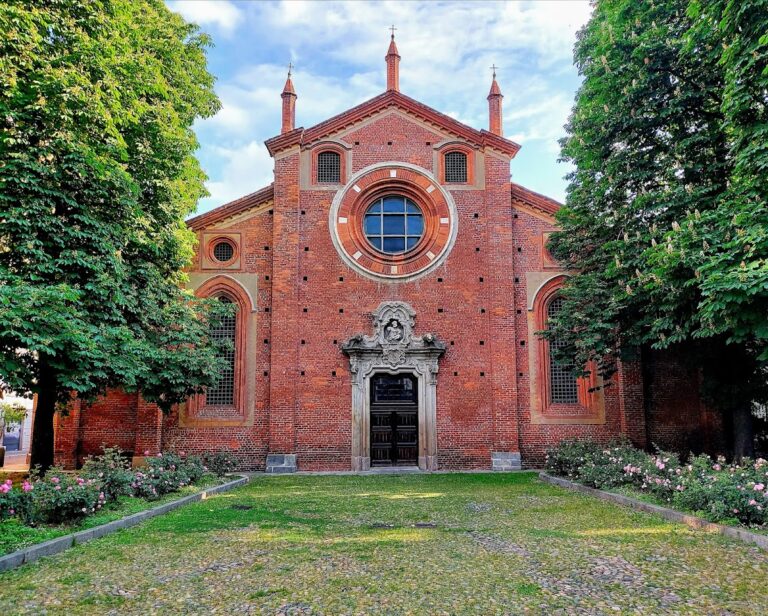
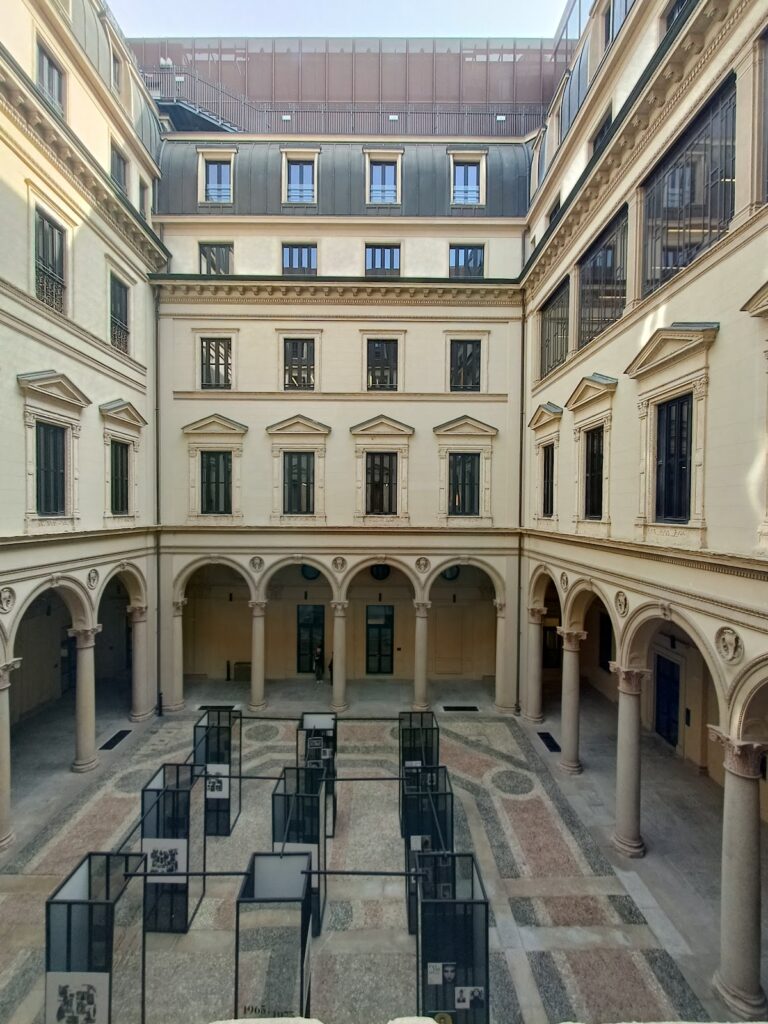
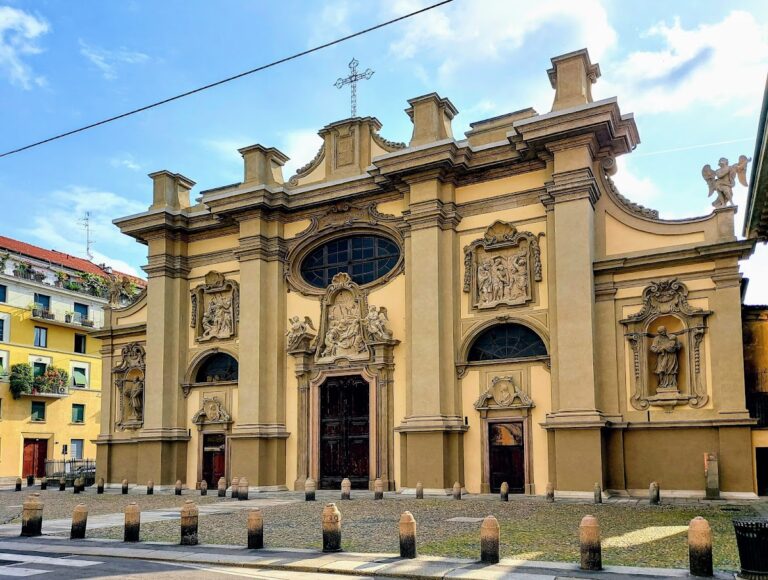
The church has a Gothic exterior and a restrained Renaissance interior set within the original Gothic structure. Its gabled facade faces an adjoining courtyard rather than Via San Barnaba. Brickwork frames a central splayed portal with a pointed lunette, two tall pointed-arch windows, and a circular rose window, a large round window usually filled with tracery and glass. Before the 1900 restoration, the entrance had a Baroque pronaos, or porch before the doorway, supported by two Tuscan columns. Its tympanum carried Simone Peterzano’s fresco of the Madonna and Child between Saints Philip and James and a Franciscan.
The church’s left side runs parallel to Via San Barnaba and has a sequence of side chapels projecting from the nave wall. A small portico supported by a marble column stands before the side entrance near the facade. At the opposite end of the nave, a Renaissance bell tower with a square plan rises above the church. Its bell chamber opens through a paired window on each side.
Nave and chapels
The interior is arranged as a single nave divided into five bays. Each bay has a cross vault decorated with fifteenth-century frescoes of radiant suns bearing the inscriptions PAX, the Latin word for peace, and IHS, a Christian abbreviation derived from the name of Jesus and promoted in the devotional tradition associated with Bernardino of Siena. A masonry screen once stood between the third and fourth bays, separating the area for the faithful from the choir, and fragments of its painted decoration survive.
Five chapels line the left wall of the nave. Each opens through a double arch supported at the center by a simple marble column. The fifth chapel contains the sixteenth-century painting Madonna della Pace on its altar. The church also formerly held valuable frescoes by Bernardino Luini and Gaudenzio Ferrari. Luini’s paintings included scenes of the Virgin and Saint Joseph in the Chapel of Saint Joseph, while parts of the detached frescoes are exhibited at the Pinacoteca di Brera.
Presbytery and apse
The presbytery occupies the fifth bay and is raised several steps above the nave. Rebuilt in a modern style after the Second Vatican Council, the worldwide Catholic council held from 1962 to 1965, it contains a marble high altar and a wooden ambo on the left. Behind it, a rectangular apse has a richly decorated barrel vault. Tanzio da Varallo painted its frescoes between 1630 and 1633, placing Angels Singing the Gloria at the center, the Annunciation on the left, and the Adoration of the Shepherds on the right.
Pipe organ
A pipe organ stands on the choir loft in the apse behind the presbytery. Pietro Bernasconi built it in 1891, and it was originally placed behind the high altar, where it remained concealed. Gianfranco Torri restored it in 1997 and installed it in its current position. The instrument has entirely mechanical action, two manuals of 58 notes each, a chromatically extended first octave, and a straight 27-note pedalboard. Its restrained case, made in 1997, frames 25 principal pipes arranged in a single pointed group with horizontally aligned mitre mouths.