Santa Maria del Castello in Mesocco: A Romanesque Church in Switzerland

Site at a Glance
- Rating
- 4.8
- Popularity
- Very Low
- Country
- Switzerland
- Primary era
- Medieval
- Eras represented
- Medieval, Early Modern, Modern
- Civilizations
- Holy Roman Empire, Swiss
- Site type
- Religious
- Remains
- Church
On this page13 sections
History
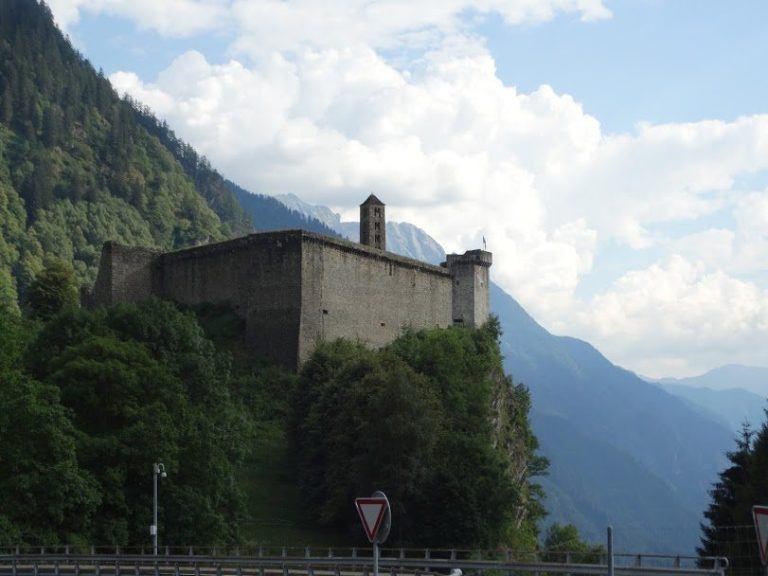
Santa Maria del Castello is a Romanesque Catholic church in Switzerland, associated with the medieval castle complex of Mesocco and dedicated to Mary. It probably originated around 1100, when it replaced an earlier medieval complex, and it belongs to the Diocese of Chur. The church stands below and beside Castello di Mesocco in the Misox valley.
Medieval foundation and fifteenth-century renewal
The church first appears in the foundation charter of San Vittore in 1219. By the fifteenth century, it was receiving new endowed altars and extensive artistic decoration. On 23 January 1450, Count Heinrich von Sax-Misox founded an altar dedicated to John the Baptist in memory of his deceased brother Johannes. Heinrich was a medieval count of the Sax-Misox family. This altar and two others were consecrated on 6 June 1459, probably after substantial renovation during the 1450s. A Cross Altar is mentioned in 1479, and another renovation had taken place before the visitation of 1583.
Between 1459 and 1469, the Lombard painters Cristoforo and Nicolao da Seregno produced a major cycle of wall paintings in the church. The Seregno painters worked extensively in churches of the southern Alpine valleys during the period, combining biblical subjects, saints, and scenes of seasonal life. Their work became a central part of Santa Maria del Castello’s artistic and historical character.
Seventeenth-century rebuilding
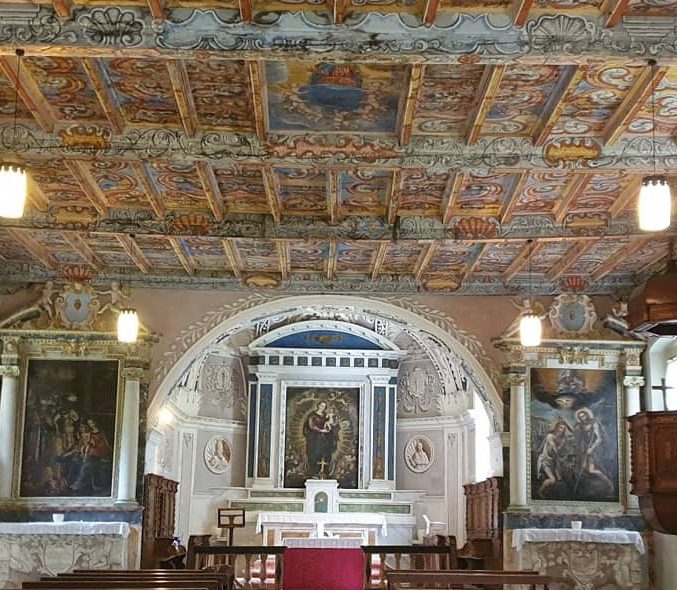
In 1627, Giovanni Battista Viscardi of San Vittore directed a major rebuilding campaign. The old apses were demolished, the nave was extended four metres eastward, and a new choir was built beneath a cross vault. The work also introduced a moulded board ceiling and enlarged the windows. The eastern extension remains identifiable through a joint in the southern wall. A sacristy was added on the north side in 1680.
The church continued to acquire and modify its furnishings. The Cross Altar was built around the beginning of the eighteenth century, while the high altar and side altars belong mainly to the seventeenth and nineteenth centuries. These changes layered later devotional arrangements onto the medieval church.
Modern restoration
Renovation under Max Bachofen took place in 1923. During this work, a damaged pair of November and December scenes in the monthly cycle was recreated by E. Dillena using models from the church of Monte Carasso. The south-wall Trinity fresco was also discovered and restored as far as possible. The exterior was renovated between 1974 and 1976 under Walter Golder of Roveredo, and the latest restoration took place in summer 2010.
Remains
Church fabric and bell tower
The original building was an undivided hall church with a rectangular nave, two semicircular apses, and a bell tower. The rebuilding of 1627 changed the eastern end by replacing the apses with an extended nave and a newly constructed choir. The church and tower are covered with stone slabs, and the joint in the southern wall still marks the four-metre extension.
The six-storey Romanesque bell tower stands on the south side of the nave. Its upper four storeys have paired round-arched windows. An arcosolium, an arched recess often associated with a tomb or funerary space, was created in the southern part of the tower during the fourteenth century.
Medieval painted decoration
North-wall monthly cycle
The north nave wall, approximately six metres high and twelve metres long, carries three superimposed bands of frescoes painted between 1459 and 1469 by Cristoforo and Nicolao da Seregno. The upper band presents episodes from the Passion of Christ, including Christ’s ascent to Calvary and a framed Crucifixion.
The middle band combines Saint George fighting the dragon, Saint Martin sharing his cloak with a beggar, and the archangel Michael weighing souls. It also includes saints such as Bernardino of Siena, Stephen, Anthony, Peter as pope, and Lucy of Syracuse, together with an Adoration of the Magi.
The lowest band forms a calendar of months, a sequence of images showing recurring seasonal and agricultural activities. Each of its twelve scenes measures 115 by 91 centimetres. The images connect farming, household work, illness, courtly activity, and biblical imagery, placing the yearly rhythms of human life beneath scenes concerned with the heavenly realm.
January shows a bourgeois man warming himself beside a stove, with firewood, hams, and sausages around him. In February, a kneeling man sharpens vine stakes. March depicts a long-haired young man playing a double horn beside an opened seed pod. April appears as a young rider on a white horse carrying a flowering branch, while May shows an aristocratic couple departing for falconry.
June presents a farmer mowing grass with a scythe, and July shows a well-dressed reaper cutting ripe grain with a sickle. August depicts a sick man approaching medicine bottles. September shows a cooper fitting hoops to a wine barrel before the grape harvest. October portrays a peasant couple gathering chestnuts, November shows the butchering of a pig, and December depicts the slaughter of an ox.
South-wall and facade paintings
A badly damaged Trinity fresco occupies part of the south wall. It is attributed to the Seregno workshop and includes Saint Anthony on the right and an enthroned Madonna on the left. An inscription identifies the donor as Giuliano de Malagrida, who was parish priest of Mesocco in 1449.
A fragment of a Last Supper from approximately 1570 to 1580 survives on the same wall. The original painting was about six metres long, but the installation of the Cross Altar around the beginning of the eighteenth century disturbed it. Five apostles remain recognizable, including John leaning against Christ.
The facade bears a monumental image of Saint Christopher dated 1469, probably made by the Seregno workshop. Numerous inscriptions occupy the lower part of the church, with the oldest dating from 1469.
Altars and furnishings
High and side altars
The stucco high altar probably dates from the first half of the nineteenth century. Its image of the Madonna was painted in 1634 by Mathis Chefeler, an artist from Uri. The stucco side altars date from approximately 1630 to 1640. The Three Kings Altar contains an Epiphany painting on the left, probably also by Chefeler, while the John Altar on the right depicts the Baptism in the Jordan.
Cross Altar
The Cross Altar stands against the south wall and surrounds a directly wall-painted image of the Madonna and Saint Catherine of Siena from the second half of the sixteenth century. The altar was constructed around this painting at the beginning of the eighteenth century.
Pulpit and holy-water basin
The walnut pulpit dates from 1730. It has inlaid tendril ornament and a domed sounding board. A white-marble holy-water basin dates from approximately 1650.