Santa Maria del Carmine, Pisa: A Carmelite Church and Renaissance Art Site


Site at a Glance
- Rating
- 4.4
- Popularity
- Low
- Country
- Italy
- Primary era
- Early Modern
- External website
- Open
- Eras represented
- Medieval, Early Modern, Modern
- Civilizations
- Grand Duchy of Tuscany, Italian, Republic of Pisa
- Site type
- Religious
- Remains
- Church
On this page15 sections
History
Santa Maria del Carmine is a Roman Catholic church in Pisa, Italy, established for the Carmelite order and dedicated to the Virgin Mary of Mount Carmel. Built between 1324 and 1328 south of the Arno, the church formed part of a Carmelite monastery on Piazza del Carmine along Corso Italia. The monastery itself no longer survives as a complete complex, but the church remains an active Catholic place of worship.
The Carmelite Foundation
The Carmelites are a Catholic religious order whose spiritual tradition is associated with Mount Carmel and the Virgin Mary of Mount Carmel. Santa Maria del Carmine was created as part of that religious setting in the fourteenth century. Its early history is also reflected in surviving works of art, including fragments of fourteenth-century fresco painting and a partially preserved Annunciation that was later moved from the monastic cloister to the refectory, the community’s dining hall.
During the fifteenth century, additional chapels and altars were installed inside the church. In 1426, the notary Giuliano di Colino degli Scarsi da San Giusto commissioned the Florentine painter Masaccio to produce a major altarpiece for the chapel of Saint Julian. The commission cost 80 florins. Masaccio was probably assisted by Andrea di Giusto, who painted the predella, the smaller narrative panels beneath the main image, and contributed to the central panel.
The Pisa Altarpiece
Masaccio’s great work became known as the Pisa Altarpiece. It was a large, multi-panel Renaissance composition organized around a central image with subsidiary panels and a predella. The altarpiece was dismantled and dispersed in the eighteenth century. Eleven of approximately twenty original panels have since been identified in collections in Pisa, London, Berlin, Naples, and Los Angeles. The Saint Paul panel remains in Pisa at the National Museum of San Matteo.
Rebuilding and Later Changes
The church and its adjoining monastic complex were substantially enlarged and rebuilt from the second half of the sixteenth century into the early seventeenth century. This period brought the monumental Baroque altars and paintings that shape much of the interior today. The church was reconsecrated in 1612, and a new organ was built the following year by Andrea Ravani, an organ builder from Lucca.
The organ was repeatedly rebuilt and repaired over the centuries, while the church continued to accumulate works associated with Carmelite devotion and Catholic worship. A monument to Nicola Pisano by Salvino Salvini was placed in the square before the church in 1862. The present facade belongs to another later phase. Alessandro Gherardesca designed it in the 1830s, and it was completed in 1835. He prepared both a Neo-Gothic and a classically styled reconstruction project, but neither alternative was adopted.
War Damage and Conservation
Bombing during the Second World War, particularly in 1943 and 1944, severely damaged the roof structures and the monastic cloister. Between 1965 and 1973, the roof was restored and its structures reinforced with reinforced-concrete beams. The cloister later underwent a major restoration completed in 2012, while the historic organ received its last major restoration in 2013. These interventions preserved elements of the church and former monastery that had survived both rebuilding and wartime destruction.
Remains
The Church Building
Facade
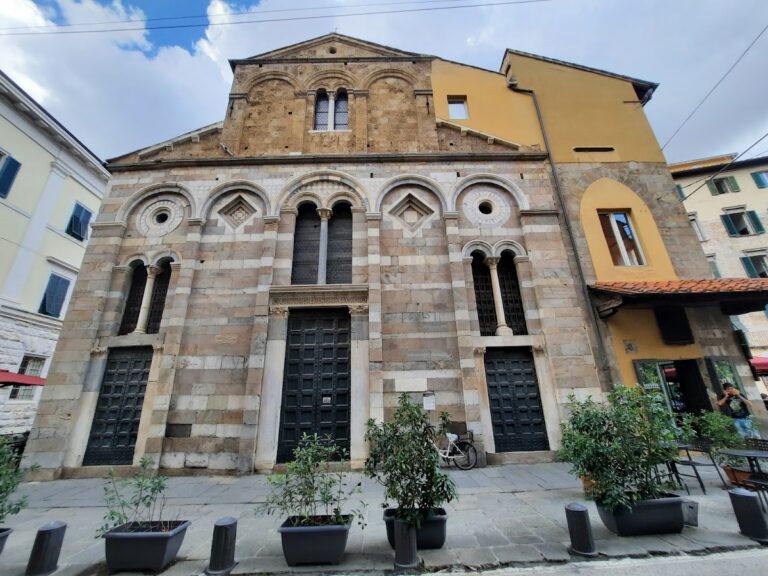
The present facade was designed by Alessandro Gherardesca and completed in 1835. Two niches beside the main entrance contain statues of the prophet Elijah and John the Baptist. Made by artists from Carrara, the statues are dated 1697 and belong to the church’s later decorative history.
Nave and Altars
The church has a basilical plan with a single nave and a large, unified interior hall. Its open roof-truss ceiling leaves the structural timber framework visible. Above it, a gabled brick roof is visible along the side and rear elevations, where the roof structure remains an evident part of the building’s external form.
Monumental Baroque altars contain paintings by Baccio Lomi, Aurelio Lomi, Santi di Tito, Alessandro Allori, Francesco Curradi, Andrea Boscoli, Crescenzio Gambarelli, and Giovanni Domenico Piastrini. The works include Baccio Lomi’s Madonna and Child with Saints Barbara, John the Baptist, Anthony of Padua, and Margaret from 1576; Santi di Tito’s Assumption of the Virgin, painted between 1579 and 1584; and Alessandro Allori’s Ascension of Christ from 1581.
Other paintings include Aurelio Lomi’s Virgin in Glory with Saints, made around 1590, Andrea Boscoli’s Annunciation from 1594, and Crescenzio Gambarelli’s Ecstasy of Saint Teresa of Avila from 1622. Francesco Curradi’s Apparition of the Virgin to Saint Andrew Corsini dates from around 1629. Giovanni Domenico Piastrini’s Virgin in Glory with Saints Joseph, Vittoria, and Ranieri has been recently restored.
The high altar contains a monumental crucifix attributed, with uncertainty, to the Pisan master Giuseppe Giacobbi. It dates to the late seventeenth or early eighteenth century. Together with the altarpiece paintings, the crucifix reflects the church’s later program of richly articulated Catholic decoration.
Organ
Andrea Ravani’s organ, built in 1613, is preserved in the church. Its repeated rebuilding and repair altered the instrument over time, while the major restoration carried out in 2013 secured its place among the surviving furnishings of the building.
Former Monastic Areas
Cloister
The cloister was part of the Carmelite monastery that once adjoined the church. It suffered severe damage in the bombing of 1943 and 1944 and was later restored, with the major work completed in 2012. Three cloister lunettes, semicircular fields used for painted decoration, preserve parts of an early seventeenth-century fresco cycle devoted to the life of Christ and episodes from the lives of Carmelite saints.
The cloister also contains a wall tomb and a bust of Tiziano Aspetti by Felice Palma, dated 1606. The bust is a copy; the original is preserved in the National Museum of San Matteo.
Refectory and Sacristy
The refectory contains a partially preserved fourteenth-century Annunciation fresco transferred from the cloister. The painting is attributed, with uncertainty, to Giovanni da Milano. Its position in the former communal dining hall preserves part of the monastery’s earlier decorative history.
The sacristy contains remains of another fourteenth-century fresco. Further fragments of fourteenth-century frescoes were discovered in the main church when later plaster accidentally fell away, revealing earlier painted decoration beneath.
Former Family Chapel
A tomb slab dated 1517 commemorates Giovanni Riccardi in a former family chapel. The chapel is now dedicated to Mary Magdalene de’ Pazzi, a sixteenth-century Carmelite mystic and saint. The slab and the chapel’s later dedication preserve distinct traces of the church’s changing devotional and commemorative use.
Surviving Panels from the Pisa Altarpiece
Several panels formerly belonging to Masaccio’s Pisa Altarpiece survive in museums. The enthroned Madonna and Child is in the National Gallery in London, while the Crucifixion is in the Museo di Capodimonte in Naples. The Saint Paul panel is in Pisa at the National Museum of San Matteo, and Saint Andrew is held by the J. Paul Getty Museum in Los Angeles.
The Gemäldegalerie in Berlin preserves panels depicting Saint Augustine, Saint Jerome, two Carmelite saints, the martyrdom of Saint John the Baptist, the crucifixion of Saint Peter, the stories of Saint Julian and Saint Nicholas, and the Adoration of the Magi. Together these dispersed works provide the surviving record of the ambitious altarpiece once made for Santa Maria del Carmine’s chapel of Saint Julian.