Santa Maria de Ripoll: A Benedictine Monastery and Catalan Cultural Centre


Site at a Glance
- Rating
- 4.5
- Popularity
- Medium
- Country
- Spain
- Primary era
- Medieval
- External website
- Open
- Eras represented
- Medieval, Early Modern, Modern
- Civilizations
- Spanish
- Site type
- Religious
- Remains
- Monastery
On this page15 sections
History
Santa Maria de Ripoll is a Benedictine monastery in Ripoll, Spain, founded around 879 to 880 by Count Wifred the Hairy during the repopulation and reorganization of the Ripoll valley and the plain of Vic after their reconquest. Probably established over an earlier Visigothic religious site, it became one of Catalonia’s principal religious and cultural institutions. Benedictines followed the Rule of Saint Benedict, a framework of communal worship, discipline, learning, and labor.
Foundation and Early Development
Wifred placed his son Radulph at Ripoll to be educated under monastic discipline. Radulph later became abbot of Ripoll and bishop of Urgell. Wifred also founded the nearby monastery of Sant Joan de les Abadesses for his daughter Emma. Ripoll received extensive lands, public rights, fishing rights on the Ter and Freser rivers, a share of market tolls, and legal privileges, including exemption from the counts’ courts for certain crimes. Its monks could choose their abbot according to the Benedictine Rule.
The first consecration of the monastery church took place on 20 April 888 under the dedication of Santa Maria. The church was entrusted to Abbot Daguí and the Benedictine community. Under Abbot Énnec, Count Miró demolished this first church and built a larger replacement, consecrated in 935. Abbot Arnulf, who was also bishop of Girona, directed another enlargement, completed at the consecration of 977. A stable monastic community is recorded from the early eleventh century.
The Age of Abbot Oliba
Abbot Oliba governed Ripoll from 1008 to 1046 and carried out the monastery’s decisive medieval expansion. The church was enlarged, a crypt and transept were added, and the basilica was consecrated on 15 January 1032. Oliba also expanded the western part of the church and developed its monumental entrance. During his tenure, the library gained 71 manuscripts, while the monastery’s collection grew to 246 manuscripts by the time of his death in 1046.
Ripoll’s scriptorium, the monastic writing room where scribes copied, translated, and composed books, and its school made the monastery an important centre of learning. Its manuscripts included Latin translations of Arabic mathematical and astronomical works. Gerbert of Aurillac, the future Pope Sylvester II, stayed at Ripoll for three years between 967 and 970 to study the quadrivium, the advanced medieval curriculum of arithmetic, geometry, music, and astronomy. Theft of the monastery’s books was punishable by excommunication.
Ripoll founded or helped establish daughter monasteries, including Santa Maria de Montserrat and Saint-Martin-du-Canigou. From 1070 to 1169 it depended on the Abbey of Saint-Victor of Marseille. The monastery remained Catalonia’s principal religious centre until the fifteenth century, when its decline began with the loss of control over Montserrat in 1402.
Dynastic Burials and Later History
Santa Maria de Ripoll served as a burial place for the counts of Barcelona and Besalú. Those interred included Wifred the Hairy, Ramon Berenguer III, Ramon Berenguer IV, Bernat Tallaferro of Besalú, and Radulph, Wifred’s son and the monastery’s abbot. Other counts of Barcelona were also buried there, although the locations of some graves are now unknown.
On 2 February 1428, an earthquake with an intensity of IX on the Mercalli scale destroyed one of the monastery’s bell towers and severely damaged the rest of the complex. The Mercalli scale measures an earthquake through its observed effects on buildings, people, and the landscape. The damaged parts of Ripoll were rebuilt in the Gothic style.
The monastery was secularized and abandoned by its monks in 1835. It was then ravaged and burned, destroying the library and much of the archives. Part of the cloister disappeared in 1847, and the tower of the abbey palace was lost in 1856. The abbey palace, grain hall, and other monastic buildings were subsequently treated as a quarry, and their stone was sold.
Between 1826 and 1830, Josep Moretó Codina attempted to convert the church into a Neoclassical building and reduced its five naves to three. After the confiscation of monastic property, Martí Sureda and Elías Rogent prepared competing restoration proposals. Sureda favoured conserving the surviving remains, while Rogent advocated reconstruction. Bishop Josep Morgades i Gili of Vic secured the monastery’s return to the Church for use as a parish church and commissioned Rogent’s project, first presented in 1863. Construction took place from 1886 to 1893.
Rogent’s reconstruction was largely new and substantially altered the building’s original appearance, although it sought to reproduce the church associated with Abbots Arnulf and Oliba. The basilica was reconsecrated on 10 July 1893. The surviving remains of the counts of Barcelona and the abbots that had escaped the 1835 fire were returned to the monastery at that ceremony. Santa Maria de Ripoll was declared a Historic-Artistic Monument in 1931 and remains a nationally recognized cultural monument and a Catholic institution associated with the Diocese of Vic.
Written Culture
Ripoll’s intellectual activity continued beyond the production of biblical and scientific manuscripts. The Gesta Comitum Barcinonensium, regarded as the first history of Catalonia, was written there in the late thirteenth century. Other works copied or apparently composed at the monastery included chronicles of the First Crusade, a liturgy concerning the crusaders’ conquest of Jerusalem in 1099, an early work about El Cid, and a song composed for Count Ramon Berenguer IV. Some manuscripts formerly belonging to Ripoll entered the old-books collection of the University of Barcelona after the 1835 confiscation, and the monastery’s historical property marks have also been recorded and described.
Remains
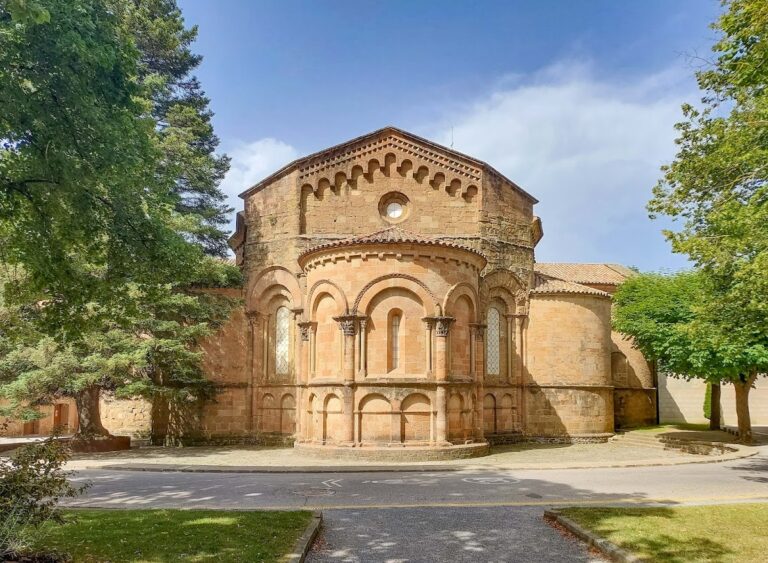
The present complex is dominated by a church measuring approximately 60 metres in length and 40 metres in width, together with a two-storey cloister and the monumental entrance portico. Much of the church belongs to Elías Rogent’s nineteenth-century reconstruction, while the cloister and portico preserve more medieval fabric. The surviving arrangement therefore combines reconstructed Romanesque forms with remains altered by rebuilding, fire, and later losses.
The Church
Medieval Plan and Reconstructed Interior
The medieval church planned under Abbot Arnulf had five naves, five apses, and barrel vaults. Abbot Oliba added a high transept, the cross-arm of a church crossing its main nave, and increased the number of apses to seven, including those associated with the transept. The Romanesque basilica also had a crypt, a chapel or burial space beneath a church, and a western entrance framed by a portico and flanked by bell towers.
The central apse held the altar of Santa Maria. The smaller apses contained altars dedicated to the Savior, the Holy Cross, Saint Michael the Archangel, Saint Pontius, Saint Raphael, Saint Nicholas, and Saint George. The medieval altar of the Virgin had a jasper setting, a gold frontal decorated with precious stones and enamels, silver side panels, and a baldachin with chased silver-covered columns and roofing.
The nineteenth-century arrangement has three naves, reflecting the reduction made during the 1826 to 1830 rebuilding. Rogent also introduced a central tower over the crossing and columns separating the lateral naves, features not known to have existed in the original building. The present church is consequently an extensive reconstruction based on the medieval basilica rather than a wholly preserved survival of its fabric.
Monumental Entrance Portico
The entrance portico is approximately one metre thick and is formed from stone blocks attached to the church wall. Severe damage from the fires that followed the monastery’s abandonment in 1835, together with later restoration, affected the sculpture, but the portico remains a major work of Catalan Romanesque art. Its design was conceived as a structure resembling a triumphal arch.
Created in the mid-twelfth century, the frontal relief is divided into seven horizontal bands. Its style is related to the tomb of Ramon Berenguer III and to part of the cloister. The two upper bands show God enthroned with the symbols of the four Evangelists, together with the blessed and the elders of the Apocalypse. The central bands present the histories of David and Solomon on the left and Moses on the right. Moses receives the tablets of the law in the presence of Aaron, an unidentified prince, and a bishop.
The lower section contains mythical animals commonly identified with the visions of the prophet Daniel. Nearly destroyed statues of Saints Peter and Paul flank the portico as guardians of the basilica entrance. Other scenes show Cain and Abel, Jonah, and the twelve months of the year.
Burial Area
The transept contains the tombs of the counts of Besalú and several counts of Barcelona. The burials extend chronologically from Wifred the Hairy to Ramon Berenguer IV, preserving the church’s role as a dynastic burial place within the surviving architectural complex.
The Cloister
The two-storey cloister, a covered walkway surrounding an open courtyard, preserves more of the original structure than the church. Its first storey began around 1180 and continued until the beginning of the fifteenth century. The upper storey was built between the fifteenth and sixteenth centuries.
Each side has thirteen semicircular arches supported by paired columns with capitals inspired by Corinthian forms. Every capital carries distinct carved decoration, including subjects from classical mythology and scenes of daily life. The capitals were made by Pere Gregori and Jordi de Déu, and together they form a materially varied sculptural programme within the cloister.
Manuscripts and Intellectual Remains
The Ripoll Bible
The Ripoll Bible, also called the Farfa Bible, was produced around 1015 to 1020 and is the most valuable surviving manuscript associated with the monastery. It contains numerous illustrations and introductory texts arranged as an encyclopedic presentation of sacred scripture. The manuscript is now preserved in the Vatican Library.
The Roda Bible
The Roda Bible was produced around 1010 to 1015 and was later kept at Sant Pere de Rodes after being given by the abbot of Ripoll. It consists of four volumes, two decorated with coloured miniatures and two in black and white. Marshal Noailles took it to France as a war trophy in 1693, and it is now held by the National Library of France.
The Fluvià Bible and Other Works
The Fluvià Bible, one of the three great Bibles associated with Oliba’s period, was lost in the fire that destroyed the monastery in 1835. The surviving manuscript tradition also preserves the work of named illustrators and calligraphers, including the monk Oliva, who produced a calendar and a chart of the abacus and measurements, as well as Garcías, Arnald, and Guifré.