Santa Maria de Blanes: A Gothic Parish Church in Spain
Site at a Glance
- Rating
- 4.5
- Popularity
- High
- Country
- Spain
- Primary era
- Medieval
- Eras represented
- Medieval, Modern
- Civilizations
- Crown of Aragon, Spanish
- Site type
- Religious
- Remains
- Church
On this page14 sections
History
Medieval parish and patronage
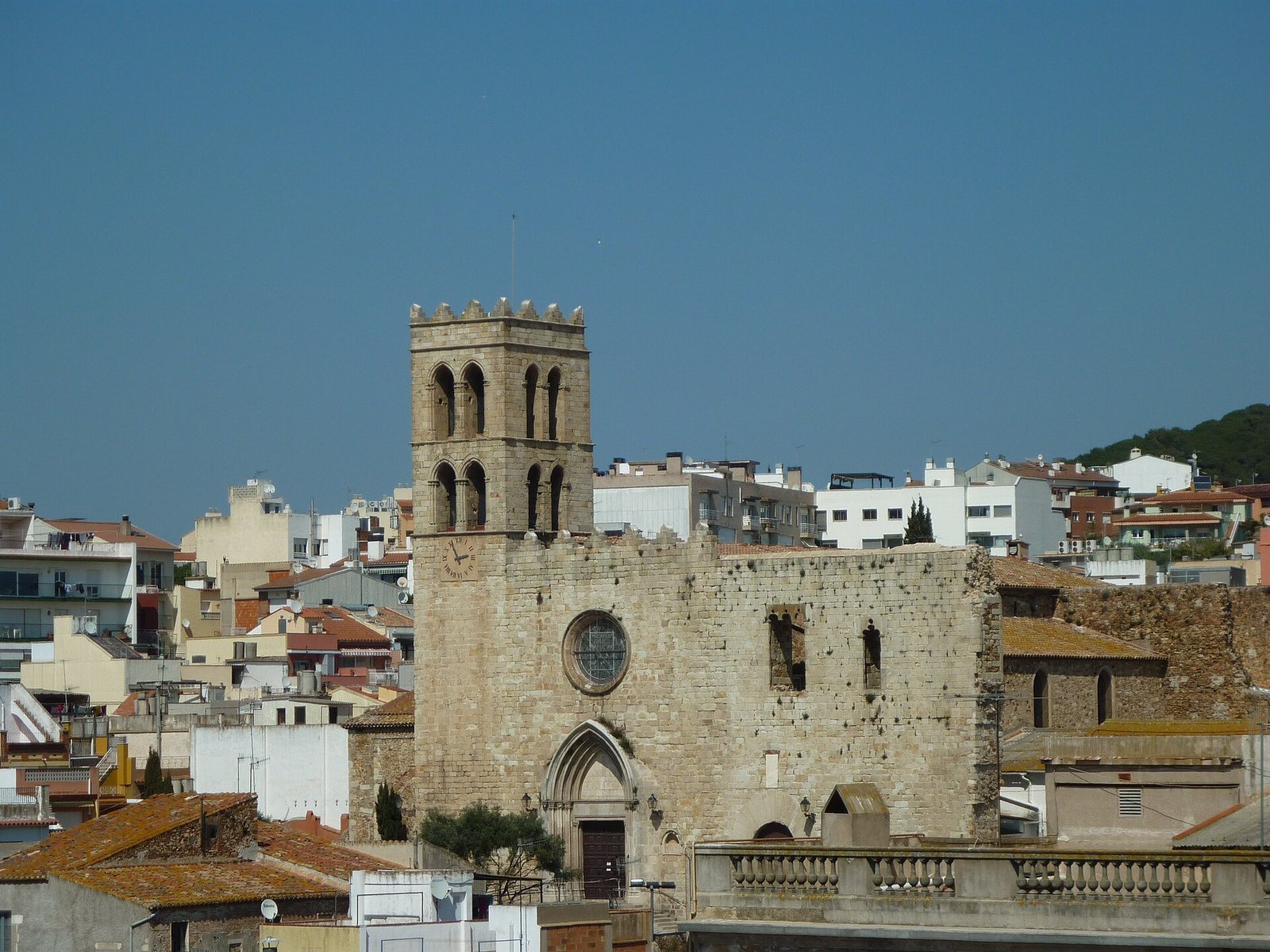
Santa Maria de Blanes is a Gothic church in Blanes, Spain, built in stages between 1350 and 1410. Its earliest surviving notices date to 974. The church belonged to the parish of Tordera until 1319, when it became a parish in its own right. The Viscounts of Cabrera were major patrons, and plans were commissioned from Arnau Bargués, a Catalan Gothic architect.
The Viscounts held the privilege of burial inside the church. Jaume and Tomàs, illegitimate sons of Bernardo III of Cabrera, were the first to receive it, in 1417 and 1418. In 1438, the cemetery in the square in front of the church was transferred to a new site behind the building, and the deceased were reburied there. In 1487, Isabel de Cabrera, widow of Joan Ramon Folc III de Cardona, Count of Cardona and Prades, arranged for a balcony to be opened from the palace wall onto the church, allowing her to attend services from her home.
War and destruction
During the War of the League of Augsburg, a late-seventeenth-century conflict between France and a coalition of opposing powers, the parish was looted and damaged. In 1694, French troops led by General Clark attacked the port but were driven back by an army sent by the viceroy, the monarch’s representative. As the French withdrew, they set fire to the town. The church interior was destroyed, and explosives demolished the Viscounts of Cabrera’s palace.
On 22 July 1936, the church was set alight. The fire continued until the structure collapsed, destroying most of the interior, including the Baroque main altarpiece, a decorated structure behind an altar, and the pulpits made by Antoni Gaudí, raised platforms from which clergy preach. The mayor and local residents then prevented further demolition.
Temporary worship and reconstruction
After Francoist forces, the Nationalist troops led by Francisco Franco in the Spanish Civil War, entered Blanes on 2 February 1939, the Catholic Centre of Blanes provided space for Mass and other services. Architect Portillo submitted plans on 3 March for a temporary parish church at Esbarjo, where Mass was being celebrated by the end of the year. During the 1940s, the Holy Family altar was used for services at those temporary premises.
A reconstruction committee was formed in 1940, and work began in April under a law for rebuilding destroyed churches. Ramón Serrano Suñer also helped obtain assistance. Francesc Folguera was appointed architect, but illness led him to ask Lluís Bonet i Garí to start the work. Bonet continued until the church reached roof level; Folguera then took charge of the interiors and the altar canopy. Bishop of Girona Josep Cartañà Ingles blessed the reconstructed church on 23 December 1944. In 1949, Santa Maria de Blanes was designated a Cultural Asset of National Interest as a historic monument. It is also included in the Inventory of the Architectural Heritage of Catalonia. In 2000–01, its rose-window glass was removed for cleaning and restoration in Barcelona.
Remains
Gothic fabric
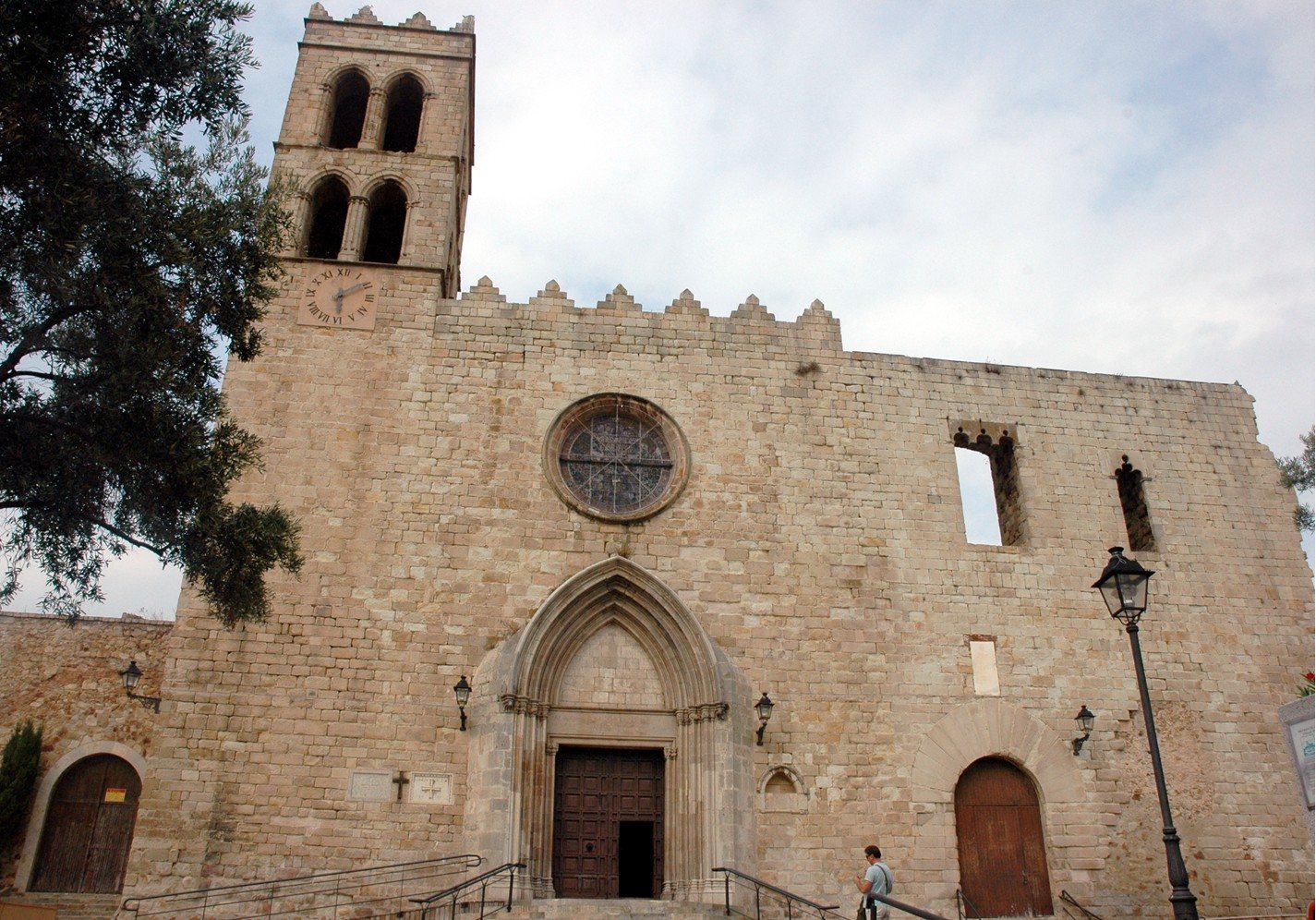
The church combines a three-aisle Gothic interior with a surviving Gothic façade and square bell tower. Its central aisle is 10 metres wide, and the interior reads as a single nave. The columns serve mainly a decorative purpose.
Façade and tower
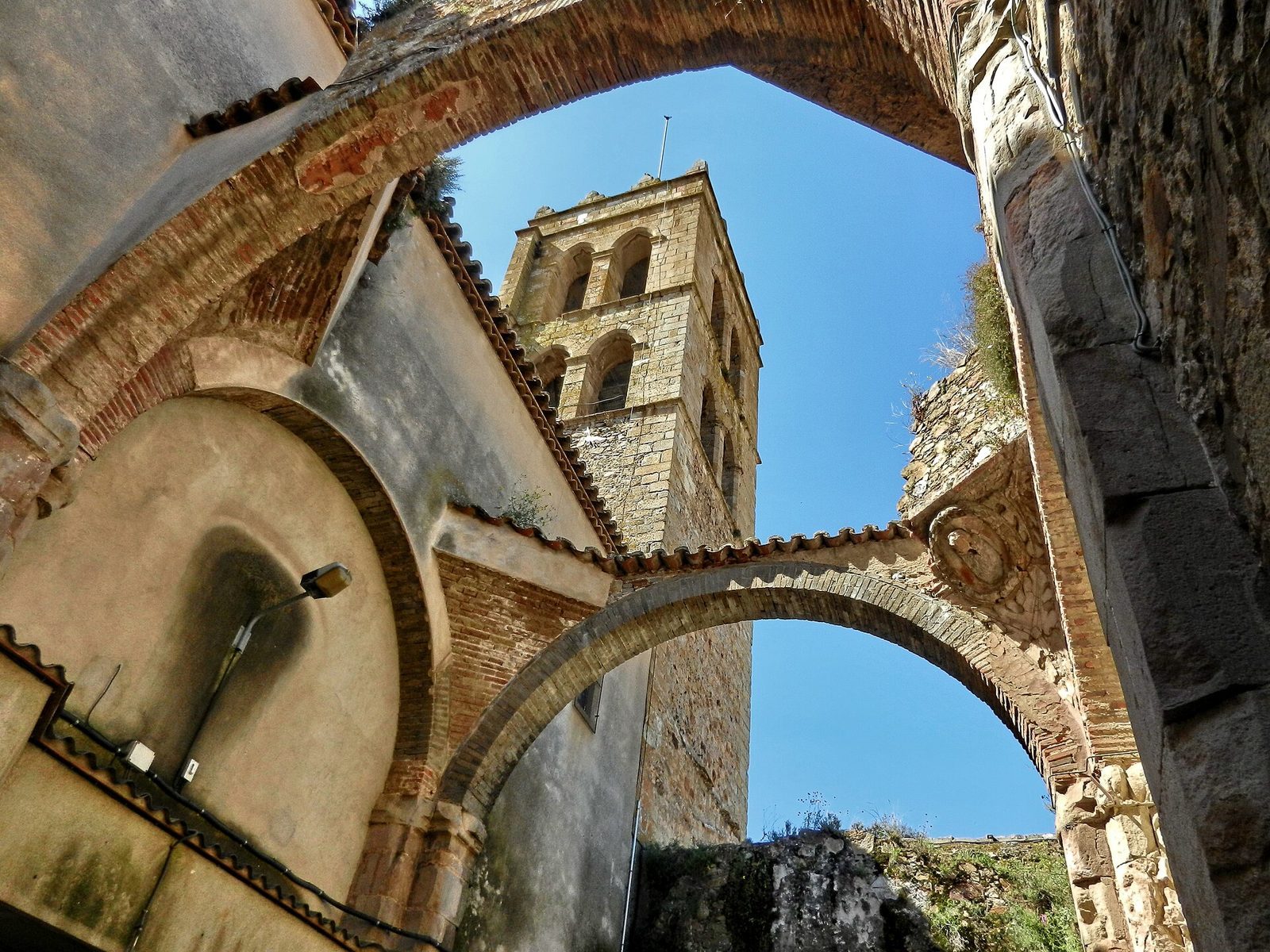
The entrance is framed by four pointed arches, each rising to a peak, with moulded bands following their curves and columns supporting them. A large circular rose window sits above the doorway, while raised sections along the top of the façade form its crenellations. The square tower has two levels, with paired pointed-arch windows on each side. The façade, tower, and sacristy are parts of the original church that survived the 1936 fire and were restored afterward.
Presbytery and altar furnishings
Windows and main altar
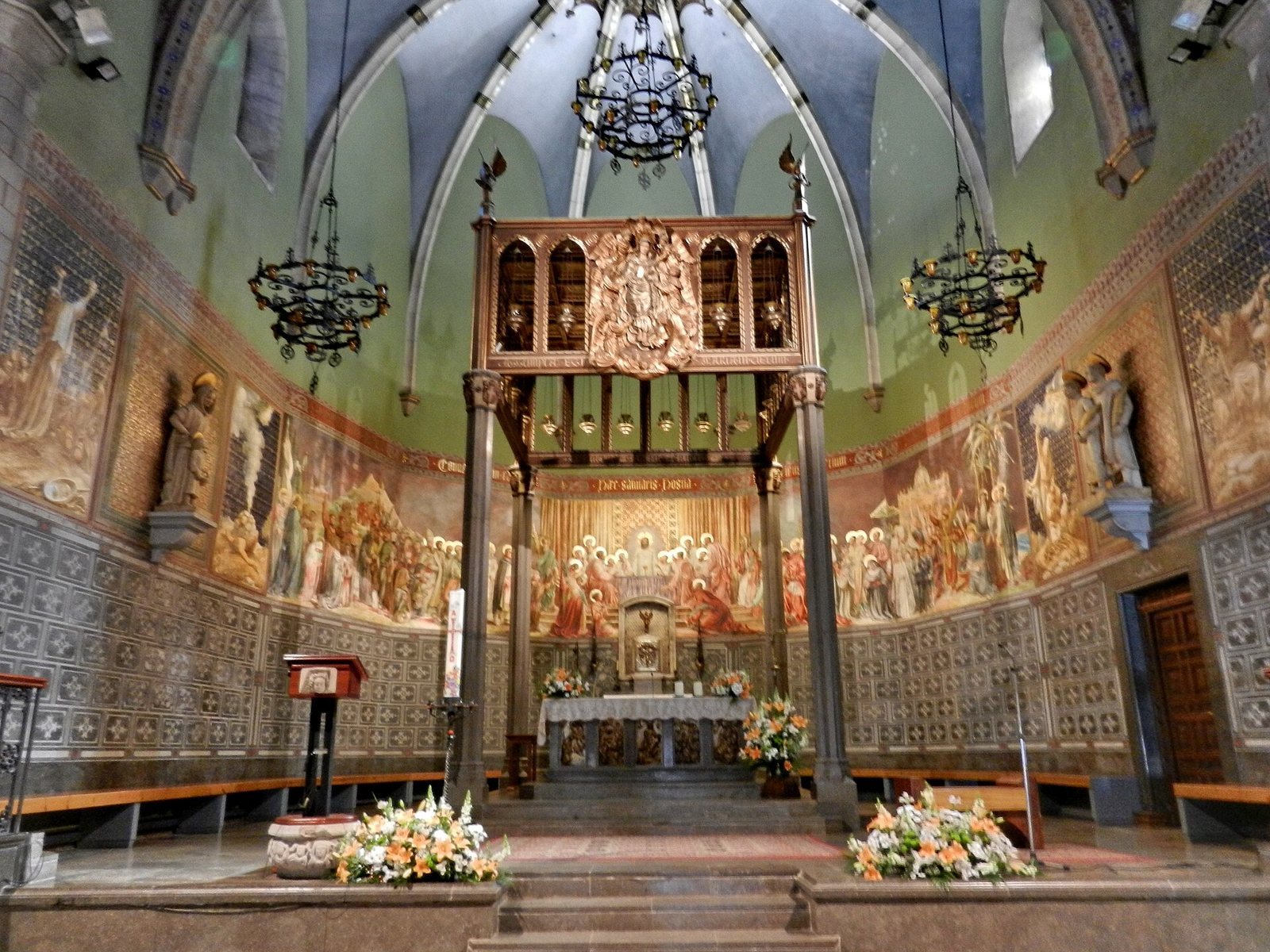
The presbytery, the area around the main altar, receives light through the rose window and stained-glass windows at the sides. The rose-window glass, made by master glazier Lluís Rigall, depicts the Assumption, the Catholic belief that Mary was taken into heaven. The main altar is of dark polished marble, with reliefs at its centre and five gilded-bronze panels showing episodes from Mary’s life. A tabernacle, a receptacle for the consecrated Eucharist, is set in a white-marble niche and has a gilded iron door. The Eucharist is the Christian sacrament commemorating Christ’s Last Supper.
Frescoes and baldachin
Jaume Busquets i Mollera painted the presbytery frescoes, images made on wet plaster, with the Eucharist as their central subject. He also created the image of the Assumption on the baldachin, a canopy over the altar, and paintings at the main altar. Completed in 1946, the baldachin has four columns with alabaster capitals bearing Blanes’s coat of arms. Its front medallion shows the Virgin Mary assumed into heaven.
Other altars and devotional images
Altars and chapels
The church includes altars dedicated to the Rosary, a Catholic prayer devotion associated with Mary; the Holy Family; and the Risen Christ. A fresco of Pentecost, which commemorates the descent of the Holy Spirit upon the apostles, is positioned behind the Risen Christ altar. Other features include the Carmelite altarpiece, associated with a Catholic religious order, and the chapels of the Holy Sepulchre, the Blessed Sacrament, and Reconciliation, the Catholic sacrament of confession and absolution.
Sculptures
Among the church’s sculptures are Saint Anne, traditionally regarded as Mary’s mother and the patron of Blanes; Our Lady of Easter; and the Crucified Christ. An image of Our Lady of Vilar faithfully reproduces the image venerated at the Shrine of Our Lady of Vilar.
Choir and organ
The choir is beneath the rose window. Its organ was reconstructed with some pipes salvaged from the 1936 fire.