Santa Maria Assunta: The Parish Church of Castello Querciola


Site at a Glance
- Rating
- 4.1
- Popularity
- Very Low
- Country
- Italy
- Primary era
- Medieval
- Eras represented
- Medieval, Early Modern
- Civilizations
- Holy Roman Empire
- Site type
- Religious
- Remains
- Church
On this page6 sections
History
Santa Maria Assunta is the parish church of Castello Querciola in Viano, Italy, dedicated to the Assumption of Mary, the Christian doctrine and feast concerning her being taken into heavenly glory. The site began with a tenth-century place of worship, a pre-Matildic Romanesque chapel from the period before the prominence of Matilda of Canossa, the ruler and patron associated with territories in northern and central Italy. Connected to the parish church of Baiso, the chapel also served the diocese’s military garrison at Castello Querciola. The present building dates from the thirteenth century and was later rebuilt.
Medieval origins and later condition
The chapel was probably reconstructed and enlarged in 1367, a date commemorated on the facade. The church continued as a parish place of worship, but later episcopal inspections repeatedly described problems with its condition. A pastoral visit, meaning a bishop’s formal inspection of a parish and its religious administration, recorded poor maintenance in 1543. Bishop Claudio Rangoni made a similar assessment in 1609. About fifty years later, Bishop Rinaldo d’Este described the church as poorly maintained, dark, and damp. Bishop Gianagostino Marliani also noted deficiencies, while describing the building as small, ancient, robust, and covered by a vaulted ceiling.
At the beginning of the eighteenth century, the church was enlarged with a new choir and two side chapels. Francesco Maria d’Este visited it in 1790. By 1888, Vincenzo Manicardi reported that the building was in good condition.
Twentieth-century reconstruction
The vault collapsed in 1972, at a time when authorization from the Bologna superintendency, a public heritage-protection authority, was apparently expected for demolition. Instead, the church was reconstructed. The work was completed by 1976, when Bishop Gilberto Baroni’s pastoral visit coincided with the first solemn Mass in the rebuilt church. The church was consecrated that year after the roof had been reconstructed. Liturgical reordering of the presbytery, the part of the church reserved for the altar and officiating clergy, was completed in 1980.
Remains
Santa Maria Assunta stands in Castello Querciola, west of Viano, with the traditional eastward orientation used for Christian liturgy. Its surviving form combines a simple stone exterior with a single-nave interior expanded by two side chapels. The roof and ceiling reflect the major rebuilding carried out after the 1972 collapse, while the altar and tabernacle preserve eighteenth-century decorative elements.
Facade and roof
The austere, gabled facade is built from exposed stone. A doorway with a horizontal lintel forms the principal entrance. Above it, the facade has a blind lunette, a semicircular recessed feature, and a small single-light window arranged along the central axis. The year 1367 is commemorated on the facade. The two-pitched roof was completely rebuilt during the 1970s. Its wooden truss structure supports curved terracotta tiles. A bell tower stands set back on the left, in the area of the apse, the usually semicircular end of the church. Its bell chamber opens through four single-light windows.
Interior and furnishings
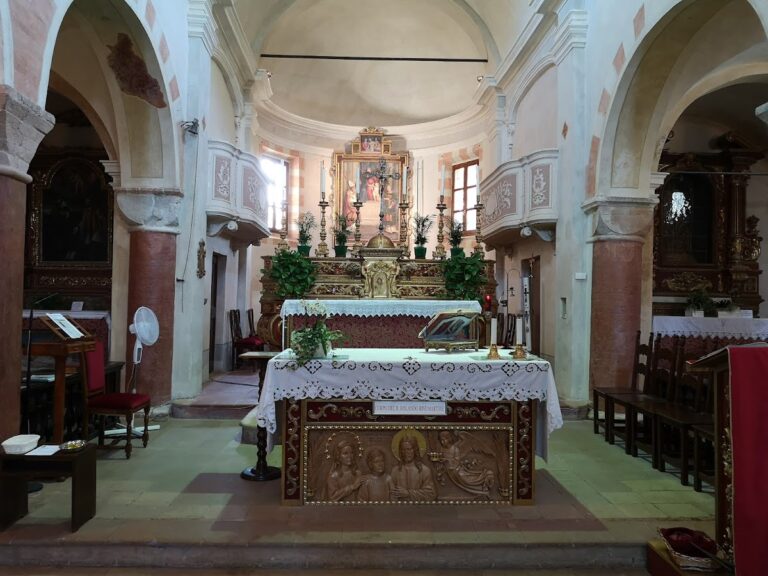
The interior consists of a single nave, the main longitudinal space of the church, with two side chapels. The nave has an exposed-beam ceiling, while the chapels are covered by barrel vaults, continuous semicircular ceilings. The presbytery occupies the semicircular-ended apse. The eighteenth-century altar is made of carved and gilded wood, with festoons and cherubs decorating its surface. The tabernacle contains a representation of the Dove among clouds, set on a small throne supported by angels acting as caryatids, sculpted human figures used as architectural supports.