Sant’Elena: A Baroque Church and Charitable Foundation in Villafranca
Site at a Glance
- Popularity
- Very Low
- Country
- Italy
- Primary era
- Early Modern
- Eras represented
- Early Modern, Modern
- Civilizations
- Duchy of Savoy, Italian
- Site type
- Religious
- Remains
- Church
On this page22 sections
History
Sant’Elena is a Baroque Catholic church in Villafranca, Italy, commissioned in 1645 by Bishop Giacomo Goria and designed by Amedeo di Castellamonte. Its construction formed part of a charitable and educational foundation, and it became a distinctive example of Baroque architecture in the province of Asti.
Foundation and construction
In 1629, Villafranca’s community asked Goria, a fellow townsman and bishop of Vercelli, for a loan to rebuild Sant’Elena. He agreed, then converted the loan into a donation in 1645. The new church was planned on the site of an earlier Sant’Elena oratory, next to the house where Goria was born.
Goria’s 1645 endowment established the Opera Pia Sant’Elena, a charitable foundation that commissioned the church for twelve Oblate canons. Canons were members of a church’s clergy, and Oblate described their religious dedication. They were to provide pastoral care in Villafranca and across the diocese of Asti, the area under a bishop’s authority, and teach local boys. The foundation also provided for an Ursuline convent, whose Catholic sisters educated girls from Villafranca, Villanova, and nearby communities. Its other provisions included a doctor and free medicines for poor residents, dowries for poor girls, and Capuchin preachers, members of a branch of the Franciscan order, during Advent and Lent.
Born in Villafranca in 1571, Goria became bishop of Vercelli in 1611. He had close connections to the Savoy court: he tutored the sons of Duke Charles Emmanuel I and served as secretary to Cardinal Maurizio of Savoy. The House of Savoy ruled territories centered on Savoy and Piedmont, and Goria’s patronage made the church’s construction possible.
Work began in 1645 to Castellamonte’s designs, under builder Francesco Garove and with workers from the Luganese area. Records of the Opera Pia support Castellamonte’s authorship of both the church and its facade. They include a 1647 payment to Giovanni Battista Comerro for collecting the architect’s drawings, as well as a gift of six turkeys sent to Castellamonte. Goria’s sudden death in 1648 stopped construction for a year. Work then continued under his nephews, especially Abbot Petrino Aghemio, and the foundation’s administrators.
The building work ended in December 1652, when the roof was finished. Luca Corbellini carried out stucco work between 1662 and 1664, and in 1665 builder Carlo Luigi Vanelli constructed five tombs commissioned by Goria. The church was consecrated on 12 April 1671, the centenary of Goria’s birth. His remains were placed in the tomb he had chosen at the foot of the altar.
Parish use and later care
The Opera Pia owned Sant’Elena until recent times; it is now owned by the town parish dedicated to Saint Mary of the Assumption. An agreement of 1 October 1883 between Bishop Giuseppe Ronco of Asti and the foundation established the church’s perpetual use as the parish church. The town’s former parish church, the Romanesque Saint Mary of Musanzia, a medieval style associated with rounded arches and heavy masonry, was demolished in the nineteenth century. Sant’Elena’s bell tower also served a civic function. The church belongs to the Catholic diocese of Asti.
Sant’Elena is part of Turin’s Savoy Baroque circuit. Its paintings connected with the Shroud of Turin, a Christian relic believed by devotees to bear the image of Jesus, also link it to other churches associated with the Shroud. A major restoration campaign began in 2003, renewing the church’s interior and furnishings.
Remains
Sant’Elena has a single nave, the main body of the church, with four chapels and an apse, the church’s end section. Its Baroque design brings together an elaborate facade, a decorated interior, paintings, sculpture, and historic furnishings.
Plan, facade, and interior
Facade
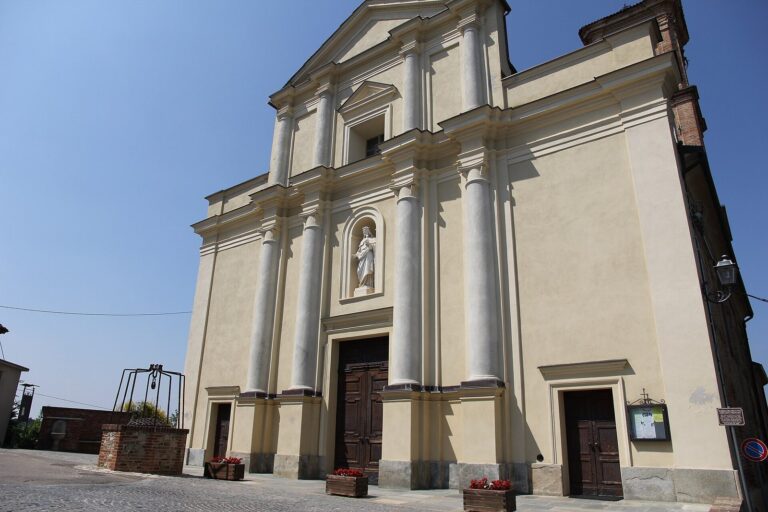
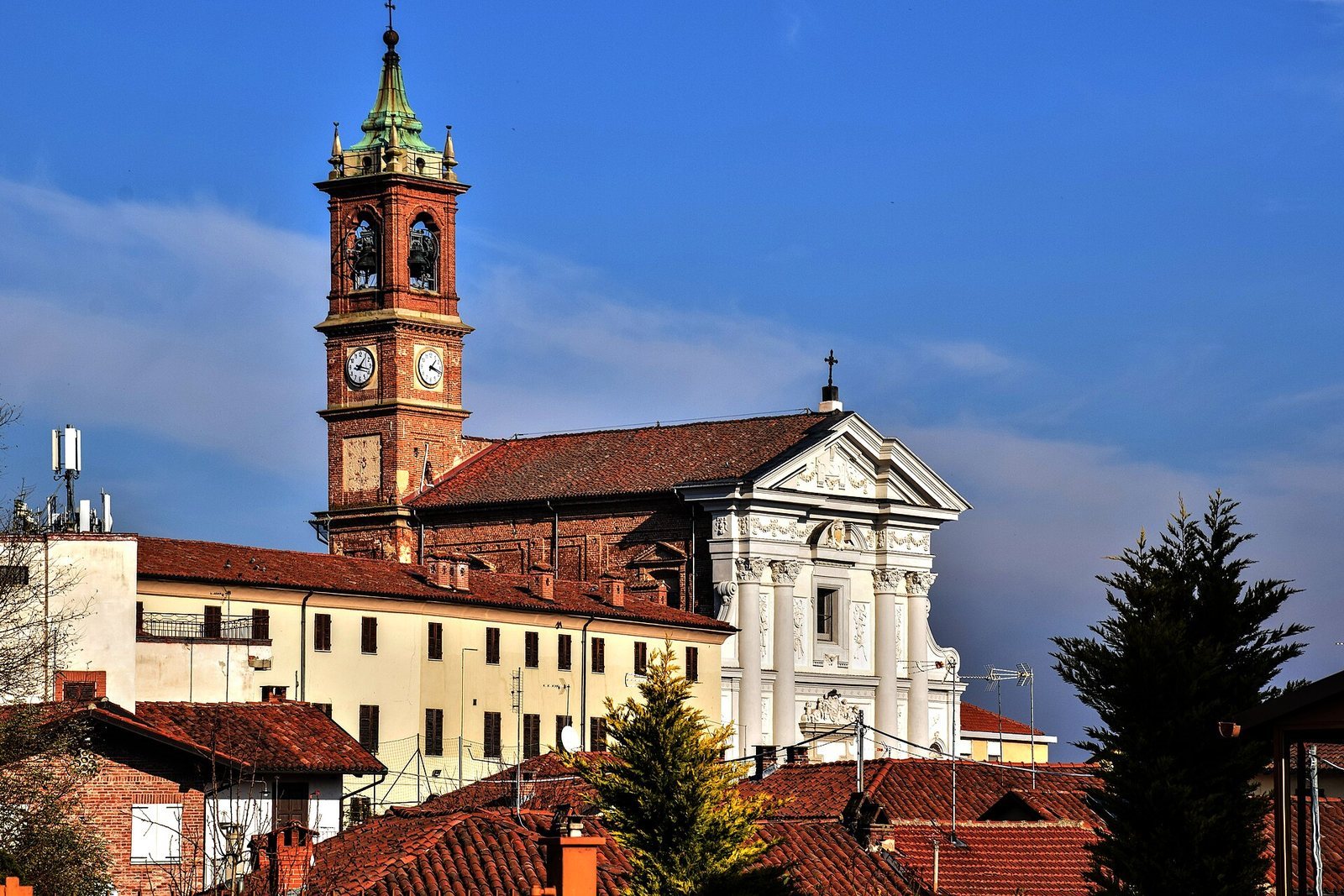
The facade has two pairs of oversized Composite columns, a classical column style, completed by 1652. An entablature, the horizontal structure above columns, separates the levels. Above it, a large triangular pediment, the gable-shaped top of a facade, is broken at the center. Curled volutes, or spiral ornaments, connect the differing heights of the nave and side chapels. Giacomo Solari added plaster ornament and stucco, decorative plasterwork, in 1679 to Castellamonte’s designs.
A plaque above the entrance, dated 1679 and topped by Goria’s coat of arms, names Abbot Petrino Aghemio and members of the Goria, Aghemio, and Monte families as financiers of the facade. An iron cross made by the Marchioni brothers of Asti was placed on the pediment in 1865.
Bell tower
The church’s bell tower also functioned as a civic tower. Its dual use connected the church building with the public life of Villafranca.
Nave and apse
Inside, wall-mounted supports with Corinthian-style column tops carry a broad horizontal molding. Luigi Morgari painted the church’s ceiling in 1911, during work marking three hundred years since Goria’s consecration as a bishop. A seventeenth-century wooden choir stands in the apse.
Main altar
The main altar dates to 1687 and adapts a design developed by Carlo and Amedeo di Castellamonte for altars at Santa Maria al Monte dei Cappuccini, Corpus Domini, and San Francesco da Paola in Turin. Its composition has a central broken pediment supported by two Corinthian columns, a classical column style, with Goria’s coat of arms between them. Side doors, each topped by a smaller broken pediment, carry marble busts of Saint Helena and Saint Eusebius. In 2018, a new altar and an ambo, a raised stand for readings, were installed facing the congregation and consecrated by Bishop Marco Prastaro of Asti.
Chapels
Shared chapel decoration
The four chapels have stucco decoration, including figures representing the Virtues above their arches. A large episcopal coat of arms sits above the arch of the principal chapel, accompanied by smaller stucco ornaments. Restoration brought the original seventeenth-century colors to light. The chapels were restored between 2004 and 2006, while work on the Virtues took place in 2004 and 2005. The church also retains seventeenth-century wooden altars dedicated to the Immaculate Conception and Saint Francis of Assisi.
Chapel of Saint Charles
A painting in this chapel shows Saint Charles Borromeo venerating the Shroud and is possibly by Giovanni Andrea Casella. Two statues, of Saint Francis de Sales and Saint Philip Neri, were made in 1672. In September 2012, a painting of Blessed Amadeus IX of Savoy venerating the Shroud was placed here. It came from a rural chapel at Fransos, dates to the early eighteenth century, and was restored in 2012 in memory of local historian Renato Bordone, who had advocated for the restoration work. Between the chapel and the Chapel of the Crucifix, a memorial plaque honors Canon Petrino Malabaila, provost of Sant’Elena from 1679 to 1695. The Goria family gallery is above it.
Chapel of the Crucifix
Abbot Petrino Aghemio, Goria’s nephew, paid for this chapel, made in 1671–72. It contains a wooden group showing Christ on the cross, with the Virgin Mary and the apostle John at its foot. Francesco Borello carved the figures; he also made a similar crucifix for Turin Cathedral.
Chapel of Saint Francis
Bartolomeo Aghemio, a canon of Turin’s metropolitan church, paid for this chapel in 1679. Its painting is attributed either to Guglielmo Caccia, known as Moncalvo, or to his daughter Orsola Maddalena Caccia, and may once have belonged to Goria. The marble baptismal font here, with its walnut-wood cover, was made between 1742 and 1764.
Chapel of the Immaculate
Pietro Francesco Monte, a lawyer in Turin and Goria’s great-nephew, paid for this chapel in 1679. Its painting is attributed to Giovanni Peruzzini.
Paintings and furnishings
Madonna of Oropa
The church’s principal painting is a large canvas by Felice Santelli, painted in Rome in 1651. It depicts the Madonna of Oropa with Saint Helena and Saint Eusebius, while Goria kneels at their feet. A conservation review in 2014 established Santelli’s authorship of the work. The Madonna of Oropa is a Marian devotion associated with the Sanctuary of Oropa in Piedmont.
Pulpit
Alessandro Riccio made the wooden pulpit in 1671. It stands between the chapels of the Immaculate and Saint Francis. The pulpit was moved to the sacristy in the 1970s and converted into a counter, then returned to its original position in 2018.
Choir and organ
The pipe organ was installed in 1890 and made by the Giovanni Mentasti firm in Varese during the second half of the nineteenth century. The wooden choir stalls were dismantled in 2007 and restored in 2011. Restoration of the choir loft and main door followed in 2014–15. The small choir galleries associated with the pulpit and the Oblates were restored in 2017–18.
Sacristy paintings and altar crucifix
The sacristy contains a portrait of Goria and a painting of the Deposition from the Cross. The crucifix on the main altar probably dates to the nineteenth century and was restored in May 2010.
Transferred font and statue
The baptismal font and its walnut cover came from Saint Mary of Musanzia, the former parish church, as did a statue of the Madonna of Musanzia. Both were transferred to Sant’Elena.
Later interior restoration
Between 2016 and 2018, restoration work covered the main altar, the Barge quartzite floor, and stucco and paintings in the choir, the area around the altar, and the side walls. The counterfacade was restored in 2018.