Sant’Antonio di Padova: A Franciscan Church and Convent in Palermo
Site at a Glance
- Popularity
- Medium
- Country
- Italy
- Primary era
- Early Modern
- Eras represented
- Early Modern
- Civilizations
- Kingdom of Sicily, Spanish
- Site type
- Religious
- Remains
- Church
On this page24 sections
History
Foundation and Franciscan role
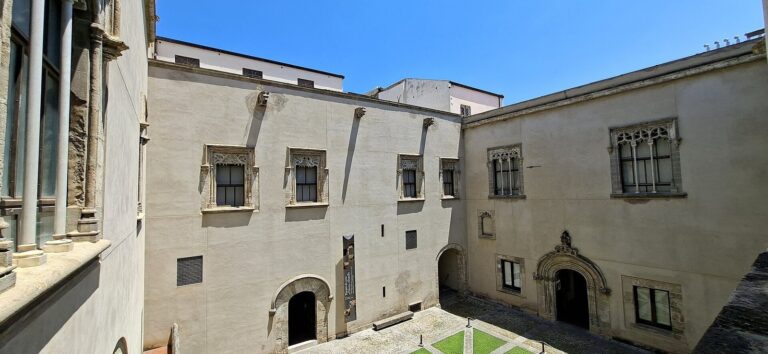
Sant’Antonio di Padova is a Catholic church and adjoining convent in the historic center of Palermo, Italy. Built in Baroque style, an ornate European style, for the Reformed Observants, a reform branch of the Franciscan Friars Minor, the complex was founded in 1630 and completed in 1633. It served as Palermo’s logistical and medical outpost for the Franciscan monastery at Santa Maria di Gesù outside the city. The church belongs to the Archdiocese of Palermo.
The church’s foundation stone was laid on 13 June 1630. Notary Giovanni Battista Brocco drew up the foundation deed two days later, with the approval of Archbishop Giannettino Doria. Francisco Fernández de la Cueva, Duke of Alburquerque and viceroy of Sicily, supported the foundation; a viceroy governed a territory on behalf of its monarch. Completion in 1633 was supported by Fernando Enriquez Afán de Ribera, Duke of Alcalá and a later viceroy, and Philip III of Sicily, who ruled as Philip IV in Spain.
The convent, built with the church, housed the Reformed Observants, also known as the Zoccolanti. It was restored in 1642 and enlarged and improved in 1667.
Changes to the surrounding city
In 1635, an avenue leading toward the sea and a square in front of the church were laid out. The avenue was dedicated to the Duke of Alcalá and is now Via Lincoln. In 1793, construction of Via Oreto brought the demolition of the old Porta di Vicari. Marcantonio Colonna, Prince of Stigliano, oversaw a redesign for a new entrance to Palermo’s historic center. Statues of Saint Anthony and Saint Peter of Alcántara, a Spanish Franciscan friar associated with reform of the order, had been intended for niches in the new gate but were transferred to the convent instead.
The Fountain of the Nymph was moved to Piazza Alberigo Gentile in 1873. The nearby Oratory of the Nativity was an annex to the complex; its Fountain of Life motif and canopy later became part of an altar in the church.
Changing uses
In 1866, laws suppressing religious orders led to the confiscation of the convent. Its rooms were used for army storage and ovens. Reformed Friars Minor returned in 1947. During wartime, the complex’s crypts served as air-raid shelters. In 1930, the church became a sanctuary and took on parish duties. In 2004, the University of Palermo assigned some convent rooms to a language and museum center.
Remains
Exterior and setting
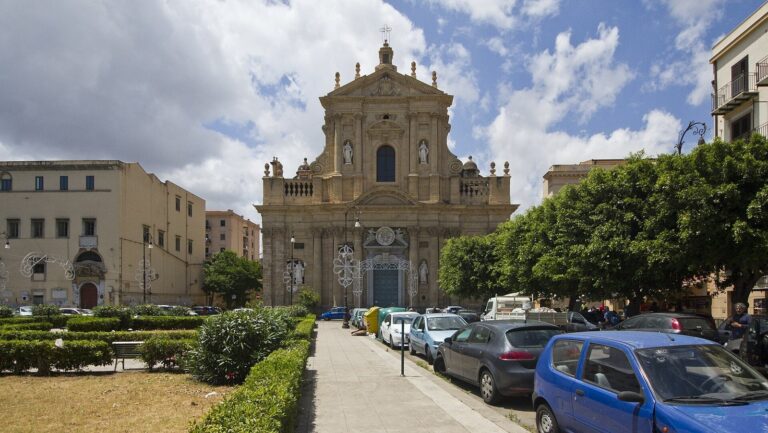
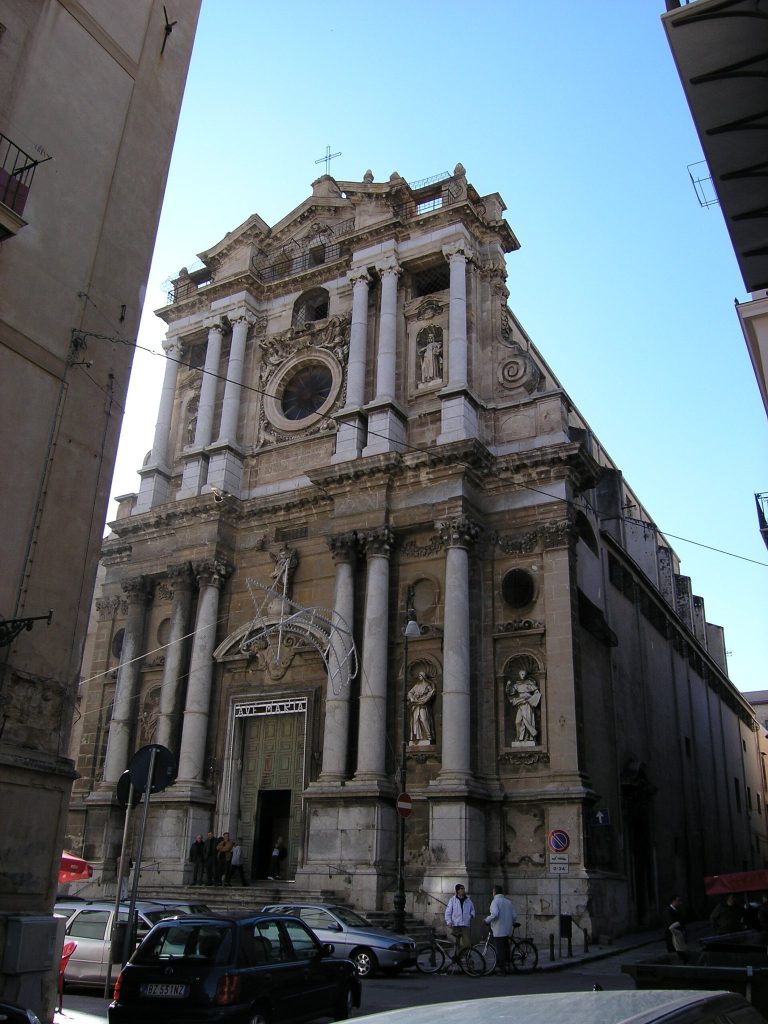
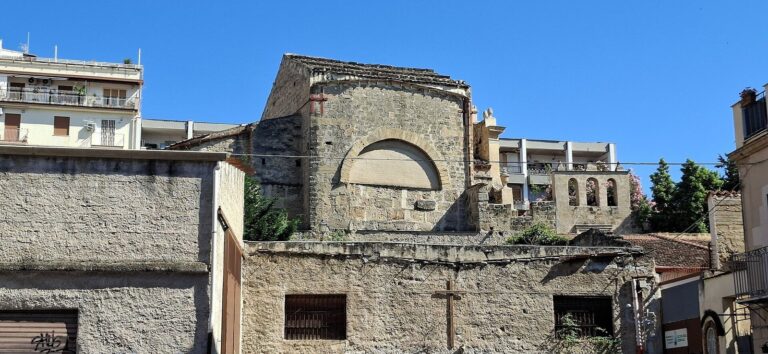
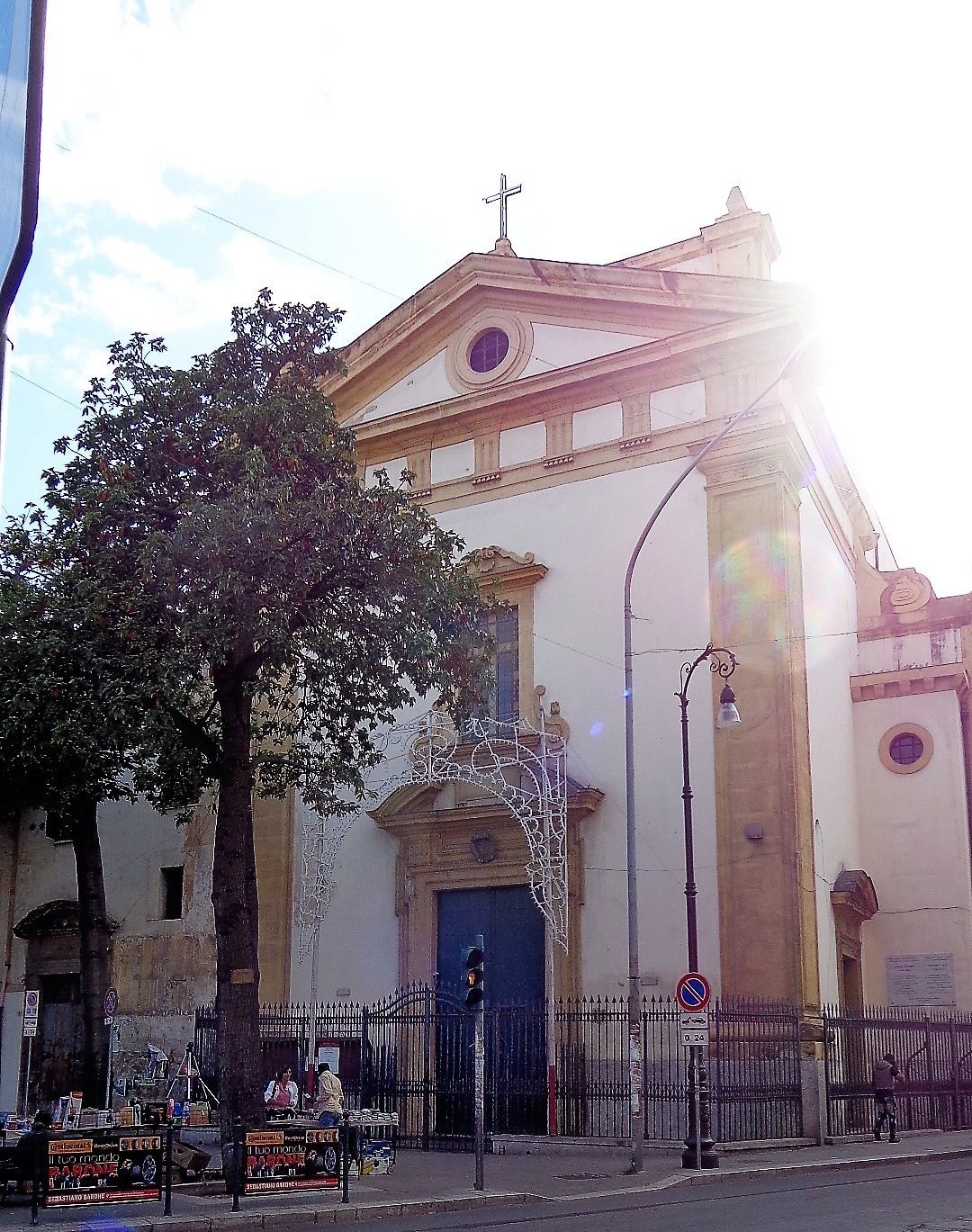
The complex includes the church, convent, and crypts at a crossroads in Palermo’s historic center, near the site of the old Porta di Vicari. The church faces east and has a single nave, or main central space. Its Baroque fabric includes later Neoclassical features, a revival of classical forms.
Facade and portal
The facade has an entablature, a horizontal architectural band, and shallow Doric wall columns at its corners. A triangular pediment above contains an oculus, a circular opening. A gate protects the late-Mannerist portal, a late phase of an elaborate Renaissance style. The portal has its own pediment, with a window set between it and the entrance. An upper story and pediment complete the facade.
Square and avenue
The church square was decorated with a marble hemicycle, a semicircular architectural feature. Via Lincoln follows the avenue toward the sea laid out in 1635.
Nave and side chapels
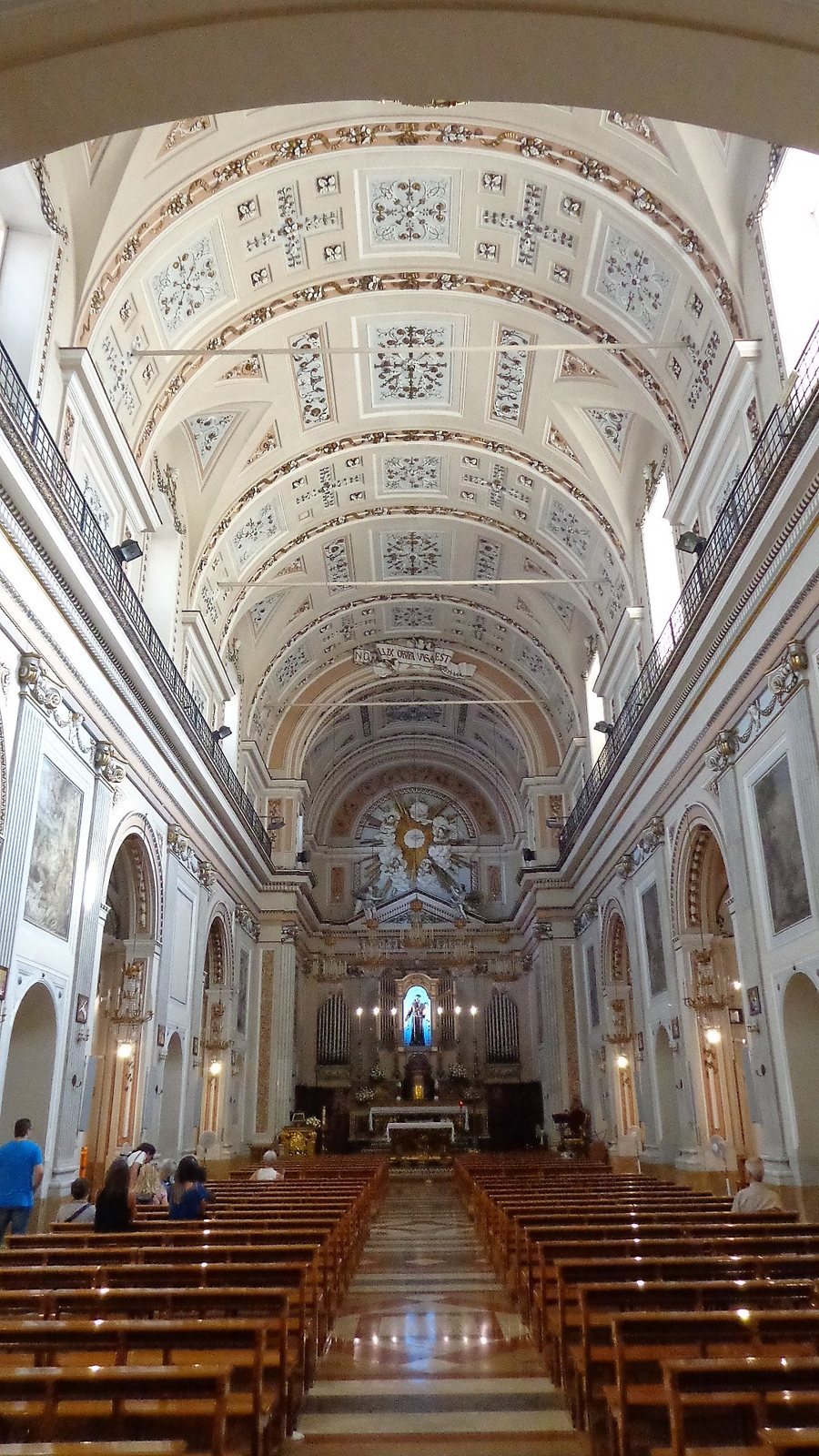
The nave’s walls have Neoclassical decoration made between 1793 and 1795 by Salvatore Peres, Domenico Sanseverino, and Giovanni Firriolo. Paired Ionic wall columns divide the surfaces into a rhythm of chapels and recessed niches. Frescoes between the columns show episodes from Saint Anthony’s life. Pietro Novelli painted the miracle of a child in a boiling cauldron and the story of a miser who found a heart in a chest. Giuseppe Velasco painted the Virgin offering the Child to Saint Anthony, the reattachment of a foot, the sermon to the fishes, the raising of a dead person, and Saint Anthony among beggars.
Our Lady of Help
The Chapel of Our Lady of Help, also called Our Lady of Bethlehem, was dedicated in 1736. Its altar painting is a seventeenth-century copy of the Virgin of Bethlehem, brought from a private home. Pedro Manuel Colón de Portugal, Duke of Veragua, helped introduce this devotion from Spain.
Sacred Heart
The chapel now dedicated to the Sacred Heart was formerly devoted to Our Lady of Mercy of Savona. A Neoclassical statue of Christ stands on its altar. Wall paintings show Pope Honorius III approving an indulgence and the Virgin appeasing her Son. A painting of the Virgin’s appearance to a peasant in Savona on 18 March 1536 is now in the picture gallery.
Saint Francis of Assisi
Giuseppe Crestadoro painted the chapel’s frescoes. A nineteenth-century statue of Saint Francis stands on an eighteenth-century marble altar with inlays and large projecting scrolls. The vault painting shows the saint among childlike figures and Franciscan symbols. Two canvases from the school of Vito d’Anna depict Saint Francis expelling heresy and the Virgin granting an indulgence. The statue took the place of an earlier painting of the saint by Andrea Carrera.
Most Holy Crucifix and Reliquary
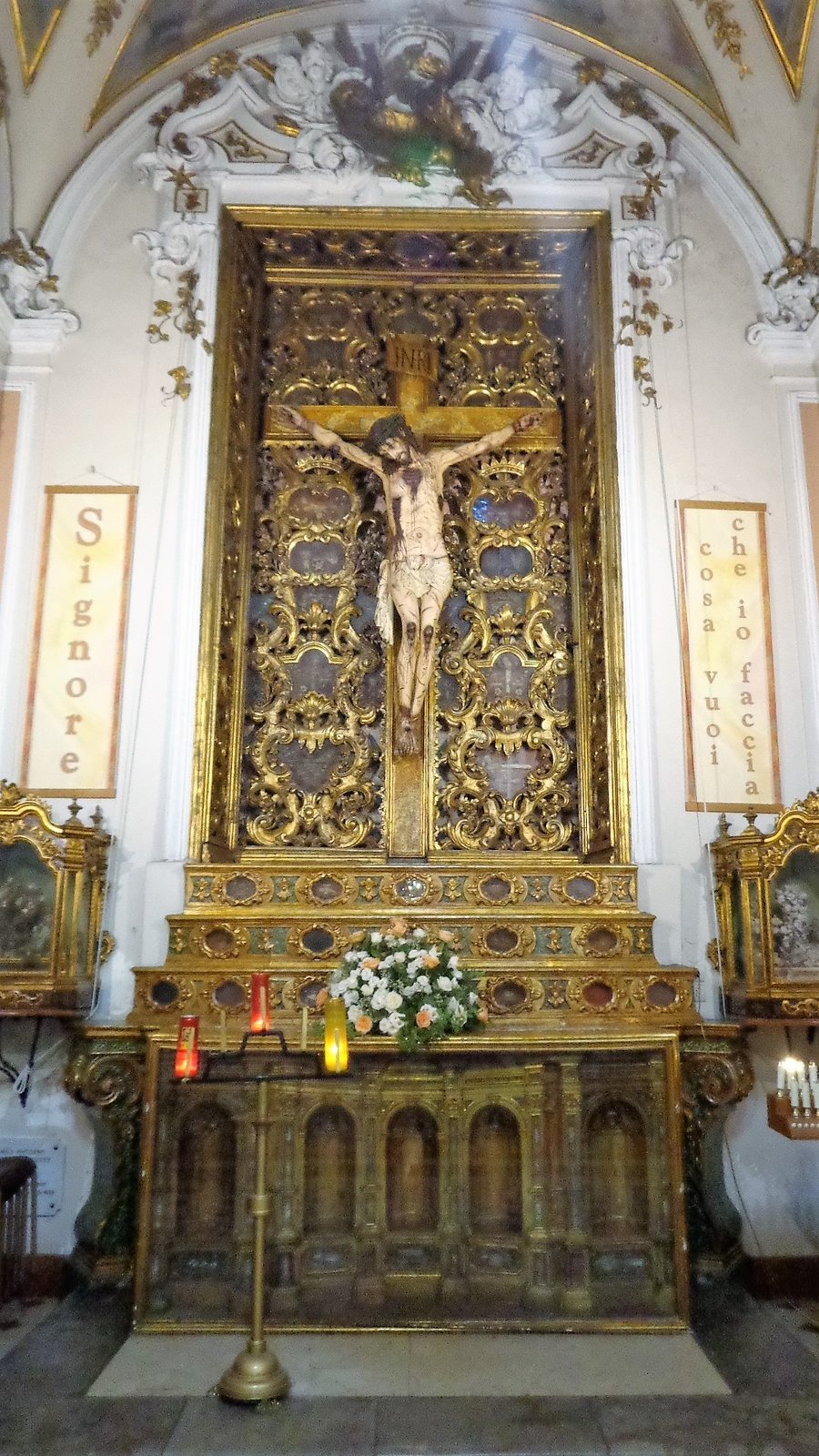
A crucifix by Friar Umile da Petralia is held in an ornate reliquary, a container for sacred remains, above a gilded and painted wooden altar. The vault has perspective-painted recesses with the risen Christ among angels. Two gilded Rococo cases, in a decorative style known for elaborate ornament, contain figures of Saint Rosalia and Saint Jerome. Nearby canvases depict scenes from the Passion. Friar Umile is buried in the chapel.
Saint Joseph
The chapel now dedicated to Saint Joseph was formerly dedicated to Saint Anne. Stucco decoration in the tradition associated with the Sicilian sculptor Giacomo Serpotta covers its front and vault, with figures, drapery, and flowers. Antonio Grano painted childlike figures on the vault, and scenes of the Annunciation to Saint Anne and the Annunciation to Saint Joachim in arched panels on either side. Stucco frames contain the Presentation of the Virgin and the Ecstasy of Saint Paschal Baylon, a Spanish Franciscan friar.
Immaculate Conception
A painting by Pietro Novelli, dated to around 1627, stands above an altar made in 1701 with inlays and different colored marbles. Its central panel has a Fountain of Life design beneath a canopy in the manner of Bernini. Local craftsmen from the school of Paolo Amato made these elements, which came from the Oratory of the Nativity. Two framed frescoes depict the Immaculate Virgin with Saint Francis and Saint Clare, and a debate over the Immaculate Conception.
Madonna of Trapani
A marble statue by Gaspare Guercio, dated 1654, stands on an eighteenth-century altar integrated with the surrounding stucco. The vault is painted as a perspective scene of God the Father blessing among childlike figures. Giuseppe Crestadoro’s two canvases show the Assumption and the Nativity of the Virgin.
Main altar and sanctuary
Main altar
The monumental main altar combines polychrome marble and gilded wood, with angels and biblical scenes. Its tabernacle, the receptacle for the Eucharist, takes the form of a round temple. A nineteenth-century statue of Saint Anthony with the Child, made by Palermo sculptor Vincenzo Piscitello, stands in a wooden case. The saint holds a Gospel book, referring to his work as a preacher and theologian, and a lily associated with purity. The statue replaced an earlier painting of Saint Anthony. Above it, the Holy Spirit appears among angels and clouds within a gilded sunburst.
Choir and altar area
Wooden choir stalls from the eighteenth century stand behind the altar. Guglielmo Borremans’s two frescoes of 1718 on the walls depict the Communion of Saint Teresa of Ávila and the Eucharistic Miracle. The central altar table, an example of Rococo woodwork, came from the altar of Saint Stephen. Against the inner face of the church’s entrance wall is a choir; beneath its arch, Borremans painted the Glory of Saint Anthony in 1718. Two funerary monuments commemorate Giuseppe Stella, in 1758, and, opposite it, Monsignor Antonio Calcagno, in 1773. The latter is attributed to Ignazio Marabitti.
Saint Benedict the Moor
The altar area includes a chapel dedicated to Saint Benedict the Moor, a Sicilian Franciscan friar of African descent. It contains an eighteenth-century statue and two wall frescoes showing episodes from his life.
Baptistery, crypts, and picture gallery
Baptistery
The baptistery beneath the choir was made in the early twentieth century. It occupies the former Chapel of Saint Paschal Baylon. A statue of Saint John the Baptist stands in a niche behind the baptismal font.
Crypts
An extensive network of burial passages lies beneath the complex. The remains of Gaspare Guercio and Friar Umile da Petralia are held there.
Picture gallery
The small picture gallery holds four paintings removed from church chapels in the nineteenth century, when statues took their places. Vincenzo Carrera’s early seventeenth-century canvas of Saint Francis Receiving the Stigmata bears the arms of the Del Carretto family, relatives and successors of the Curti family, who founded its chapel. A Holy Family with Saints Anne, Onuphrius, and Rosalia, from the first half of the seventeenth century, is attributed to Geronimo Gerardi. Gerardo Astorino’s mid-seventeenth-century painting shows the Apparition of Our Lady of Mercy of Savona. The Stoning of Saint Stephen, by an unknown artist and dated to the second quarter of the seventeenth century, came from the former Chapel of Saint Stephen, now dedicated to the Child of Prague and once under the patronage of the Cicala family.