Sant’Antonio alla Motta: A Catholic Church in Varese, Italy
Site at a Glance
- Popularity
- Low
- Country
- Italy
- Primary era
- Early Modern
- Eras represented
- Medieval, Early Modern
- Civilizations
- Duchy of Milan, Habsburg, Holy Roman Empire, Spanish
- Site type
- Religious
- Remains
- Church
On this page14 sections
History
Sant’Antonio alla Motta is a Catholic church in Varese, Italy, dedicated to Anthony the Abbot, an early Christian ascetic venerated as a saint. It follows the Ambrosian rite, a Catholic liturgical tradition associated especially with Milan, and belongs to the Archdiocese of Milan. The present church grew from a chapel through a project begun in 1593 and was completed during the seventeenth century.
Market, court, and medieval chapel
From around the year 1000, the hill at Piazza della Motta served as the setting for Varese’s daily market, an annual horse market, and a court for the Seprio, a historical district. In the Middle Ages, a civic confraternity, a religious association whose members undertake devotional or charitable activities, established itself there and built a chapel.
The church and its painted decoration
In 1593, architect Giuseppe Bernascone designed an enlargement of the chapel to create a church. Building work continued into the early decades of the seventeenth century, and the church was completed within that century. Its painted decoration was expanded in several campaigns during the seventeenth and eighteenth centuries.
Shortly before 1748, the committee responsible for the church’s upkeep and works asked painter Pietro Antonio Magatti to undertake further decoration. In poor health, Magatti declined and recommended Giuseppe Baroffio, with whom he had previously worked in an informal partnership. Their agreement set 1750 as the target for completion, but Baroffio’s main work was finished only in 1756. Magatti then arranged for his young pupil Giovanni Battista Ronchelli, who was also a confraternity member, to paint the principal narrative scenes.
Bonfire and annual observances
A votive bonfire is lit on the evening of 16 January, before the church’s feast day for its patron on 17 January. Its first recorded occurrence in Varese dates to 1572, and the custom has continued annually. Its origins probably combine medieval European practices intended to guard against ergotism, an illness caused by eating grain contaminated with ergot and historically known as Saint Anthony’s fire, with a legend that Anthony stole fire from Hell with a piglet’s help.
Local tradition tells of street boys taking wooden objects for the fire, including wheelbarrows and nearby residents’ shutters. The committee promoting the event still uses the name Monelli della Motta, or “Motta’s rascals,” in reference to the story. People toss small notes carrying new-year wishes into the flames. In earlier times, cooled embers were kept in stables for good luck, and people took away salt blessed during the occasion. Animals are blessed in the church forecourt on 17 January.
In 2007–08, a comprehensive conservation campaign replastered the exterior walls and renewed the roof, while the interior paintings were cleaned and repaired.
Remains
Plan, orientation, and exterior
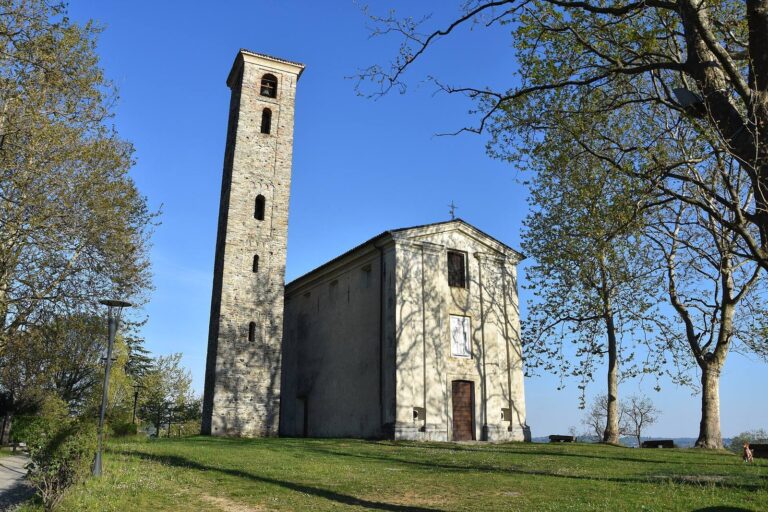
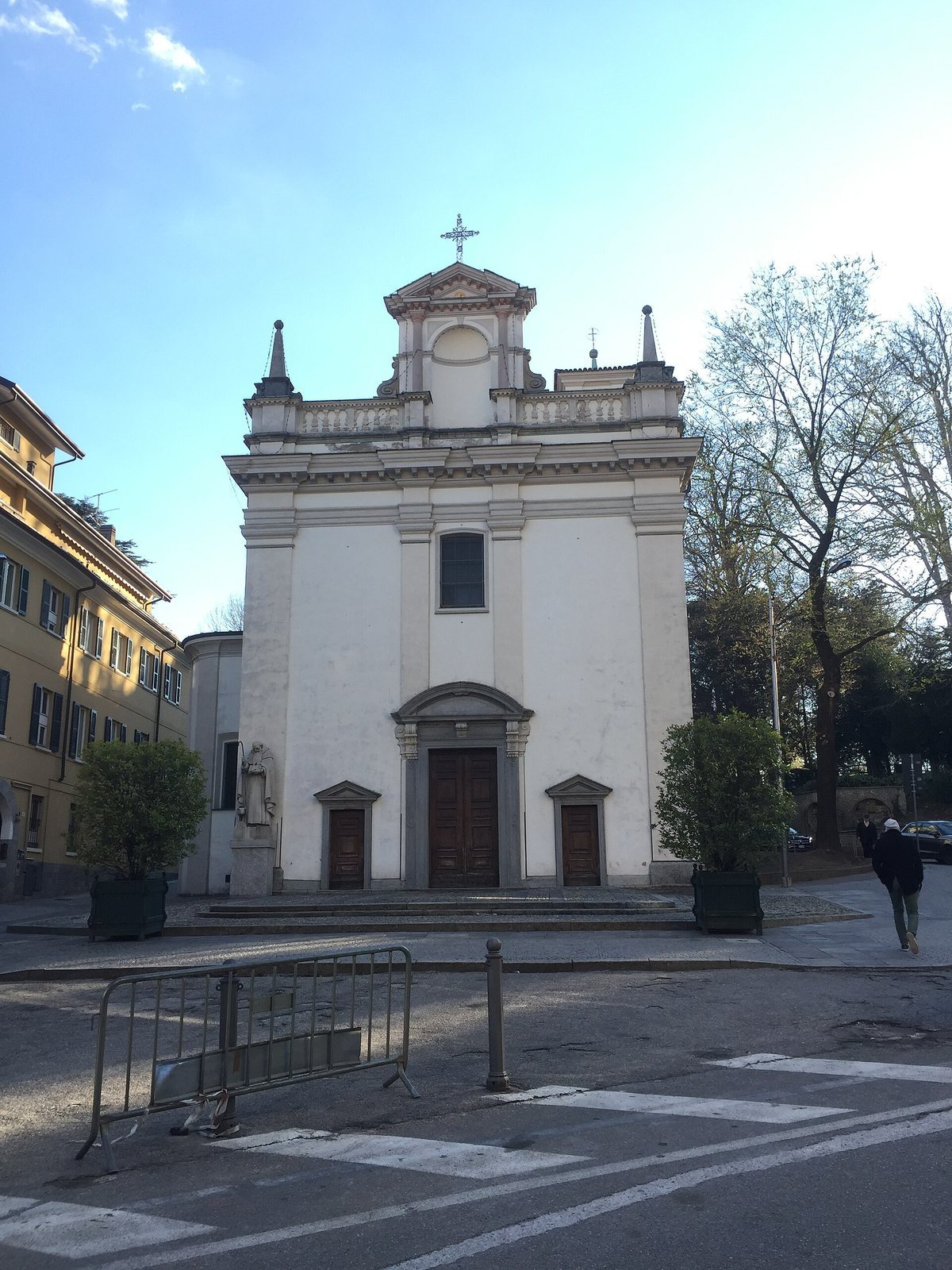
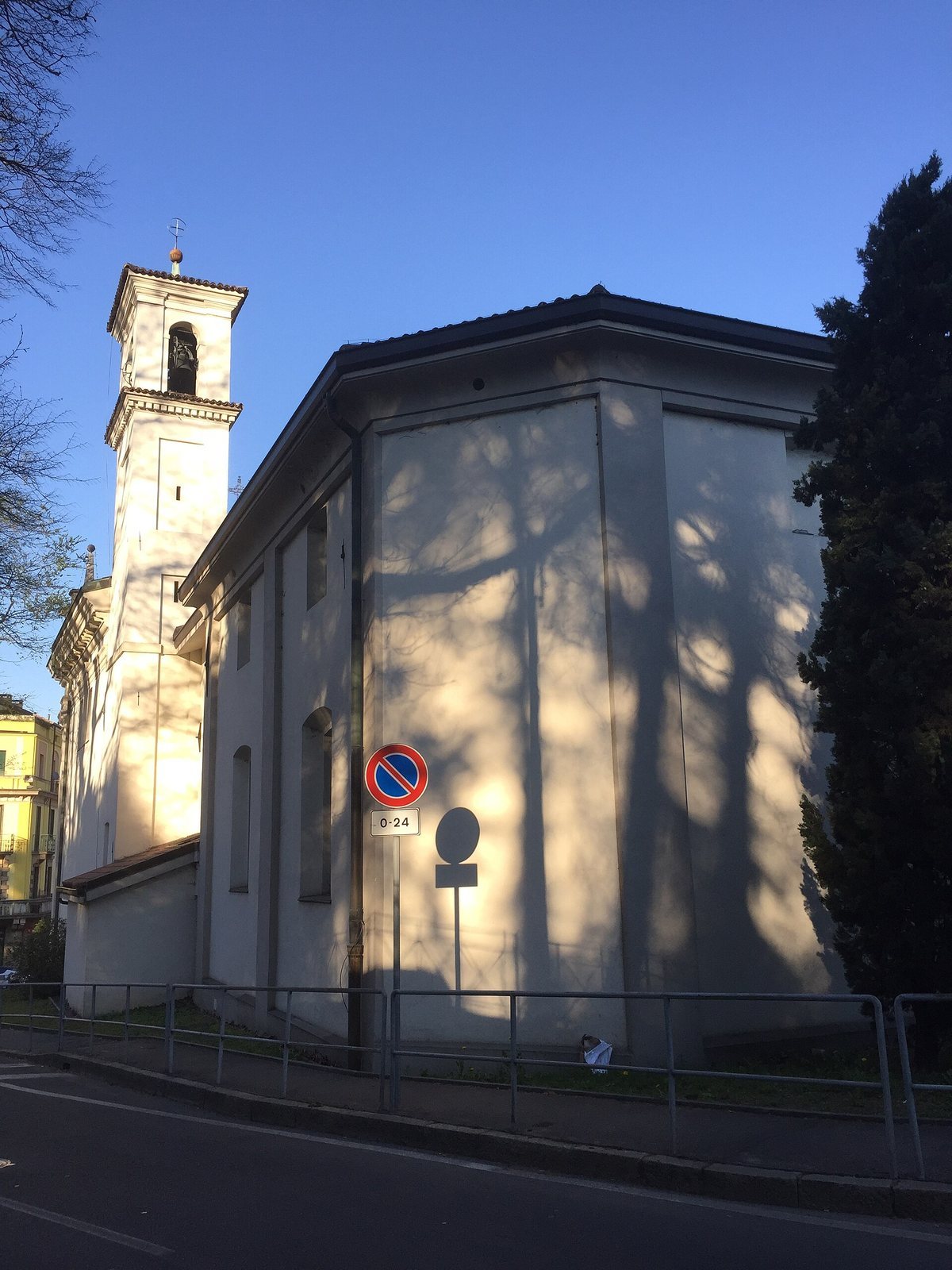
The church stands on the hill at Piazza della Motta, a short distance from the garden of Villa Mirabello. Its T-shaped plan has a broad, square front section and a narrower, elongated rear section containing the presbytery, the area around the altar, and the apse, the recessed end of the church. The steep slope made a west-to-east nave, the main body of a church, impractical. The façade therefore faces north, while the principal altar is at the southern end. An altar on the east side of the nave carries the formal title “main altar.” A small bell tower rises on the right of the rear section; a chapel and the sacristy, a room for preparing services and storing church furnishings, project from the left. The building also has a dome. Its simple exterior contrasts with its richly ornamented interior.
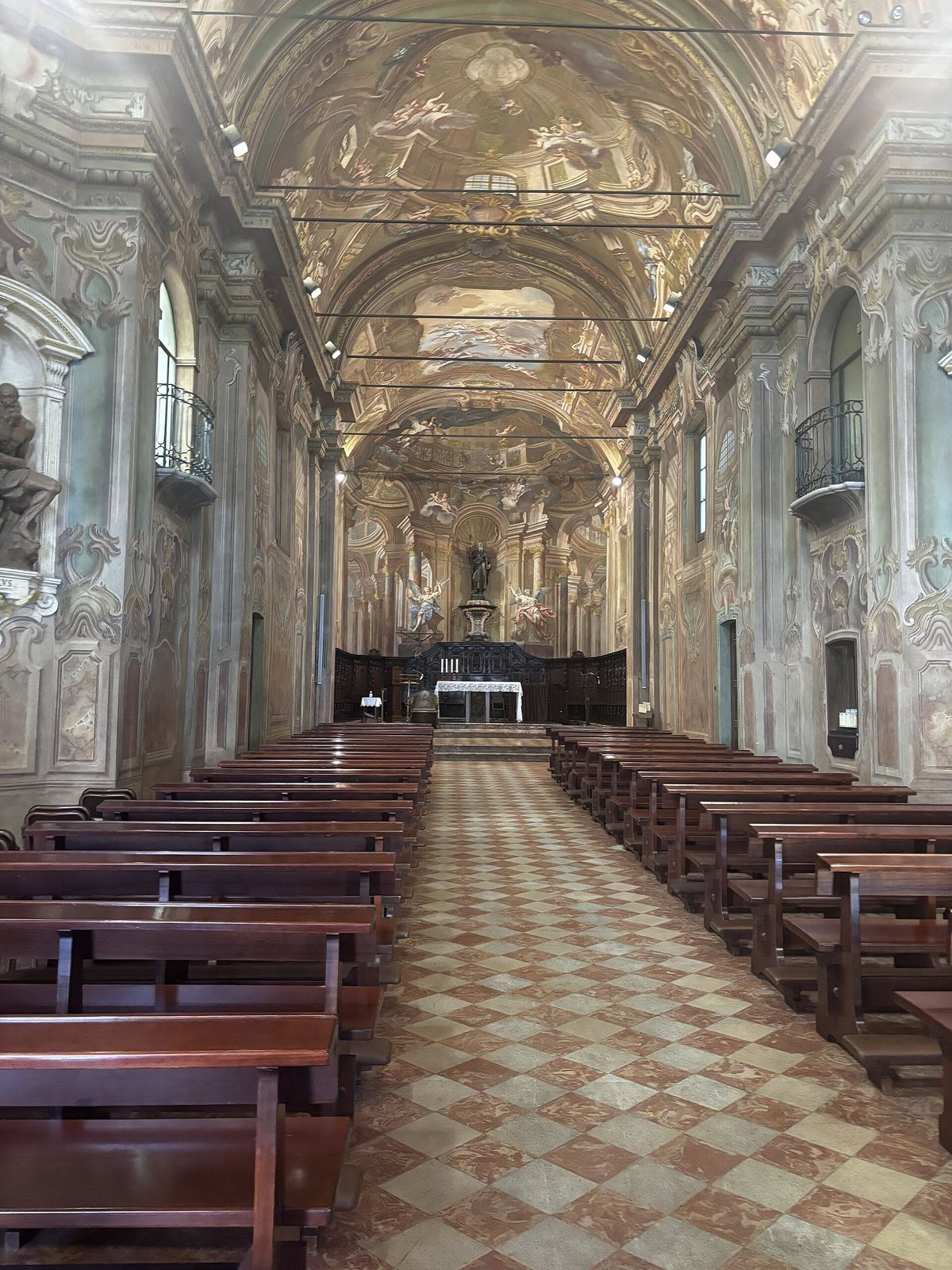
The terracotta floor, in a Lombard style, remains slightly sloped despite efforts to level the site, descending from the apse toward the entrance. A lighter area of paving marks the section retained from the earlier chapel.
Painted interior
Illusionistic architecture and frescoes
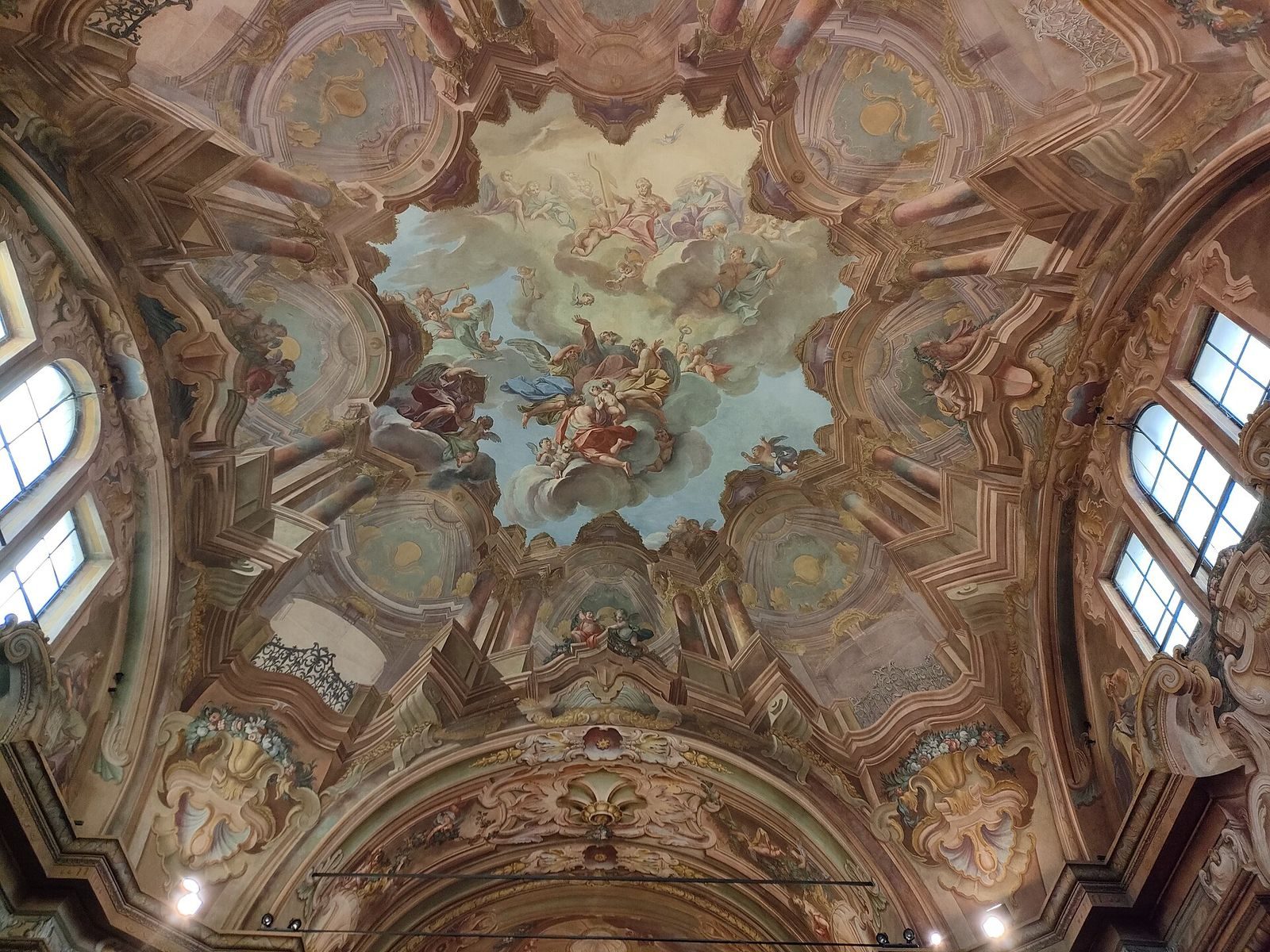
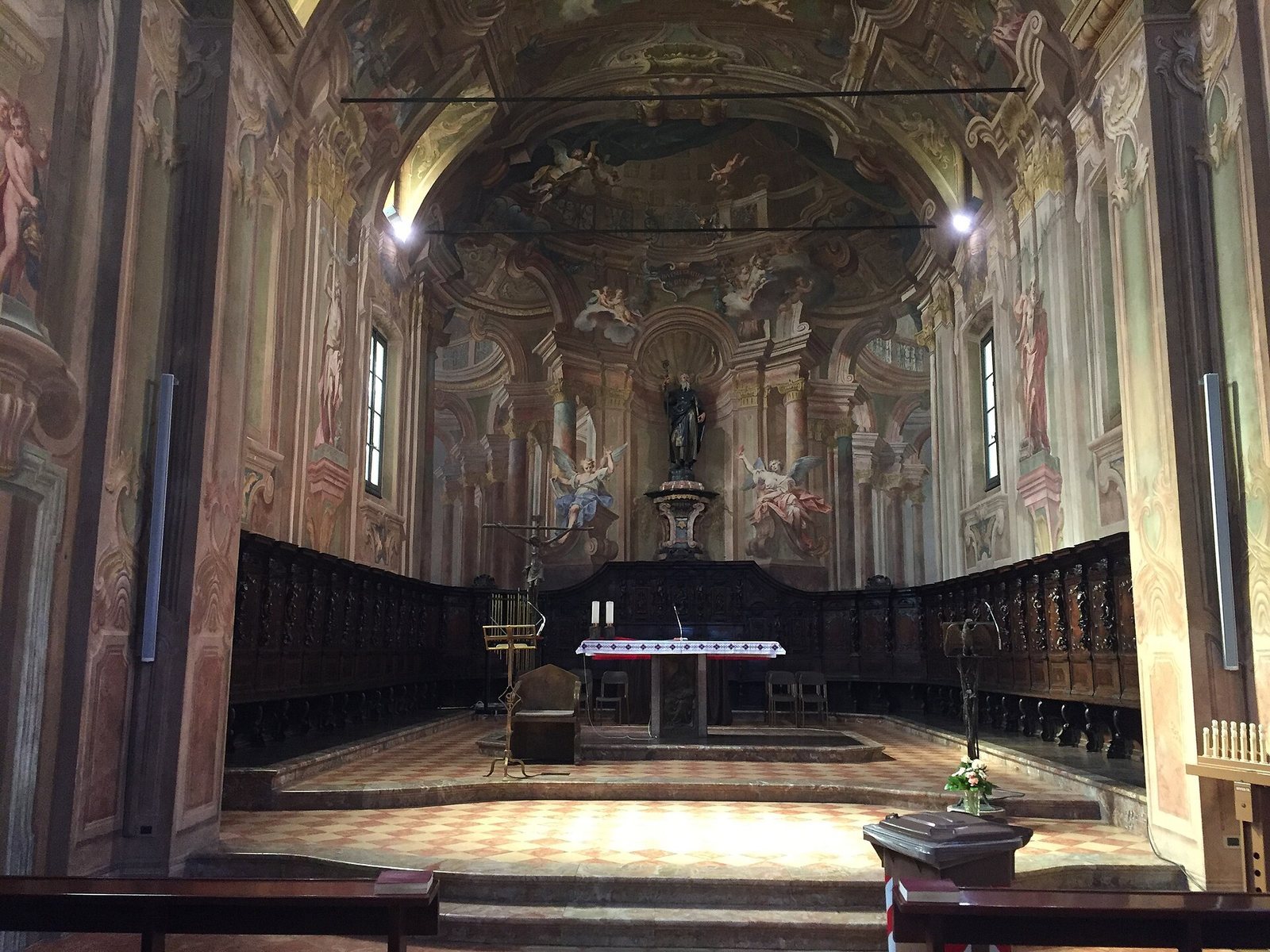
The interior combines Baroque, an ornate style associated especially with the seventeenth century, and Rococo, a later highly ornamental style. Baroffio painted most of the wall decoration, using perspective to create the appearance of features such as parapets, balconies, and tiers of columns. He specialized in painted architectural illusion rather than painting figures. Ronchelli’s frescoes show the Glory of Saint Anthony in the nave and the Exaltation of the Holy Cross in the choir. In the first, Anthony rises toward God and Jesus Christ, who sit on clouds amid rejoicing angels. An angel carries a crozier, a curved pastoral staff used as a sign of religious authority, while others sing “Hosanna.” In the second, ranks of angels lift a large Holy Cross set diagonally across almost the entire painted field.
Plants, produce, and symbolic motifs
Fruits and plants recur throughout the decoration. Figs, pomegranates, pine cones, grapes, and quinces signify prosperity and fertility and had once been dedicated to Venus, the ancient Roman goddess associated with love and fertility. Onions were thought to counter harmful paranormal influences; lemons signify fidelity in love, pears physical health and hope, and apples temptation. Other fruits and vegetables also appear. The painted varieties offer a record of the period’s biodiversity, although many later changed or became extinct.
Putti, masks, and acanthus
Bare-bellied putti, child figures used in decoration, lean on grotesque masks with suggestive faces, unusual noses, protruding tongues, and prominent donkey ears. The figures represent carnal instinct, balanced by acanthus leaves, stylized ornamental foliage that symbolizes atonement for sin. The masks also evoke Carnival, which falls near the date of the church’s patronal feast.
Furnishings and sculpture
Choir stalls and statue
Monumental wooden choir stalls, seats for clergy or choir members, follow the curve of the apse around the principal altar. Cabinetmaker Marco Antonio Bernasconi carved them in 1604, including plant motifs in their decoration. A wooden statue of Anthony by sculptor Sessa di Velate stands raised at the center of the presbytery.
East nave altar and confessional
The east-side altar formally titled the “main altar” holds an oil painting of the Adoration of the Magi by an anonymous artist active between the sixteenth and seventeenth centuries. Opposite it, a wooden confessional from the late seventeenth century, carved by Bernardino Castelli, is set into the wall.
Terracotta hermit saints
Four niches along the sides of the nave contain terracotta statues of hermit saints. The works are attributed to Francesco Selva and Dionigi Bussola and date to 1613 to 1623.