Sanctuary of Our Lady of Mellieħa: Malta’s Marian Shrine
Site at a Glance
- Popularity
- High
- Country
- Malta
- Primary era
- Early Modern
- Eras represented
- Medieval, Early Modern, Modern
- Civilizations
- British, Crusader, Kingdom of Sicily, Knights Hospitaller
- Site type
- Religious
- Remains
- Sanctuary
On this page14 sections
History
The Sanctuary of Our Lady of Mellieħa is a Roman Catholic church in Malta, built in stages from the late 16th to the 18th century around a natural cave. Dedicated to the Nativity of Mary, the Christian feast of her birth, it is regarded as Malta’s oldest shrine to Mary. Traditions place its beginnings in antiquity or the medieval period, but the circumstances and date of its first use as a church remain uncertain.
Origins and traditions
One tradition says the cave was first a place of worship for Calypso, a nymph in Greek mythology, and became Christian after St Paul, an apostle of early Christianity, was shipwrecked on Malta in AD 60. St Luke, traditionally linked to early Christian accounts, is said to have painted an image of Mary on the cave wall. Other traditions credit the church’s consecration to St Paul or to St Publius, a figure associated with Malta’s early Christian community and often honored as its first bishop.
Several traditions attach specific dates to the consecration. One places it in AD 402, when bishops were travelling to a church council, perhaps at Milevum. Another links it to AD 540 and bishops accompanying Belisarius, a leading general of the Byzantine Empire, the medieval Eastern Roman state, during a stop in Malta. A third gives AD 1091, associating the consecration with bishops who accompanied Count Roger I during his invasion of Malta.
Parish church and royal visits
By the early 15th century the sanctuary served as a parish church. A document drawn up by Bishop Senatore de Mello in 1436 included it among Malta’s ten original parish churches. In 1470, people made a pilgrimage there after three years of drought. The church also received visits from the kings of Sicily Frederick III in 1373, Martin I in 1408, and Alfonso in 1432. Sicilian viceroys, governors acting on behalf of the monarch, Lope Ximénez de Urrea y de Bardaixi and Fernando de Acuña y de Herrera visited in 1468 and 1490 respectively.
During the Great Siege of Malta in 1565, Don García de Toledo reportedly visited the church. He led the relief force that brought the siege to an end. The sanctuary’s dedication later shifted from Mary’s motherhood to the Nativity of Mary.
Depopulation, attack, and renewed devotion
Raids by Barbary pirates, corsairs operating from North African ports, contributed to Mellieħa’s depopulation during the 16th century, particularly after an attack in 1551. The decline of the village contributed to the sanctuary losing its independent parish status and becoming part of the parish of Naxxar. In 1584 the Augustinian friar Aurelio Axiak, a member of a Catholic religious order, received permission to take charge of the sanctuary, and a convent was established. The priest Bennard Cassar was entrusted with the church in 1587 and became its rector in 1603.
In July 1614 an Ottoman force sacked the church and damaged statues. Bishop Miguel Juan Balaguer Camarasa later recounted that one attacker, who had slashed the main image with a knife, fell ill, prayed for forgiveness, and recovered. The man then sent candles to the sanctuary in gratitude. Tradition also holds that Grand Master Alof de Wignacourt, the senior leader of the Hospitallers, visited regularly after the attack, and that devotion to the church grew.
Expansion and pilgrimage
In 1644 the Sicilian wine merchant Mario De Vasi enlarged and embellished the church. A Confraternity of the Rosary, an organized association devoted to this Catholic prayer practice, was established there in 1669. Grand Master Ramón Perellós is said to have visited after recovering from an illness. A pilgrimage also took place during a drought in 1718.
The sanctuary was enlarged again in 1747 and reconsecrated by Bishop Paul Alphéran de Bussan on 21 May. That year, relics of Boniface, Pia, Victor, and Candida were placed in its altar. Relics of Vincent were later given to the sanctuary by Dun Lawrenz Grech Delicata, who had obtained them through Pope Pius VII from Rome’s Catacomb of Priscilla, an early Christian burial complex, on 21 April 1820.
Later history
Residents of Valletta made a pilgrimage to the sanctuary after a plague epidemic ended in 1813. Pilgrimages followed during a cholera epidemic in 1888 and took place nationally in 1949. Mellieħa regained parish status in 1844, and the sanctuary has remained associated with its parish. A new parish church dedicated to the Nativity of Mary was built nearby in the late 19th century.
Following a decree by Pope Leo XIII dated 29 May 1895, the image of Mary was crowned on 24 September 1899 by the bishops of Malta and Gozo, Pietro Pace and Giovanni Maria Camilleri, and auxiliary bishop Salvatore Gaffiero. Pope John Paul II visited and blessed the sanctuary on 26 May 1990. Restoration work took place in 1999 and 2000. In May 2015, the Maltese Episcopal Conference recognized the church as Malta’s National Shrine of Our Lady.
Remains
Entrance and courtyard
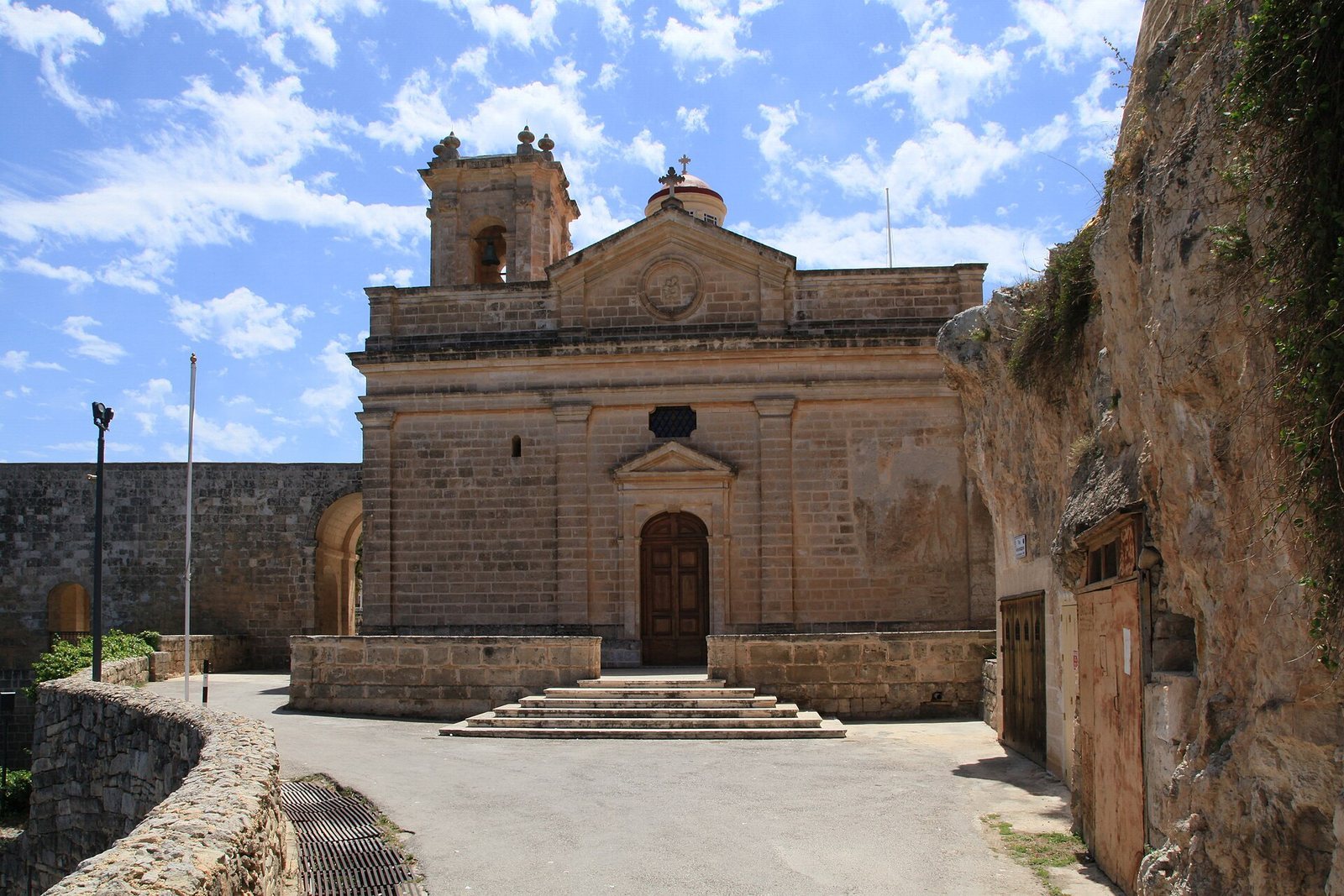
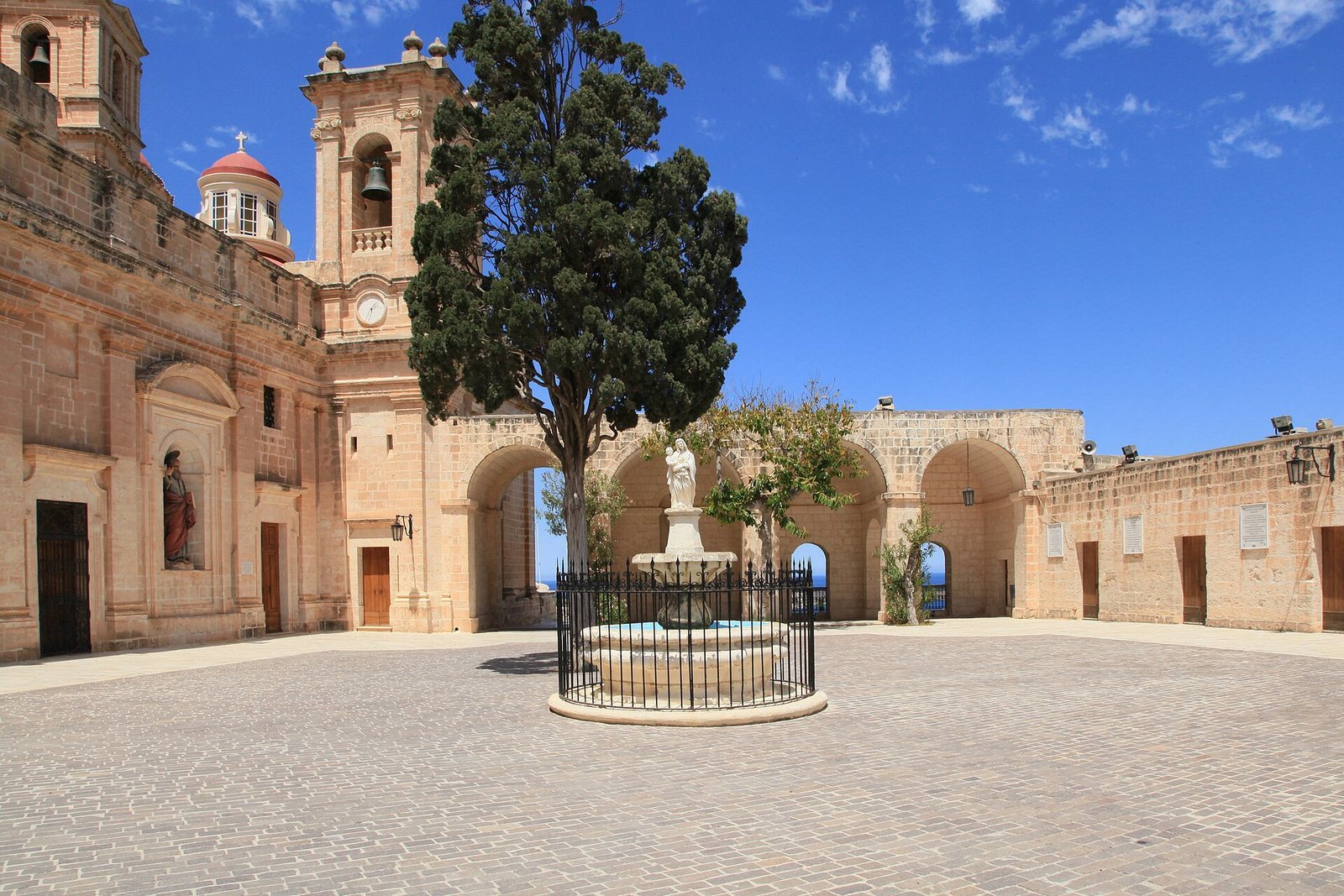
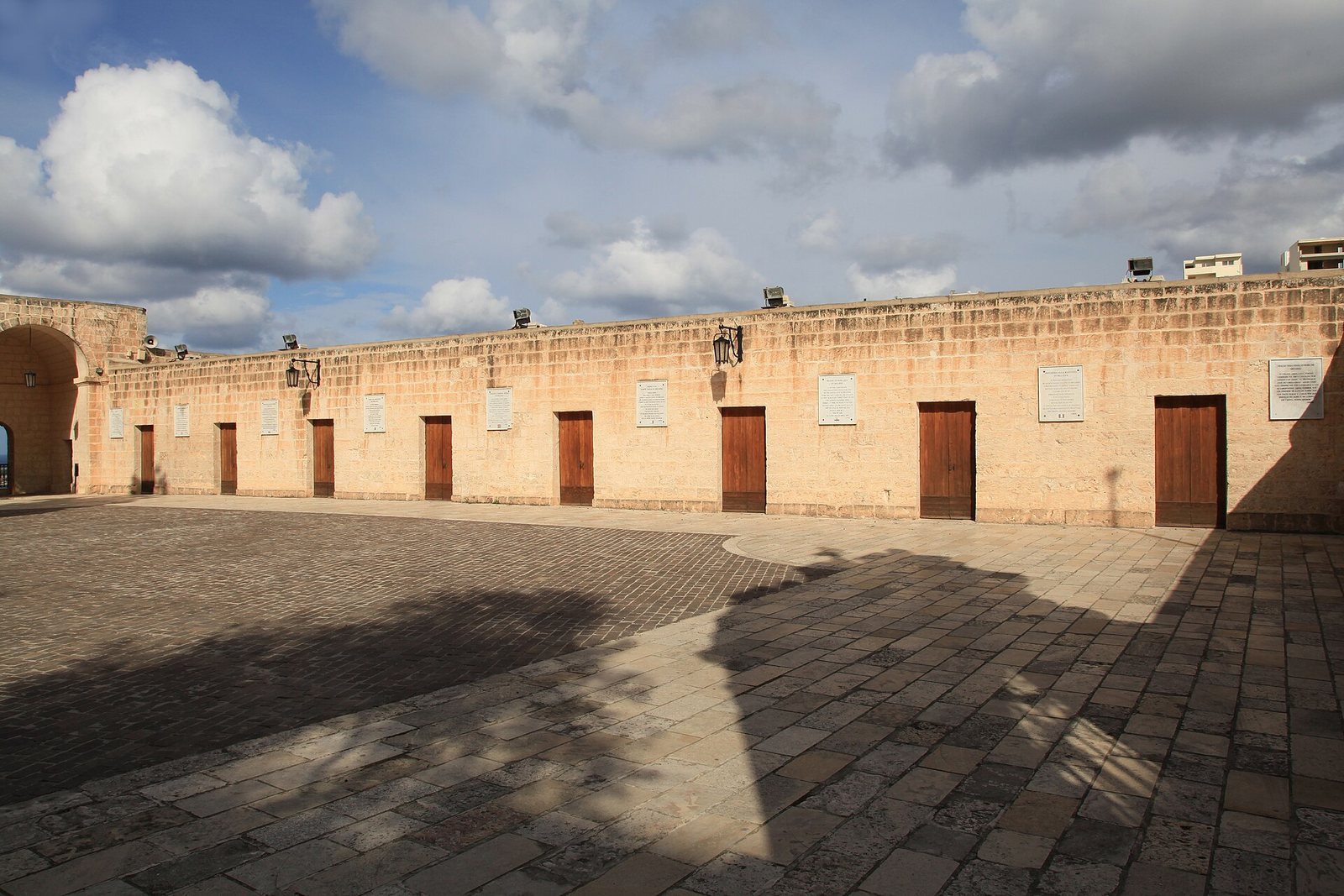
The sanctuary combines Maltese limestone construction with spaces cut directly into the natural rock. Its entrance complex begins with a monumental Baroque archway, in an ornate European style, dated 1719 and bearing inscriptions in Latin and archaic Maltese. The arch opens onto a courtyard with covered galleries where pilgrims could rest, a statue of the Virgin Mary, and a niche containing St Paul. An arch beneath the galleries gives access to the sanctuary.
Tunnel, sacristy, and rock-cut chambers
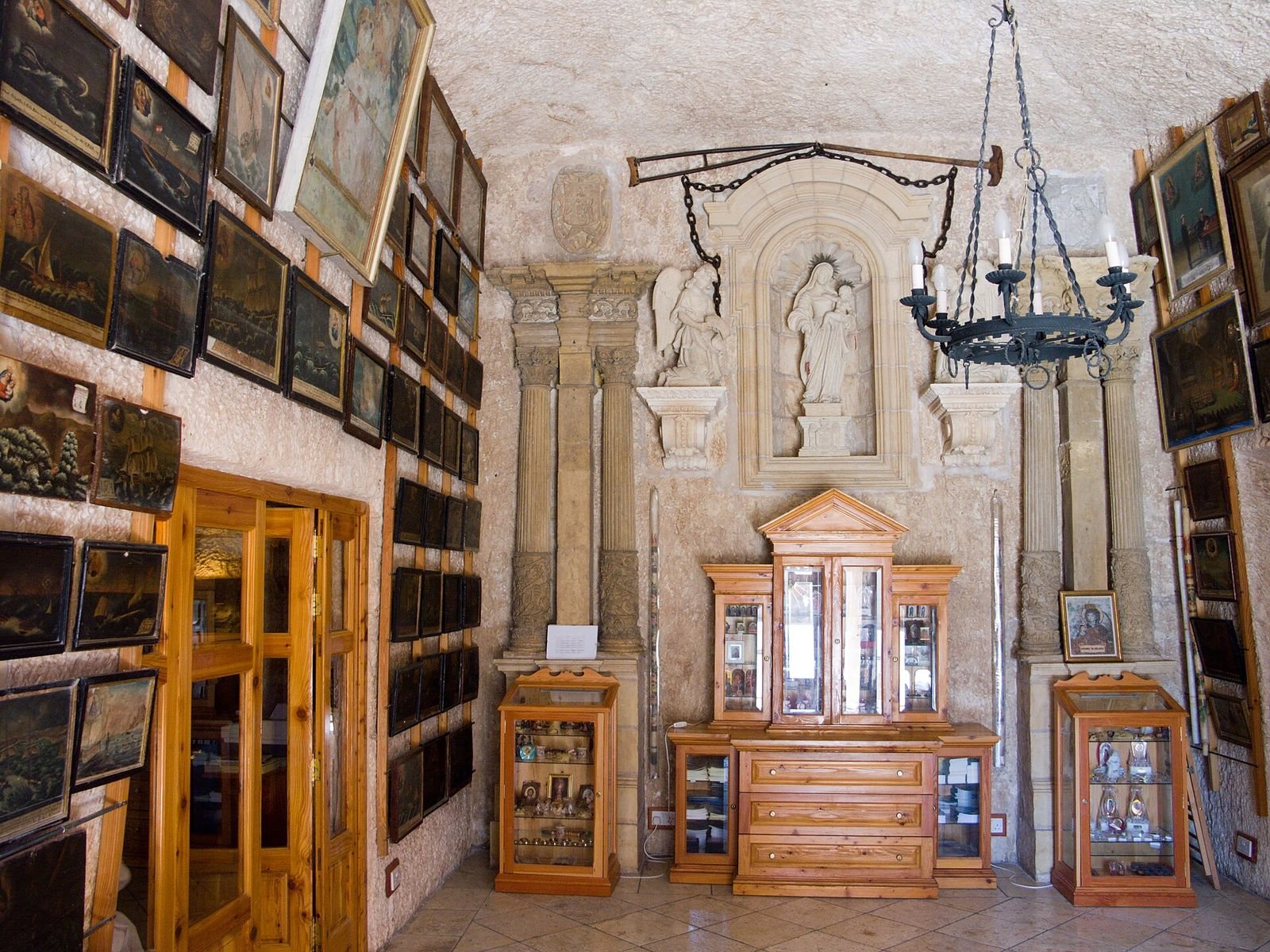
The main entrance leads to a sacristy, a room where clergy prepare for services and keep vestments and sacred objects, and to a tunnel lined with votive offerings. A small chamber cut into the rock, described as a crypt, lies to the tunnel’s left and dates to the 16th century. A further rock-cut crypt is associated with the sanctuary. The tunnel leads into the church, whose walls are decorated with marble.
Cave altar and church fittings
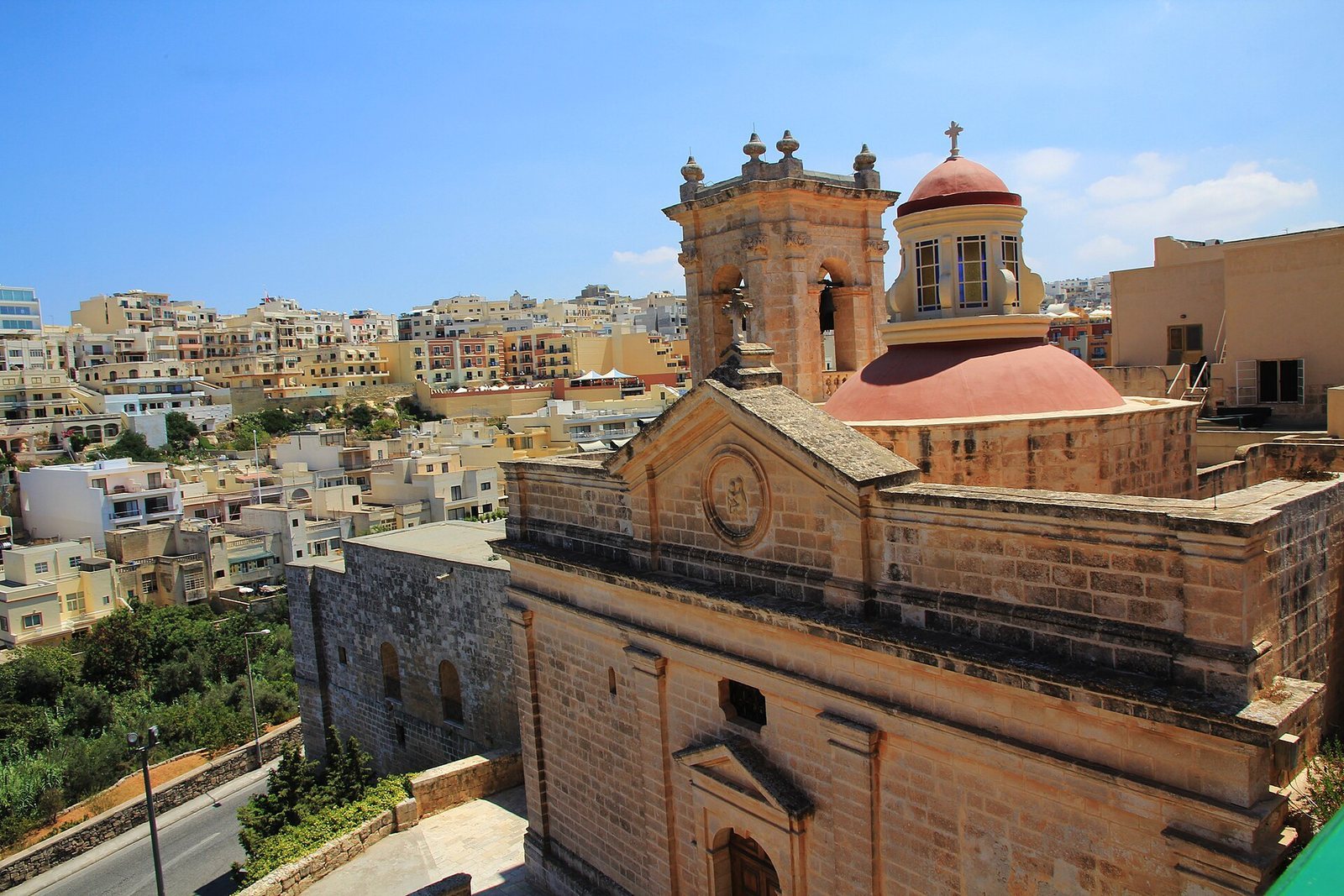
The altar incorporates the natural cave, with marble columns framing the altarpiece. The church also has a small dome and a bell tower holding three bells dated 1712, 1733, and 1857. Its clock was made by Michelangelo Sapiano in 1875 and paid for by the British government.
Paintings and votive offerings
The image above the altar
Above the altar is a medieval image of Mary holding Jesus on her right arm. It is painted either directly on the rock or on a stone slab set into a niche carved from solid rock. The work is believed to date from the late 12th or early 13th century. Its style combines features of Byzantine art, the art of the medieval Eastern Roman Empire, with Sicilian influences and local characteristics. It ranks among Malta’s oldest surviving works of late medieval art. The lower part, severely damaged in the 1614 attack, was restored in purple.
The image was in poor condition by 1587 and had been painted over. In 1972, restorer Samuel Bugeja removed the 16th-century overpainting, revealing the medieval work; a further restoration took place between 2012 and 2016. The sacristy contains a copy by Giuseppe Calì of the image as it appeared beneath the overpainting.
Other paintings and offerings
Paintings by Salvu Bonnici decorate the cave ceiling around the altar. Ċensu Busuttil restored them in 1886, and Samuel Bugeja restored them again in 1973. Other works in the church include a Madonna and a Visitation by Giuseppe Calleja; St Andrew, Our Lady of Mount Carmel, and St Paul by Anton Falzon; St Philip by Pietru Pawl Caruana; and an image of Our Lady of the Rosary tentatively attributed to Stefano Erardi.
The sacristy and tunnel contain numerous votive paintings and other offerings, gifts made in fulfilment of a vow or in gratitude for a perceived favour. One offering shows a Venetian ship and an image of Mary and Jesus. The image may have come from Kykkos Monastery, an Eastern Orthodox monastery on Cyprus, and may have reached Malta after the island fell to the Ottomans in 1571.
Inscription and crosses
A Greek inscription and seven crosses once commemorated the church’s consecration. The crosses were embellished in 1620 and survive.