Basilica of Saint Peter in Collesano: A Parish Church and Minor Basilica
Site at a Glance
- Popularity
- Low
- Country
- Italy
- Primary era
- Early Modern
- Eras represented
- Medieval, Early Modern, Modern
- Civilizations
- Italian, Kingdom of Sicily, Spanish
- Site type
- Religious
- Remains
- Basilica
On this page19 sections
History
Construction and consecration
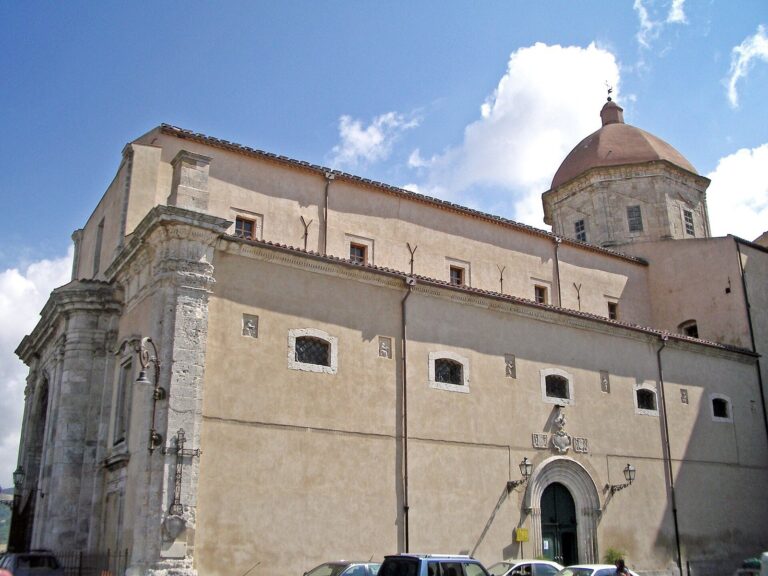
The Basilica of Saint Peter in Collesano, Italy, is a Roman Catholic parish church and the town’s mother church, dedicated to Saint Peter and belonging to the Diocese of Cefalù. Construction began in the second half of the fifteenth century and continued until 1543. Bishop Mariano Manno consecrated the church in 1548.
Bell tower and basilica title
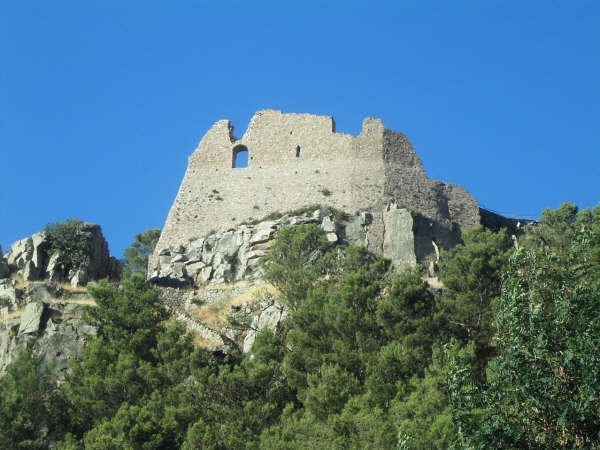
An older defensive tower beside the church served as its bell tower until 1912. In 1983, Pope John Paul II granted the church the title of minor basilica, a papal honor for a Catholic church. The decree conferring the title is dated 6 June.
Remains
Plan and exterior
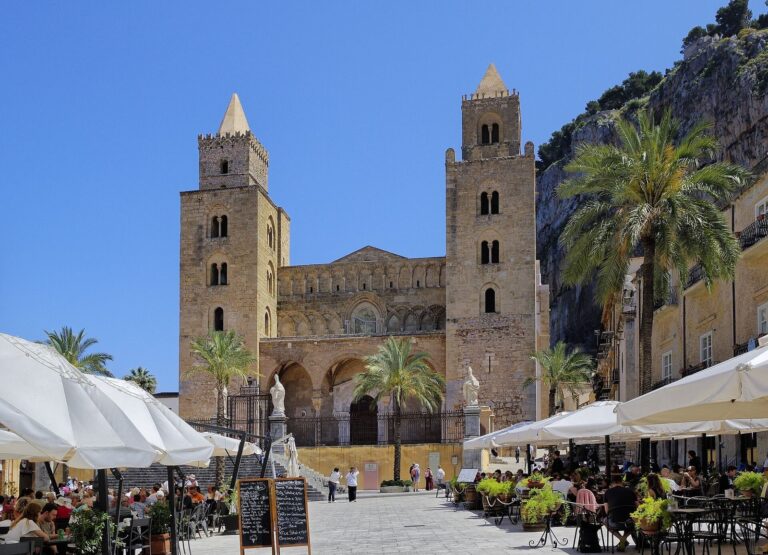
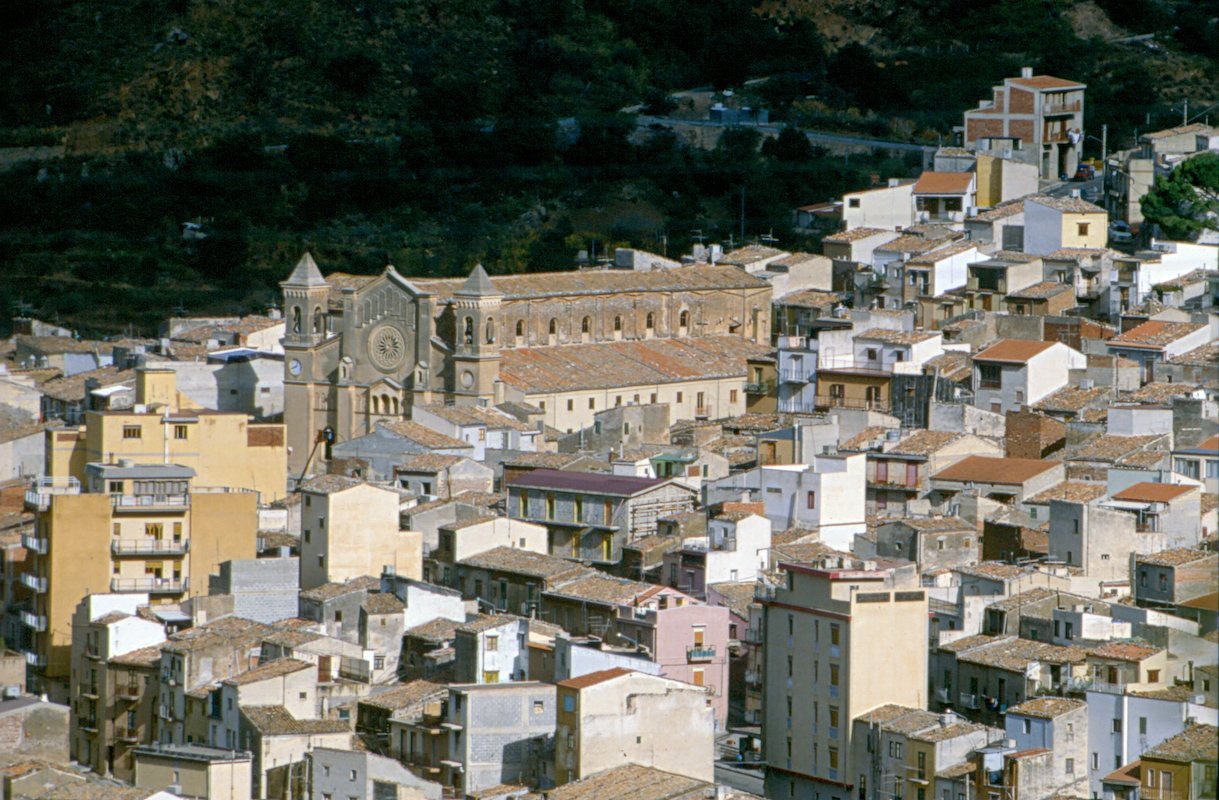
The church has a Latin-cross plan, shaped like a cross, with three naves, the lengthwise spaces of the building. Rows of fourteen columns with polygonal bases divide the interior. The building has a main entrance and a side entrance, above which a Gothic doorway survives. A monumental access staircase dates to the seventeenth century, while the facade dates to the early twentieth century. The church has two towers, including the older defensive tower standing beside it.
Central nave and right aisle
Wooden crucifix
A wooden crucifix dated 1555 hangs in the central nave beneath a timber roof supported by a framework of beams. Vincenzo Pernaci is credited with its carved wooden component and Antonello Sillaro with its painting. The cross forms part of an elaborate wooden ensemble, held on brackets supported by carved harpies. Sculptures of the Virgin Mary and Saint John the Evangelist stand beside it. On the reverse, a painted Resurrection of Christ appears above an open tomb. Carved figures on projecting arms represent King David, the prophets Isaiah, Jeremiah, and Daniel, and Saints Gregory the Great, Ambrose, and Augustine. A shaped wooden canopy rises above the ensemble.
Marble tabernacle
On the wall at the last bay of the right aisle, before the Chapel of the Most Holy Sacrament, stands a marble tabernacle dated 1489. It came from the church of Santa Maria Assunta and is attributed to Domenico Gagini, working with Giovanni Gagini, Giorgio da Milano, Andrea Mancino, and their workshops. Its predella, the decorated lower section of an altarpiece, shows Christ with the Apostles in relief and bears the arms of its patron, Francesco Sunzerio. The central register contains a ciborium, a shrine for consecrated bread and wine, surrounded by twelve adoring cherubs. Niches and compartments at the sides hold the Evangelists and the Doctors of the Church, saints recognized for their contributions to Catholic teaching. Above are a Nativity in a lunette and a Crucifixion between Saints Peter and Paul, framed by candelabra. At the top, God the Father appears among angels, with the angel and Virgin of the Annunciation at the sides, also framed by candelabra.
Chapel of the Most Holy Sacrament
In the right aisle, this chapel has stucco, or molded plaster, decoration and statues made by Giuseppe Li Volsi in 1619. The sculptures are arranged in two tiers around the ciborium and represent Saints Barbara, Mary Magdalene, Agatha, and Christina. Giuseppe Salerno painted a cycle of twenty-one frescoes on the Eucharist, the Catholic sacrament of consecrated bread and wine. Some remain in good condition, including a Last Supper.
Icon and predella
A 1555 religious panel painting on the chapel’s side wall is dedicated to Baldassare Massa, son of the marble worker Giuliano. Its images occupy three horizontal bands. The upper band shows God the Father among angels and grotesque figures; the middle shows the risen Christ with Saints Peter and Paul; and the lower depicts the Immaculate Conception, the Catholic belief that Mary was preserved from original sin from the moment of her conception, between Saint John the Evangelist and Saint Blaise, a bishop. Saint Blaise may have been the room’s original dedicatee. Beneath the panel is a lower altarpiece section of a different style, showing the Apostles in pairs and attributed to Antonello Gagini.
Presbytery
Painted cycle
The presbytery, the sanctuary area around the main altar, has stucco decoration devoted to the glorification of God the Father. Its painted cycle consists of twenty-two oval scenes and thirteen panels concerning Christ’s life, Passion, death, and Resurrection, as well as the Church’s apostolic mission. Gaspare Vazzano painted the cycle around 1618–1624 and signed it. Simone lo Guasto, Francesco Costantino, and Giacomo de Arena assisted him. Some elements have also been attributed, with uncertainty, to Giuseppe Salerno or Giovanni Giacomo Lo Varchi.
Triumphal arch and vault
The painted decoration of the triumphal arch includes Saints Stephen the Protomartyr, Basil the Great, and Athanasius on one side, and Saints Lawrence, Gregory Nazianzen, and John Chrysostom on the other. It also depicts Saints Joachim and Anne with the Evangelists and Apostles Matthew, John, Luke, and Mark. The presbytery vault contains scenes of the Nativity, Adoration of the Magi, Circumcision, Baptism, the Supper at Bethany, Temptation in the Desert, Resurrection, Transfiguration, and the Trinity.
Wall paintings
Panels on the left wall depict Peter’s calling and the Crucifixion of Saint Peter; those on the right show Saul’s conversion on the road to Damascus and the beheading of Saint Paul. Biblical verses appear beneath these scenes. On the rear wall, a nineteenth-century Assumption of the Virgin took the place of an earlier painting by Vazzano. Nearby are scenes of the giving of the keys and Saints Peter and Paul in prison. The upper register shows Jesus among the Doctors of the Church and the expulsion of the merchants from the Temple. Pilasters divide the large panels and carry roundels of female martyrs. Scrollwork, decorative child figures, and monochrome images of Prudence, Temperance, Fortitude, and Justice complete the framing.
Other chapels, paintings, and furnishings
Annunciation Chapel
The oil painting of the Annunciation came from the castle and has been in the Annunciation Chapel since 1848.
Marian paintings
A painting of Our Lady of the Angels, dated 1618 and attributed to Gaspare Vazzano, depicts the Virgin with Saints Catherine of Alexandria, Francis of Assisi, Andrew the Apostle, and Mary Magdalene. It was transferred in 1926 from the church of the same name at a Capuchin friary, a house belonging to a branch of the Franciscan order, and placed in the left aisle. The Chapel of the Crucifix holds a fifteenth-century image of Mary of the Miracles by an unknown artist. Giovanni Giacomo Lo Varchi added a depiction of God the Father to its upper part in 1643.
Other paintings and statues
A panel painting of Saint Catherine of Alexandria, dated 1596, is by Giuseppe d’Alvino, also called Sozzo. It came from the ruined church dedicated to the same saint. Other paintings include images of Saint Joseph, Saint John the Baptist, Saint Roch, Saint John Bosco, the Sacred Heart, and the Resurrection. The church also has a sixteenth-century statue of Saint John the Baptist by an unknown sculptor and a crucifix by Giovan Paolo Del Duca, dated to about 1632. Wooden statues of Saint Roch and Saint John the Baptist also belong to the church’s furnishings. Many of its paintings and wooden statues came from other churches in Collesano.
Other furnishings and devotional objects
A marble baptismal font dates to 1650. The church also holds a painting of Saint Rosalia, probably by Pietro Novelli, and a marble group depicting the Presentation of the Virgin Mary, made in 1546 by an unknown artist and placed in a side aisle. A wooden reliquary contains fragments of relics of the martyrs Mark, Hyacinth, and Basilia.