Church of Saint Nicholas of Myra: Mother Church of Rodi Garganico
Site at a Glance
- Popularity
- Low
- Country
- Italy
- Primary era
- Early Modern
- Eras represented
- Medieval, Early Modern, Modern
- Civilizations
- Italian, Kingdom of Naples, Spanish
- Site type
- Religious
- Remains
- Church
On this page18 sections
History
A new parish church
The Church of Saint Nicholas of Myra is Rodi Garganico’s Catholic mother church in Italy, at the northern edge of the town’s old fishing quarter. As the town’s principal church, it belongs to the Archdiocese of Manfredonia–Vieste–San Giovanni Rotondo and the North Gargano vicariate, an administrative grouping of parishes.
Earthquakes in the Gargano area during the seventeenth century made the former parish church of the Most Holy Crucifix unusable. The town chose a flatter site that was considered safer in seismic conditions, at the settlement’s northern edge between its main gate, now Piazza Garibaldi, and the two sunset arches, now Piazza Rovelli. Building work began in 1680.
While construction continued, worship took place in the Church of the Annunciation, across Corso Umberto I from the new building. That church was later formally deconsecrated and converted to commercial use. Services at Saint Nicholas began after its construction, before its formal dedication for worship in 1826. During a pastoral visit, Archbishop Eustachio Dentice donated relics, physical remains or objects associated with saints and venerated as sacred, of Saints Theodore and Christopher. The church’s dedication is thought to reflect Dentice’s devotion to Saint Nicholas of Myra, a Christian bishop of late antiquity whose veneration spread through both Eastern and Western Christianity. Dentice was metropolitan archbishop of Manfredonia and perpetual administrator of Vieste.
Saint Christopher as co-patron
Local devotion to Saint Christopher, a Christian martyr traditionally associated with protecting travelers, was linked to Turkish incursions between 1673 and 1678. A traditional account describes an attempted entry into the town on July 11, 1678, by 150 attackers. It says parish priest Lattanzio Paolozzi stood in the forecourt of the old Church of the Most Holy Crucifix, holding up an image of Christopher and assuring those who prayed to the saint that they would survive. The town drove the attackers back, killing two and capturing six. People credited both Christopher and the Virgin Mary with protecting them, and a local saying urged people to invoke Christopher before proceeding safely.
Townspeople, particularly porters who regarded Christopher as their patron, sought to have him recognized as Rodi’s second patron saint. With the support of Abbot Spinelli, Archbishop Orsini of Manfredonia named Christopher a co-patron, a saint honored alongside another patron, in 1680 and moved his feast from the 26th to July 3. Orsini was the Dominican friar Vincenzo Maria Orsini, later Pope Benedict XIII. In 1681, Spinelli gave the town a statue of Christopher and its first relics of the saint. The statue arrived aboard a sailing vessel belonging to the Carbone family.
Later changes
Following the Second Vatican Council, the Catholic Church’s major 1962–1965 council, a wooden altar table was installed to replace the earlier arrangement in which the priest celebrated Mass facing away from the congregation. In 1980, after the Church of the Most Holy Crucifix closed again, a statue of the dead Christ was placed in Saint Nicholas’s presbytery, the raised altar area reserved for clergy. Statues of Saint Michael the Archangel and Saint Roch were set on other altars.
Remains
The church has a single nave, with altars along its side walls and the high altar opposite the entrance. Its most elaborate interior feature is the decorated structure behind the high altar, made in Apulia’s late Baroque style, an ornate European artistic style prominent in the seventeenth and eighteenth centuries.
Exterior
Main entrance façade
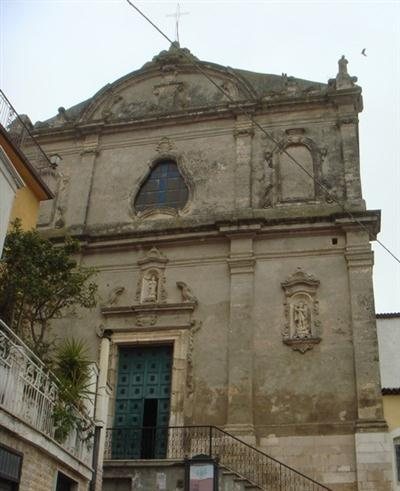
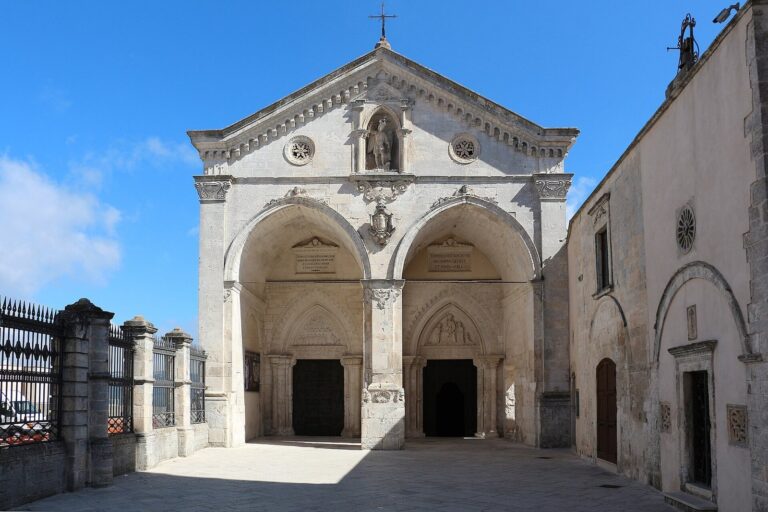
Near Luigi Rovelli Square, the main façade faces Corso Umberto I. Its plain surface is interrupted by an entrance portal set three steps above ground and framed by a double lintel. Higher up are a window added long after the church was built and a small statue of the Madonna.
Side façades
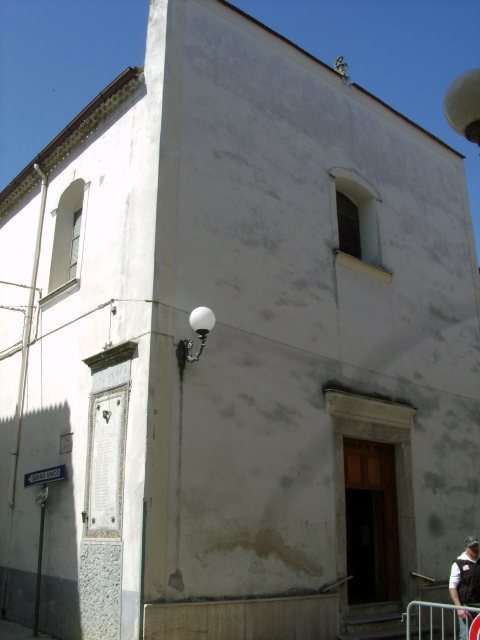
The plain right façade faces a courtyard leading to the sacristy and bell tower. On the left, the façade along Via Mazzini carries a plaque commemorating 23 people who died in the Wars of Independence. A blocked portal there was formerly used to take the statue of Saint Nicholas out for processions. Local people traditionally kissed a black stone beside it before entering the church.
Bell tower
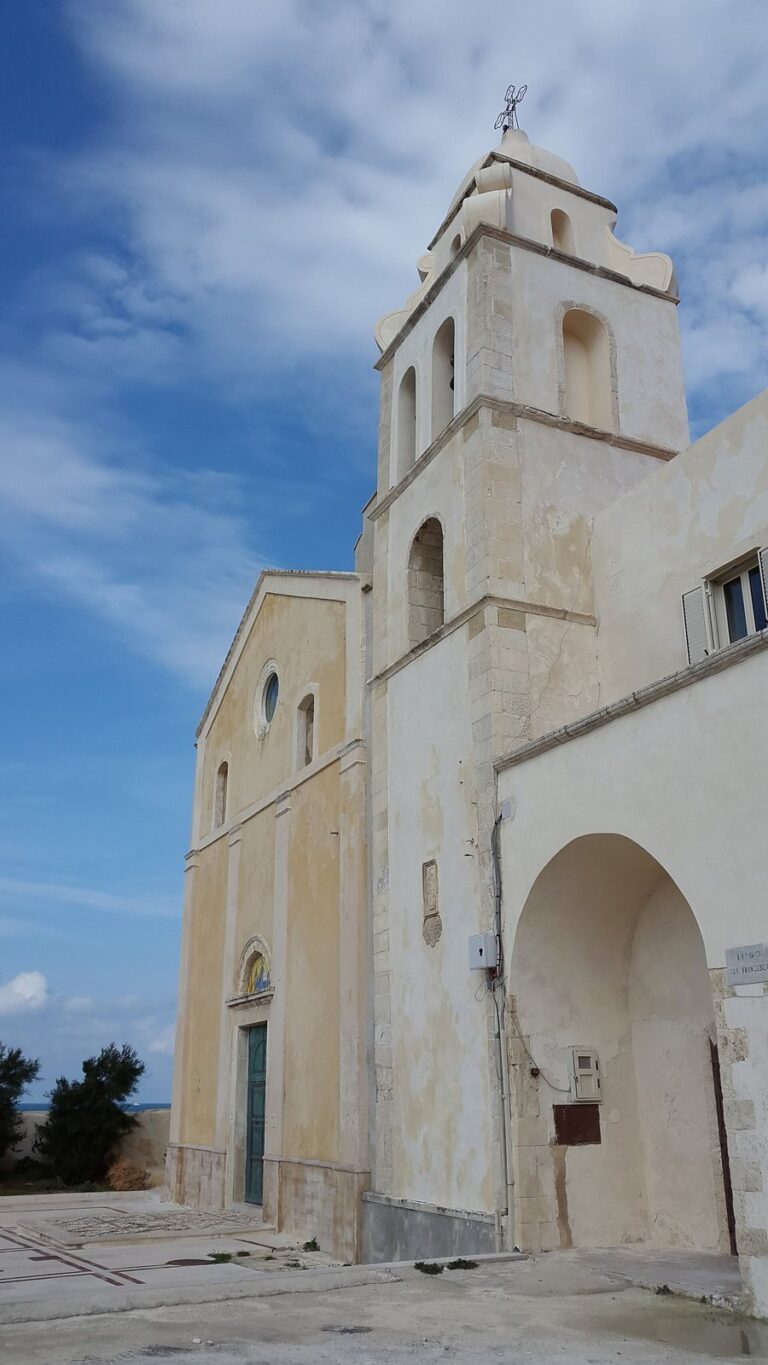
The tower predates the church and served a defensive purpose before its construction. It has a square base and three upper levels, with four arrow slits and four small round-headed windows. An octagonal drum, the upright support beneath a dome, carries a bulb-shaped dome. The dome dates to the twelfth century, while the tower’s main body dates to the thirteenth. Its forms tend toward Romanesque, a medieval architectural style, and the dome gives the tower an Orthodox appearance and vivid coloring. During a later restoration, an out-of-alignment stone was interpreted as evidence of an earlier structure supporting part of the tower.
Interior and altars
Nave and presbytery
The church’s single nave has side altars, with the high altar on the wall opposite the entrance. Its ceiling vault, once built of masonry, is now ornamented with recessed wooden panels. The raised presbytery was formerly enclosed by an iron railing and is dominated by the high altar. The choir was removed; a canvas depicting Saint Christopher had stood above it. A wooden covering conceals a fresco of the saint, which could not be restored.
High altar
Made by local artists in 1680–81, the two-tiered structure behind the high altar narrows toward the top. Its lower tier has curved scroll forms, inset cherubs and a central niche framed by three twisted columns. The niche holds the statue of Saint Christopher, whose intense expression and dark complexion contrast with the lighter face of the child he carries. The statue was placed so it could be seen from outside the church.
The upper tier repeats the scrolls and cherubs around a smaller central niche, formerly occupied by a statue of the risen Christ, with an angel on either side. Above the columns, an inscription presents God as the community’s God; a stone crowning element tops the composition. The marble altar table and embossed-silver tabernacle, the container for the consecrated Eucharist, have floral decoration. On the tabernacle, the Redeemer blesses the faithful.
Altar of Saint Catherine
The former altar of Saint Catherine once held a canvas depicting two saints. That painting was removed and a confessional brought from the Sanctuary of Our Lady of Libera was installed in its place.
Altar of Saint John Bosco
Previously dedicated to Saint Philomena, this altar was changed after the Holy See issued a directive following new findings about her biography, and her statue was removed. Wooden statues of Saint John Bosco and Saint Dominic Savio, dated 1971, now stand there with a statue of Saint Rita. Two coats of arms at the base show a crowned rose, the emblem of the Crowned Rose confraternity that maintained the altar. The rose also represents the struggle between light and darkness.
Altar of Saint Nicholas of Myra
This altar was formerly dedicated to the Rosary. Until the 1960s it held a painting of Our Lady of Pompeii by Angelo Gallucci, a sculptor from Rignano. A wooden statue group replaced the painting, showing Saint Nicholas bringing three children back to life after they had been shut inside a barrel.
Altar of Purgatory
Once the Trinity altar, this shrine first held a painting of the Trinity, with Assisi suspended among clouds and Saints Alphonsus Liguori and Thomas Aquinas in the foreground. The canvas, dated 1844 and attributed to the Abruzzese painter Giuseppe Palma, combined styles of its period. It was later replaced by a 1681 altarpiece of the Madonna of Mercy, also known as the Madonna of Purgatory, by Pier Paolo di Nunzio. The Virgin and Child appear on a cloud amid angels rescuing souls in Purgatory, while two more angels hold the Virgin’s crown. At the base, a baptismal font that had first served as a holy-water basin is decorated with acanthus leaves and floral patterns.
Altar of the Sacred Heart of Jesus
Formerly the Purgatory altar, this altar once held the Madonna of Purgatory altarpiece. It now has small statues of the Sacred Heart of Jesus and the Immaculate Conception.
Altar of the Nativity
Also known as the altar of Saint Joseph, this altar has a painting by Kalendus Martu dated 1481. It depicts the Nativity with a pronounced nighttime effect and is in the Neapolitan style.