San Cristoforo alla Certosa: A Carthusian Church in Ferrara


Site at a Glance
- Rating
- 4.6
- Popularity
- Low
- Country
- Italy
- Primary era
- Early Modern
- External website
- Open
- Eras represented
- Medieval, Early Modern
- Civilizations
- Duchy of Ferrara
- Site type
- Religious
- Remains
- Church
On this page14 sections
History
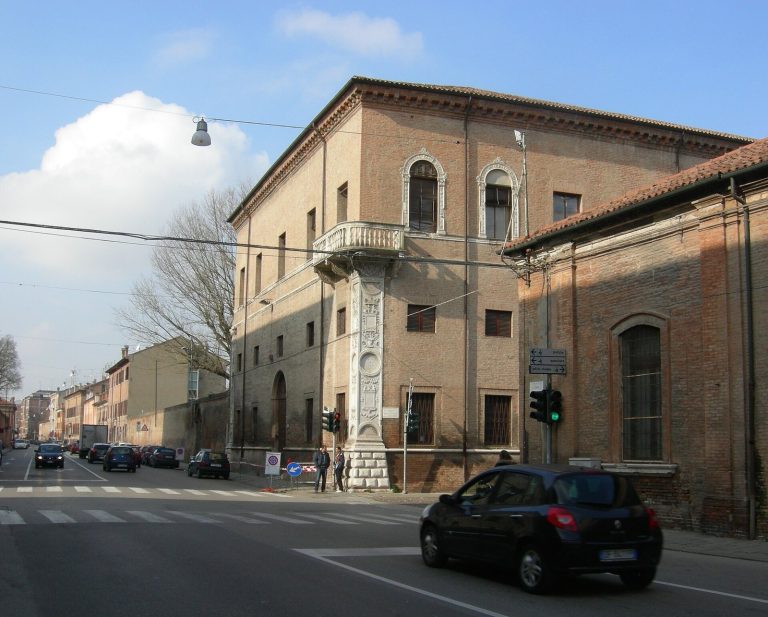
San Cristoforo alla Certosa is a Roman Catholic church in Ferrara, Italy, built for the Carthusian order during the Renaissance and dedicated to Saint Christopher. Its history is closely connected with the Este dynasty, the ruling family of Renaissance Ferrara, and with the city’s expansion beyond its earlier urban boundaries.
Foundation of the Carthusian monastery
In 1452, Borso d’Este commissioned a large monastery at Ferrara and invited Carthusian monks from Grenoble to establish it. The Carthusians, also known as the Order of the Cartusians, followed a highly secluded form of Catholic monastic life. In keeping with that tradition, the monastery was first placed in an isolated area away from Ferrara’s city center.
The situation changed during the Addizione Erculea, the major urban expansion commissioned by Ercole I d’Este and planned by the architect and urban planner Biagio Rossetti. The expansion brought the monastery close to Ferrara’s new urban center and within the city walls. This transformation connected the formerly secluded religious complex with the developing Renaissance city.
Construction and later religious history
Construction of the present church began in 1498 beside the monastery’s earlier place of worship. The building opened for worship in 1551. It is regarded as Biagio Rossetti’s most mature work, although the evidence for his authorship has been considered insufficient by some scholars.
The Carthusian monks lost possession of the church and monastery during the Napoleonic suppressions, when religious institutions were dissolved and their property confiscated. The municipality of Ferrara acquired the complex, reopened the church for worship in 1813, and converted the adjacent area into a public cemetery. That cemetery later developed into the monumental Certosa cemetery, of which San Cristoforo alla Certosa remains an integral part.
Demolition, wartime damage, and restoration
The primitive church and the cloister were later demolished. Their former area was occupied by a portico that defines the square in front of San Cristoforo. During the Second World War, the church suffered severe damage. The bell tower, the roof over the apse, and the southern gable of the transept were destroyed.
Numerous restoration and consolidation campaigns followed, beginning in the early postwar period and continuing through the twentieth century. More recent conservation has also returned major paintings to the interior. In February 2026, a large work by Giuseppe Avanzi depicting the Apparition of Saint Bruno to Roger, Count of Sicily, before the battle was returned to the right wall after restoration.
Remains
San Cristoforo alla Certosa has a single-nave interior with six lateral chapels. The church stands beside the monumental Certosa cemetery, while the portico in front occupies the former area of the primitive church and cloister and gives form to the adjacent square. The building combines Renaissance fabric, later additions, religious artworks, and furnishings associated with the Carthusian community.
Exterior and entrance
Unfinished facade
The facade remains unfinished and appears to have been intended to receive a marble facing. Its present form therefore preserves the building’s incomplete exterior treatment rather than a finished marble front.
Marble portal
A monumental marble portal was added in the eighteenth century. Above it is the coat of arms of the Carthusian order. Gaetano Barbieri designed the portal, while the Veronese sculptors Pietro Puttini and Francesco Zoppo executed the two putti that accompany it.
Interior and Carthusian decoration
Heraldic pillar reliefs
Marble bas-reliefs at the bases of the pillars date from the beginning of the sixteenth century. They display heraldic devices connected with members of the Este family. Borso d’Este is represented by the paraduro, well, and unicorn; Ercole I d’Este by the diamond, oak, and hydra; Alfonso I d’Este by the grenade; and Ippolito I d’Este by the falcon. Numerous other religious symbols associated with the Carthusians are distributed through the church.
Paintings and restored canvases
The church contains works by Nicolò Rosselli, Niccolò Pisano, Ludovico Carracci, Agostino Carracci, Sebastiano Filippi, Bartolomeo Cesi, Francesco Naselli, Giacomo Parolini, Giuseppe Antonio Ghedini, and other painters from Ferrara active in the late sixteenth century.
Among the large-scale works is Giuseppe Avanzi’s painting of the Apparition of the Blessed Virgin and Saint Peter to the Companions of Saint Bruno. Covering approximately 36 square meters, the canvas survived the Napoleonic confiscations and the bombing of January 1944. It was later rolled without protection and exposed to the weather. After extensive restoration, it returned to its former position on the left wall of the presbytery, almost eighty years after its removal.
Another very large painting by Avanzi, measuring more than 39 square meters, depicts the Apparition of Saint Bruno to Roger, Count of Sicily, before the battle. Saint Bruno was the eleventh-century founder of the Carthusian order, while Roger I was a Norman ruler of Sicily. The restored painting returned to the right wall in February 2026.
Altar and choir furnishings
High altar ciborium
The high altar carries a wooden ciborium, an architectural canopy placed over a Christian altar. The architect Nicolò Donati designed it, and Marc’Antonio Maldrato made it in 1597.
Wooden choir
The wooden choir consists of 56 stalls with perspective inlay work, a decorative technique that sets pieces of wood into a surface to create patterns and pictorial effects. The choir is attributed to Pier Antonio degli Abbati. It originated in the church of Sant’Andrea and was transferred to San Cristoforo alla Certosa at the end of the nineteenth century.