Church of St Nicholas the Wonderworker: An Orthodox Church in Nikolo-Gastun
Site at a Glance
- Popularity
- Low
- Country
- Russia
- Primary era
- Early Modern
- Eras represented
- Early Modern
- Civilizations
- Russian
- Site type
- Religious
- Remains
- Church
On this page11 sections
History
The Church of St Nicholas the Wonderworker is an inactive Orthodox church in Nikolo-Gastun, Tula Oblast, Russia. It is regarded as one of the region’s oldest churches and is a federally significant cultural heritage site. Church tradition places its beginnings at least as early as the late 15th century, while the date of the later stone building is disputed. The church is associated with Russian ornamental architecture, a tradition characterized by elaborate decorative forms.
The icon and the first church
According to local tradition, an image of Saint Nicholas, revered in Eastern Christianity as a wonderworker, was found near the settlement of Gostuni beside the Gostunka stream. The image was believed to have miraculous powers, and a wooden church was built at the place of its discovery. The story is connected with the Christianization of the Vyatichi, an East Slavic tribal group.
The image became known as the Gostun Icon of St Nicholas and grew into an important Orthodox sacred object. In 1503, Grand Prince Ivan III of Moscow took it to Moscow. Three years later, his son and successor, Grand Prince Vasily III, ordered a brick church built for it in the Moscow Kremlin and placed the image there. Church tradition also places a pagan sanctuary near the discovery site and interprets the Christian shrine’s proximity to it as a miraculous reconciliation between religions.
The stone church and its chapel
The stone church’s construction date is uncertain. One tradition attributes it to an order by Ivan IV, also known as Ivan the Terrible, in 1563; another places its construction in 1660. A separate story says that Ivan IV gave the church another revered icon of Saint Nicholas in 1564, during a visit to Belyov District. This gift followed the parishioners’ transfer of devotion from the image taken to Moscow.
A heated side chapel was built by the nun Martha Ivanovna. It was dedicated to the early Christian bishops and theologians Athanasius and Cyril of Alexandria, and to Onuphrius the Great, venerated as an early Christian ascetic. The chapel was later rebuilt on the order either of Martha’s son, Tsar Michael Fyodorovich, the first Romanov ruler, or her grandson and his successor, Tsar Alexis Mikhailovich.
Parish life and changing uses
The village belonged to the church until 1764. Following an administrative reform under Empress Catherine II, its peasants became state peasants, subject to the state rather than a private landowner. The church underwent a major renovation in 1861.
It closed in the 1930s and was subsequently adapted for several secular uses, including a village club with a cinema, storage, and production premises. In 2002, local businesspeople and other enthusiasts began restoration work without official authorization, and a fund was set up to support the effort. The church’s vaults collapsed in October that year. Whether the work contributed to the collapse or the building’s age was responsible remains unresolved; an expert assessment could not be funded.
In December 2022, the church was included in a federal conservation program for 2023 and 2024.
Remains
The site’s physical history extends from a wooden predecessor at the traditional place of the icon’s discovery to a later stone church in the Russian ornamental tradition. Its surviving fabric includes parts of the church and side chapel, while associated features and objects preserve links to the site’s religious traditions.
Church fabric
Main church
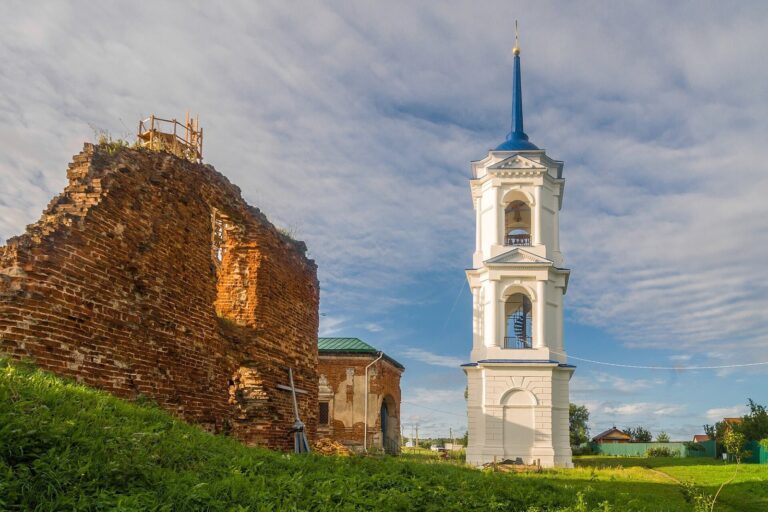
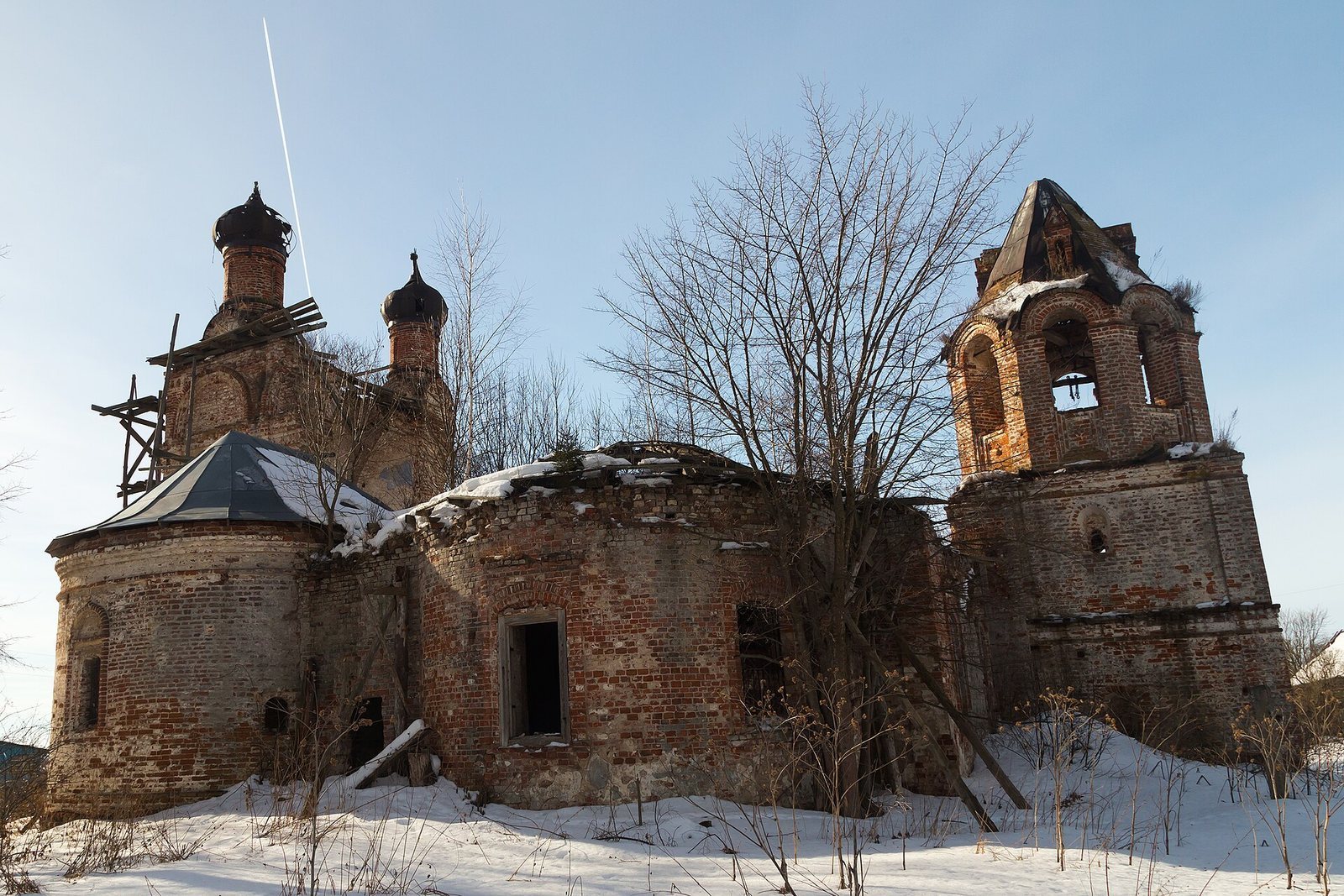
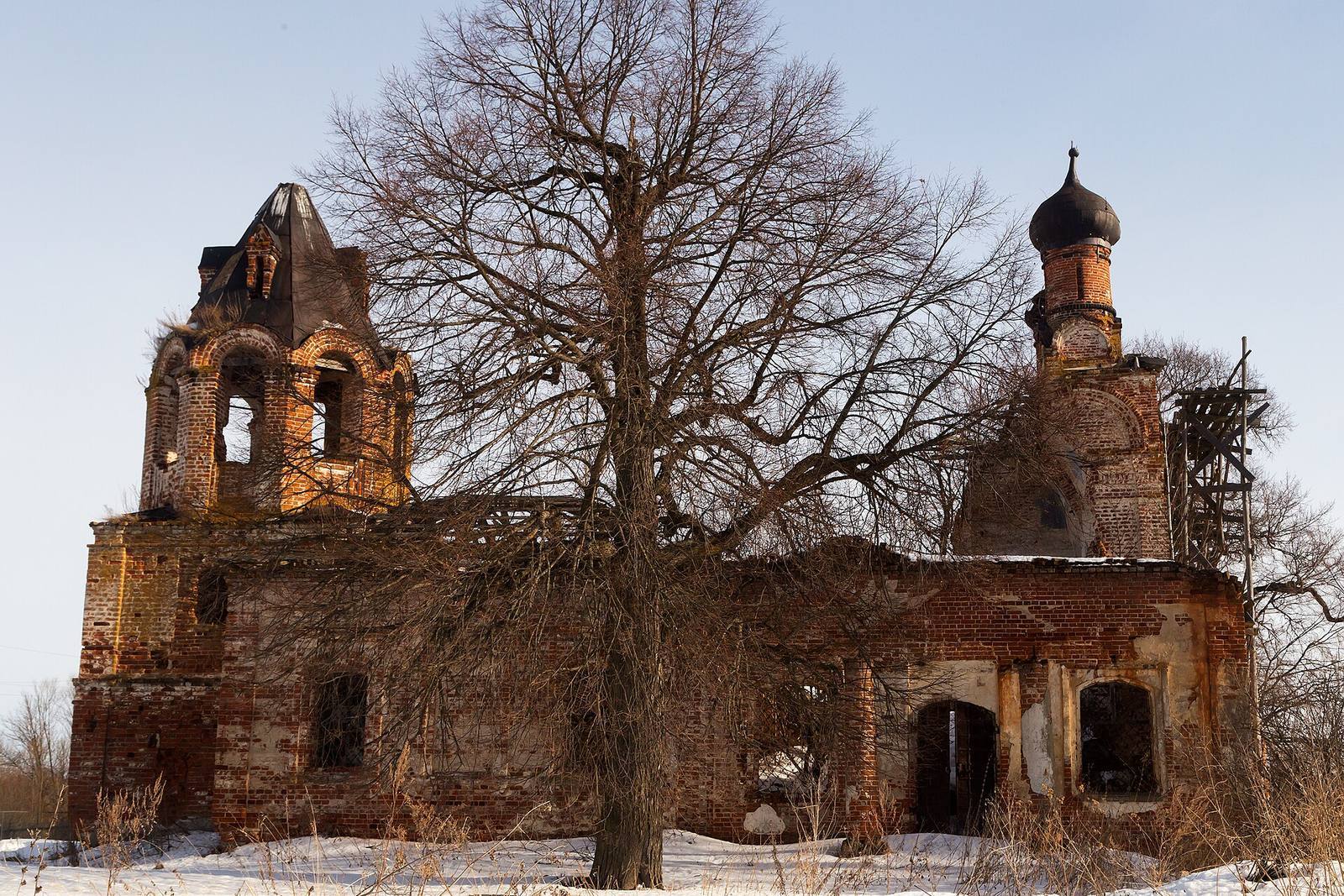
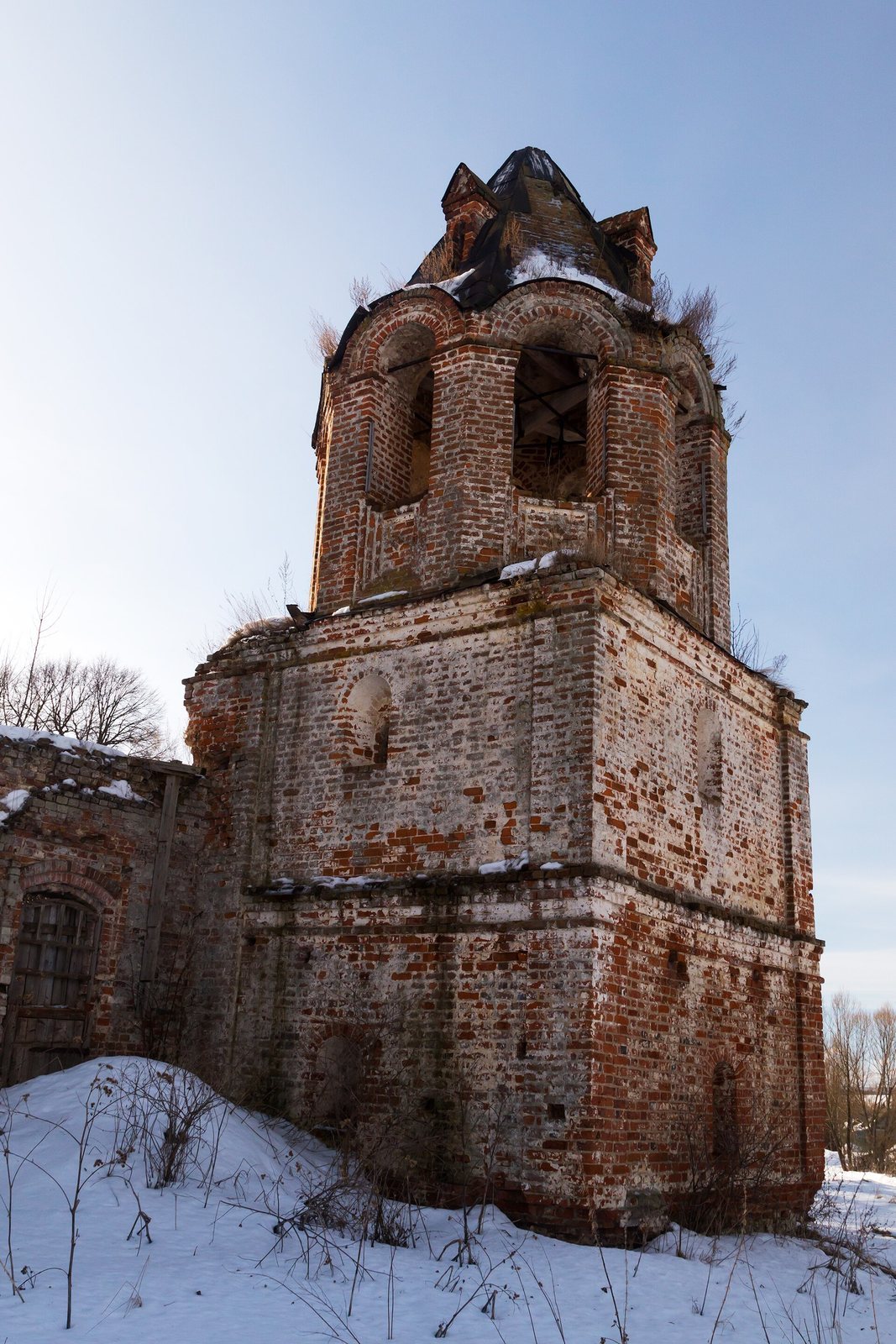
The remaining architectural features include the bell tower and a separate wall with two cupolas still hanging from it. The church is deteriorating, and its collapsed vaults have left the building in a fragmentary condition.
Side chapel
The chapel began as a wooden structure and was later rebuilt in stone. A section of its wall survives among the remains of the church.
Associated sacred features and objects
The boulder near the icon site
A huge boulder regarded as sacred in pagan tradition lay near the reported place where the icon was found. Church tradition called it “blue,” deriving the epithet from a word meaning “demon.”
The altar cross
A 1562 altar cross, a liturgical cross used at the altar, was among the central objects at a 2002 exhibition at the State Museum of Architecture. The exhibition explored the churches associated with Nikolo-Gastun in the Moscow Kremlin and Belyov District.