Saint James Church in Tarchomin, Warsaw: A Gothic Parish Church
Site at a Glance
- Popularity
- Medium
- Country
- Poland
- Primary era
- Early Modern
- Eras represented
- Early Modern, Modern
- Civilizations
- Kingdom of Poland, Polish–Lithuanian Commonwealth, Russian
- Site type
- Religious
- Remains
- Church
On this page12 sections
History
Origins and the brick church
Saint James Church in Tarchomin, Warsaw, Poland, began as a wooden parish church in the early 15th century. Its first known written mention appears in a court book of New Warsaw in 1427. The Gołyński family became lords of Tarchomin in the second half of the 15th century and later sponsored the brick church.
In 1510, the nobleman Grzegorz Borzym directed that he be buried at the church and left it claims worth four kopy, a traditional unit equal to 60 grosz each. The claims concerned a rye stack and a tithe purchased at Ciemniewo, and were held against Wojciech, heir to Tarchomin. Building work was begun by Jakub Gołyński, a Masovian voivode, or provincial governor, and his son Mikołaj, a Płock cathedral canon, or member of its clergy chapter, who was also the parish priest. Warsaw starosta Adrian Gołyński, an official who administered a royal district, continued the work.
The year 1518, found on a brick in the chancel, the part of a church around the altar, is conventionally used as the building’s construction date. It is unclear whether the work was complete by Adrian’s death in 1540. The church was standing by 1570, when Płock canon Jan Dąbrowski endowed an altar benefice, an endowment supporting services at a particular altar. Bishop Piotr Dunin Wolski consecrated it in 1582.
Damage and 18th-century enlargement
During the Swedish Deluge, Sweden’s mid-17th-century invasion and occupation of much of the Polish–Lithuanian Commonwealth, the church was looted. Tarchomin was also devastated and lost population, and the church fell into disrepair.
After the Ossoliński family acquired Tarchomin in the early 18th century, Franciszek Maksymilian Ossoliński initiated restoration and enlargement in 1720. The work was largely complete by 1730, with further additions made afterward. In 1785, the parish belonged to the Diocese of Płock, the Archdeaconry of Pułtusk and the Deanery of Radzymin.
Repairs and the parish today
Estate owner Władysław Kisiel-Kiślański supported major repairs to the church and other parish buildings between 1894 and 1898. German forces confiscated the bells in 1941, and wartime action damaged the church in 1944. Repairs to the roof and ceilings followed in 1945; copper sheeting was added to the roof in 1982–1983.
The church is now the seat of the Roman Catholic Parish of St James the Apostle in the Diocese of Warsaw-Praga and the Tarchomin deanery.
Remains
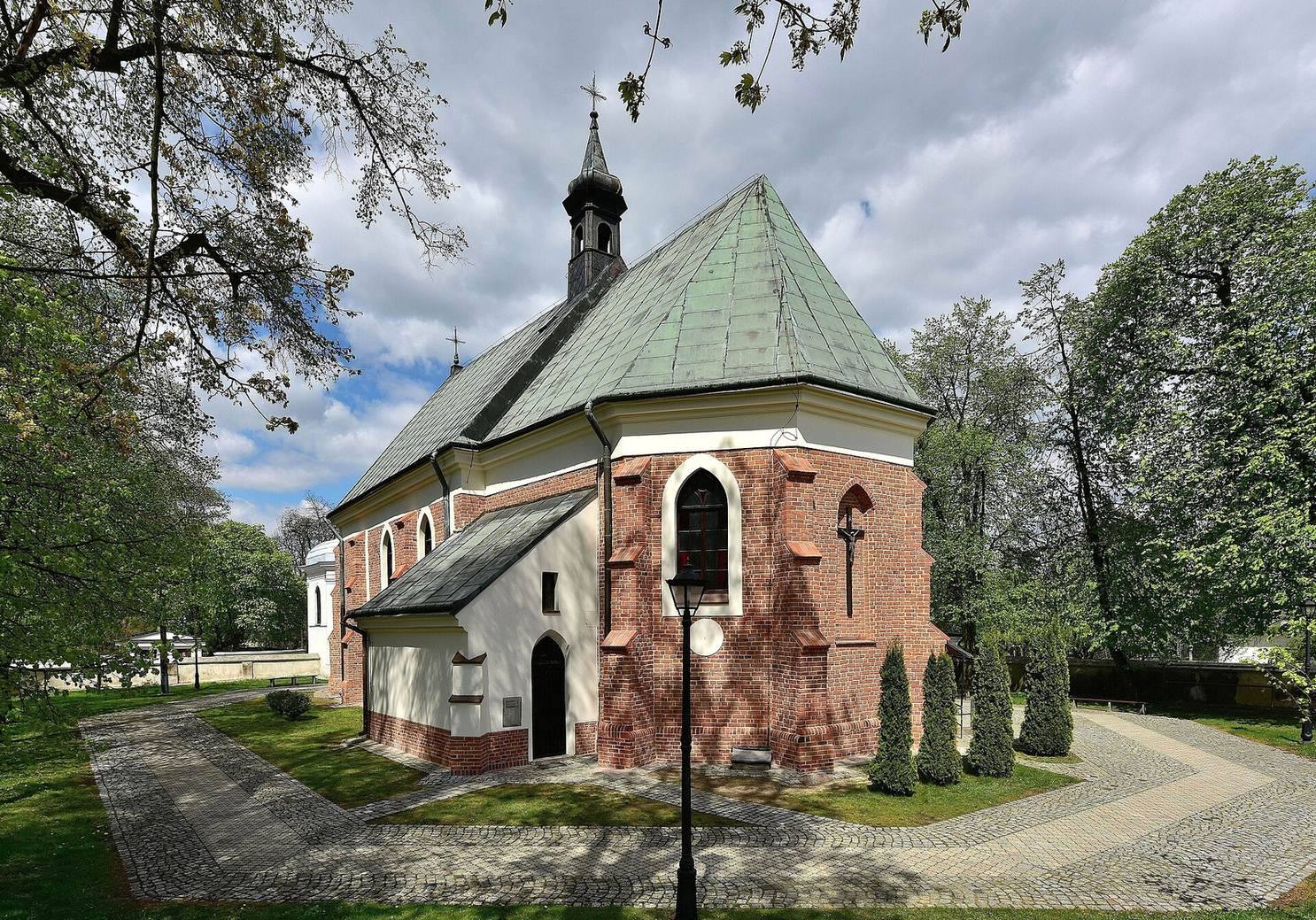
The church stands on a small artificial mound intended to protect it from flooding by the Vistula. Its single-nave brick plan includes a narrower, lower chancel extending southeast. The surviving building combines Gothic exterior fabric with later additions and a Baroque interior.
Exterior and churchyard
Church fabric and additions
The walls use Polish bond, a named pattern for laying bricks. Traces of a portal and ornament made with dark-fired bricks, darkened in firing, survive on one side wall; the original entrance was also in a side wall. An 18th-century porch was added at the front, along with a sacristy, a room for clergy’s vestments and sacred vessels, and a treasury beside the chancel. The church has two sacristies. Its exterior was plastered and reinforced with 12 buttresses, projecting supports for the walls.
Churchyard wall
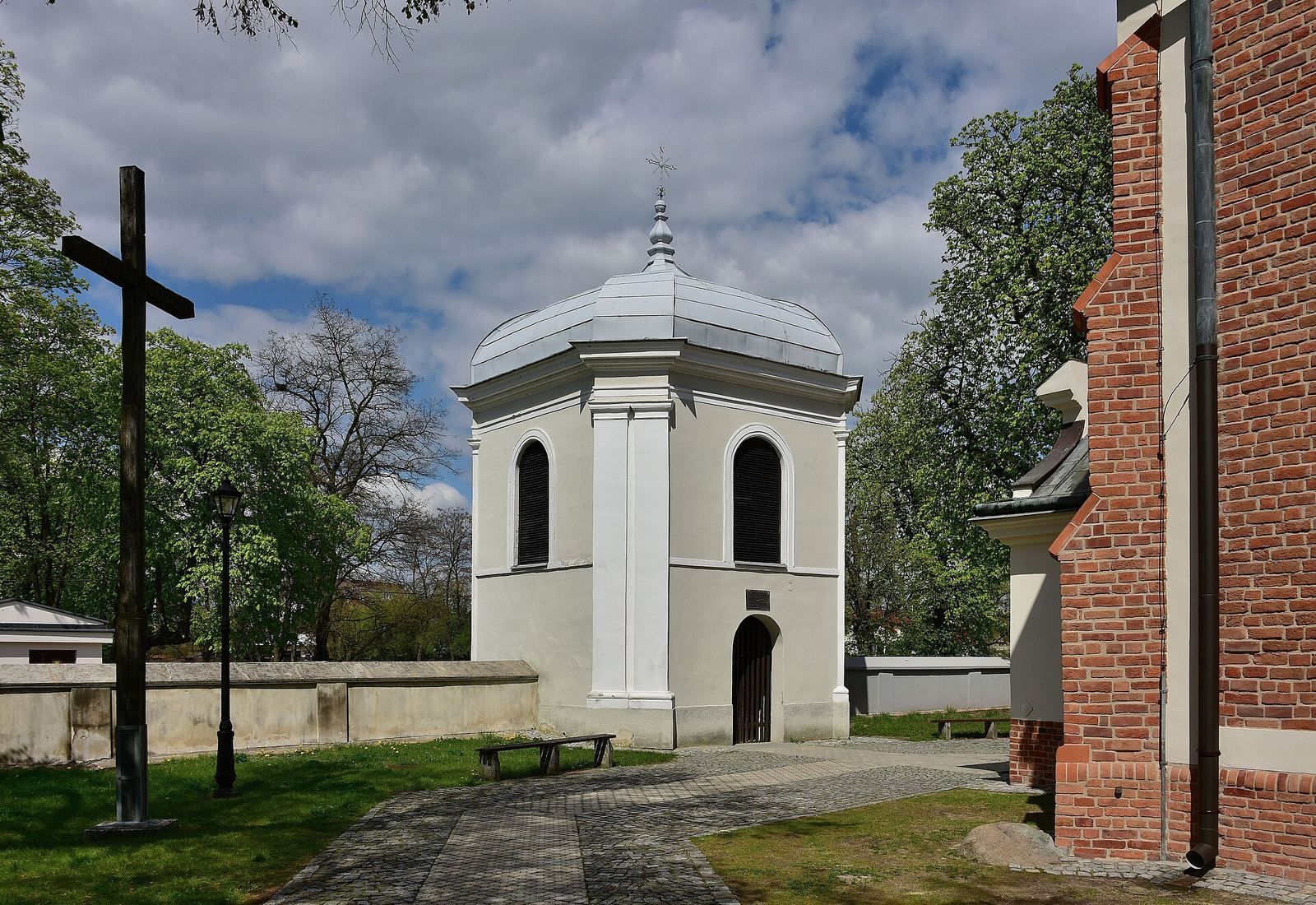
The churchyard was reorganized during the 18th-century works. A charnel house, a building for storing human bones, and a Baroque bell tower were incorporated into the wall surrounding it.
Interior and furnishings
Altars and church furnishings
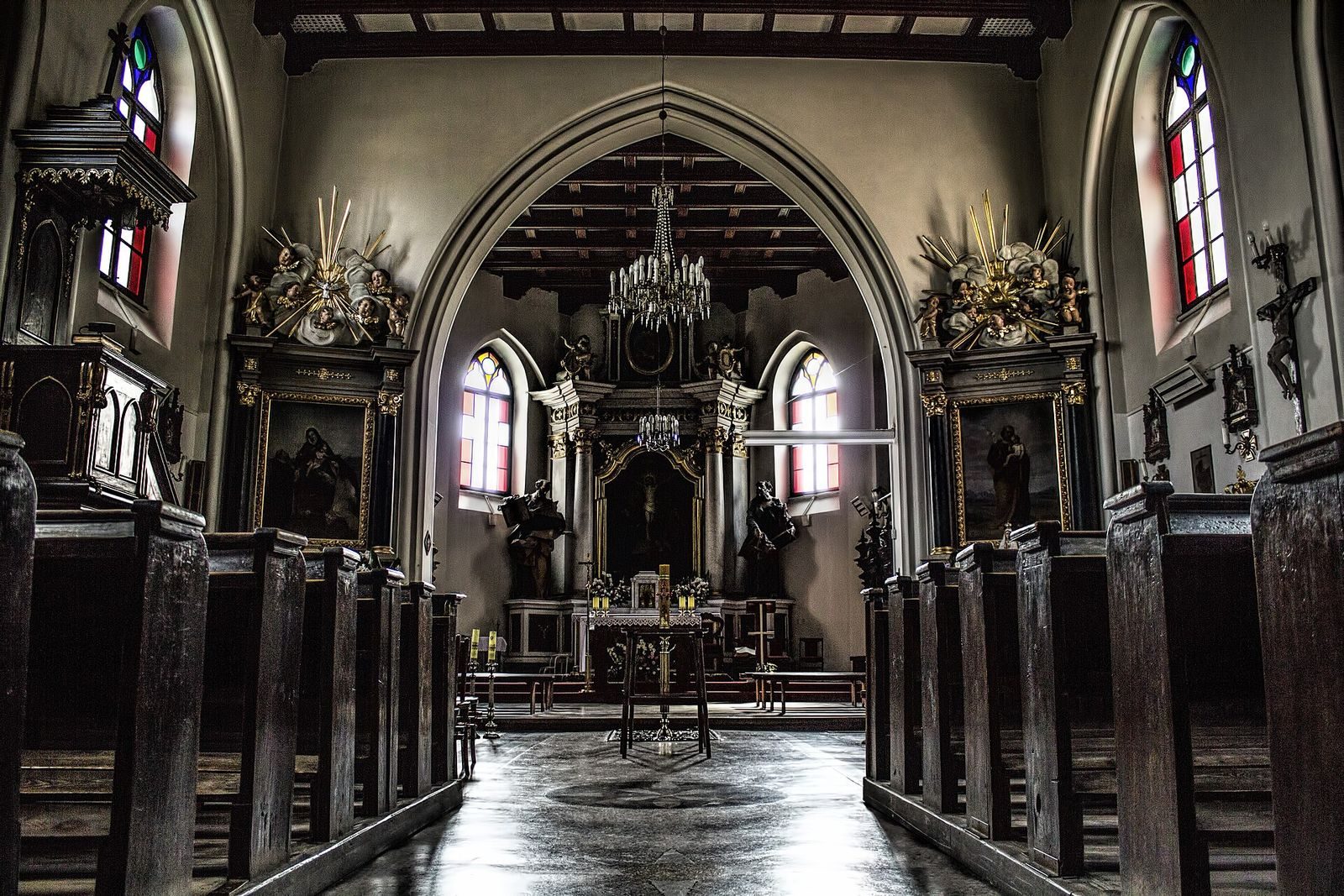
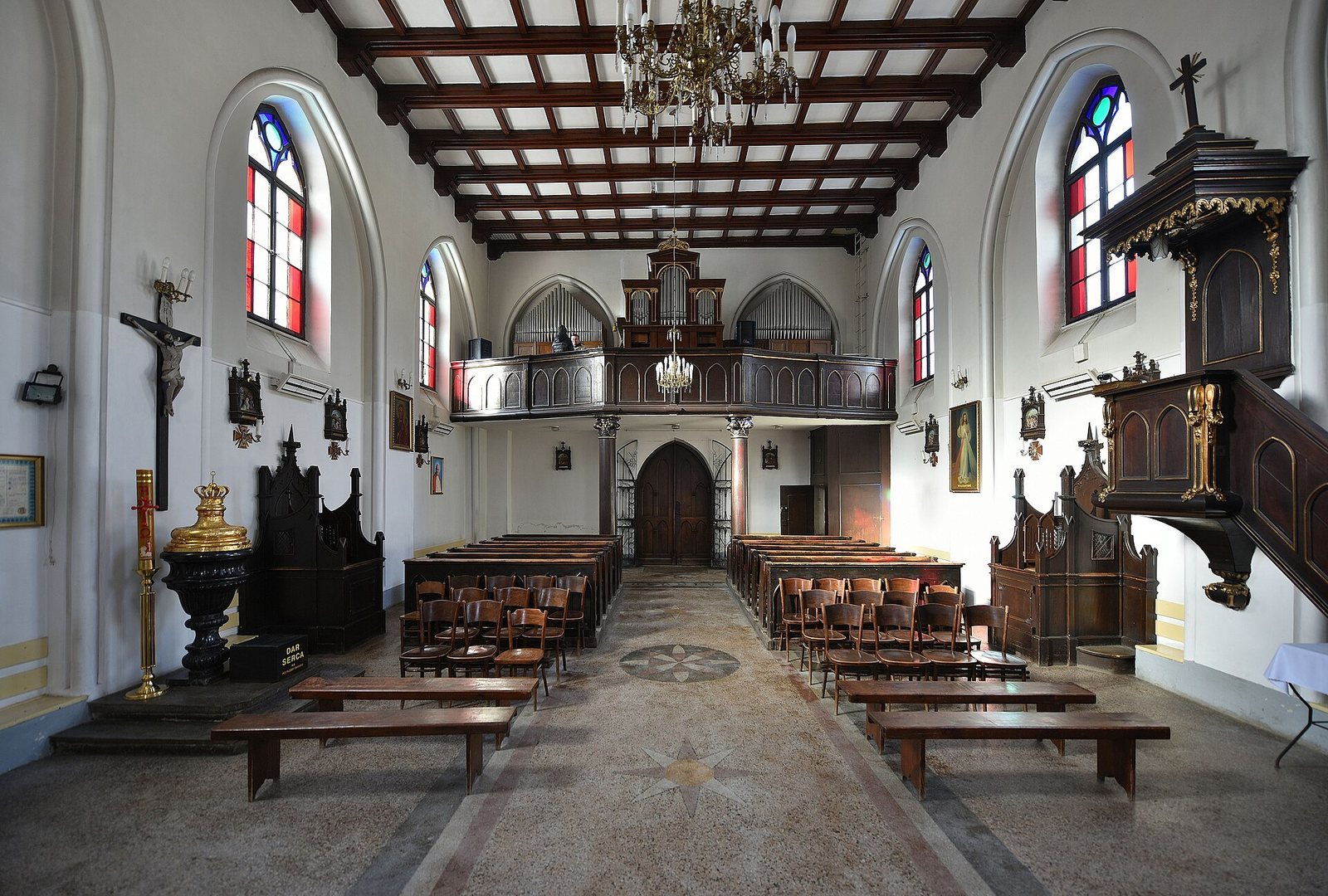
The interior has a Baroque character. Its furnishings include a wooden choir gallery, an elevated space for singers or musicians, a high altar with a tabernacle, a container for the reserved Eucharist, and two side altars. The high altar displays a painting of Christ on the Cross, with a painting of St James the Apostle above it; tall figures of St Peter and St Paul, carved from limewood, stand at either side. A pulpit and a black-marble baptismal font were added after 1730. Candlesticks bear the founder’s coat of arms, and 18th-century memorial tablets commemorate the Stadnicki family.
Burials and memorials
The Ossoliński family crypt, an underground burial chamber, lies beneath the church floor. A bronze floor plaque bearing the family’s Topór coat of arms covers the crypt of Ignacy Ossoliński, who died in 1755 at the age of five. Its inscription gives him the titles of standard-bearer of the Royal Court, an official entrusted with carrying a ruler’s banner, and captain of Sandomierz, and links him to the Laska Regiment of the Great Royal Banner. In 1978, a small coffin containing bones and an information plaque was found during construction of a room for altar servers.
Floor, wall paintings and organ
The floor, finished in terrazzo, a hard surface made with stone chips, dates to the late 19th century. Franciszek Stelmaski painted the four Evangelists and Saints Stanislaus and Adalbert on the chancel walls.
A seven-stop organ was installed in 1878 and built in Warsaw by Józef Szymański. It was partly enlarged after the Second World War, thoroughly overhauled in 1978–1979, and given a second manual in 2006. The instrument now has 16 stops, each selecting a set of pipes with a particular tone, and two hand-played keyboards.