Saint George Cathedral: A Pre-Mongol White-Stone Church in Yuryev-Polsky


Site at a Glance
- Rating
- 4.8
- Popularity
- Low
- Country
- Russia
- Primary era
- Medieval
- Eras represented
- Medieval, Early Modern
- Civilizations
- Russian
- Site type
- Religious
- Remains
- Cathedral
On this page13 sections
History
Saint George Cathedral is a Russian Orthodox cathedral in Yuryev-Polsky, Russia, built by the rulers of the Vladimir-Suzdal principality between 1230 and 1234 in the pre-Mongol period. It stands within the town’s ancient fortified center, inside the ring of twelfth-century earthworks associated with the medieval Kremlin. The cathedral was the last major white-stone church built in Rus before the Mongol invasion, the thirteenth-century conquest that transformed the political landscape of the medieval East Slavic realm.
Foundation and princely patronage
Yuryev-Polsky was founded by Yuri Dolgorukiy in 1152. A white-stone church dedicated to Saint George was traditionally believed to have occupied the site of the present cathedral, although recent archaeological research places the 1152 church at another, currently unidentified location. That earlier building was probably comparable in form to the Saint Boris and Saint Gleb Church at Kideksha and the Transfiguration Cathedral at Pereslavl-Zalessky.
In 1212, Yuryev-Polsky became the center of a separate principality and was assigned to Sviatoslav Vsevolodovich, a member of the Vladimir-Suzdal ruling dynasty and a son of Vsevolod III. By 1230, the earlier church was regarded as dilapidated and beyond repair. Sviatoslav ordered its dismantling and personally supervised construction of the present cathedral. The completed building became one of the surviving pre-Mongol churches of the Vladimir-Suzdal principality and later influenced the first stone Assumption Cathedral in Moscow, built in 1326–1327.
Chapel, collapse, and reconstruction
A Trinity side chapel was added at the cathedral’s northeastern corner no earlier than 1252 and no later than the end of the fourteenth century. Sviatoslav’s burial was transferred there, and the structure later became known as the Trinity Chapel.
A substantial part of the cathedral collapsed in the fifteenth century, probably during the 1460s. In 1471, Grand Prince Ivan III of Moscow ordered its restoration, which was carried out by Vasili Yermolin, a merchant-patron and builder. The reconstructed church was considerably lower and more squat than the original, and its former proportions were not reproduced. Yermolin reused surviving white-stone blocks and carved fragments instead of replacing the collapsed sections with brick. With no accurate plan or drawings of the earlier building available, many stones were reassembled in an arbitrary order, producing the unusual arrangement of reliefs visible in the cathedral’s decoration.
Later alterations and modern restoration
The rebuilt cathedral underwent further changes. In the mid-seventeenth century, its original curved roof sections, called zakomara, were replaced by a hipped roof. A tent-roofed bell tower was added above the western entrance vestibule, or narthex. A four-tier bell tower followed in 1781, the Trinity Chapel was enlarged into a separate full-sized church in 1817, and a sacristy was added on the south side in 1827. These additions gradually obscured the medieval building.
Archpriest Alexander Znamensky, rector from 1889 to 1917, proposed removing the later structures. A new Trinity Cathedral was built nearby and consecrated in 1915, but the older additions remained until after the October Revolution of 1917. Saint George Cathedral closed in 1923. Restoration from 1923 to 1936, led by Pyotr Baranovsky and Igor Grabar, dismantled the bell tower, sacristy, and heated chapel. Additional restoration followed in 1957–1962 and during the 1980s. During the Soviet period, the building was used as a museum.
Georgy Wagner partially or fully reconstructed several sculptural compositions, including the Trinity, Crucifixion, Seven Sleepers of Ephesus, Daniel in the Lions’ Den, the Three Youths in the Fiery Furnace, and the Ascension of Alexander the Great. He proposed that eleven or fewer master sculptors, perhaps eight or nine, had worked on the cathedral. He also argued that the principal sculptor may have signed one of two images of the Mandylion, the Image Not Made by Hands, above the entrance to the northern narthex.
Baranovsky’s archive became accessible in 2017 after almost forty years of his research on the cathedral. The documents have supported renewed study of the original appearance and the preparation of a scientifically based conservation and reconstruction program. By May 2019, rapid deterioration had created an urgent need for restoration, and an earlier restoration project was being revised in light of additional research. The cathedral is a federally significant cultural-heritage monument of the Russian Federation and was recognized by the Russian government in late 2015 as an especially valuable cultural-heritage monument.
Remains
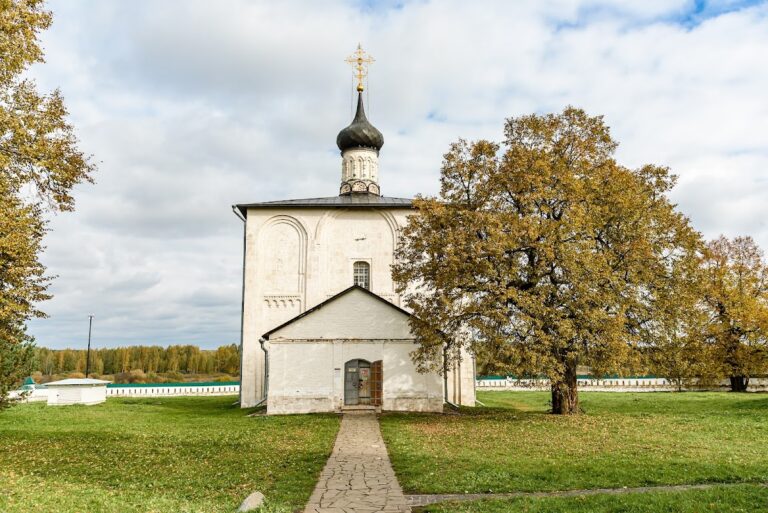
Saint George Cathedral is a cross-domed white-stone church whose square main volume is supported by four square-section columns. Its eastern end terminates in an apse, the usually semicircular end of the sanctuary. The building was asymmetrical from the outset. Surviving medieval fabric stands separately within an open meadow after the removal of the later Trinity annex and south sacristy.
Surviving medieval structure
Walls and entrance areas
The remains of the 1230–1234 building include the first tier of the western narthex and the northern half of the wall up to the arcaded-column belt, a horizontal band of small blind arches framed by columns. The eastern bases of the apses also survive. The southern narthex and adjoining walls remain near the corners only up to the socle, the lower supporting part of a wall. The northern narthex and the largest surviving section of the cathedral walls preserve much of the medieval structure.
Roof-line ornament
The arcaded-column belt remains on the central and western bays of the northern wall. Its survival helps identify the organization of the medieval elevations, although the fifteenth-century rebuilding changed the cathedral’s height and proportions. The four-tier bell tower added in 1781 no longer survives, and the former Trinity annex and south sacristy were removed during twentieth-century restoration.
Carved white-stone decoration
Relief program
Approximately 450 carved white-stone fragments survive. They represent saints, animals, birds, and griffins, alongside interlaced geometric designs, foliage, and hybrid creatures. The cathedral is identified as the only ancient Rus church with a carved elephant. Its exterior decoration combines religious and secular subjects. Biblical scenes appear beside the legendary ascension of Alexander the Great in a chariot drawn by two winged griffins.
A particularly notable griffin, whose tail is shaped as a palmette, decorates the base of the archivolt, the band of molding following the curve of an arch, at a portal. The carved stones were sculpted before being incorporated into the walls. The combination of human and animal reliefs with floral ornament gives the cathedral’s carving an unusual place within the art of Rus.
Reused and reconstructed fragments
The dense mixture of motifs also reflects the reuse of reliefs from the earlier church. During the 1471 rebuilding, some carved stones were placed in random positions, while others were used structurally with their decorated faces buried inside the walls. Several fragments were scattered on neighboring farms and later recovered by Pyotr Baranovsky during Soviet-era restoration.
The reliefs and vegetal designs may have been produced by separate groups of artists. One group of twelve worked on the reliefs, while another group of approximately eighteen to twenty-four worked on the floral ornament. The sculptural compositions and most of the original carvings have been reconstructed on paper, while Wagner’s work provides partial or complete restorations of several major scenes.
Interior sculpture and surviving object
The Sviatoslav Cross
The so-called Sviatoslav Cross is a multi-part stone icon depicting the Crucifixion of Jesus Christ with attendant figures. It originally occupied the central zakomara of one cathedral façade. The cross is now exhibited inside the church as part of the collection of the Yuryev-Polsky Historical, Architectural, and Art Museum.
Nearby sites