Saint Francis of Assisi Church: A Franciscan Foundation in Montecarotto
Site at a Glance
- Popularity
- Very Low
- Country
- Italy
- Primary era
- Early Modern
- Eras represented
- Early Modern, Modern
- Civilizations
- Italian, Papal States
- Site type
- Religious
- Remains
- Church
On this page11 sections
History
Saint Francis of Assisi Church is a Catholic church just beyond the former walls of Montecarotto, Italy, begun in 1612 for the Franciscan Observants and later given a Neoclassical façade.
Foundation and Franciscan community
Dedicated to Saint Francis of Assisi, the thirteenth-century Italian religious leader associated with the founding of the Franciscan movement, the church and its convent were established for the Franciscan Observants. This branch of the order sought stricter observance of its rule. In 1612, Montecarotto’s General Council decided to entrust the convent to the Observants, whose presence was already known locally through their nearby community at San Martino of Arcevia. A solemn ceremony marked the laying of the church’s first stone that year.
By August 1616, part of the church, friars’ cells, and other facilities were ready, and worship began. The head of the religious community held the title of Guardian. Work on the convent continued from 1630 to 1695. Although the church had been in use since 1616, it was completed in 1660.
Suppression and return
During the Napoleonic period, the convent was closed and transferred to state ownership. The friars returned in 1816, after the Napoleonic era, but the Italian government removed them definitively in 1867, when it suppressed the convent.
War memorial and commemoration
Vito Pardo, a Venetian sculptor, designed the First World War memorial on the church façade. It was commissioned during Carlo Mariotti’s term as Montecarotto’s podestà, the municipality’s chief executive, from 1928 to 1933. Pardo conceived the church front and memorial together as a shrine to the fallen and to devotion to the homeland, joining religious and national remembrance. He intended the church to be called Saint Francis of Victory, but its dedication to Saint Francis remained. The church belongs to the Diocese of Jesi.
Remains
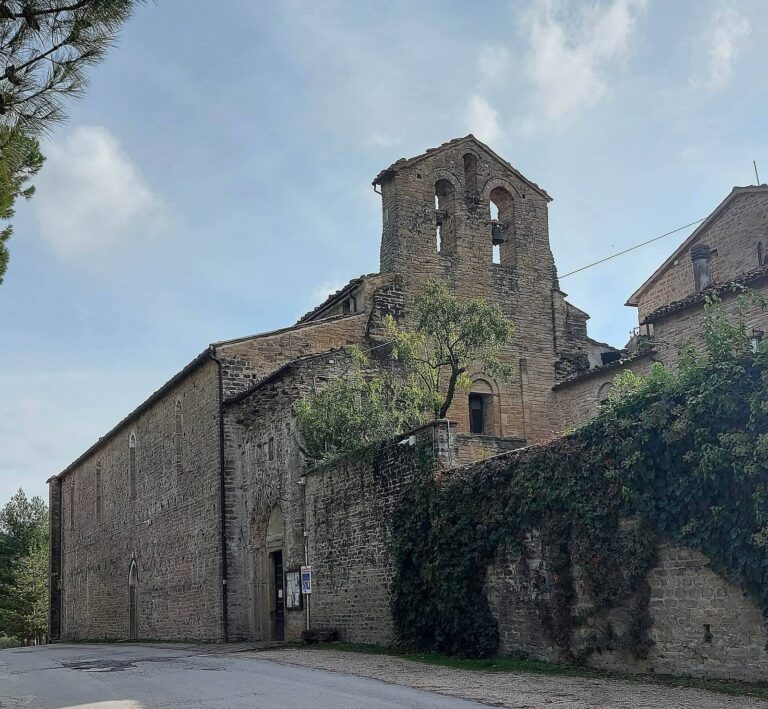
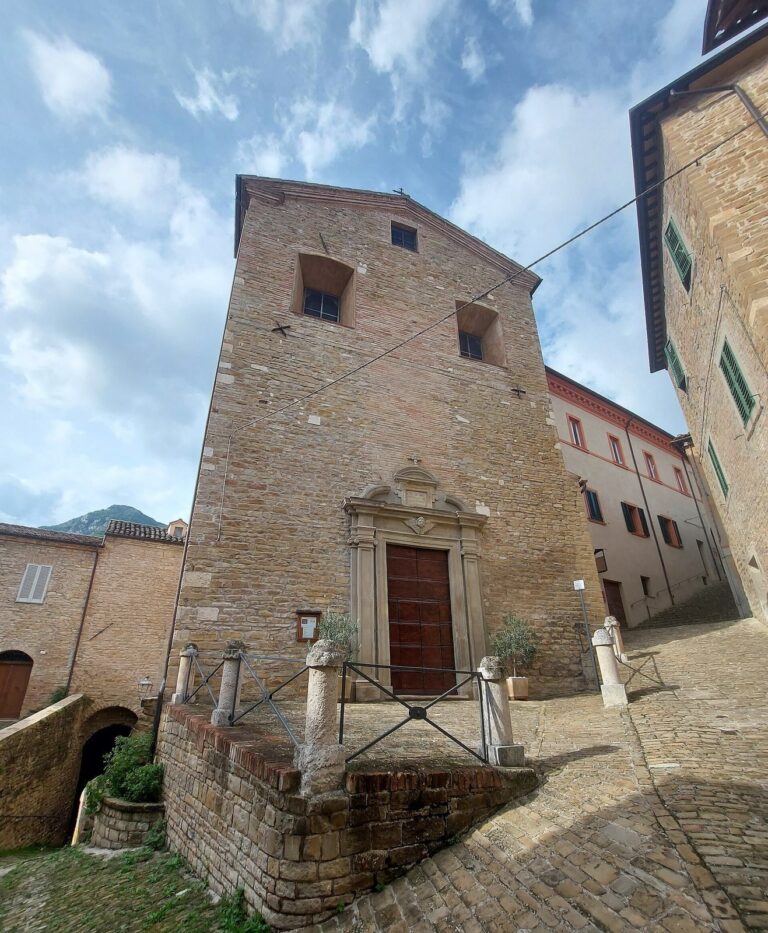
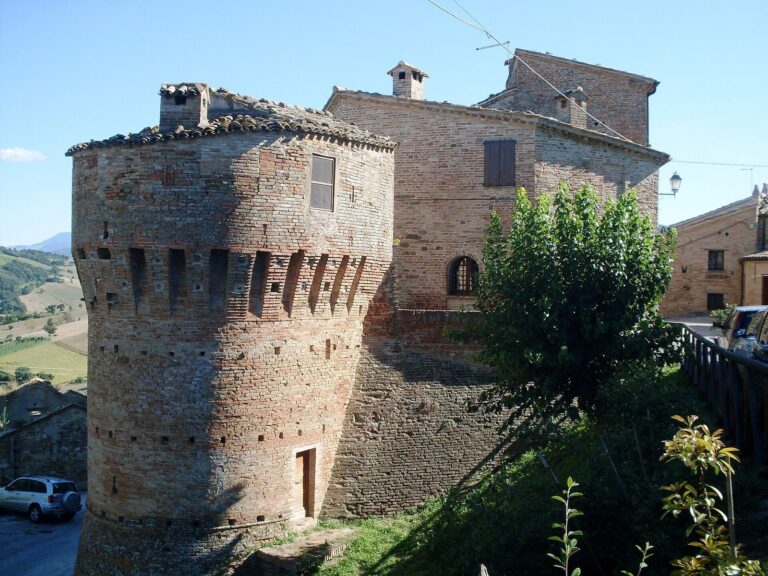
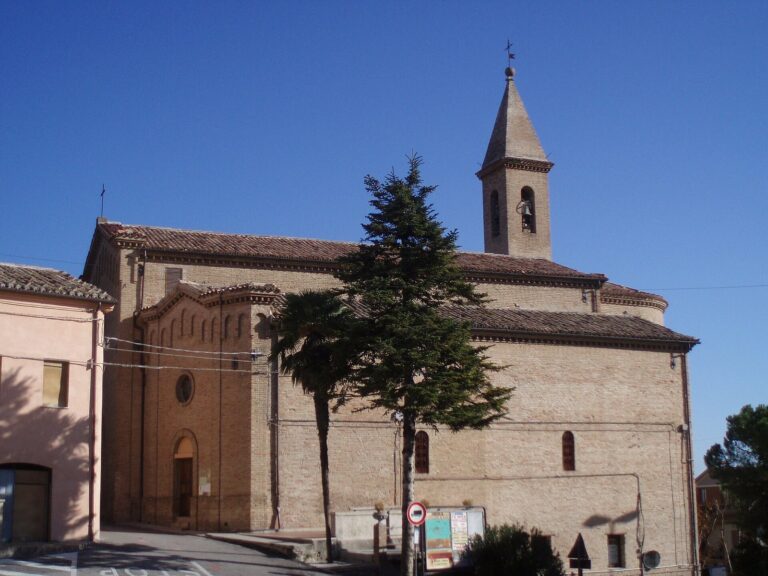
The church stands on a hill overlooking the countryside, just outside Montecarotto’s former walls. It is joined to the former Franciscan convent, now used as a retirement home. The brick church combines a single large worship space with a nineteenth-century Neoclassical façade, which also carries Pardo’s sculpted war memorial.
Church fabric and furnishings
Façade and plan
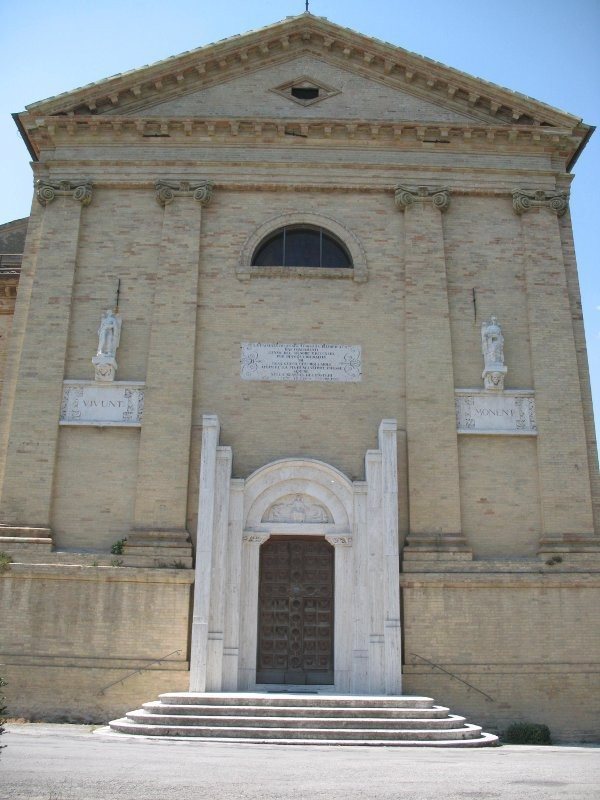
Remade in the nineteenth century, the imposing brick façade is organized around a central entrance flanked by four pilasters, shallow supports attached to a wall. Their bases rise from a band at ground level, and their scroll-shaped tops support a horizontal molding. Above it sits a triangular pediment, a roof-like triangular feature, framed by the upper edge of the façade. Inside, the church has one broad nave, or main worship space, seven altars, and a sacristy.
Altars, furnishings, and organ
The interior contains stucco decoration, paintings, statues, period furnishings, and a choir loft. An eighteenth-century Nativity by Antonio Massi of Jesi is among its artworks. Four altar frontals made using scagliola, a decorative plaster technique that imitates marble, date to 1708. Four walnut confessionals from the early nineteenth century have carved decoration and twisted columns. The choir loft holds Pietro Nachini’s organ, numbered 56 in his works and dated 1740. Restoration in 1997 returned the instrument to musical use.
First World War memorial
Façade sculpture and inscriptions
The memorial’s stonework incorporates winged statues and plaques set at mid-height within the façade’s pilasters. Around the entrance, columns rise progressively higher toward the outer edges; the outermost columns carry three tiers of panels decorated with military emblems framed by floral designs. Projecting supports, or corbels, beneath the statues and upper beam form part of the sculpture. The left support bears a woman’s face with abundant hair, while the right one carries a skull. Other supports combine military and floral ornament, with “Faith” inscribed on the inner left and “Fatherland” on the inner right. Plaques below the statues carry the Latin words vivunt, “they live,” recalling the fallen, and monent, “they warn,” evoking war’s tragedies.
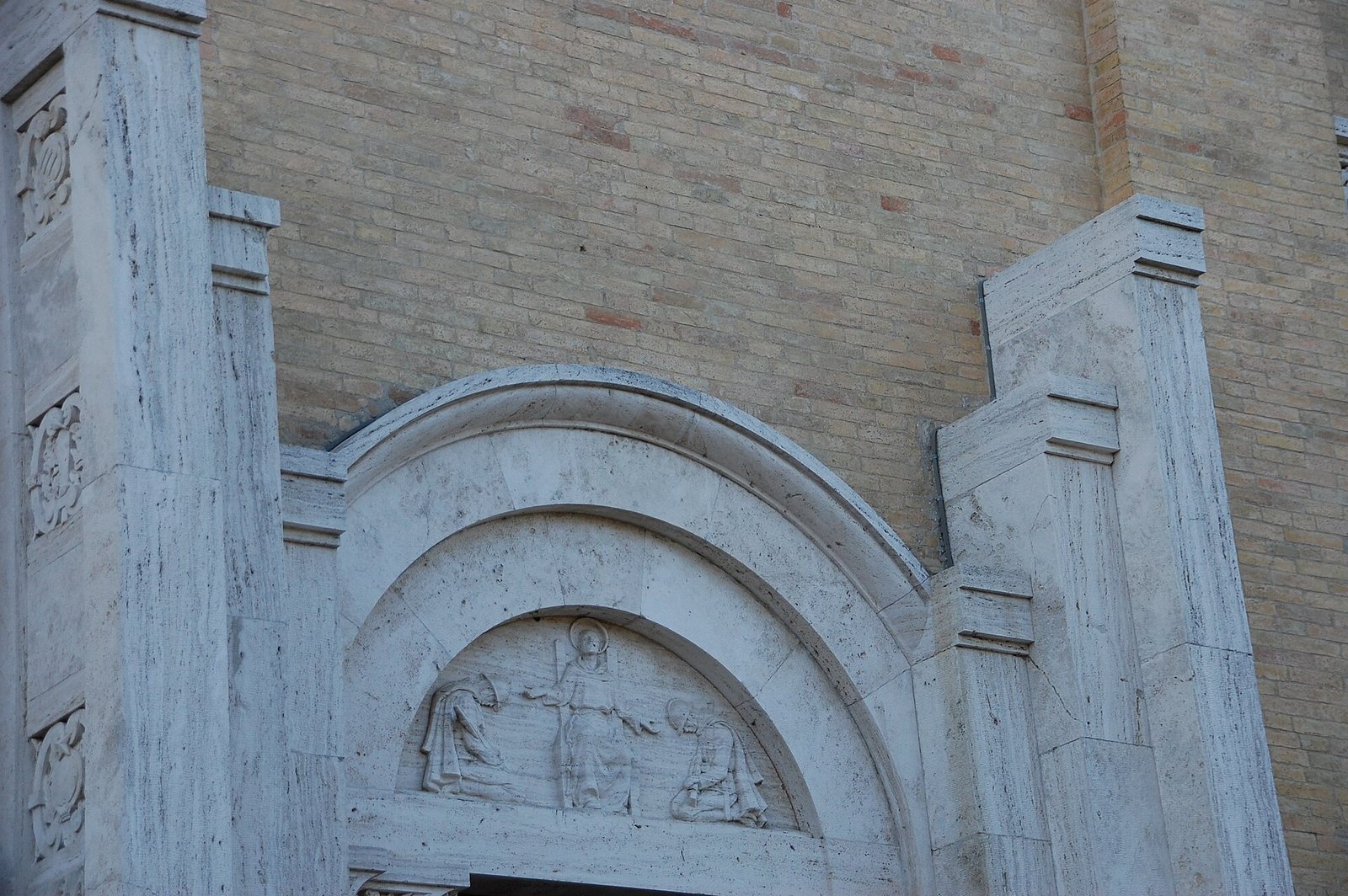
The left-hand figure represents winged Victory as an angel holding Montecarotto’s coat of arms. Opposite her, a turret-crowned figure personifies Italy, wearing a crown and rich drapery and holding a cross. Above the entrance, a carved scene fills a lunette, the semicircular field over a doorway. A saint in monastic clothing, possibly Saint Francis, opens his arms toward two kneeling soldiers in First World War uniforms. The soldier on the left holds a flag, while the one on the right holds a rifle.
Monumental wooden door
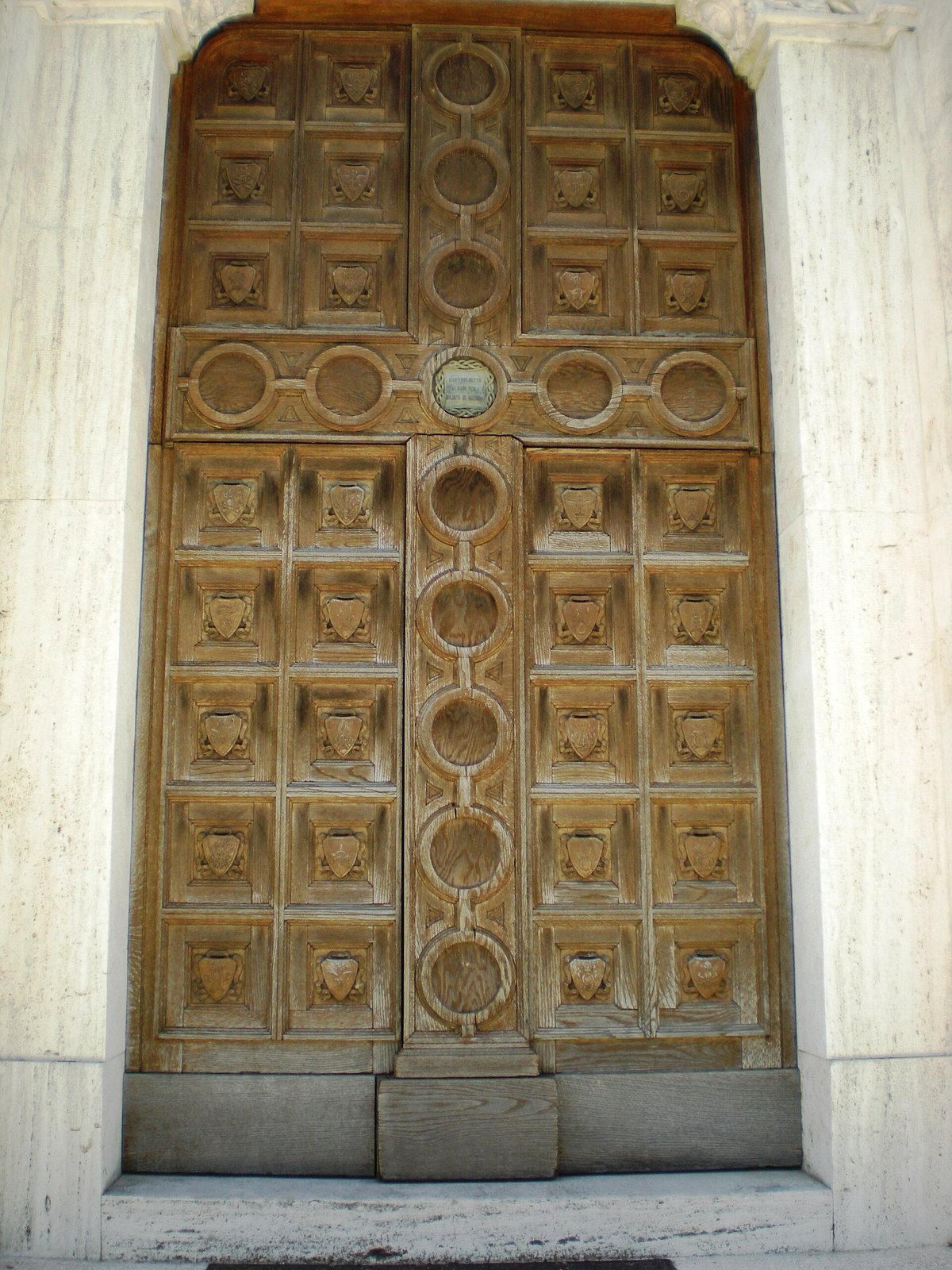
Pardo designed the monumental oak door, which was assembled at Spartaco Santelli’s carpentry shop in Montecarotto and installed after the Second World War because of wartime circumstances. Its 32 panels are carved in shallow relief with military coats of arms. Four large fields are divided by a Latin cross formed from 14 circular panels. The central brass panel bears the inscription “Montecarotto to its sons fallen in War,” surrounded by an intertwined-ribbon wreath. Pardo’s original design is preserved at the Civic Museum and Mail Art Museum. The door was restored and inaugurated on 8 December 2011.
The emblems represent formations of the Royal Italian Army, Navy, and Air Force, the armed services of the Kingdom of Italy. They include coast, fortress, anti-aircraft, field, mountain, and heavy artillery; naval air service; territorial militia; aircraft observers; and army engineering, telegraph, bridge, railway, and motor transport units. Other panels refer to infantry, grenadiers, machine gunners, grenade-launcher and mortar units, light cavalry, dragoons, lancers, the Arditi assault troops, and the Alpini mountain infantry. The Royal Carabinieri, Financial Guard, military medical corps, general staff, Bersaglieri, and Royal Air Force and Navy are also represented. Many of the formations shown served during 1915–1918 but no longer exist as branches or corps in Italy’s modern armed forces.