Rokštejn Castle: A Medieval Gothic Stronghold in Czechia


Site at a Glance
- Rating
- 4.7
- Popularity
- Low
- Country
- Czechia
- Primary era
- Medieval
- External website
- Open
- Eras represented
- Medieval
- Civilizations
- Holy Roman Empire, Kingdom of Bohemia, Margraviate of Moravia
- Site type
- Military
- Remains
- Castle
On this page9 sections
History
Rokštejn Castle is a medieval Gothic spur castle in Czechia, built in the 1280s in Moravia by the Hrutovice noble family. Hrut of Kněžice ordered the fortress above the Brtnice valley, where its elevated position provided a defensible base over the surrounding territory. The ruined site is regarded as one of the oldest Moravian castles built in the architectural tradition of the Danube region.
Foundation and early lordship
The land around Brtnice had earlier been transferred by Constance of Hungary to the Cistercian monastery of Porta Coeli when it was founded in 1233. The Cistercians were a Catholic monastic order known for disciplined communal life, agricultural development, and austere religious practice. Constance’s son, Wenceslaus I, king of Bohemia from 1230 to 1253, later reclaimed the area because he suspected that it contained silver deposits. Mining attempts failed, and he granted the Pirnitzer district to Hrut of Kněžice.
Rokštejn first appears in written evidence in 1289, when it belonged to the brothers Bernart, Zdislav, and Vrš of Rukstein. The name was also written as Rukštejn, Rokštýn, and Ruckstein. The castle controlled a lordship that included a number of villages in the surrounding countryside, linking the fortress to a broader territorial estate rather than to an isolated stronghold.
Transfer to the margraves and the Waldsteins
In 1360, the Hrutovice family transferred the Ruckstein lordship and its associated villages to Margrave John Henry. A margrave was a high-ranking territorial ruler, traditionally charged with governing a border region. The estate included Stařeč, Slavice, Římov, Okříšky, Číchov, Petrovice, Jestřebí, Přibyslavice, Čáslavice, Dolní Smrčné, Panská Lhota, Uhřínovice, and Malé.
John Henry left the estate to his son John Sobieslaus in 1371. In 1378, John Sobieslaus pledged it to Hynko of Waldstein, after which Rokštejn was held by the Waldstein family, a prominent Bohemian and Moravian noble house. Hynko lived at the castle, as did his son-in-law Zikmund of Křižanov. Major rebuilding took place at the beginning of the fifteenth century, reflecting the castle’s continuing residential and military role.
Margrave conflicts and the Hussite Wars
At the end of the fourteenth century, Rokštejn became a stronghold of the Moravian margraves Jobst and Prokop during their struggle with the prosperous royal city of Iglau. Jobst and Prokop were members of the Luxembourg dynasty who held the margraviate of Moravia. The conflict reached a decisive moment when Prokop attacked Iglau in 1402. Because Rokštejn stood in opposition to the royal city, it acquired major strategic importance in the struggle.
A smaller watch castle belonging to the Rokštejn domain stood on a spur above the confluence of the Brtnice and Jihlava rivers near Přímělkov. This outlying position formed part of the domain’s defensive organization. During the Hussite Wars, the religious and political conflicts that followed the reformist teachings of Jan Hus, the castle was drawn into the wider contest between Hussite nobles and forces loyal to the Catholic Church and Emperor Sigismund.
Hynko of Waldstein’s son Heinrich supported Sigismund and the city of Iglau. Heinrich’s own sons, Heinrich and Zdenko, later joined the Hussite side and seriously damaged Iglau. Rokštejn then became a principal operational base for Hussite nobles in Moravia, giving the castle a direct role in the military upheavals of the fifteenth century.
Capture, abandonment, and investigation
During the Bohemian-Hungarian War, Hynko of Waldstein fought for George of Poděbrady, the Bohemian king from 1458 to 1471 and a leading ruler of the moderate Hussite tradition. In 1468, forces commanded by Matthias Corvinus captured and devastated Rokštejn. Corvinus, king of Hungary from 1458 to 1490, intervened militarily in the Bohemian-Hungarian conflicts. Rokštejn was not repaired or rebuilt after the attack, and by the sixteenth century it had become abandoned.
Extensive archaeological investigation began in 1981. Until his death, the work was directed by Zdeněk Měřínský of the Institute of Archaeology and Museology at Masaryk University in Brno. The excavations have clarified the development of the castle and its two-part organization, while recovered objects have added evidence for life and activity at the site.
Remains
Spur setting and castle divisions
Rokštejn occupies a rocky spur on the right side above the Brtnice valley. Its position lies among the villages of Malé, Střížov, Přímělkov, Horní Smrčné, Dolní Smrčné, and Panská Lhota. The site is a double castle, meaning that its fortified complex was divided into distinct upper and lower sections. The lower castle formed a separate component of the complex by 1444, when a settlement referred to it directly.
Keep, palace, and enclosing walls
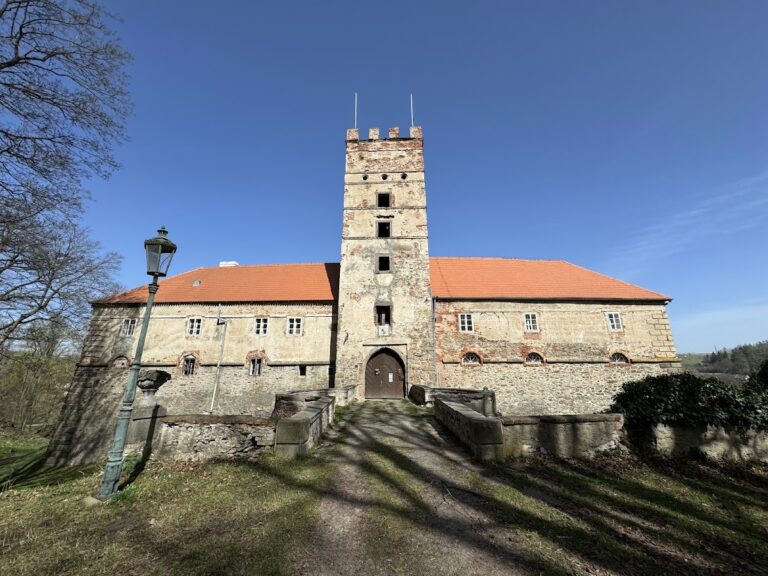
The surviving complex is dominated by a powerful keep, the principal fortified tower that combined defensive and residential functions. The walls of a three-storey palace remain alongside it, forming the central architectural elements of the ruined castle. Parts of the main palace, sections of two-storey defensive towers, and remnants of the enclosing walls survive in fragmentary condition. Together, these remains show the arrangement of the principal buildings within the fortified spur.
Watch castle and archaeological finds
A separate small watch castle stood on another spur above the confluence of the Brtnice and Jihlava rivers near Přímělkov. It belonged to the Rokštejn domain and extended the defensive system beyond the main castle. Archaeological work at Rokštejn has recovered numerous fragments of ceramics, bones, and pieces of metal objects. These finds complement the surviving masonry by providing material evidence of activity within the castle complex.
Nearby sites