San Benedetto: An Olivetan Monastery in Pistoia


Site at a Glance
- Rating
- 4.4
- Popularity
- Very Low
- Country
- Italy
- Primary era
- Medieval
- Eras represented
- Medieval, Early Modern
- Civilizations
- Grand Duchy of Tuscany, Republic of Florence
- Site type
- Religious
- Remains
- Monastery
On this page9 sections
History
San Benedetto is a former Olivetan monastery in Pistoia, Italy, founded in 1380 by the Benedictine Olivetan congregation, whose religious observance developed at Monte Oliveto. It became a religious and institutional center that later housed an Ecclesiastical Academy, hosted the Synod of Pistoia, and served military and diocesan purposes after its suppression.
Foundation and Early Development
On 28 August 1380, Bishop Giovanni Vivenzi blessed and laid the monastery’s foundation stone with the assistance of the cathedral canons and the city clergy. The initiative came from Bartolomeo Franchi, a canon who had held important offices at the papal court. Franchi provided 8,000 gold florins for the foundation.
The exact date of completion is unknown, but the monastery was certainly finished before 1386. By then, its community had reached twelve monks, the number specified in Piero Guidotti’s donation deed. Giovanni Donati accepted the donation for the Olivetan order and became the monastery’s first abbot.
The day after the foundation-stone ceremony, Bishop Vivenzi incorporated the church of Santa Maria at Spedalino Asnelli in Agliana into the new monastery. This arrangement was intended to restore the hospital’s standing and direct its revenues toward the regular progress of construction. The monks also undertook to maintain the houses at Osnello and receive poor people there. Lorenzo, an Olivetan abbot, ratified a related agreement on 15 March 1437.
An Olivetan Chapter and Civic Patronage
From 1 to 4 May 1391, San Benedetto hosted the general chapter of the Olivetan order. A general chapter was the congregation’s formal assembly for discussing its affairs. This was the first time the meeting had taken place outside Monte Oliveto Maggiore, whose location could not be reached because of wartime conditions.
Until at least the sixteenth century, Pistoia’s leading families showed relatively little interest in the monastery, although substantial civic donations supported alterations and extensions. After Giovanni Donati, a Pistoian prior was not appointed until 1516. From the second half of the sixteenth century, members of noble city families increasingly became abbots. Important families also financed artistic work between the late sixteenth and early seventeenth centuries, and Jacopo Melani served as chapel master.
Suppression and Episcopal Reform
At the request of Bishop Scipione de’ Ricci and under a decree from Grand Duke Pietro Leopoldo, officers of the Bargello forced the monks to leave on 18 August 1782. The Bargello was the grand-ducal police and judicial authority whose officers could enforce government orders. The monastery was suppressed, and its property was transferred to the ecclesiastical patrimony used to finance new parish churches and support priests.
De’ Ricci had already chosen the monastery as the seat of an Ecclesiastical Academy, a center for theological culture connected with the Jansenist networks of Port-Royal and Utrecht. Jansenism was a rigorist movement within early-modern Catholic theology. The church was rededicated as San Leopoldo in honor of Pietro Leopoldo, the grand duke of Tuscany, and hosted the Synod of Pistoia from 18 to 28 September 1786. A diocesan synod is a formal assembly concerned with religious and administrative matters within a diocese. The Pistoia assembly approved Jansenist theses promoted by Bishop de’ Ricci.
After the episcopal palace was sold in 1786, the offices of the diocesan curia moved to the area near Porta Lucchese, where the former Olivetan monastery stood. The diocesan curia was the administrative office of a bishop and his diocese. De’ Ricci moved into the monastery in September 1788 while awaiting a new episcopal residence. He remained there until 24 April 1790, when he left Pistoia during a violent popular uprising.
Barracks, Seminary, and Later Use
The complex subsequently declined. French troops began using it as a barracks in 1799, housing as many as 1,000 soldiers. This military function continued until 1827, when Bishop Toli joined the monastery buildings to those of the episcopal seminary. De’ Ricci had previously transferred the seminary to the nearby monastery of Santa Chiara.
The former Olivetan monastery later ceased to be used by the seminary. In 1957, the church regained the title of San Benedetto and, together with the adjoining buildings, became a subsidiary church of the parish of San Vitale. The southwest wing was restored intermittently between 1978 and 1984 for use by an organization assisting older people. Carlo Sguazzoni and Natale Rauty designed and directed the work.
Remains
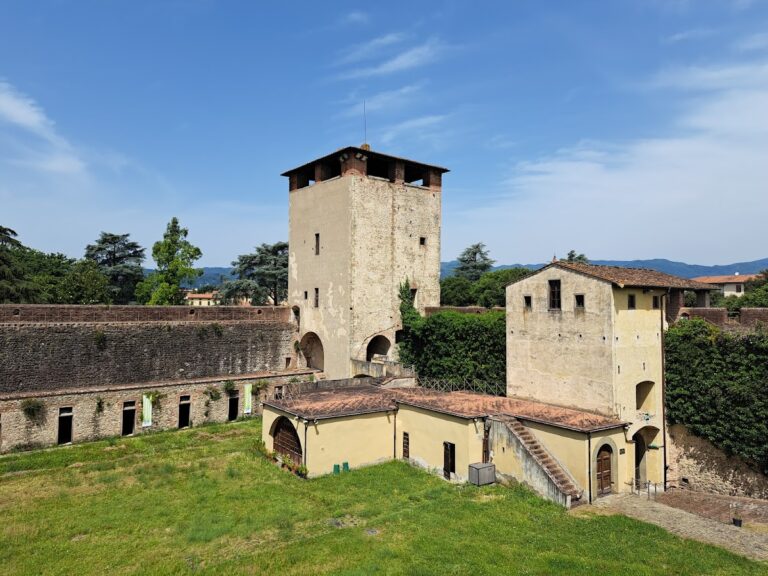
The monastery occupied a roughly 7,500-square-metre plot near Pistoia’s western walls, in an area then largely given over to vegetable gardens. Its layout was defined by public roads on three sides, while the southern edge bordered gardens owned by other ecclesiastical institutions. The surviving church and adjoining monastery buildings form the principal architectural elements associated with the former complex.
Monastery Site and Boundaries
The original plot measured six Pistoian staiora, a local land measure equivalent to approximately 7,500 square metres. Via dello Stallone bordered it to the north. This road was later called Via degli Spensieriti and is now Via Bindi. To the east, the road leading to the monastery of Santa Chiara corresponded to today’s Via del Seminario. Via delle Cerchie formed the western boundary, following a route inside the walls that once circled the city and later disappeared.
Vegetable gardens belonging to other religious institutions bordered the monastery on the south. The Olivetans acquired these gardens about twenty years after the foundation. A secondary road running perpendicular to the city walls separated them from the monastery of Santa Chiara; this road also later disappeared.
Church
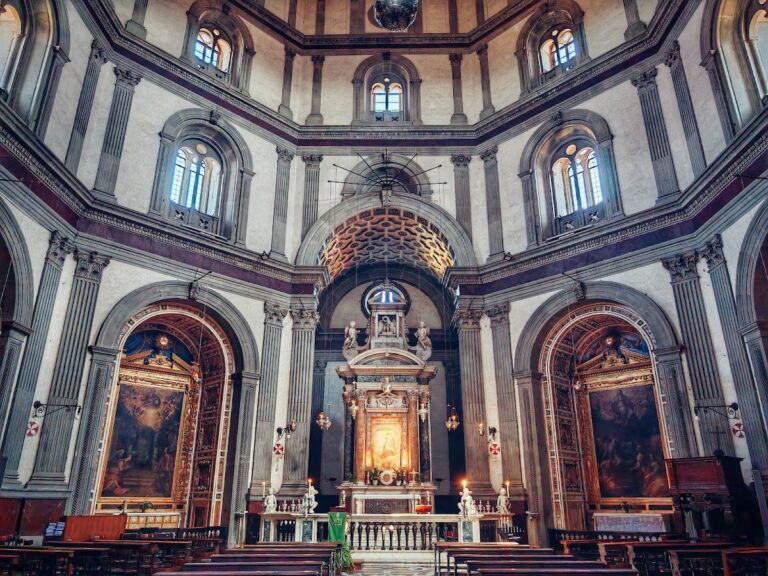
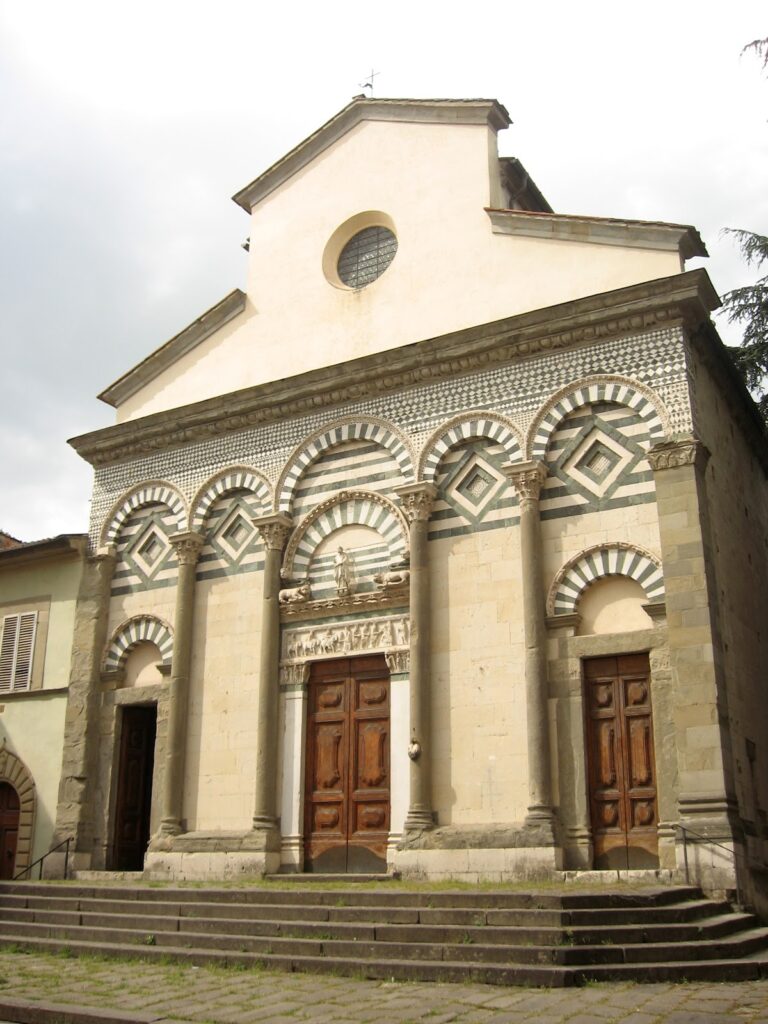
The church has a single nave, and a renovation carried out in 1630 added the portico in front of the facade. Its paintings preserve evidence of the artistic phases associated with the monastery. These include an Annunciation by Giovanni Bartolomeo Cristiani dated 1390, a sixteenth-century work from the Florentine school depicting Saint Benedict, the Redeemer, the Virgin, and Saint Bartholomew, and an early seventeenth-century Adoration of the Shepherds at the altar of the Pistoian painter and patron Bartolomeo Carafantoni. The Adoration is attributed to a painter whose identity is not known. The church also contains a painting of Saint Frances of Rome by Giacinto Gimignani.
Cloister
The small cloister is decorated with the Stories of the Order of the Knights of Saint Benedict, painted by Giovan Battista Vanni in 1660. The cycle provides a visual connection between the monastery’s architectural setting and the Benedictine religious tradition followed by the Olivetans.