Rocca Fregoso: A Medieval and Renaissance Castle in Italy



Site at a Glance
- Rating
- 4.5
- Popularity
- Medium
- Country
- Italy
- Primary era
- Medieval
- External website
- Open
- Eras represented
- Medieval
- Civilizations
- Duchy of Urbino
- Site type
- Military
- Remains
- Castle
On this page8 sections
History
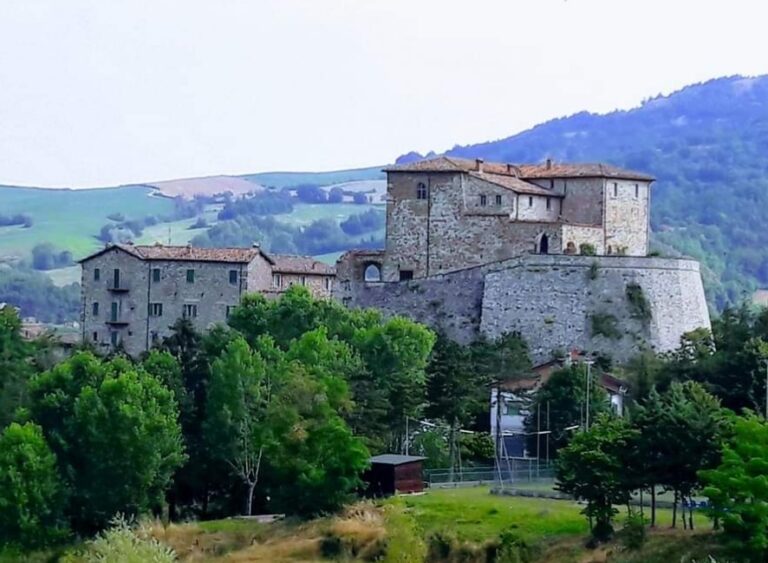
Rocca Fregoso is a high-medieval fortified castle in Sant’Agata Feltria, Italy, whose first core was built in the tenth century at the initiative of Raniero Cavalca, Count of Bertinoro. Renovated in 1474, it became a Renaissance aristocratic residence and the seat of the Sant’Agata branch of the Genoese Fregoso family.
The tenth-century foundation
The castle developed on a defensible hill above the settlement. Its first fortified core dates to the tenth century, when Raniero Cavalca established the early structure. The complex later acquired additional medieval and Renaissance elements, creating the form associated with Rocca Fregoso.
The Fregoso residence
In 1474, Federico da Montefeltro granted his illegitimate daughter Gentile twelve fiefs, including the County of Sant’Agata Feltria, an area of approximately 80 square kilometres. Gentile married Agostino Fregoso, son of Lodovico Fregoso, doge, or elected head of state, of the Republic of Genoa. This marriage established the Sant’Agata branch of the Genoese Fregoso family.
The castle was renovated in the same year and adapted as a Renaissance residence for the family. In the absence of surviving documentation, its definitive realization is attributed to Francesco di Giorgio Martini, an Italian Renaissance architect and engineer known for court commissions and military architecture. The Fregosos lived at Rocca Fregoso from 1474 to 1660, maintaining a small court that influenced the settlement and commissioned local artists to decorate the palatine chapel, a chapel attached to a ruler’s or noble family’s residence.
Political and dynastic events
In 1501, Guidobaldo I da Montefeltro, duke and ruler of Urbino, took refuge at the castle after troops commanded by Cesare Borgia expelled him from the Duchy of Urbino. Ottaviano Fregoso defended Sant’Agata and received the county from Pope Leo X in 1513. He became doge of Genoa in 1515.
After Ottaviano’s death in 1524, his brother Federigo and his son Aurelio governed the county. They lived both in the castle and in the palace within the settlement. In 1631, Cardinals Antonio and Taddeo Barberini stayed at the residence while travelling to take possession of the Duchy of Urbino for their uncle, Pope Urban VIII. Their journey followed the death without male heirs of Francesco Maria II, the last Della Rovere ruler of Urbino.
Decline, reuse, and rehabilitation
In 1660, the Fregoso county was incorporated into the Papal States, territories governed by the pope as a temporal ruler. The end of the fief began the fortress’s decline and led to its adaptation for different purposes. From 1781 to 1820, the castle housed a Franciscan convent. It was later abandoned and subsequently used as a military prison and a school.
The keep, the principal fortified tower of a medieval castle, collapsed in 1835. Major consolidation work was carried out on the sandstone supporting the foundations in 1877. In recent decades, the complex has undergone extensive rehabilitation. It now houses the permanent Rocca delle Fiabe museum and also accommodates temporary installations promoted by Antonio Faeti.
Remains
Rocca Fregoso occupies the Sasso del Lupo, or Wolf Rock, a sandstone hill above Sant’Agata Feltria at approximately 580 metres in elevation. The hilltop complex combines medieval and Renaissance features, with a construction sequence extending from the tenth-century core through the 1474 renovation. Its surviving fabric consists of stone, rubble masonry, and brickwork.
Fortified complex
The castle’s defensive character is expressed by its position on the sandstone hill and by the polygonal tower known as the Tower of Simonetto Fregoso. The supporting sandstone at the foundations received substantial consolidation in 1877. Following later rehabilitation, the restored complex is described as well preserved.
Palace and palatine chapel
The palace contains a hexagonal palatine chapel. Its frescoes were executed by local artists commissioned by the Fregoso court during the period when the castle served as the family’s aristocratic residence. The chapel forms part of the Renaissance palace complex that emerged from the 1474 transformation of the earlier fortress.